
LAWC-213 · Lesson 5 of 12 · 21 min
Intestacy
▶ Video coming soon A video version of this lesson is on the way.
Raymond Sutcliffe, fifty-eight, died last winter when his snowmobile went through the ice on a lake north of Corwin. He had talked about making a will for years and never did. Professor Ellerby puts his family tree on the board: his wife Carol, to whom he had been married for thirty years; their children Megan and Scott; their son Liam, who died in 2020 leaving two children, Ava and Noah; Raymond's mother, still alive at eighty-five; and his brother. Raymond's house was in joint names with Carol. In his sole name he had a business account, a portfolio of investments and a share of a hunting camp, together worth about 1,250,000 dollars after debts. 'The legislature wrote Raymond a will,' Ellerby says. 'Most people would not have written it this way, and it is still better than a fight.'
This lesson covers who counts as a spouse on intestacy, the spouse's preferential share, the division of residue between a spouse and issue, distribution when there is no spouse, more remote relatives and escheat, partial intestacy, the treatment of minors' shares and the appointment of an estate trustee without a will. Section references are to the Succession Law Reform Act unless otherwise stated.
When the intestacy rules apply
Part II of the Act applies when a person dies without a will, when a will is invalid, and when a valid will fails to dispose of all the deceased's property, such as when a residuary gift lapses with no alternate beneficiary. In the last case, the deceased dies partially intestate, and Part II governs only the undisposed property. The rules apply to property the deceased owned at death, wherever it is, for movable property such as money and investments, if the deceased was domiciled in Ontario. Real property outside Ontario passes under the law of the place where it is situated. Property that passes outside the estate, such as Raymond's half of the house he owned as a joint tenant with Carol, is not affected; Carol takes the house by survivorship.
Ellerby notes that intestacy is common. Many surveys suggest that around half of adult Canadians do not have a valid will, and the proportion is higher among younger adults. Intestacy is often not a disaster, especially for a married couple with a modest estate and young children, but it can produce results the deceased would not have wanted, particularly for unmarried couples and blended families.
Who is a spouse
For Part II, a spouse means either of two persons who are married to each other, or who have together entered into a marriage that is voidable, or void in good faith on the part of the person asserting a right. It does not include an unmarried partner, however long the relationship. This differs from the definitions used for dependant support under Part V and for support under the Family Law Act, which include unmarried partners who have cohabited for three years or have a child together in a relationship of some permanence. The legislature has repeatedly declined to give unmarried partners an intestate share, and the Supreme Court upheld a similar exclusion from property division in Nova Scotia (Attorney General) v. Walsh, 2002 SCC 83, which students met in family law.
An unmarried partner of an intestate therefore takes nothing on intestacy. The partner may claim dependant support from the estate if the deceased was supporting them or was under a legal obligation to do so immediately before death, and may claim a share of the deceased's property through unjust enrichment and a constructive trust or monetary award under Kerr v. Baranow, 2011 SCC 10. Lesson 6 covers dependant support and lesson 10 covers unjust enrichment. Ellerby tells the class that unmarried couples who own property in one partner's name are the people for whom a will matters most.
Since January 1, 2022, a separated spouse also takes nothing on intestacy. Section 43.1 provides that a spouse is not entitled to an intestate share if, before the death, the spouses were separated within the meaning of the section, using the same test as section 17 for wills: living separate and apart because of the breakdown of the marriage for the three years before death, or a separation agreement, court order or family arbitration award settling their rights, and in either case living apart at the time of death. As with wills, this does not remove a separated spouse's equalization rights under the Family Law Act or a possible claim for dependant support.
A spouse and no issue
Under section 44, where a person dies intestate leaving a spouse and no issue, the spouse is entitled to the whole of the property. The deceased's parents, brothers and sisters take nothing. A married couple without children is therefore often well served by the intestacy rules, unless one of them wants to benefit their own relatives or a charity.
A spouse and issue: the preferential share
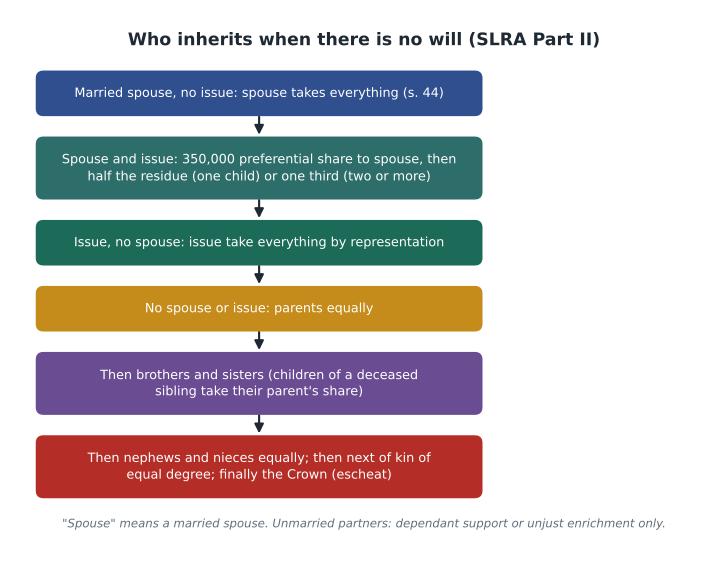
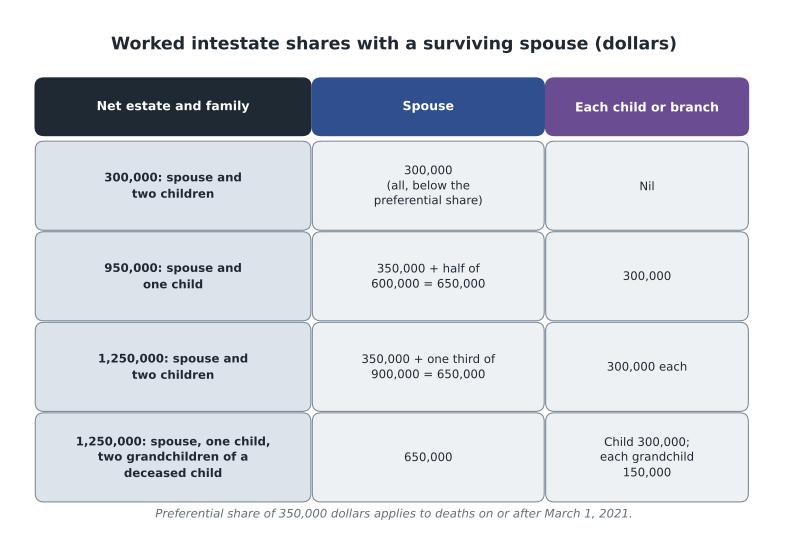
Where a person dies intestate leaving a spouse and issue, section 45 gives the spouse a preferential share: if the net value of the property is not more than the preferential share, the spouse takes all of it; if it is more, the spouse takes the preferential share first. The preferential share is fixed by regulation. For deaths on or after March 1, 2021, it is 350,000 dollars, raised from 200,000 dollars by Ontario Regulation 122/21. Net value means the value of the property after payment of debts, funeral expenses and the expenses of administration, including estate administration tax. Because property that passes by survivorship, such as a jointly held house, is outside the estate, a surviving spouse often receives far more than the preferential share in practice.
After the preferential share, section 46 divides the residue. Where the deceased left a spouse and one child, the spouse takes one half of the residue. Where the deceased left a spouse and more than one child, the spouse takes one third. The children take the rest in equal shares. Where a child has died before the intestate, leaving issue alive at the intestate's death, that child is counted for this purpose and the child's issue take the share the child would have taken. Under section 47, issue take by representation, which Ontario applies per stirpes: the shares are fixed at the level of the intestate's children, and each deceased child's share is divided among that child's descendants.
Raymond's estate
Applying these rules, Carol takes the house by survivorship, outside the estate. From the estate of 1,250,000 dollars net, Carol first takes the preferential share of 350,000 dollars, leaving a residue of 900,000 dollars. Raymond left three children for this purpose: Megan, Scott and Liam, because Liam died leaving issue. Carol therefore takes one third of the residue, 300,000 dollars, for a total of 650,000 dollars. The remaining 600,000 dollars is divided into three shares of 200,000 dollars: one for Megan, one for Scott and one for Liam's branch, which Ava and Noah share equally at 100,000 dollars each. Raymond's mother and brother take nothing, because Raymond left a spouse and issue.
Ellerby points out the effect of the numbers. Ava and Noah are eight and five. Their shares cannot simply be paid to them, and Liam's widow, their mother, may need to apply to court to manage the money for them, as discussed below. Carol, who is fifty-six and will live in the house for decades, receives only about half of the estate's investments. Many couples in the Sutcliffes' position would have left everything to the surviving spouse in a will, trusting the survivor to provide for the children and grandchildren.
No spouse: issue, parents and others
Where there is no spouse, section 47 sets out the order of distribution. If the intestate leaves issue, the issue take everything, with children taking equal shares and the issue of a deceased child taking that child's share by representation. If there are no issue, the parents take in equal shares, or the survivor takes all. If there are no parents, the brothers and sisters take in equal shares, and the children of a deceased brother or sister take their parent's share. If there are no brothers or sisters, and no children of brothers or sisters alive, nephews and nieces take equally. Representation does not extend beyond nephews and nieces: grand-nephews and grand-nieces do not take the share of a deceased nephew or niece.
If none of these relatives exists, the property goes to the next of kin of equal degree of kindred, counted by going up from the intestate to the nearest common ancestor and then down to the relative. A first cousin is in the fourth degree: up two generations to the grandparents and down two to the cousin. Kindred of the half blood, such as a half-brother, take equally with kindred of the whole blood in the same degree. Only if there are no next of kin at all does the property escheat to the Crown in right of Ontario, under section 47(7) and the Escheats Act, 2015. In practice, estates of people with no known relatives are administered by the Office of the Public Guardian and Trustee, which searches for heirs, and the Crown may make payments to people with a moral claim.
Partial intestacy
Where a will disposes of part of the estate, Part II applies only to the undisposed part. A common example is a will that leaves 'the residue of my estate to my wife, if she survives me', with no alternate gift. If the wife dies first, the residue passes on intestacy to the testator's issue, or if none, to the next relatives in the order above. The same issue arises where a residuary gift fails for uncertainty or because a beneficiary witnessed the will. Partial intestacy is entirely avoidable with careful drafting, which is why every competent will has a gift over of the residue in case the main beneficiaries die first.
Children, adopted children and posthumous children
For intestacy, a child includes a child born outside marriage and an adopted child, and an adopted child is treated as a child of the adoptive parents and not of the birth parents. A stepchild who was not adopted is not a child for intestacy purposes, which is a frequent source of hardship in blended families. A stepchild may be a dependant for support purposes, however, if the deceased was supporting them. Since 2017, the Act has also allowed a child conceived after a parent's death through assisted reproduction to inherit on intestacy if statutory conditions are met, including written consent by the deceased and birth within a fixed period after death. Descendants and relatives conceived before the intestate's death and born alive afterward are treated as if born before the death.
Minors' shares
An intestate share payable to a minor cannot be paid to the child, who cannot give a valid receipt. Unless a court appoints a guardian of property, the share is generally paid into court, where it is held and invested until the child turns eighteen, at which point the child receives it outright. Parents are not automatically guardians of their children's property. A parent or other person can apply under the Children's Law Reform Act to be appointed guardian of the child's property, usually with a bond and with an obligation to account, and the Office of the Children's Lawyer represents the child's interests in estate matters. Small amounts can be paid to a parent under the Act without a court appointment, but most intestate shares are larger than that limit.
Ellerby sees this as one of the strongest practical reasons for a will. A will can appoint a trustee to hold a child's share, give the trustee power to use it for the child's benefit, and delay the child's absolute entitlement to a more sensible age, such as twenty-five. An intestacy gives an eighteen-year-old full control over whatever the court has been holding.
Appointing an estate trustee without a will
When there is no will, nobody has authority to act for the estate until the court appoints an estate trustee. Under the Estates Act, the court may appoint the deceased's spouse, or the person with whom the deceased was living in a conjugal relationship immediately before death, or the next of kin, or several of them. In practice, the applicant files an application for a certificate of appointment of estate trustee without a will under Rule 74, with the consents of persons entitled to share in the estate. The court will normally require a majority of beneficiaries, by value, to consent.
An estate trustee without a will is usually required to post a bond, in the form of an insurance company's guarantee, to protect creditors and beneficiaries, unless the court dispenses with it. The court commonly dispenses with a bond where all beneficiaries are adults who consent and the debts are paid, but rarely where minors are entitled. In Raymond's estate, Carol would apply, with Megan and Scott's consents, and would likely need a bond or an order dispensing with it because Ava and Noah are minors. The Office of the Children's Lawyer would be served with the application.
Worked problem
Three intestacies
Work out who takes in each case. (a) Rosalie dies intestate leaving her husband of four years and no children; her parents are alive; her net estate is 420,000 dollars. (b) Lucas dies intestate, unmarried, leaving his partner Jordan, with whom he lived for nine years, his father, and a sister. His net estate is 280,000 dollars. (c) Francine dies intestate leaving no spouse, issue, parents, brothers or sisters. Her late brother's son Martin is alive, and her late sister's daughter Josée has died leaving a son, Rémi.
Show solution
- (a) Section 44: a spouse and no issue. Rosalie's husband takes everything. Her parents take nothing.
- (b) Lucas has no spouse for Part II, because Jordan was not married to him. No issue, so his father takes everything under section 47. Jordan's remedies are a dependant support claim, if Lucas was supporting Jordan, and an unjust enrichment claim if Jordan contributed to Lucas's property.
- (c) No spouse, issue, parents or siblings. Nephews and nieces take equally, but representation stops there. Martin is a nephew and takes. Josée, a niece, died before Francine, and her son Rémi, a grand-nephew, cannot take her share by representation. Martin takes the whole estate.
Common mistakes
MistakeGiving an unmarried partner a share on intestacy because they meet the Family Law Act support definition.
InsteadPart II applies only to married spouses. An unmarried partner's remedies are dependant support and unjust enrichment.
MistakeUsing a 200,000 dollar preferential share.
InsteadFor deaths on or after March 1, 2021, the preferential share is 350,000 dollars.
MistakeGiving the spouse half the residue where there are two or more children.
InsteadThe spouse takes one half with one child and one third with two or more children, after the preferential share.
MistakeIncluding jointly owned property in the intestate estate.
InsteadProperty held in joint tenancy passes by survivorship outside the estate, subject to any resulting trust.
MistakePaying a minor's intestate share to the parent.
InsteadExcept for small amounts, the share is paid into court or managed by a court-appointed guardian of property.
Practice problems
Work each problem on paper first, then reveal the answer to check.
An intestate leaves a spouse and two children and a net estate of 500,000 dollars. What does the spouse take?
Show answer
The preferential share of 350,000 dollars, then one third of the 150,000 dollar residue, which is 50,000 dollars, for a total of 400,000 dollars. Each child takes 50,000 dollars.
An intestate leaves no spouse. One daughter is alive; a son died earlier leaving three children. How is the estate divided?
Show answer
Per stirpes: half to the daughter and half to the son's branch, which the three grandchildren share equally, one sixth each.
An intestate leaves a half-sister and a full brother, and no spouse, issue or parents. How do they share?
Show answer
Equally. Kindred of the half blood take equally with kindred of the whole blood in the same degree.
Summary and key terms
- Part II applies to intestate and partially intestate estates; property passing outside the estate is unaffected.
- "Spouse" on intestacy means a married spouse; unmarried partners take nothing, and since 2022 separated spouses meeting the section 43.1 test take nothing.
- A spouse with no issue takes everything. A spouse with issue takes a 350,000 dollar preferential share, then one half of the residue with one child or one third with more.
- Without a spouse, the estate goes to issue by representation, then parents, siblings and their children, nephews and nieces, next of kin, and finally the Crown.
- Minors' shares are paid into court or managed by a guardian of property; adopted children inherit, stepchildren do not.
- An estate trustee without a will is appointed by the court and usually needs consents and a bond.
- Preferential share
- The amount, 350,000 dollars for deaths on or after March 1, 2021, that a surviving spouse takes first on intestacy.
- Per stirpes
- Distribution by representation, in which descendants of a deceased person share that person's portion.
- Partial intestacy
- Where a valid will does not dispose of all the deceased's property.
- Next of kin
- The relatives nearest in degree, counted through the nearest common ancestor.
- Escheat
- The passing of property to the Crown when there are no heirs.
- Bond
- A guarantee, usually from an insurer, posted by an estate trustee to protect creditors and beneficiaries.
Lesson quiz · 5 questions
Score 60% or more to complete this lesson.
Create a free account to save your progress, take quizzes and earn a certificate.