
LAWC-213 · Lesson 6 of 12 · 23 min
Dependant support and the rights of surviving spouses
▶ Video coming soon A video version of this lesson is on the way.
Professor Ellerby returns to Rika Vandermeer's draft will. Rika has decided, after Joelle Tobin's advice, to leave her house to Nolan Prowse, two thirds of her investments to her daughter Maeve and one third to her son Pieter. Theo Marchetti asks what would have happened if she had stuck with her first idea, leaving Maeve only a small share. Ellerby answers with a question: 'Who in Rika's family was she supporting when she came to see Tobin?' The answer, Maeve, opens the subject of this lesson. Ontario lets testators leave their property to whomever they want, but it does not let them leave their dependants without adequate support, and it does not let one spouse use a will to defeat the other spouse's share of family property.
This lesson covers dependant support under Part V of the Succession Law Reform Act, the Supreme Court's decision in Tataryn and its reception in Ontario in Cummings, the limitation period and the clawback of assets outside the estate, and the surviving spouse's rights under the Family Law Act: the election under section 6 between the will or intestacy and an equalization payment, the deadlines, the effects of the election and the right to remain in the matrimonial home.
The purpose of dependant support
Part V gives the court power to order support from the estate of a deceased person who has not made adequate provision for the proper support of their dependants. The claim exists whether the deceased died with a will or without one, and it applies to both the will and the intestacy rules. Its purpose is not to redistribute estates fairly among family members but to ensure that people who depended on the deceased are not left in need, and that the public does not have to support people whom the deceased was supporting. Ellerby calls it the family protection corner of the triangle.
Who is a dependant
Section 57 defines a dependant as the spouse, parent, child, brother or sister of the deceased to whom the deceased was providing support or was under a legal obligation to provide support immediately before death. Both parts of the definition matter: the claimant must be in one of the listed relationships, and the deceased must have been providing support, or have been under a legal obligation to do so, immediately before death. An adult child who was financially independent has no claim, however unfair the will. An adult child with a disability whom the deceased was helping to support, like Maeve, is a dependant.
The definitions are broad. Spouse for Part V includes a married spouse and an unmarried partner who meets the Family Law Act definition, meaning a person who cohabited with the deceased continuously for at least three years, or in a relationship of some permanence as the parents of a child. It also includes a former spouse, so that a former spouse who was receiving support under a court order or agreement can claim against the estate. Child includes a grandchild and a person whom the deceased demonstrated a settled intention to treat as a child of their family, such as a stepchild. Parent includes a grandparent and a person who demonstrated a settled intention to treat the deceased as a child of their family.
The legal obligation branch covers cases where the deceased was not actually paying support but was required to. A father under a child support order who had stopped paying, a person who had signed a separation agreement promising support, and a parent of a minor child all had legal obligations immediately before death. The obligation to support a minor child under the Family Law Act makes every minor child of the deceased a dependant, whether or not they lived together.
Adequate provision and the section 62 factors
Under section 58, if the deceased has not made adequate provision for the proper support of a dependant, the court may order that such provision as it considers adequate be made out of the estate. The court considers the circumstances listed in section 62, which include the dependant's current assets and means and those they are likely to have in the future; the dependant's capacity to contribute to their own support; the dependant's age and physical and mental health; the dependant's needs, having regard to the accustomed standard of living; the proximity and duration of the relationship with the deceased; the contributions the dependant made to the deceased's welfare and property; any agreement between them; any previous distribution of property; the claims of other dependants; and, for a spouse, factors drawn from family law such as the length of cohabitation and the effect of the relationship on the spouse's earning capacity.
Section 62 also allows the court to consider the deceased's reasons for making or not making provision, if they can be shown, and to refuse support to a dependant whose conduct was so unconscionable as to constitute an obvious and gross repudiation of the relationship. Ellerby stresses that this conduct bar is narrow; ordinary family estrangement does not meet it. The court looks at the circumstances at the date of the hearing, not only at death.
Tataryn and Cummings
In Tataryn v. Tataryn Estate, [1994] 2 S.C.R. 807, the Supreme Court of Canada interpreted British Columbia's Wills Variation Act, which allowed the court to vary a will that did not make adequate, just and equitable provision for a spouse or children. Justice McLachlin, for the Court, held that the court must consider two kinds of obligation: legal obligations, meaning the support and property obligations the law would have imposed on the deceased during life, such as support and a share of family property on separation; and moral obligations, meaning society's reasonable expectations of what a judicious person would do in the circumstances, assessed by contemporary community standards. Mr. Tataryn's will had left his wife only a life interest and had sought to exclude one of his sons; the Court increased the wife's share and gave both sons something.
Ontario's Part V is narrower than the British Columbia statute. It speaks of adequate provision for proper support, which focuses on need, and it is available only to dependants, not to every child. In Cummings v. Cummings (2004), 69 O.R. (3d) 398, the Court of Appeal for Ontario held that Tataryn is nevertheless relevant in Ontario. In deciding what is adequate and proper, an Ontario court considers both the legal obligations the deceased would have had during life and the moral obligations arising from society's expectations of a judicious person. Moral obligations can raise the amount of support above bare need, especially for a spouse or a child who contributed to the deceased's welfare. They do not, however, give a non-dependant a claim.
In practice, Ontario courts assess a dependant's needs, then consider the deceased's legal and moral obligations and the size of the estate, and make an order that provides adequate support in light of all the circumstances. Large estates attract more generous orders, and courts often make lump-sum awards to achieve a clean break between the dependant and the other beneficiaries.
Orders, timing and the clawback
Section 63 gives the court wide powers over the form of support. It may order periodic payments, a lump sum, the transfer of property, the possession or use of property for life or a fixed period, or that property be held in trust for the dependant. The court may make an order despite any agreement or waiver to the contrary, so a marriage contract that waives support on death does not prevent a claim, although the court will consider it. Section 64 allows interim orders, which are important where a dependant needs support while the claim is litigated.
Section 61 sets the limitation period. An application must be made within six months from the grant of a certificate of appointment of estate trustee, although the court may allow an application at a later time as to any portion of the estate remaining undistributed at the date of the application. Section 67 provides that once a notice of application is served, the estate trustee must not distribute the estate until the court orders otherwise. An estate trustee who distributes during the six months, or after notice of a claim, risks personal liability. This is why estate trustees commonly wait six months after the certificate before making a final distribution.
Section 72 is one of the most important provisions in Part V. For the purpose of determining the amount available for support, certain property passing outside the estate is deemed to be part of the net estate. This includes gifts made in contemplation of death, money in joint accounts that passes by survivorship, property held in joint tenancy, life insurance proceeds payable on death, and certain other transactions that the deceased entered into to pass value to others on death. A dependant can therefore reach assets that never formed part of the estate for administration purposes, such as a large insurance policy naming a new partner. The court can order the recipients of those assets to contribute.
Worked problem
Maeve and the first draft
Suppose Rika had signed her first plan, leaving the house, worth 600,000 dollars, to Nolan and dividing investments of 300,000 dollars equally between Pieter and Maeve, so Maeve receives 150,000 dollars. Maeve, forty-two, has multiple sclerosis, works part-time, receives Ontario Disability Support Program income support, and Rika had paid 600 dollars a month toward her rent for five years. Rika also had a joint account with Maeve of 40,000 dollars. Analyze a Part V claim by Maeve.
Show solution
- Standing. Maeve is Rika's child and Rika was providing support immediately before death. She is a dependant under section 57.
- Adequacy. Rika's support was about 7,200 dollars a year, and Maeve's needs are likely to grow as her illness progresses. A 150,000 dollar gift may be adequate in the short term, but the court will consider her age, health, limited earning capacity and needs over her lifetime, and her loss of income support if she receives a large lump sum outright.
- Legal and moral obligations. Rika had no legal obligation to support an adult child, but Cummings allows the court to consider moral obligations. A judicious parent with an estate of 900,000 dollars would make more secure provision for a disabled daughter she had been supporting. Pieter is not a dependant and has no claim.
- Clawback. The joint account passes to Maeve by survivorship, or is held for the estate on a resulting trust (lesson 7). Either way, under section 72 it is counted in the value available for support, and if Maeve keeps it, it reduces her need.
- Likely outcome. A court could order additional provision, perhaps by a fund held in trust for Maeve, which may also protect her disability support. The gift to Nolan would bear a share of the cost. This is why Tobin advised Rika that her first plan was vulnerable.
The surviving spouse's election
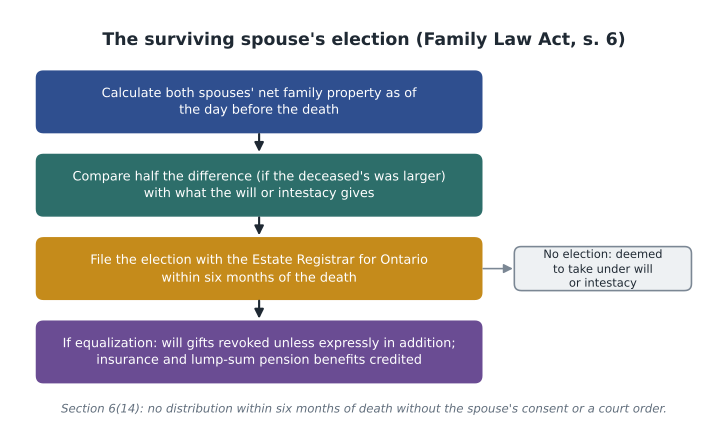
A married spouse has an additional and often more valuable right. Section 5(2) of the Family Law Act provides that when a spouse dies, if the net family property of the deceased spouse exceeds that of the surviving spouse, the surviving spouse is entitled to one half of the difference. Net family property is calculated as students learned in family law, with the valuation date being the day before the date of death. Section 6 then requires the surviving spouse to choose. The spouse may take under the will, or on intestacy, or a combination if the will disposes of only part of the estate. Or the spouse may elect to receive the equalization payment.
The election must be filed in the office of the Estate Registrar for Ontario within six months after the spouse's death, in the prescribed form. If the spouse does not file an election within that time, section 6(11) deems the spouse to have elected to take under the will or on intestacy. The court may extend the six-month limit under section 2(8) of the Family Law Act if there are apparent grounds for relief, the delay was incurred in good faith, and no person will suffer substantial prejudice. The limit is strict, and missing it is a classic source of negligence claims against lawyers acting for widows and widowers.
The election has consequences. If the spouse elects equalization, gifts to the spouse under the will are revoked and the will is read as if the spouse had predeceased, unless the will expressly provides that the gifts are in addition to the equalization entitlement. The spouse also loses any intestate share. Under sections 6(6) and 6(7), life insurance proceeds and lump-sum pension benefits the spouse receives because of the death are credited against the equalization payment, unless a written designation or the policy provides that the payment is in addition. Under section 6(12), the spouse's equalization entitlement has priority over gifts in the will, intestate shares and orders under Part V of the Succession Law Reform Act, except an order in favour of a child of the deceased.
Section 6(14) protects the spouse while the election is pending. The estate trustee must not make any distribution within six months after the death without the spouse's written consent or a court order, and, if the spouse applies under section 5, must not distribute until the application is determined. A surviving spouse who is also the estate trustee, or who is a beneficiary under the will, should be advised to get independent legal advice before making or letting the deadline pass on the election.
The matrimonial home on death
Under section 26 of the Family Law Act, a spouse who has no interest in the matrimonial home but is occupying it at the time of the other spouse's death may retain possession of it rent-free for sixty days after the death, whatever the will says. Where the home was held by the deceased spouse and a third person as joint tenants, the joint tenancy is deemed to have been severed immediately before death, so that the third person does not take the deceased's share by survivorship and that share falls into the estate, where it is available for the equalization calculation. A home held by the spouses themselves as joint tenants passes to the survivor in the ordinary way.
Walter Holloway's election
Margaret Holloway's will gave Walter a life estate in Ferncliffe Farm. Ellerby asks the class whether Walter should have elected equalization. Margaret inherited the farm in 1984, during the marriage, so under section 4(2) of the Family Law Act the farm is excluded from her net family property, except for the part that was the matrimonial home. Under section 18(3), where property that includes a matrimonial home is normally used for a purpose other than residential, the matrimonial home is only the part of the property that may reasonably be regarded as necessary to the use and enjoyment of the residence: the farmhouse and its yard, not the eighty acres of fields and woodlot. The excluded-property rule does not apply to a matrimonial home, so the farmhouse portion is in Margaret's net family property.
Suppose the farmhouse and yard are worth 450,000 dollars, Margaret's other property included in her net family property is 150,000 dollars, and Walter's own net family property is 200,000 dollars. Margaret's net family property is 600,000 dollars, the difference is 400,000 dollars, and Walter's equalization entitlement would be 200,000 dollars, against which the insurance and registered fund he received as beneficiary would be credited unless the designations said otherwise. Against that, the will gives him the right to live on and use the whole farm for life, including its income. After advice from his own lawyer, Walter did not file an election. Section 6(11) deems him to have elected to take under the will. Ruth, as estate trustee, waited the six months before taking any step that could prejudice an election, as section 6(14) required.
Common mistakes
MistakeTelling an excluded independent adult child that they can claim dependant support.
InsteadOnly dependants, people the deceased was supporting or legally obliged to support immediately before death, can claim under Part V.
MistakeTreating Tataryn as giving every Ontario child a claim for a fair share.
InsteadCummings applies Tataryn's legal and moral obligations in fixing adequate support, but only for dependants.
MistakeIgnoring insurance and joint accounts in a dependant support claim.
InsteadSection 72 deems them part of the net estate for determining support, and recipients can be ordered to contribute.
MistakeMissing the six-month election deadline under section 6.
InsteadThe election must be filed with the Estate Registrar for Ontario within six months of death; otherwise the spouse is deemed to take under the will or intestacy.
MistakeDistributing an estate a month after death because the will is clear.
InsteadSection 6(14) of the Family Law Act bars distribution within six months without the spouse's consent or a court order, and Part V claims run for six months from the certificate.
Practice problems
Work each problem on paper first, then reveal the answer to check.
A man's will leaves everything to his second wife. His sixteen-year-old son from his first marriage lives with his mother and receives child support under a court order. Can the son claim?
Show answer
Yes. The son is a child to whom the father was under a legal obligation to provide support immediately before death, so he is a dependant under section 57. The court will order adequate provision, and section 6(12) of the Family Law Act gives a child's support order priority even over a spouse's equalization claim.
A widow elects equalization. Her husband's will had left her a 100,000 dollar cash gift. Does she receive it as well?
Show answer
No, unless the will expressly provides that the gift is in addition to her equalization entitlement. Otherwise the gift is revoked and the will is read as if she had predeceased.
A woman lived with her partner for eight years without marrying. His will leaves her nothing. She worked unpaid in his business. What claims should she consider?
Show answer
She has no equalization election, because she was not married. She may claim dependant support if he was supporting her, and she may claim unjust enrichment for her unpaid work under Kerr v. Baranow.
Summary and key terms
- Part V allows a dependant to claim adequate provision for proper support from an estate, whether there is a will or not.
- A dependant is a spouse, including an unmarried partner and a former spouse, a parent, a child or a sibling whom the deceased was supporting or legally obliged to support immediately before death.
- Cummings applies Tataryn's legal and moral obligations to fixing support in Ontario; section 62 lists the factors.
- Claims must be brought within six months of the certificate of appointment; section 72 brings joint accounts, insurance and similar assets into the calculation.
- A married surviving spouse may elect an equalization payment under Family Law Act section 6 within six months of death; otherwise they are deemed to take under the will or intestacy.
- Electing equalization revokes gifts under the will unless they are expressly in addition, and the estate trustee must not distribute within six months without consent or a court order.
- Dependant
- A spouse, parent, child or sibling the deceased was supporting or legally obliged to support immediately before death.
- Adequate provision
- Support sufficient for the dependant's proper needs, assessed under section 62.
- Moral obligation
- Society's reasonable expectation of what a judicious person would do for family, from Tataryn.
- Clawback
- The inclusion of certain non-estate assets in the value available for dependant support under section 72.
- Election
- The surviving married spouse's choice under Family Law Act section 6 between the will or intestacy and equalization.
- Estate Registrar for Ontario
- The office where a surviving spouse files the section 6 election.
Lesson quiz · 5 questions
Score 60% or more to complete this lesson.
Create a free account to save your progress, take quizzes and earn a certificate.