
LAWC-213 · Lesson 11 of 12 · 25 min
Estate litigation, passing of accounts and powers of attorney
▶ Video coming soon A video version of this lesson is on the way.
On the last regular day of the course, Professor Ellerby puts three files on the table. In the first, a son is challenging his mother's will, made a year before she died, which left most of her estate to her second husband. In the second, Colin Holloway has asked his sister Ruth to pass her accounts as estate trustee of their mother's estate, because he does not understand why she has paid herself nothing but has paid her husband's cousin to repair the barn roof. In the third, a woman's attorney for property, her nephew, has been writing himself cheques. 'Three different kinds of dispute,' Ellerby says, 'and in each the first question is the same: what does the court need to know, and how will it find out?'
This lesson covers the procedure for challenging a will under Rule 75 of the Rules of Civil Procedure, including notices of objection, proof in solemn form, the minimal evidentiary threshold, orders for directions, mediation, limitation periods and costs; the passing of accounts; and powers of attorney and guardianship under the Substitute Decisions Act, 1992, including attorneys' duties and the remedies for abuse.
Starting a will challenge
A person who wants to contest a will has several entry points. Before a certificate of appointment issues, any person who appears to have a financial interest in the estate may file a notice of objection with the court, under Rule 75.03, stating the nature of their interest and the grounds of objection. The objection prevents the certificate from issuing without notice to the objector. The estate trustee can then serve a notice to objector, requiring the objector to file a notice of appearance setting out their interest; if the objector does not respond, the estate trustee may proceed. In practice, a notice of objection is followed by an application or motion for directions.
After a certificate has issued, or where no certificate is being sought, a person with a financial interest can apply to have the will proved in solemn form, meaning that the propounder must prove its validity by full evidence in a contested proceeding, or apply to have the certificate returned and revoked. A person who suspects that a later will exists, or who wants the original will produced, can seek orders for assistance under Rule 74.15, which include orders requiring a person to produce a testamentary document, to attend for examination, or to accept or refuse an appointment as estate trustee.
The minimal evidentiary threshold
Courts do not allow a will to be put to proof merely because a disappointed relative asks. In Neuberger v. York, 2016 ONCA 191, the Court of Appeal for Ontario held that an interested person who asks the court to require proof of a will in solemn form must meet a minimal evidentiary threshold: they must adduce or point to some evidence which, if accepted, would call into question the validity of the will. Later decisions have described this as a screening function that protects estates from the cost and delay of unmeritorious challenges, while allowing challenges supported by some real evidence, such as medical records showing serious cognitive decline, or evidence that a beneficiary arranged the will, to proceed to production and discovery.
In Ellerby's first file, the son has evidence that his mother had been diagnosed with moderate dementia six months before the will, that her second husband drove her to a lawyer she had never used, and that the new will departed sharply from three earlier wills. That evidence would likely meet the threshold, which allows the son to obtain the drafting lawyer's file, the mother's medical records and examinations of the key witnesses. Whether the will is ultimately valid will depend on the Vout v. Hay analysis from lesson 3.
Directions, estate trustees during litigation and mediation
Under Rule 75.06, any person who appears to have a financial interest in an estate may apply for directions, or the court may give directions on its own initiative, as to the procedure for bringing any matter before the court. An order for directions typically defines the issues to be tried, names the parties and who will represent minors or persons under disability, sets a timetable for disclosure, affidavits of documents and examinations, requires mediation, and decides who will pay for what in the interim. Orders for directions are the backbone of Ontario estate litigation and allow the court to tailor procedure to the dispute.
Where the estate needs to be managed while its validity or administration is disputed, the court may appoint an estate trustee during litigation, often a neutral professional such as a trust company or a lawyer, to preserve and manage the assets without distributing them. The named estate trustee's powers may be suspended in the meantime. This is common where the named estate trustee is also the main beneficiary of the challenged will, because their conflict makes it inappropriate for them to control the estate while the dispute continues.
Under Rule 75.1, mediation is mandatory in contested estates, trusts and substitute decisions proceedings in Toronto, Ottawa and Windsor. Elsewhere, including Corwin, courts frequently order mediation as part of directions. Estate disputes are well suited to mediation because they are often driven by family history and grievance as much as by law, and because the cost of litigation can quickly consume a modest estate. Ellerby says that in her practice most contested estates settled at or after mediation, often with a payment from the main beneficiary to the challenger.
Limitation periods
Ontario courts have applied the two-year basic limitation period in the Limitations Act, 2002 to will challenges. The period presumptively runs from the date of death but is subject to discoverability: it runs from the day the claimant knew or ought to have known of the facts on which the claim is based. In Shannon v. Hrabovsky, 2024 ONCA 120, the Court of Appeal upheld a ruling that the period had run from the date the deceased's daughter obtained a copy of the will, rather than from the date of death, because she could not have known the basis of a challenge before seeing it. Dependant support claims have their own six-month period from the certificate of appointment, and the spouse's election under the Family Law Act has a six-month period from death. Ellerby tells the class to diarize every one of them on the day a client first calls.
Costs
Historically, the costs of estate litigation were often paid from the estate, whatever the result, which encouraged challenges. In McDougald Estate v. Gooderham (2005), the Court of Appeal for Ontario held that the modern approach to costs in estate litigation follows the ordinary civil rule that the unsuccessful party pays, subject to limited public policy exceptions. The estate may bear the costs where the litigation was caused by the testator's own conduct, such as an ambiguous or carelessly drafted will, or where there were reasonable grounds to question the validity of the will or the conduct of the estate trustee, so that it was in the interests of the estate that the questions be resolved. Challengers who lose on weak grounds can expect to pay costs personally.
Passing of accounts
An estate trustee must account to the beneficiaries. Most estates are closed informally: the estate trustee prepares accounts, sends them to the residuary beneficiaries with a proposed distribution, and asks each to sign a release. If a beneficiary refuses to approve the accounts, or if the estate trustee wants the court's approval to obtain a full discharge, the estate trustee can apply to pass the accounts in the Superior Court under Rules 74.16 to 74.18. A beneficiary or other interested person can also apply for an order requiring the estate trustee to pass accounts.
Estate accounts in Ontario follow a standard format. They show the assets at the date of death, capital receipts and disbursements, revenue receipts and disbursements, investments and assets on hand, liabilities, and the compensation the estate trustee claims. They cover the period from death, or from the last passing, to the date of the accounts. The estate trustee serves the accounts and notice of the application on the interested persons, who may file notices of objection to particular items. The court can hear the objections, require explanations and documents, disallow improper expenses, reduce or increase compensation, and order an estate trustee to repay amounts with interest. If no objections are filed, an unopposed judgment approving the accounts can be granted on paper.
In Ellerby's second file, Ruth has kept good records. Her accounts show the farm's income and expenses, the barn roof repair paid to a contractor at a competitive quoted price, the estate administration tax, legal and accounting fees, and no compensation. Colin's objection is that the contractor is a relative of Ruth's husband. Ellerby asks whether this is a breach of trust. Arjun Mehta says it is not automatically one, because Ruth did not profit, but that hiring a relative creates at least the appearance of a conflict and Ruth should be able to show that the price was fair and the work necessary. Ellerby agrees, and adds that Ruth would have been wiser to get two quotes and tell Colin in advance. Passing accounts gives Ruth a court-approved discharge, which is worth having in a family where trust has worn thin.
Powers of attorney
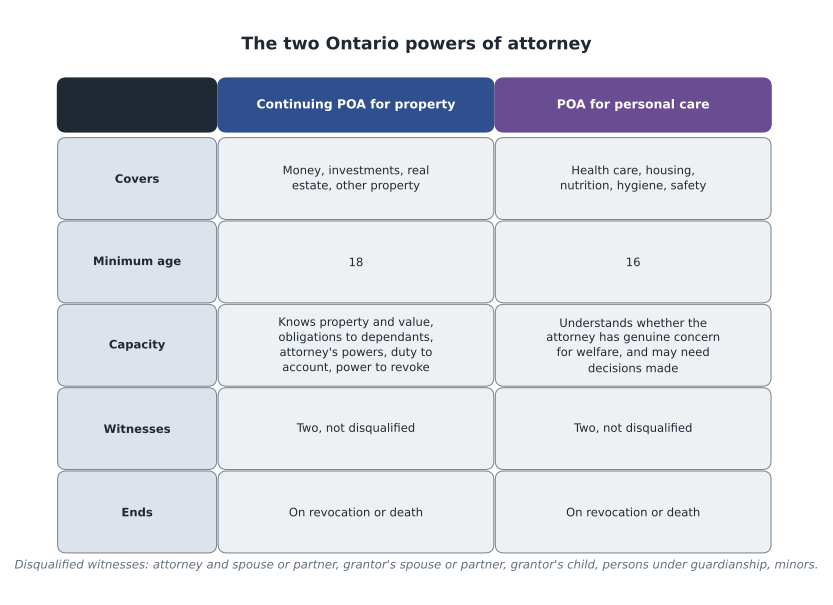
A will speaks only on death. While a person is alive but unable to manage their affairs, decisions are made by an attorney under a power of attorney or by a guardian appointed under the Substitute Decisions Act, 1992. There are two kinds of power of attorney in Ontario. A continuing power of attorney for property authorizes the attorney to deal with the grantor's property, and continues to be effective if the grantor becomes mentally incapable. A power of attorney for personal care authorizes the attorney to make personal care decisions, such as health care, housing, nutrition, clothing, hygiene and safety, but only when the grantor is incapable of making them.
A person may give a continuing power of attorney for property if they are at least eighteen and have capacity under section 8. That requires that the grantor know what kind of property they have and its approximate value, be aware of obligations owed to their dependants, know that the attorney will be able to do on their behalf anything in respect of property that the grantor could do if capable, except make a will, know that the attorney must account for dealings with the property, know that they may revoke the power while capable, appreciate that unless the attorney manages the property prudently its value may decline, and appreciate the possibility that the attorney could misuse the authority. The capacity to give a power of attorney for personal care, under section 47, is lower: the grantor must be at least sixteen, have the ability to understand whether the proposed attorney has a genuine concern for the grantor's welfare, and appreciate that the grantor may need to have the attorney make decisions for them.
Both kinds must be executed in the presence of two witnesses, each of whom signs as witness. The Act disqualifies certain people from witnessing: the attorney or the attorney's spouse or partner, the grantor's spouse or partner, a child of the grantor or a person whom the grantor has demonstrated a settled intention to treat as a child, a person whose property is under guardianship or who has a guardian of the person, and a person under eighteen. Since 2020, powers of attorney, like wills, can be witnessed remotely by audio-visual communication if one witness is a licensee. A power of attorney can name more than one attorney, jointly or jointly and severally, and can name substitutes.
Attorneys' duties
An attorney for property is a fiduciary who must exercise their powers and duties diligently, with honesty, integrity and in good faith, for the incapable person's benefit. The Act requires an attorney acting for an incapable person to manage the property in a way consistent with decisions about the person's personal care, to make the expenditures reasonably necessary for the person's support, education and care and for the support of their dependants, to keep accounts of all transactions, and to encourage the person to participate in decisions as far as possible. An attorney who is paid must meet the standard of care of a person in the business of managing property; an unpaid attorney must meet the standard of a person of ordinary prudence. Compensation is available according to a fee scale set by regulation unless the power of attorney provides otherwise.
Attorneys must not use the grantor's property for themselves without authority. A nephew who writes himself cheques, or who transfers his aunt's house to himself, is in breach of his fiduciary duty and may be required to repay, may be removed, and may face criminal charges for theft or fraud. Under section 42 of the Act, the court may order an attorney to pass their accounts on the application of the grantor, the attorney, a guardian, a dependant, the Public Guardian and Trustee, the Children's Lawyer, a judgment creditor or, with leave, any other person. Where there is serious concern about abuse, the Public Guardian and Trustee has a statutory duty to investigate allegations that an incapable person is suffering or may suffer serious adverse effects as a result of someone's dealings with their property or person.
Ellerby stresses one practical rule. A power of attorney ends on the grantor's death. From that moment, the attorney has no authority at all, and the estate trustee takes over. An attorney who continues to write cheques after death is acting without authority. The estate trustee has the right to require the former attorney to account for the period of the attorneyship, and many estate disputes begin with a demand by an estate trustee, or by a beneficiary, that a sibling who acted as attorney explain where the money went. Section 36 of the Succession Law Reform Act, discussed in lesson 4, also gives a beneficiary of a specific gift rights to the proceeds where the attorney sold the property.
Guardianship and substitute decisions
Where a person who is incapable of managing property has no continuing power of attorney, or the attorney is unable or unsuitable, a guardian of property may be appointed. Under the Act, the Public Guardian and Trustee can become the statutory guardian of property after a certificate of incapacity is issued following an assessment by a capacity assessor or, for a patient of a psychiatric facility, by a physician. A family member may then apply to replace the Public Guardian and Trustee as statutory guardian. Alternatively, any person may apply to the Superior Court to be appointed guardian of property or guardian of the person, but the court will not appoint a guardian if a less restrictive alternative, such as a power of attorney, is available.
Health care decisions for an incapable person are governed by the Health Care Consent Act, 1996, which sets a hierarchy of substitute decision-makers: a guardian of the person, an attorney for personal care, a representative appointed by the Consent and Capacity Board, a spouse or partner, a child or parent, a brother or sister, any other relative, and finally the Public Guardian and Trustee. A substitute decision-maker must follow the incapable person's prior capable wishes, if applicable, and otherwise act in their best interests. Disputes about capacity and treatment decisions go to the Consent and Capacity Board, not the courts at first instance.
Worked problem
Rika, two years on (hypothetical)
Suppose that when Rika signed her new will she also signed a continuing power of attorney for property naming Maeve and Pieter jointly and severally, and a power of attorney for personal care naming Maeve. Two years later, her dementia has progressed. Nolan Prowse tells Maeve that Rika has asked him to sell her car and keep the money for his help. Pieter, in Calgary, wants Rika to move into a care home near him. Rika says she wants to stay in Corwin. Advise Maeve.
Show solution
- Property decisions. Maeve and Pieter can act separately as joint and several attorneys, but must consult and must act for Rika's benefit, not their own or Nolan's. Before treating Rika as incapable, they should consider whether she can still make this decision; if she can, the decision is hers.
- The car. If Rika is incapable, giving her car to Nolan is a gift from her property. An attorney may make gifts only within the limits the Act allows, generally where the person has enough property to meet their needs and the gift is consistent with what the person would have wanted. Maeve should not simply hand the car over on Nolan's word. If Nolan has taken it already, she may need to recover it.
- Specific gift. If Rika's will leaves her car to anyone in particular, section 36 of the Succession Law Reform Act would give that beneficiary rights to any remaining sale proceeds. Maeve should keep the proceeds identified.
- Where Rika lives. This is a personal care decision for Maeve, as attorney for personal care, if Rika is incapable of making it. Maeve must follow Rika's prior capable wishes and her current wishes so far as possible. Rika's wish to stay in Corwin is relevant, as is her safety.
- Records. Maeve must keep accounts. If Pieter or Nolan later challenges her conduct, she may be asked to pass her accounts under section 42.
Common mistakes
MistakeAssuming any disappointed relative can force a will to be proved in solemn form.
InsteadUnder Neuberger v. York, the challenger must meet a minimal evidentiary threshold.
MistakeTelling a challenger the estate will pay their costs.
InsteadMcDougald Estate v. Gooderham applies loser-pays, with exceptions where the testator caused the dispute or there were reasonable grounds to question the will.
MistakeLetting an attorney for property keep acting after the grantor dies.
InsteadA power of attorney ends on death. The estate trustee takes over and can require the former attorney to account.
MistakeUsing the grantor's adult child as a witness to a power of attorney.
InsteadThe Substitute Decisions Act disqualifies the grantor's child and others from witnessing.
MistakeApplying for guardianship where a valid power of attorney exists.
InsteadThe court will not appoint a guardian if a less restrictive alternative is available.
Practice problems
Work each problem on paper first, then reveal the answer to check.
A beneficiary refuses to sign a release because she thinks the estate trustee overpaid for legal fees. What can the estate trustee do?
Show answer
Apply to pass the accounts in the Superior Court. The beneficiary may file a notice of objection to the legal fees, and the court can approve or reduce them. A court-approved passing gives the estate trustee a discharge.
A woman of seventeen wants to give her mother a power of attorney for personal care. Can she?
Show answer
Yes. The minimum age for a power of attorney for personal care is sixteen, if she has capacity under section 47. A continuing power of attorney for property requires the grantor to be eighteen.
A will challenge is brought three years after the death by a son who received a copy of the will two months after the death. Is it likely to be time-barred?
Show answer
Probably. The two-year limitation period under the Limitations Act, 2002 runs from when the claimant knew or ought to have known the basis of the claim, which here was at the latest when he received the will, more than two years earlier.
Summary and key terms
- A will is challenged by a notice of objection, an application to prove it in solemn form, or orders for assistance and directions under Rules 74 and 75.
- A challenger must meet a minimal evidentiary threshold (Neuberger v. York); orders for directions shape the litigation, and mediation is mandatory in Toronto, Ottawa and Windsor.
- The two-year limitation period applies to will challenges, subject to discoverability (Shannon v. Hrabovsky); costs generally follow the event (McDougald Estate v. Gooderham).
- Estate trustees account to beneficiaries informally or by passing accounts under Rules 74.16 to 74.18.
- The Substitute Decisions Act provides continuing powers of attorney for property and powers of attorney for personal care, with capacity, age and witness requirements; attorneys are fiduciaries who must keep accounts.
- A power of attorney ends on death; guardianship is available only where no less restrictive alternative exists.
- Notice of objection
- A document filed before a certificate issues to prevent it from issuing without notice to the objector.
- Order for directions
- An order setting the issues, parties and procedure in estate litigation.
- Estate trustee during litigation
- A neutral person appointed to manage an estate while its validity or administration is disputed.
- Passing of accounts
- The court's review and approval of an estate trustee's or attorney's accounts.
- Continuing power of attorney for property
- A power of attorney over property that continues if the grantor becomes incapable.
- Power of attorney for personal care
- A power of attorney for personal care decisions when the grantor is incapable of making them.
- Statutory guardian
- A guardian of property, often the Public Guardian and Trustee, appointed after a certificate of incapacity.
Lesson quiz · 5 questions
Score 60% or more to complete this lesson.
Create a free account to save your progress, take quizzes and earn a certificate.