
LAWC-213 · Lesson 7 of 12 · 23 min
Assets outside the will: beneficiary designations, joint accounts and pensions
▶ Video coming soon A video version of this lesson is on the way.
Professor Ellerby asks the class to guess what proportion of a typical Corwin estate in her practice passed under the will. Guesses range from seventy to ninety percent. 'In a lot of the files I closed in my last few years, less than half,' she says. 'The house was in joint names with the spouse. The pension went to the spouse under the plan. The insurance went to whoever was named on the form. The registered funds went to whoever was named on a different form, signed at the bank fifteen years earlier. The will governed the car, the furniture and a chequing account.' She writes on the board: 'The will is only one of the client's dispositions.'
This lesson covers property that passes outside the will: joint accounts and joint tenancies, including the presumptions set out by the Supreme Court in Pecore v. Pecore; beneficiary designations on life insurance and registered plans; pensions; gifts in contemplation of death; and the consequences of all of these for estate administration tax, income tax, creditors and claims by dependants and spouses. A lawyer who drafts a will without asking about these assets has done half the job.
Joint tenancy and survivorship
When two or more people own property as joint tenants, the right of survivorship means that on the death of one, the survivor or survivors become entitled to the whole. The deceased's interest does not form part of their estate, cannot be dealt with by their will and does not pass on intestacy. Joint bank accounts work the same way: the bank's account agreement usually provides that the balance belongs to the surviving holder. Married couples commonly own their home and bank accounts jointly for exactly this reason, so that the survivor has immediate access without waiting for a certificate of appointment.
Survivorship, however, governs only the legal title. The question who is entitled to the beneficial interest is answered by the law of trusts. Where one person puts property into joint names with another without receiving payment, the law must decide whether the transferor meant to make a gift, either of an immediate half interest or of the right of survivorship, or whether the transferor kept the whole beneficial interest and simply added a name for convenience, such as to let a child pay bills. That is the question in Pecore.
Pecore v. Pecore
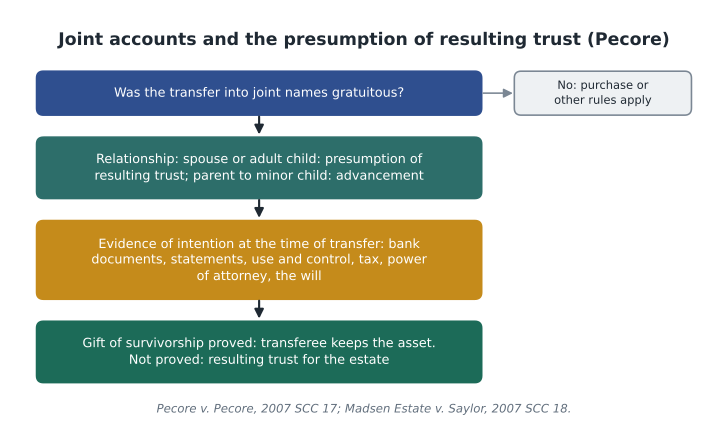
In Pecore v. Pecore, 2007 SCC 17, a father placed mutual funds and bank accounts into joint names with his adult daughter, who helped him with his finances. He continued to control the accounts and pay the tax on the income. After his death, the daughter's former husband argued that the accounts belonged to the estate, in which he had an interest under the will, rather than to her by survivorship. Justice Rothstein, for the majority, set out the law for all of Canada's common-law provinces.
Where property is transferred gratuitously, the starting point is a presumption of resulting trust: the law presumes that the transferor did not intend a gift, so the transferee holds the property in trust for the transferor or, after death, for the transferor's estate. The old presumption of advancement, which assumed that a father intended a gift to his child, now applies only to transfers from a parent to a minor child. Transfers to adult children, even dependent adult children, attract the presumption of resulting trust, because adult children are often added to accounts for convenience and because parents may want to treat all their children equally through their wills. The presumption of advancement between spouses was abolished in Ontario by the Family Law Act, which applies a presumption of resulting trust in most cases but treats property held as joint tenants by spouses as intended to pass by survivorship.
The presumptions are only the starting point. The court looks at the evidence of the transferor's intention at the time of the transfer. Relevant evidence includes the wording of the bank documents, although the Court said these are not conclusive because people often sign bank forms without understanding them; whether the transferor continued to control and use the account; who paid the tax on the income; whether the transferor granted the transferee a power of attorney, which may suggest the transferee was added only to help; any statements the transferor made; and the transferor's will. Evidence of intention arising after the transfer may be admitted if it is relevant to intention at the time, but must be treated with caution.
Pecore also recognized that a transferor can make a gift of the right of survivorship alone. A parent can keep full control and beneficial ownership of an account during life while intending the child to take whatever remains at death. In Pecore itself, the trial judge found that the father intended exactly that, and the daughter kept the accounts. In the companion case of Madsen Estate v. Saylor, 2007 SCC 18, the evidence pointed the other way: the father had added his daughter to accounts for convenience, and the daughter held the balances on a resulting trust for the estate, to be shared with her siblings under the will.
The Holloway credit union account
Two years before her death, Margaret Holloway added Colin's name to her savings account at the local credit union so he could pay her bills while she was ill. The account holds about forty thousand dollars. Colin says it is his. Under Pecore, the transfer was gratuitous and Colin is an adult, so the presumption of resulting trust applies. Colin must prove that Margaret intended to give him the right of survivorship. Ruth, as estate trustee, has gathered the evidence: the credit union form is a standard joint account form with a box marked 'with right of survivorship'; Margaret's will makes no mention of the account; Margaret wrote all the deposits and Colin wrote cheques only for her hydro and pharmacy bills; Margaret told Ruth in hospital that Colin was 'on the account to look after the bills'; and Margaret paid the tax on the interest.
Ellerby asks Hannah Kowalczyk to argue for the estate and Daniel Whitecloud for Colin. Kowalczyk points to the purpose of adding Colin, Margaret's statement to Ruth, her continued control and the tax treatment, all of which resemble Madsen. Whitecloud points to the survivorship box and argues that Margaret, a careful woman, knew what she was signing. Ellerby says that on these facts the estate has the better argument, and that the account is likely to be found to be held by Colin on a resulting trust for the estate, to be divided under the residue of the will. She adds a professional point: Ruth, who would share the account if the estate succeeds, has a personal interest in the outcome and should consider seeking the court's directions rather than deciding the question herself.
Adding a child to the title of a house
Parents sometimes add a child to the title of their house as a joint tenant, often to avoid estate administration tax. Pecore applies in the same way: unless the evidence shows a gift, the child holds the interest on a resulting trust for the parent and the parent's estate. Such transfers carry risks that Ellerby lists for the class. The child's creditors or spouse may make claims against the child's interest. The transfer may trigger land transfer tax if consideration is involved and can complicate the principal residence exemption for capital gains tax. The parent loses the ability to sell or mortgage the house without the child's signature. And the transfer may provoke litigation among siblings after the parent's death. The saving in estate administration tax, fifteen dollars per thousand above the first fifty thousand, is rarely worth those risks.
Life insurance designations
Life insurance proceeds are payable under the insurance contract. Under Ontario's Insurance Act, the insured may designate a beneficiary in the policy, in a separate declaration or in a will, and may generally change a revocable designation at any time. A designation in a will is effective only if the will identifies the contract or the insurance, and a later designation revokes an earlier one to the extent of inconsistency. If a will purporting to designate a beneficiary is revoked, the designation is revoked with it. Proceeds payable to a named beneficiary do not form part of the estate, are not subject to estate administration tax and are not available to the deceased's creditors. Proceeds payable to the estate, or where the named beneficiary has died and no alternate is named, fall into the estate.
An insured may also designate a beneficiary irrevocably, in which case the insured cannot change the designation or deal with the policy without the irrevocable beneficiary's consent. In Moore v. Sweet, 2018 SCC 52, Mr. Moore had bought a life insurance policy while married to Ms. Moore and named her as beneficiary. After they separated, they agreed orally that she would pay the premiums and he would keep her as the beneficiary. She paid the premiums for about thirteen years. Without telling her, he later named his new partner, Ms. Sweet, as the irrevocable beneficiary. On his death, the Supreme Court held by a majority of seven to two that Ms. Sweet had been unjustly enriched at Ms. Moore's expense and that the proceeds should be held on a constructive trust for Ms. Moore. Lesson 10 examines the unjust enrichment analysis. The practical lesson for this lesson is that a designation fixes who receives the money from the insurer, but not necessarily who is entitled to keep it.
Registered plans and Part III
Part III of the Succession Law Reform Act allows a participant in a plan, which includes registered retirement savings plans, registered retirement income funds, many pension and benefit plans and, since 2009, tax-free savings accounts, to designate a beneficiary of the plan's benefits on death. The designation may be made by an instrument signed by the participant, usually a form from the financial institution, or by will. A later designation in a will revokes an earlier one only if it relates expressly to the plan, and a designation in a will is revoked if the will is revoked. As with insurance, benefits paid to a named beneficiary pass outside the estate.
Registered plans create a tax mismatch that surprises families. Under the Income Tax Act, the value of an RRSP or RRIF is generally included in the deceased's income in the year of death, unless it passes to a surviving spouse or common-law partner, or in some cases a financially dependent child or grandchild, who can roll it into their own plan. If a parent names one child as beneficiary of a large RRIF, that child receives the whole account, but the income tax on it, which may be close to half its value at the top marginal rate, is a liability of the estate and may be paid from the shares of the other beneficiaries. The Income Tax Act allows the Canada Revenue Agency to collect from the beneficiary in some cases, but the primary liability is the estate's. A will that divides the residue equally among three children while one of them is named on the RRIF produces anything but equality.
Pensions
Registered pension plans have their own rules, set by the Pension Benefits Act for plans registered in Ontario. If a member dies before retirement, the member's spouse is generally entitled to the pre-retirement death benefit, unless the spouses were living separate and apart at the date of death or the spouse has waived the entitlement in the prescribed form. Only if there is no eligible spouse does the benefit go to the designated beneficiary or the estate. If a member has retired with a spouse, the pension is normally paid as a joint and survivor pension, under which the surviving spouse receives at least 60 percent of the pension for life, unless both spouses waived this in the prescribed form before the pension began. For pension purposes, spouse includes a qualifying unmarried partner. A member cannot defeat these rights by will or by naming someone else as beneficiary.
Gifts during life and in contemplation of death
A completed gift during life removes property from the estate. The donor must have intended to make the gift, the recipient must have accepted it and the property must have been delivered, or the transfer completed by deed or registration. Gifts made shortly before death may be attacked for incapacity or undue influence, as discussed in lesson 3, and may be counted in the net estate for dependant support under section 72.
A donatio mortis causa is a gift made in contemplation of the donor's imminent death, conditional on death, with delivery of the property or the means of control of it. Students met Margaret's gift of the sapphire brooch to Emma in property law: Margaret, in hospital a week before she died, handed Emma the brooch, saying 'This is yours when I'm gone'. The gift is effective on Margaret's death and does not depend on the will. It is outside the estate for administration purposes but within section 72 for dependant support purposes. A gift by will is revocable, a donatio mortis causa is revoked if the donor recovers, and an outright gift during life is irrevocable once complete.
Planning tools outside the will
People over sixty-five can transfer property into an alter ego trust, or for couples a joint partner trust, without triggering an immediate tax disposition, under rules in the Income Tax Act. The trust holds the property for the settlor during life and then passes it to the people named in the trust, outside the estate and outside estate administration tax. Such trusts can be useful for privacy and for avoiding a probate application in several provinces, but they cost money to set up and administer and do not avoid dependant support claims, because property in them can be brought into the calculation in some circumstances. Ellerby warns against selling them as a universal solution.
Worked problem
Reviewing Rika's non-estate assets
Before Rika signs, Joelle Tobin reviews her assets outside the will. Rika has a RRIF of 180,000 dollars naming Pieter as beneficiary, signed in 2008. She has a joint chequing account with Maeve of 40,000 dollars, opened in 2021 so Maeve could help with bills. She has a small life insurance policy of 25,000 dollars naming her late husband, and no alternate. Her new will gives the house to Nolan, two thirds of the investments to Maeve and one third to Pieter. What should Tobin advise?
Show solution
- RRIF. Pieter would receive the whole 180,000 dollars outside the will, while the income tax on it, likely a large fraction, would be paid by the estate, reducing the investments Maeve shares. This contradicts Rika's plan to favour Maeve. Rika should consider changing the designation, perhaps to her estate or to Maeve, or adjusting the residue.
- Joint account. Under Pecore the presumption is a resulting trust for the estate, consistent with a convenience account. If Rika wants Maeve to keep the balance on death, she should say so in writing now; if not, she should record that it is for convenience only, to avoid a dispute.
- Life insurance. The named beneficiary has died and there is no alternate, so the proceeds would fall into the estate. Rika can name a new beneficiary, such as Maeve, or leave it to pass under the will.
- Coordination. Tobin should prepare a summary showing who receives what from all sources, inside and outside the will, so that Rika can see the real result of her plan, and should record Rika's decisions in the file.
Common mistakes
MistakeAssuming a joint account with an adult child belongs to the child on death.
InsteadUnder Pecore the presumption is a resulting trust for the estate. The child must prove the parent intended a gift of survivorship.
MistakeTreating the bank's survivorship form as conclusive.
InsteadPecore treats bank documents as evidence only; the court looks at all the evidence of intention at the time of the transfer.
MistakeLeaving the tax on a designated RRIF out of the estate plan.
InsteadUnless rolled over to a spouse or qualifying dependant, the income tax falls on the estate, even though the beneficiary receives the plan.
MistakeTelling a client he can leave his pension to his children by will while he has a spouse.
InsteadThe Pension Benefits Act gives the spouse priority unless a valid waiver was signed or the spouses were living apart.
MistakeForgetting non-estate assets in a dependant support claim.
InsteadSection 72 brings joint accounts, insurance and gifts in contemplation of death into the calculation.
Practice problems
Work each problem on paper first, then reveal the answer to check.
A mother transferred her house into joint names with her twelve-year-old son. She dies. Which presumption applies?
Show answer
The presumption of advancement, because the transfer was from a parent to a minor child. The son is presumed to take the house as a gift unless the evidence shows otherwise.
A man's 2015 insurance declaration names his brother. His 2024 will says "I leave all my property to my wife". Who receives the insurance?
Show answer
The brother. A designation in a will is effective only if the will identifies the insurance contract. A general gift of "all my property" does not change the designation.
A woman retired with a pension while married and both spouses signed nothing. She dies. What does her husband receive?
Show answer
Unless a valid waiver was signed before the pension began, the pension was a joint and survivor pension, and he receives at least 60 percent of it for life.
Summary and key terms
- Much of a modern estate passes outside the will, through joint ownership, designations and pensions.
- Under Pecore, a gratuitous transfer to an adult child is presumed to be held on a resulting trust for the transferor's estate; advancement applies only to minor children; the evidence of intention at the time decides.
- Insurance and registered plan designations pass benefits directly to the named beneficiary, outside the estate; a designation in a will must identify the contract or plan.
- Moore v. Sweet shows that a designation decides who receives the money, not always who may keep it.
- Income tax on registered plans often falls on the estate; pensions are governed by the Pension Benefits Act, which gives a spouse priority.
- Non-estate assets are counted for dependant support under section 72 and may be credited against a spouse's equalization payment.
- Right of survivorship
- The right of a surviving joint tenant to the whole property on the death of another joint tenant.
- Presumption of resulting trust
- The presumption that a person who gives property for nothing intends to keep the beneficial interest.
- Presumption of advancement
- The presumption that a parent who transfers property to a minor child intends a gift.
- Beneficiary designation
- A direction naming who receives insurance or plan benefits on death.
- Irrevocable beneficiary
- A beneficiary whose designation the insured cannot change without consent.
- Donatio mortis causa
- A gift in contemplation of imminent death, conditional on death, with delivery.
- Alter ego trust
- A trust for a settlor aged sixty-five or older that holds property for life and passes it on death outside the estate.
Lesson quiz · 5 questions
Score 60% or more to complete this lesson.
Create a free account to save your progress, take quizzes and earn a certificate.