
LAWC-213 · Lesson 8 of 12 · 24 min
Estate administration
▶ Video coming soon A video version of this lesson is on the way.
Ruth Holloway has been the estate trustee of her mother's estate for some months when she comes to the Brannock legal clinic, supervised by Professor Ellerby, with a shoebox of papers and a list of questions. Does she really need a certificate of appointment? Why does the bank say it needs one when the will names her? How much tax will she pay? Can she pay herself for the hours she has spent? When can she give Colin and Emma their money? Ellerby tells the class that Ruth's questions are the syllabus for this lesson, and that the most common reason estate trustees end up in court is not dishonesty but doing the right things in the wrong order.
This lesson covers the source of an estate trustee's authority, certificates of appointment and when they are needed, the estate administration tax and the Estate Information Return, the small estates procedure introduced in 2021, multiple wills, the estate trustee's duties in collecting assets, paying debts and filing tax returns, the timing of distribution, and compensation.
The source of authority
An estate trustee named in a will derives their authority from the will itself, from the moment of death. Ruth could, and did, arrange her mother's funeral, change the locks on the farmhouse, notify the insurer and collect Margaret's mail before any court document was issued. Under the Estates Administration Act, the deceased's property vests in the estate trustee as the deceased's personal representative. A certificate of appointment does not create the authority; it confirms it, by having the court accept the will as valid and the estate trustee as entitled to act.
An estate trustee without a will has no authority until the court appoints them. A family member who acts before being appointed, such as by selling the deceased's car, is an executor de son tort, a wrongdoer who may be liable to the estate and its creditors. A named estate trustee who does not want to act may renounce, but only before intermeddling with the estate; once they have begun to deal with the assets, they can be released only by the court.
When a certificate of appointment is needed
Ontario law does not require every estate to obtain a certificate. A certificate is needed when a third party will not deal with the estate trustee without one. Banks and investment firms usually insist on a certificate for accounts above their internal thresholds, because a certificate protects them if the will later turns out to be invalid. Land registered in the deceased's sole name generally requires a certificate to be transferred or sold, although the land titles system allows some transfers without one in limited cases. A certificate is also useful, and sometimes essential, where the will is likely to be challenged, because the application process gives notice to interested people and the certificate settles the estate trustee's authority.
Many estates are administered without a certificate. Where all significant assets are held jointly with a spouse or pass by designation, and the remaining accounts are small, banks will often release funds on the strength of a notarial copy of the will, a death certificate and an indemnity. Ruth's estate is different: Margaret owned the farm and the Pike Lake lot in her sole name, and Ruth must have authority confirmed by the court to deal with the land, transfer the lot to Severn Township and register Walter's life estate and the remainder.
Applying for a certificate
Under Rule 74, an applicant for a certificate of appointment of estate trustee with a will files an application, the original will and any codicils, an affidavit of execution or other proof of due execution, proof that notice of the application was served on everyone entitled to share in the estate, including the Office of the Children's Lawyer for minors and the Public Guardian and Trustee for adults under disability or charities, and the estate administration tax deposit. Applications can be filed in person, by mail or through the court's online portal. Court staff and a judge review the application. If the will appears regular and there is no objection, the certificate issues, often within weeks, though delays of several months have occurred in busy locations.
Where there is no will, the applicant files an application for a certificate of appointment of estate trustee without a will, with consents of persons entitled to a majority of the estate's value and, usually, a bond. Other forms of certificate exist for succeeding estate trustees, for estate trustees during litigation and for the confirmation in Ontario of a grant made in another jurisdiction. A notice of objection filed by an interested person before the certificate issues prevents it from issuing without notice to the objector, as lesson 11 explains.
Estate administration tax
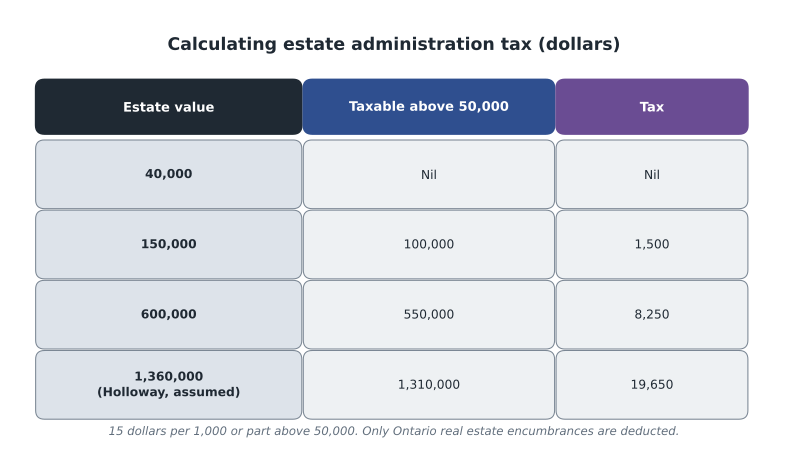
The Estate Administration Tax Act, 1998 imposes tax on the value of the estate of a deceased person for which a certificate of appointment is issued. For deaths on or after January 1, 2020, no tax is payable on the first 50,000 dollars of the estate's value. Above that amount, the tax is 15 dollars for every 1,000 dollars, or part of 1,000 dollars, of value. In effect, the tax is about one and a half percent of the value above 50,000 dollars. An estate worth 240,000 dollars pays tax on 190,000 dollars, which is 2,850 dollars.
The value of the estate is the value of all the property that belonged to the deceased at death and that passes through the estate, less only the value of encumbrances on Ontario real property, such as a mortgage. Other debts of the deceased, such as credit card balances, income tax, legal fees and funeral expenses, are not deductible. Real property outside Ontario is not included. Assets that pass outside the estate, such as jointly held property passing by survivorship and insurance or plans paid to a named beneficiary, are not included. The applicant estimates the tax and pays it as a deposit with the application.
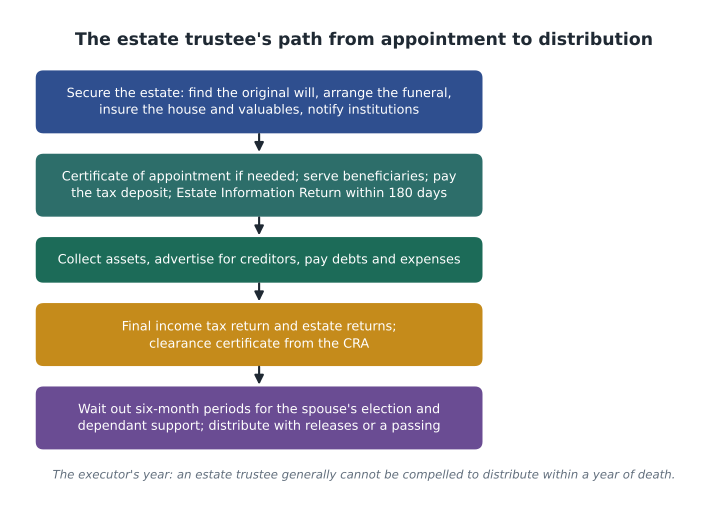
Within 180 calendar days after the certificate is issued, the estate trustee must file an Estate Information Return with the Ministry of Finance, listing the estate's assets and their values at the date of death. If the estate trustee later discovers new property or finds that a value was wrong, they must file an amended return within sixty days and pay any additional tax. The ministry may audit returns and assess additional tax. Making a false or misleading statement in a return is an offence, punishable by a fine of at least 1,000 dollars and up to double the tax that should have been paid, and imprisonment of up to two years.
Applying the rules to Ruth's estate on assumed values, the farm and the Pike Lake lot are worth 1,200,000 dollars, with no mortgage. Margaret's chequing account holds 25,000 dollars and her co-operative shares are worth 95,000 dollars. If the credit union account is held by Colin on a resulting trust for the estate, its 40,000 dollars is estate property too. The insurance and registered fund payable to Walter are outside the estate. The estate's value is therefore 1,360,000 dollars, and the tax is 15 dollars for each of the 1,310 thousands above 50,000 dollars, or 19,650 dollars. Ruth will pay it from the estate's cash, which may require a bank loan or a short delay until the shares are sold.
Multiple wills
Because estate administration tax applies only to estates for which a certificate is issued, Ontario lawyers commonly prepare two wills for clients who own assets that can be transferred without a certificate, such as shares in a private corporation, loans to family members or personal effects. The primary will deals with assets that require a certificate, such as bank accounts and land, and is submitted for probate. The secondary will deals with the rest and is not submitted. Tax is paid only on the assets governed by the primary will. Ontario courts accepted the validity of this technique in Granovsky Estate v. Ontario (1998), and it remains widely used. Each will must be drafted so that it does not revoke the other, and the estate trustees must keep careful track of which assets fall under which will.
Small estates
Since April 1, 2021, Ontario Regulation 110/21 has provided a simplified procedure for small estates, defined as estates with a value of 150,000 dollars or less. A single applicant may apply for a small estate certificate using shorter forms. The applicant must send a copy of the signed application to each beneficiary, or each person entitled on intestacy, at least thirty days before filing it with the Superior Court. The application can be filed by mail or email. If the applicant later discovers more property and the estate's value remains within the limit, they can amend the certificate; if the value rises above the limit, they must apply for an ordinary certificate. Estate administration tax is payable in the usual way, and the Estate Information Return is due within 180 days of the certificate.
Collecting and protecting the assets
An estate trustee is a fiduciary who must act honestly, in good faith and for the benefit of all the beneficiaries. The first duties are practical. The estate trustee must find out what the deceased owned and owed, secure the assets, and insure them. Many home insurance policies limit or suspend coverage if a house is vacant for more than a short period, so the insurer must be told. Valuables should be moved to safekeeping, perishable goods dealt with and businesses kept running or wound down. Ruth's first months involved keeping the produce stand running for Walter and arranging for a neighbour to check the barns.
The estate trustee must also keep proper accounts of every receipt and disbursement from the date of death. Estate money should be kept in a separate estate bank account, never mixed with the estate trustee's own money. An estate trustee who commingles funds, or who uses estate money for personal purposes even temporarily, is in breach of trust. The duty to account is owed to every beneficiary, and lesson 11 covers how beneficiaries can compel a passing of accounts.
Debts and creditors
An estate trustee must pay the deceased's debts before distributing to beneficiaries. To protect themselves against unknown creditors, estate trustees commonly advertise for creditors in a local newspaper or online notice service. Section 53 of the Trustee Act provides that an estate trustee who gives notice to creditors and, after the time stated in the notice, distributes the estate having regard only to the claims of which they then have notice, is not liable to a creditor of whose claim they did not have notice at the time of distribution. The creditor may still pursue the beneficiaries who received the property. If the estate is insolvent, the estate trustee must pay funeral and testamentary expenses first and then creditors in the order the law requires, and should consider whether the estate should be administered under the Bankruptcy and Insolvency Act.
Income tax
The deceased's final, or terminal, income tax return covers income from January 1 of the year of death to the date of death. It is due by April 30 of the following year, or six months after death if death occurred in November or December. The Income Tax Act deems the deceased to have disposed of capital property at fair market value immediately before death, which can produce capital gains on a farm, a cottage, shares or investments. Property left to a spouse, or to a qualifying spousal trust, can roll over at cost, deferring the tax until the spouse's death. Registered plans are taxed as described in lesson 7. Farm property passing to a child may qualify for special rollovers, which is relevant to Ferncliffe Farm, though Walter's life estate creates a trust that must be analyzed carefully.
After death, the estate itself is a taxpayer and files trust returns on its income, such as interest earned on estate accounts. For up to thirty-six months after death, an estate can qualify as a graduated rate estate, taxed at graduated rates rather than the top rate. Before making a final distribution, an estate trustee should obtain a clearance certificate from the Canada Revenue Agency under section 159 of the Income Tax Act, which certifies that all taxes owed by the deceased and the estate have been paid or secured. An estate trustee who distributes without a clearance certificate is personally liable for unpaid taxes up to the value of the property distributed.
Timing of distribution
At common law, an estate trustee has an executor's year: they cannot be compelled to distribute the estate within one year of the death. In practice, they must also wait for other periods to run. The surviving spouse's six-month period for the Family Law Act election, and the prohibition in section 6(14) on distribution within six months of death without consent or a court order, apply where there is a spouse. The six-month period for dependant support claims runs from the certificate of appointment. Distribution before the clearance certificate risks personal tax liability. Estate trustees often make interim distributions of amounts that are clearly not needed, holding back a reserve until the tax and claims periods have passed.
Distribution must follow the will, or the intestacy rules, exactly. Specific gifts go to the named beneficiaries; general gifts are paid; the residue is divided. Gifts to minors are paid into court, to a guardian of property, or held by a trustee if the will provides for it. Before final distribution, an estate trustee usually asks each residuary beneficiary to approve the accounts and sign a release. If any beneficiary refuses, the estate trustee can pass the accounts in court.
Compensation
Section 61 of the Trustee Act entitles an estate trustee to a fair and reasonable allowance for their care, pains and trouble and time spent in administering the estate, as fixed by the court or agreed by the beneficiaries, unless the will provides otherwise. Ontario courts use a guideline, sometimes called the tariff, of about 2.5 percent of the capital and revenue receipts and 2.5 percent of the capital and revenue disbursements, plus, for trusts that continue over time, an annual care and management fee of about two fifths of one percent of the average value of the assets. An estate of 800,000 dollars, collected and fully distributed, would produce compensation under the guideline of about 40,000 dollars before any adjustment.
The guideline is a starting point, not a rule. In Laing Estate v. Hines (1998), the Court of Appeal for Ontario confirmed that the court must check the result against five factors: the size of the trust, the care and responsibility involved, the time spent, the skill and ability shown, and the success of the administration. A simple estate of large bank accounts may justify much less than the guideline, and a difficult estate with a business and litigation may justify more. Compensation is taxable income in the estate trustee's hands, while an inheritance is not, so an estate trustee who is also a beneficiary, like Ruth, may choose to waive compensation. A will can fix compensation, and professional trust companies usually require a compensation agreement before agreeing to act.
Worked problem
Ruth's administration plan
Draw up a plan for Ruth for the remaining steps in her mother's estate, given that Walter has not elected equalization, the credit union account is disputed, Emma is nineteen, and Colin's sons are eleven and seven.
Show solution
- Certificate. Apply for a certificate of appointment of estate trustee with a will, serving Walter, Colin, Emma, Severn Township, Brannock for the scholarship, the Office of the Children's Lawyer for Colin's sons and the Public Guardian and Trustee for the charitable gift. Pay the estate administration tax deposit.
- Disputed account. Write to Colin setting out the estate's position on the credit union account and, if he does not agree, apply for directions rather than deciding the issue in her own favour.
- Land. After the certificate issues, register a transmission of the farm into her name as estate trustee and then deal with Walter's life estate and the remainder as the will directs; transfer the Pike Lake lot to Severn Township on the terms of the gift.
- Tax. File Margaret's terminal return, considering any farm rollover and the deemed disposition; file trust returns for the estate; obtain a clearance certificate before final distribution.
- Information return and claims. File the Estate Information Return within 180 days of the certificate. Wait six months from the certificate before distributing anything that a dependant support claim could reach.
- Ongoing trusts. Emma's twenty thousand dollar conditional gift, the scholarship fund and the co-operative shares for the grandchildren will continue as trusts; Ruth must invest them prudently under section 27 of the Trustee Act and keep accounts (lessons 9 to 11).
Common mistakes
MistakeTelling a named executor she has no authority until probate.
InsteadAn estate trustee named in a will has authority from death; a certificate confirms it. An estate trustee without a will needs a court appointment.
MistakeDeducting credit cards and funeral costs in calculating estate administration tax.
InsteadOnly encumbrances on Ontario real property are deducted. Other debts are not.
MistakeForgetting the Estate Information Return.
InsteadIt must be filed within 180 days of the certificate, and amended within sixty days of discovering new property or errors.
MistakeDistributing the estate before a clearance certificate.
InsteadWithout a clearance certificate the estate trustee is personally liable for unpaid taxes up to the value distributed.
MistakeTreating the compensation guideline as an entitlement.
InsteadThe court checks the guideline against the Laing Estate v. Hines factors and may award more or less.
Practice problems
Work each problem on paper first, then reveal the answer to check.
An estate consists of a house worth 700,000 dollars with a 200,000 dollar mortgage, a bank account of 100,000 dollars and a credit card debt of 20,000 dollars. What estate administration tax is payable?
Show answer
The value is 500,000 dollars for the house net of the mortgage plus 100,000 dollars, or 600,000 dollars. The credit card is not deducted. Tax is 15 dollars per thousand on 550,000 dollars, or 8,250 dollars.
An estate is worth 140,000 dollars and has one estate trustee named in the will. What procedure is available?
Show answer
The small estate procedure under Ontario Regulation 110/21, because the value is 150,000 dollars or less. The applicant must send the signed application to the beneficiaries at least thirty days before filing.
An estate trustee advertised for creditors, waited the stated period, then distributed. A creditor appears. Is the estate trustee liable?
Show answer
Not if the estate trustee had no notice of the claim at the time of distribution. Section 53 of the Trustee Act protects them; the creditor may pursue the beneficiaries.
Summary and key terms
- A named estate trustee's authority comes from the will at death; a certificate of appointment confirms it and is needed when third parties require it.
- Estate administration tax is nil on the first 50,000 dollars and 15 dollars per 1,000 or part above that; only Ontario real property encumbrances are deducted.
- The Estate Information Return is due within 180 days of the certificate; small estates of 150,000 dollars or less may use the simplified procedure.
- Multiple wills can limit estate administration tax to assets that need a certificate (Granovsky).
- Estate trustees must secure assets, keep accounts, advertise for creditors, file tax returns and obtain a clearance certificate before final distribution.
- Compensation under section 61 of the Trustee Act follows a guideline of about 2.5 percent of receipts and disbursements, checked against the Laing factors.
- Estate administration tax
- Ontario's tax on the value of an estate for which a certificate of appointment is issued.
- Estate Information Return
- The return listing estate assets that must be filed within 180 days of a certificate.
- Executor de son tort
- A person who intermeddles in an estate without authority.
- Clearance certificate
- A certificate from the Canada Revenue Agency that taxes have been paid, protecting the estate trustee on distribution.
- Graduated rate estate
- An estate taxed at graduated rates for up to thirty-six months after death.
- Executor's year
- The one-year period after death within which an estate trustee cannot be compelled to distribute.
- Secondary will
- A will dealing with assets that do not require a certificate, kept out of the probate application.
Lesson quiz · 5 questions
Score 60% or more to complete this lesson.
Create a free account to save your progress, take quizzes and earn a certificate.