
LAWC-212 · Lesson 9 of 12 · 20 min
Property division
▶ Video coming soon A video version of this lesson is on the way.
'Ontario does not divide property,' Professor Ferreira says, to the confusion of the class. 'At least, not in the way you think. Nobody gets half the house or half the car. Each spouse keeps what they own. What the law divides is value.' She explains that Part I of the Family Law Act gives each married spouse an equalization claim: a right to a payment that equalizes the growth in their net worth during the marriage. Understanding that idea, and the formula that carries it out, is the key to Ontario property law.
This lesson covers the purpose of Part I, the definition of property, the valuation date, the calculation of net family property, the date-of-marriage deduction, excluded property, the special rule for the matrimonial home, unequal division under section 5(6), valuation problems such as businesses and taxes, the court's remedial powers, limitation periods, and what happens on death. Lesson 10 covers the matrimonial home in more detail, pensions and the claims of unmarried partners.
The purpose and structure of Part I
Section 5(7) states the purpose of equalization: to recognize that child care, household management and financial provision are the joint responsibilities of the spouses and that inherent in the marital relationship there is equal contribution, whether financial or otherwise, by the spouses to the assumption of these responsibilities, entitling each spouse to the equalization of the net family properties, subject only to the equitable considerations in section 5(6). Ontario adopted this model in the Family Law Act, 1986, building on the Family Law Reform Act of 1978. Both followed the public reaction to the Supreme Court's decision in Murdoch v. Murdoch (1973), which had denied a ranch wife any share of the ranch she had worked on for years and prompted law reform across the country.
The structure is simple. Each spouse calculates their net family property under section 4. The spouse whose net family property is smaller is entitled to one half of the difference between the two (section 5(1)). Ownership does not change; one spouse pays the other. A spouse who owns more at separation, after deducting what they brought into the marriage and what is excluded, pays the other spouse.
Property and the valuation date
Property is defined broadly in section 4(1) as any interest, present or future, vested or contingent, in real or personal property. It includes property over which a spouse has a power of appointment exercisable in their favour, property disposed of under a revocable power, and, specifically, the spouse's interest in a pension plan. Courts have included business interests, stock options, professional practices, contingent interests and even the right to future payments. A professional licence or degree is not itself property, though income it produces may affect support.
The valuation date is, in most cases, the date the spouses separate with no reasonable prospect that they will resume cohabitation. Section 4(1) also lists other dates: the date of a divorce, the date a marriage is declared a nullity, the date one spouse starts an application based on improvident depletion, and the day before the date a spouse dies. Because property is valued on that date, fixing the separation date can change the result significantly, especially for volatile assets such as shares or a business.
Calculating net family property
Net family property is, in summary, the value of all property a spouse owns on the valuation date, minus their debts and liabilities on that date, minus the net value of property, other than a matrimonial home, that they owned on the date of marriage, and minus excluded property. If the result is negative, it is deemed to be zero (section 4(5)). The calculation is done separately for each spouse, then compared.
The date-of-marriage deduction recognizes that the equalization scheme is designed to share the growth in wealth during the marriage, not what each spouse brought in. A spouse who owned investments worth 100,000 dollars when they married, net of debts then owing, deducts that value. If they had net debts at the date of marriage, the negative value is added back, because they started the marriage below zero.
Debts and liabilities include mortgages, loans, credit card balances and contingent liabilities, including the income tax that would be payable on disposition of an asset. Section 4(1) refers to 'debts and other liabilities', and courts allow notional disposition costs, such as tax and real estate commissions, where it is likely the asset will be sold or realized, or the timing is reasonably certain. In Sengmueller v. Sengmueller (1994), the Court of Appeal held that disposition costs should be deducted where it is clear the asset will be disposed of, and can otherwise be estimated where the evidence supports it.
Excluded property
Section 4(2) excludes certain property from a spouse's net family property even though it is owned on the valuation date. The main categories are property, other than a matrimonial home, acquired by gift or inheritance from a third person after the date of marriage; income from such property if the donor or testator expressly said it was to be excluded; damages or a right to damages for personal injuries, nervous shock, mental distress or loss of guidance, care and companionship, or the part of a settlement representing those damages; proceeds of a life insurance policy payable on the death of the life insured; property, other than a matrimonial home, into which any of the above can be traced; property that the spouses have agreed by domestic contract is not to be included; and unadjusted pensionable earnings under the Canada Pension Plan.
The spouse claiming an exclusion bears the burden of proving it (section 4(3)). Tracing can be difficult when inherited money is mixed into a joint account and spent on general family expenses. Courts look for clear documentation, which is another reason clients should keep inheritances in a separate account.
The matrimonial home exception
The matrimonial home is treated differently in two ways. First, there is no date-of-marriage deduction for a matrimonial home. If a spouse owned a house when they married, and it was still a matrimonial home on the valuation date, they cannot deduct its value at marriage, and its full value is included in their net family property. Second, a gift or inheritance that is used to buy or pay down a matrimonial home loses its exclusion, because the exclusions in section 4(2) do not apply to a matrimonial home. A spouse who puts an inheritance into the mortgage on the family home has, in effect, shared it with the other spouse.
These rules can produce results that surprise clients. A spouse who owned a house before marriage, sold it during the marriage and used the proceeds for a new matrimonial home can deduct the value of the first house at the date of marriage, because on the valuation date it is no longer a matrimonial home. A spouse who kept the original house as the matrimonial home cannot. Lesson 10 explains what makes a property a matrimonial home and the other special rules in Part II.
Unequal division under section 5(6)
Section 5(6) lets the court award a spouse an amount more or less than half the difference if it is of the opinion that equalizing the net family properties would be unconscionable, having regard to a list of factors. They include a spouse's failure to disclose debts or liabilities existing at the date of marriage; debts incurred recklessly or in bad faith; the part of a spouse's net family property consisting of gifts from the other spouse; a spouse's intentional or reckless depletion of their net family property; the fact that the amount a spouse would otherwise receive is disproportionately large in relation to a period of cohabitation of less than five years; debts incurred for the support of the family; a written agreement that is not a domestic contract; and any other circumstance relating to the acquisition, disposition, preservation, maintenance or improvement of property.
Unconscionable is a high threshold. The Court of Appeal in Serra v. Serra (2009 ONCA 105) said it means a result that shocks the conscience of the court, not merely one that is unfair or harsh. In Serra, the husband's business had lost much of its value after the valuation date because of a market collapse, and equalization based on the valuation date value would have required him to pay far more than his remaining assets. The court held that a post-separation drop in value can be considered under section 5(6)(h) in an exceptional case. But ordinary market movements, or the fact that one spouse made a larger financial contribution, do not justify unequal division. The scheme presumes equal contribution.
Valuing a business
Callum's share of his engineering firm is the largest asset in the Sandoval and Whitlow file. Valuing a private business usually requires an expert, often a chartered business valuator. The valuator considers the firm's earnings, its assets, comparable sales, goodwill and any shareholder agreement restricting the sale of shares. Personal goodwill that depends on the owner's skills may be treated differently from enterprise goodwill that would transfer to a buyer. The valuator also deals with notional tax on disposition and with income that may be double counted if it is used both for the business value and for support, another 'double dipping' issue.
Courts prefer that parties agree on a joint expert, which reduces cost and conflict. Where each side retains its own valuator, the reports often differ widely, and the court must choose between them or find a value in between.
Disclosure and the net family property statement
Every equalization claim depends on disclosure. Under the Family Law Rules, each party serves a sworn financial statement listing property and debts at the date of marriage and the valuation date, and before a settlement conference or trial each serves a net family property statement (Form 13B) setting out their calculation. Supporting documents include bank and investment statements for both dates, pension valuations, appraisals and business records. Old date-of-marriage documents are often the hardest to find. A spouse who cannot prove what they owned at marriage may lose the deduction, because the burden of proving a deduction or exclusion is on the spouse who claims it. Ferreira advises clients at the first meeting to start gathering statements from the year they married, before they have been lost or destroyed. Where a spouse refuses to disclose, courts can draw adverse inferences and, in serious cases, impute a value to undisclosed assets.
Remedies, limitation periods and death
Section 9 gives the court wide powers to carry out an equalization. It can order payment of a lump sum, order payment by instalments over up to ten years, order security, order that property be transferred to or held in trust for a spouse, or order the partition or sale of property. Section 10 lets either spouse ask the court to decide questions of ownership or possession between them. Section 12 allows preservation orders, which prevent a spouse from depleting assets while the case is pending. In practice, the matrimonial home is often transferred to one spouse in exchange for a reduction in the equalization payment.
Section 7(3) imposes a limitation period. An equalization application must be brought before the earliest of two years after a divorce or a declaration of nullity, six years after the spouses separate with no reasonable prospect of resuming cohabitation, or six months after the first spouse's death. Section 2(8) lets the court extend the time if there are apparent grounds for relief, the delay was incurred in good faith, and no person will suffer substantial prejudice. Missing the deadline is a common cause of negligence claims against family lawyers.
On death, section 6 gives the surviving spouse an election: to take under the deceased's will or intestacy, or to claim an equalization payment as if the spouses had separated the day before the death. The election must be filed within six months of the death. Lesson 10 adds the related rules on pensions and life insurance.
Worked problem
Callum and Joanna: equalization
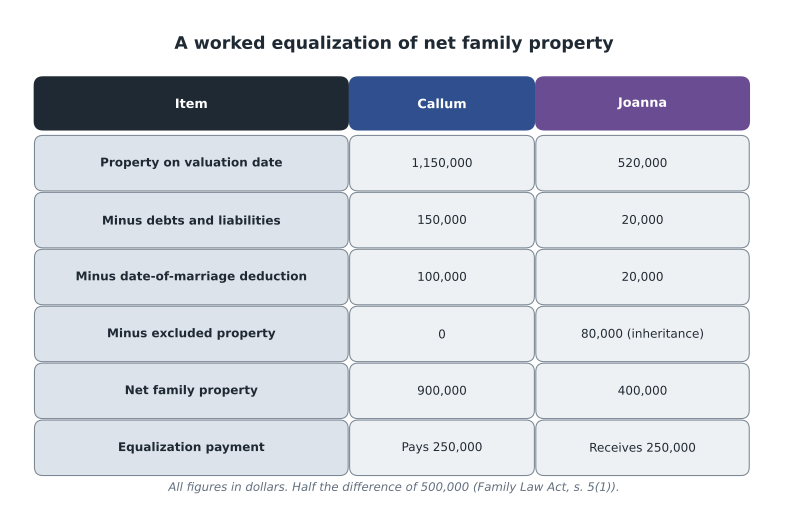
On the valuation date, Callum owns his half of the matrimonial home (300,000 dollars), shares in his engineering firm valued at 650,000 dollars, a pension valued at 150,000 dollars and other assets of 50,000 dollars. He owes 150,000 dollars, including notional tax on the firm. At the date of marriage he had savings of 100,000 dollars. Joanna owns her half of the home (300,000 dollars), a pension of 90,000 dollars, savings of 50,000 dollars and an 80,000 dollar inheritance from her aunt, kept in a separate account. She owes 20,000 dollars. At the date of marriage she had 20,000 dollars of savings. Calculate the equalization payment.
Show solution
- Callum's property: 300,000 plus 650,000 plus 150,000 plus 50,000 equals 1,150,000 dollars.
- Callum's net family property: 1,150,000 minus 150,000 debts minus 100,000 date-of-marriage deduction equals 900,000 dollars.
- Joanna's property: 300,000 plus 90,000 plus 50,000 plus 80,000 equals 520,000 dollars.
- Joanna's net family property: 520,000 minus 20,000 debts minus 20,000 date-of-marriage deduction minus 80,000 excluded inheritance (traceable, not in the home) equals 400,000 dollars.
- Equalization: the difference is 500,000 dollars; Callum owes Joanna half, 250,000 dollars. A court could order it paid partly by transferring Callum's half of the home to Joanna, with the balance by lump sum, pension division or instalments.
Common mistakes
MistakeTelling a client they will get half of each asset.
InsteadOntario equalizes value. Ownership stays the same, and one spouse makes a payment to the other.
MistakeDeducting the date-of-marriage value of a house that is still the matrimonial home.
InsteadThere is no date-of-marriage deduction for a property that is a matrimonial home on the valuation date.
MistakeArguing for unequal division because one spouse earned more.
InsteadEqual contribution is presumed; section 5(6) requires an unconscionable result, which is a very high threshold.
MistakeLetting six years pass after separation without starting a claim.
InsteadSection 7(3) bars a claim after six years from separation, two years after divorce or six months after death, subject to a limited extension.
Practice problems
Work each problem on paper first, then reveal the answer to check.
A spouse inherited 200,000 dollars during the marriage and used it to pay off the mortgage on the matrimonial home. Is the inheritance excluded?
Show answer
No. The exclusion does not apply to property that is a matrimonial home, and the inheritance cannot be traced into anything other than the home. The full value of the home is included in that spouse's net family property.
What did Serra v. Serra decide about section 5(6)?
Show answer
Unconscionable means a result that shocks the conscience of the court. A significant post-valuation drop in an asset's value can, in exceptional cases, be considered under section 5(6)(h) to adjust the payment.
A spouse dies while still married. What options does the surviving spouse have?
Show answer
Under section 6 the survivor can elect to take under the will or intestacy, or to receive an equalization payment calculated as of the day before death. The election must be made within six months.
Summary and key terms
- Part I gives married spouses an equalization payment of half the difference between their net family properties; ownership does not change.
- Net family property is property owned on the valuation date, minus debts, minus the net value of non-home property owned at marriage, minus excluded property.
- Gifts and inheritances from third parties, personal injury damages and life insurance proceeds are excluded, but not when they are put into a matrimonial home.
- No date-of-marriage deduction applies to a property that is a matrimonial home on the valuation date.
- Unequal division under section 5(6) requires an unconscionable result, a very high threshold.
- Claims must be brought within two years of divorce, six years of separation or six months of death.
- Equalization payment
- The payment of half the difference between the spouses’ net family properties under section 5 of the Family Law Act.
- Net family property
- The value of property on the valuation date minus debts, the date-of-marriage deduction and excluded property.
- Valuation date
- Usually the date of separation with no reasonable prospect of reconciliation; the date on which property is valued.
- Date-of-marriage deduction
- The deduction for the net value of property, other than a matrimonial home, owned on the date of marriage.
- Excluded property
- Property listed in section 4(2), such as third-party gifts and inheritances, left out of net family property.
- Disposition costs
- Notional taxes and selling costs deducted from an asset’s value when its disposition is likely.
Lesson quiz · 5 questions
Score 60% or more to complete this lesson.
Create a free account to save your progress, take quizzes and earn a certificate.