
LAWC-212 · Lesson 11 of 12 · 23 min
Family violence and child protection
▶ Video coming soon A video version of this lesson is on the way.
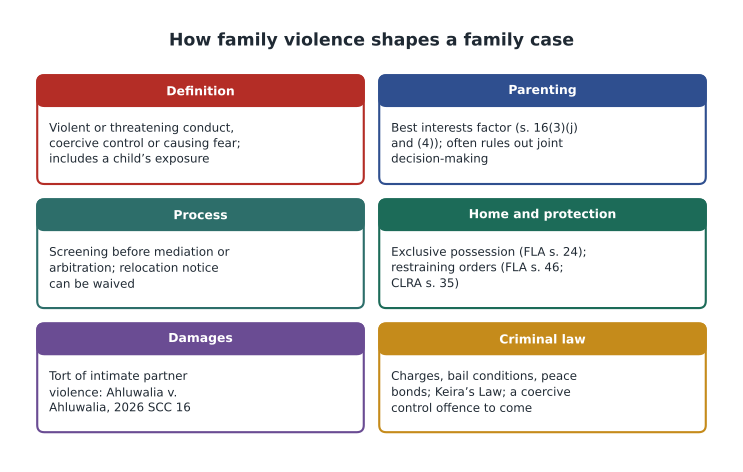
Professor Ferreira begins the class differently. 'Today's topic touches many people's lives, possibly including people in this room. We will talk about the law, not about anyone's story, and we will not use graphic descriptions. If you need to step out at any point, do.' She explains why the topic deserves its own lesson. Family violence is not a separate area of family law; it runs through every area. It affects parenting decisions, the process used to resolve a case, the matrimonial home, support, damages and criminal proceedings. A family lawyer who does not screen for it, and does not understand how it changes the analysis, can put a client or a child at risk.
This lesson covers the statutory definition of family violence, its role in parenting cases and in dispute resolution, protection orders and exclusive possession, its relevance to support and property, the tort of intimate partner violence recognized in Ahluwalia v. Ahluwalia, criminal law developments, and child protection under Ontario's Child, Youth and Family Services Act, 2017 and the federal Act respecting First Nations, Inuit and Métis children, youth and families. The capstone in lesson 12 does not involve family violence, but the screening habits from this lesson apply to every file.
What the law means by family violence
Before 2021, neither the Divorce Act nor the Children's Law Reform Act defined family violence. The 2021 amendments added a broad definition. Section 2(1) of the Divorce Act defines family violence as any conduct, whether or not the conduct constitutes a criminal offence, by a family member towards another family member, that is violent or threatening or that constitutes a pattern of coercive and controlling behaviour or that causes that other family member to fear for their own safety or for that of another person, and, in the case of a child, the direct or indirect exposure to such conduct. The definition lists examples, including physical abuse, sexual abuse, threats, harassment including stalking, failure to provide the necessaries of life, psychological abuse, financial abuse, and threats to harm animals or damage property. Section 18(1) of the Children's Law Reform Act contains a parallel definition.
Three features of the definition matter. It does not require a criminal offence or a conviction. It recognizes coercive control, a pattern of conduct that limits a partner's freedom through monitoring, isolation, financial control, intimidation or threats, even where there has been no physical harm. And it includes a child's exposure to violence between adults, reflecting research that children are harmed by witnessing or living with violence even when it is not directed at them.
Family violence and parenting
Family violence is one of the listed best interests factors in section 16(3)(j) of the Divorce Act, and section 16(4) tells the court what to consider: the nature, seriousness and frequency of the violence and when it occurred; whether there is a pattern of coercive and controlling behaviour; whether it is directed toward the child or the child is directly or indirectly exposed; the physical, emotional and psychological harm or risk of harm to the child; any compromise to the safety of the child or other family member; whether it causes the child or another family member to fear for their safety; and any steps the person engaging in the violence has taken to prevent further violence and improve their ability to care for the child.
Section 16(3)(i) adds that the court must consider the ability and willingness of each person to communicate and cooperate, and section 16(3)(k) adds any civil or criminal proceeding, order or measure relevant to the child's safety. Courts have said that family violence can make joint decision-making unworkable, because it would require the survivor to negotiate continually with the person who harmed them, and can justify supervised parenting time, supervised exchanges or, in serious cases, no parenting time. Barendregt (lesson 6) confirmed that family violence is a significant factor in relocation decisions. The Divorce Act also lets a court waive the relocation notice requirement where there is a risk of family violence, so that a parent fleeing danger is not required to disclose a new address.
Allegations of family violence must still be proved, on a balance of probabilities, with evidence. Courts are cautious both about unproven allegations and about dismissing allegations because they were not reported to police; many survivors do not report. Evidence can include the parties' own testimony, messages, medical and counselling records, witnesses and criminal records. The Court of Appeal for Ontario has repeatedly reminded trial judges to consider family violence in the round, as part of a pattern, rather than incident by incident.
Screening and the process
Lesson 1 noted that section 7.7 of the Divorce Act requires lawyers to encourage family dispute resolution unless it would clearly be inappropriate, for example because of family violence. Screening is how lawyers and mediators find out. Ontario family arbitrators must screen each party separately for power imbalances and family violence before an arbitration begins, and accredited family mediators use structured screening tools. Where violence is present, a lawyer may recommend shuttle mediation, where the parties are in separate rooms, a lawyer-assisted negotiation, or a court process with safeguards such as virtual attendance, separate waiting areas or a support person. Ferreira tells the class that screening is a continuing duty: a client may disclose only after trust is established, so the questions should be asked more than once.
Lawyers also have to think about safety in ordinary practice: not sending documents to an address the other party can access, being careful about what appears in court filings, and connecting clients to community services such as shelters, victim services and specialized counselling. Ontario's Family Court Support Worker Program, for example, provides support to survivors going through the family court process.
Protection orders and the home
Ontario has two civil restraining order provisions. Section 46 of the Family Law Act lets a court make a restraining order against a spouse or former spouse, or a person who has cohabited with the applicant for any period, if the applicant has reasonable grounds to fear for their own safety or for the safety of any child in their lawful care. Section 35 of the Children's Law Reform Act provides a similar order in parenting cases. A restraining order can prohibit the respondent from contacting or communicating with the applicant or the children, or from coming within a specified distance of their home, school or workplace. Breach of a restraining order is a provincial offence and police can arrest without a warrant. Orders can be made without notice in urgent cases.
Exclusive possession of the matrimonial home under section 24 of the Family Law Act (lesson 10) is often sought with a restraining order. Section 24(3)(f) makes violence by a spouse against the other spouse or the children a factor, and section 24(4) directs attention to the children's stability. Unmarried partners do not have Part II rights, but a restraining order can still be made, and a court may make orders about the residence in some circumstances.
Ontario passed a Domestic Violence Protection Act in 2000 that would have created emergency intervention orders, but it was never brought into force. Survivors in Ontario therefore rely on the Family Law Act and Children's Law Reform Act orders, criminal law measures such as bail conditions and peace bonds under section 810 of the Criminal Code, and in urgent cases on police intervention.
Support, property and damages
Misconduct is excluded from spousal support under section 15.2(5) of the Divorce Act, but family violence is not simply 'misconduct'. Courts have recognized that violence can cause economic disadvantage, for example by limiting the survivor's ability to work, and that the effects can be considered in assessing need and compensation. Courts have also considered family violence when deciding whether a survivor's delay in seeking retroactive child support was understandable, as Justice Martin emphasized in Michel v. Graydon (lesson 7). Financial abuse, including controlling all household money or running up debts in the survivor's name, can be relevant to property and to unequal division under section 5(6) where debts were incurred recklessly or in bad faith.
Survivors can also sue for damages. For many years, family violence claims in Ontario were framed under existing torts such as battery, assault and intentional infliction of mental suffering, which focus on individual incidents. In Ahluwalia v. Ahluwalia (2026 SCC 16), decided in May 2026, the Supreme Court recognized a tort of intimate partner violence. Justice Kasirer, for the majority, applied the established framework for recognizing a new tort: the conduct must be a wrong offending an interest the law recognizes, existing remedies must be inadequate to address it, and the new tort must be tailored to the wrong. The majority concluded that existing torts do not adequately capture a pattern of abusive and controlling conduct within an intimate relationship, and upheld a damages award of 100,000 dollars. Justice Karakatsanis concurred, taking a broader view, and Justice Jamal, with Justices Côté and Rowe, dissented. Ferreira tells the class that the details of how lower courts will apply the new tort are still developing, so lawyers should read Ahluwalia itself and the cases that follow.
Criminal law developments
Criminal law runs alongside family law. Charges for assault, threats, criminal harassment or breach of court orders may be laid, and bail conditions often prohibit contact with a partner or children, which a family court must take into account. Keira's Law, which received royal assent in 2023, amended the Judges Act to support continuing education for judges on intimate partner violence and coercive control, and amended the Criminal Code so that a justice considering bail for a person charged with an offence against an intimate partner must consider whether to require electronic monitoring. In 2026 Parliament passed the Protecting Victims Act (Bill C-16), which, among other things, creates a criminal offence of coercive control that comes into force on a later date, and a separate statute known as Bailey's Law treats the murder of an intimate partner in the course of a pattern of coercive or controlling conduct as first-degree murder. Ferreira tells the class to check the consolidated Criminal Code for the exact provisions and their commencement.
Child protection in Ontario
Child protection is the state's response to children at risk of harm from their caregivers. In Ontario it is governed by the Child, Youth and Family Services Act, 2017, which replaced the Child and Family Services Act in 2018. Section 1(1) states the paramount purpose: to promote the best interests, protection and well-being of children. Other purposes include recognizing that the least disruptive course of action that is available and appropriate should be considered, respecting children's identities and cultures, and recognizing that First Nations, Inuit and Métis peoples should be entitled to provide services to their own children wherever possible. The Act applies to children under 18. Since 2018 the age of protection has been 18 rather than 16, so that 16- and 17-year-olds can receive protection services.
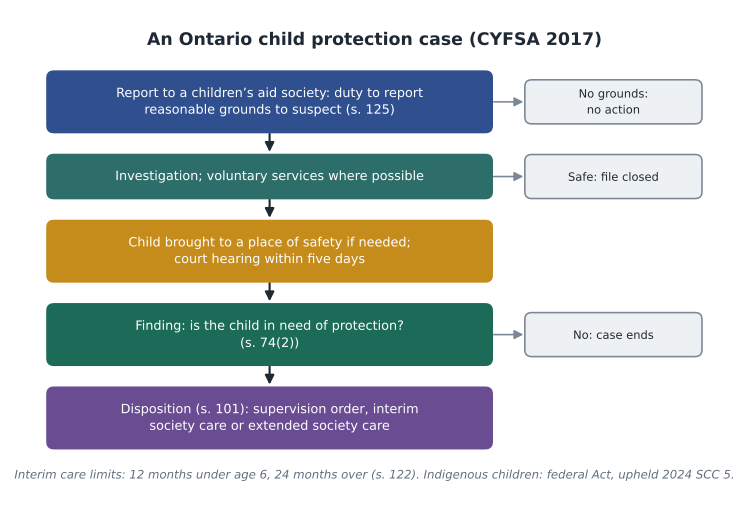
The Act is administered by children's aid societies, independent non-profit agencies designated by the province, including Indigenous societies. Section 125 imposes a duty to report: any person, including a professional working with children, who has reasonable grounds to suspect that a child is or may be in need of protection must promptly report the suspicion and the information on which it is based to a society. The duty applies even where the information is confidential, and professionals such as teachers, doctors and social workers can be prosecuted for failing to report. Lawyers are not exempt from the duty, though solicitor-client privilege is preserved by the Act.
Section 74(2) defines when a child is in need of protection. The grounds include physical harm or risk of harm, sexual abuse or exploitation or risk of it, failure to provide needed medical treatment, emotional harm or risk of it, abandonment, and a child under 12 who has seriously harmed another person where the parent has not responded appropriately. After a report, the society investigates. Many cases end with no further action or with voluntary services. Where the society believes a child is at risk and cannot be protected otherwise, it can bring the child to a place of safety, and the case must come before a court within five days.
The court first decides whether the child is in need of protection, and then makes a disposition under section 101: a supervision order placing the child with a parent subject to conditions, an order placing the child in interim society care for up to a set period, or an order placing the child in extended society care, which ends parental rights to the child's care and can lead to adoption. Section 122 sets time limits for interim society care: 12 months for a child under six, and 24 months for older children, so that young children do not drift in temporary care. Parents are entitled to legal representation, and Legal Aid Ontario funds many protection cases. The Office of the Children's Lawyer often represents the child.
Indigenous children
Indigenous children are significantly over-represented in child protection systems across Canada. The Truth and Reconciliation Commission's first Calls to Action, released in 2015, addressed child welfare. Parliament responded with An Act respecting First Nations, Inuit and Métis children, youth and families, which came into force on January 1, 2020. The Act sets national standards that apply in every province. It makes the best interests of the child the primary consideration, and requires courts and agencies to consider the child's cultural, linguistic, religious and spiritual upbringing and heritage, and the importance of continuing the child's relationship with their family, community and culture. It requires preventive care to be prioritized over removal, says a child should not be removed solely because of socio-economic conditions such as poverty or poor housing, and sets an order of priority for placements, starting with a parent and then other family members and members of the child's community. It also recognizes the jurisdiction of Indigenous governing bodies to make their own child and family services laws, which prevail over conflicting provincial laws.
In Reference re An Act respecting First Nations, Inuit and Métis children, youth and families (2024 SCC 5), the Supreme Court unanimously upheld the Act as a valid exercise of Parliament's power over 'Indians, and Lands reserved for the Indians' under section 91(24). Ontario's own Act also contains Indigenous-specific provisions, including notice to the child's band or community and a right for a band representative to participate in protection hearings. Ferreira tells the class that in any child protection case involving a First Nations, Inuit or Métis child, the first step is to identify which laws apply, including any law of an Indigenous governing body.
Worked problem
Advising on safety and parenting
A new client, Hana, tells her lawyer that during her marriage her husband monitored her phone, controlled all the family money and regularly threatened to take their seven-year-old son away if she left. There was no physical violence. She has now separated and wants a parenting order. Her husband has suggested mediation. How should the lawyer approach the file?
Show solution
- Definition: monitoring, financial control and threats can form a pattern of coercive and controlling behaviour, which is family violence under section 2(1) of the Divorce Act even without physical harm or criminal charges.
- Screening and process: under section 7.7, mediation may be inappropriate. The lawyer should screen carefully and, if Hana wishes to try dispute resolution, consider shuttle mediation or lawyer-assisted negotiation with safeguards.
- Parenting: under section 16(3)(j) and 16(4), the court will weigh the pattern, its effect on the child and on Hana, and any steps the husband has taken. Joint decision-making may be unworkable if it requires constant negotiation with him.
- Protection: if Hana has reasonable grounds to fear for her safety or her son's, she can seek a restraining order under section 35 of the Children's Law Reform Act or section 46 of the Family Law Act, and possibly exclusive possession of the home.
- Other remedies: she may have a damages claim under the tort recognized in Ahluwalia, and the financial control is relevant to disclosure and the property analysis. The lawyer should also connect her with support services.
Common mistakes
MistakeAssuming there is no family violence because there was no physical harm.
InsteadThe definition includes coercive and controlling behaviour, threats, psychological and financial abuse.
MistakeDismissing an allegation because it was never reported to police.
InsteadMany survivors do not report; courts weigh all the evidence.
MistakeRecommending mediation without screening.
InsteadScreen first and continue to screen; section 7.7 recognizes that dispute resolution may be inappropriate.
MistakeThinking professionals can wait for proof before reporting a child protection concern.
InsteadSection 125 requires a prompt report when there are reasonable grounds to suspect a child may be in need of protection.
Practice problems
Work each problem on paper first, then reveal the answer to check.
What must a court consider under section 16(4) of the Divorce Act when family violence is alleged?
Show answer
Its nature, seriousness and frequency, any pattern of coercive and controlling behaviour, whether the child was exposed, the harm or risk of harm, any compromise to safety, fear caused, and steps taken by the person to prevent further violence.
What is the main difference between a supervision order and extended society care under the Child, Youth and Family Services Act, 2017?
Show answer
A supervision order keeps the child with a parent subject to conditions and society supervision; extended society care places the child permanently in the society's care, ending the parent's rights to care, and can lead to adoption.
What did the Supreme Court decide in the 2024 reference on the federal Indigenous child and family services Act?
Show answer
It upheld the Act as valid federal legislation under section 91(24), including its recognition of the jurisdiction of Indigenous governing bodies over child and family services.
Summary and key terms
- Family violence is broadly defined, including coercive and controlling behaviour and a child's exposure, without requiring a crime.
- It is a key best interests factor and often makes joint decision-making and unscreened mediation inappropriate.
- Restraining orders under section 46 of the Family Law Act and section 35 of the Children's Law Reform Act, and exclusive possession, provide civil protection.
- Ahluwalia v. Ahluwalia (2026) recognized a tort of intimate partner violence and upheld a 100,000 dollar award.
- Ontario child protection is governed by the Child, Youth and Family Services Act, 2017, with a duty to report and time limits for interim society care.
- The federal Indigenous child and family services Act, upheld in 2024, sets national standards and recognizes Indigenous jurisdiction.
- Family violence
- Under the Divorce Act, violent or threatening conduct, a pattern of coercive and controlling behaviour, or conduct causing fear for safety, including a child’s exposure.
- Coercive control
- A pattern of conduct that limits a partner’s freedom through monitoring, isolation, financial control, intimidation or threats.
- Restraining order
- A civil court order prohibiting contact or proximity, available under section 46 of the Family Law Act and section 35 of the Children’s Law Reform Act.
- Duty to report
- The obligation in section 125 of the Child, Youth and Family Services Act, 2017 to report reasonable grounds to suspect a child is in need of protection.
- Extended society care
- A final child protection disposition placing a child permanently in a society’s care.
- Children’s aid society
- An agency designated to provide child protection services under the Child, Youth and Family Services Act, 2017.
Lesson quiz · 5 questions
Score 60% or more to complete this lesson.
Create a free account to save your progress, take quizzes and earn a certificate.