
LAWC-212 · Lesson 7 of 12 · 20 min
Child support and parenting
▶ Video coming soon A video version of this lesson is on the way.
'Child support is the most common legal obligation in family law,' Professor Ferreira says, 'and the one most often misunderstood.' She lists three mistakes she hears constantly from clients: that child support depends on how much time each parent spends with the children; that the payor can stop paying if they do not get to see the children; and that support ends automatically at 18. 'All three are wrong, or at least seriously incomplete. Child support is the right of the child, not of either parent, and the law that sets it is unusually precise.'
This lesson covers the source of the obligation, the Federal Child Support Guidelines and their Ontario twin, determining income, the table amount, special and extraordinary expenses, shared and split parenting, high incomes, step-parents, adult children, undue hardship, retroactive support under the D.B.S., Michel v. Graydon and Colucci trilogy, variation, and enforcement. Ferreira asks the class to keep the Sandoval and Whitlow file open; the calculations at the end use it.
The source of the obligation
Every parent owes support to their child. Section 31 of the Family Law Act says every parent has an obligation, to the extent that the parent is capable of doing so, to provide support for their unmarried child who is a minor or is enrolled in a full-time program of education, unless the child is 16 or older and has withdrawn from parental control. Under the Divorce Act, section 15.1 lets the court order a spouse to pay support for any or all children of the marriage. The obligation does not depend on marriage, on parenting time or on a relationship with the child. Withholding support because of a parenting dispute, or withholding parenting time because support is unpaid, is a serious mistake; the two obligations are independent.
The Guidelines
Since May 1, 1997, child support in Canada has been calculated under the Federal Child Support Guidelines, a regulation under the Divorce Act. Ontario adopted almost identical Child Support Guidelines (O. Reg. 391/97) for orders under the Family Law Act. The objectives, in section 1, are to establish a fair standard of support that ensures children continue to benefit from the financial means of both parents after separation, to reduce conflict by making calculations more objective, to improve efficiency and to ensure consistent treatment of parents and children in similar circumstances.
The heart of the Guidelines is a set of tables, one for each province and territory, showing a monthly support amount for each level of the paying parent's income and each number of children. The tables reflect average spending on children by families at each income level and the tax rules of the province. They were updated in 2006, 2011 and 2017, and the 2025 tables came into force on October 1, 2025, based on 2023 tax rules. The new tables do not change existing orders automatically; a parent can ask for a variation, and the change in the tables can be a ground for one. Quebec has its own model, so the federal tables apply in Quebec only in limited situations.
Determining income
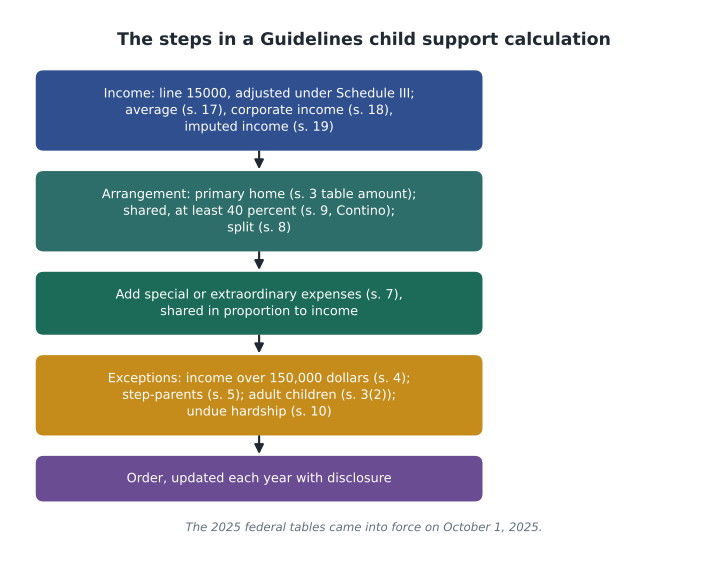
Income is the foundation of every calculation, and it is where most disputes happen. Section 16 starts with the total income on line 15000 of the parent's income tax return, adjusted under Schedule III to remove items such as certain dividends and to add others. Section 17 lets the court use a different figure if the current year would not be the fairest determination, for example by averaging three years of fluctuating income. Section 18 lets the court attribute pre-tax corporate income to a shareholder or director where it is fair to do so, which matters for self-employed parents who leave income in a company.
Section 19 allows the court to impute income. The listed circumstances include where a parent is intentionally under-employed or unemployed (unless because of the children's needs, reasonable educational needs or health), where a parent is exempt from tax, where income has been diverted, where property is not being used reasonably to generate income, and where a parent fails to provide income information. In Drygala v. Pauli (2002), the Court of Appeal held that intentional under-employment does not require bad faith; a parent who chooses to earn less than they could is intentionally under-employed, and the question becomes whether the choice is reasonable. Courts imputing income look at the parent's age, education, experience, health and the job market.
The table amount and special expenses
For a child who lives primarily with one parent, section 3(1) says the support amount is the table amount for the paying parent's income and the number of children, plus any amount under section 7. Only the payor's income determines the table amount; the recipient is presumed to spend their own share directly on the children.
Section 7 covers special or extraordinary expenses, shared between the parents in proportion to their incomes after deducting any contribution from the child. The listed categories are child care expenses incurred because of the parent's employment, illness, disability or education; the portion of medical and dental insurance premiums attributable to the child; health-related expenses exceeding insurance reimbursement by at least 100 dollars a year; extraordinary expenses for primary or secondary education or other educational programs that meet the child's particular needs; expenses for post-secondary education; and extraordinary expenses for extra-curricular activities. The court must find the expense necessary in relation to the child's best interests and reasonable in relation to the parents' means and past spending. 'Extraordinary' is defined in section 7(1.1) by reference to whether the expense exceeds what the recipient can reasonably cover with their income and the table amount, or by a list of factors.
Shared and split parenting
Section 9 applies where a parent exercises parenting time for not less than 40 percent of the time over the course of a year. The amount is not simply the table amount. The court must consider the table amounts for each parent, the increased costs of shared parenting, and the conditions, means, needs and other circumstances of each parent and child. In Contino v. Leonelli-Contino (2005 SCC 63), the Supreme Court held that section 9 does not create a presumption in favour of the simple set-off of the two table amounts, though the set-off is the usual starting point. The court must examine the budgets and actual spending of each household to ensure the child is properly supported in both. Courts count time in hours, days or overnights depending on the case; the method matters less than whether it gives a fair picture of the arrangement.
Section 8 covers split parenting, where each parent has one or more children living primarily with them. The amount is the difference between the table amounts each parent would pay to the other. Ferreira notes that the 40 percent threshold is a frequent source of litigation, because crossing it can change the support amount considerably. Courts have warned parents against seeking more time to reduce support, and judges look at the real pattern of care rather than the schedule on paper.
High incomes, step-parents and adult children
Where the paying parent's income is over 150,000 dollars, section 4 lets the court order the table amount or, if that amount is inappropriate, the table amount on the first 150,000 dollars plus an amount for the excess that the court considers appropriate given the children's condition, means, needs and circumstances. In Francis v. Baker (1999), the Supreme Court held that the table amount is presumptive even for very high incomes, and the party seeking to depart from it bears the burden of showing it is inappropriate.
A spouse who stands in the place of a parent can be liable for child support under the Divorce Act's definition of child of the marriage. Chartier v. Chartier (1999) held that a person who has stood in the place of a parent cannot unilaterally withdraw from that relationship after separation. Section 5 of the Guidelines lets the court set the step-parent's support at an amount it considers appropriate, having regard to the Guidelines and the legal duty of any other parent.
For a child who is the age of majority or older, section 3(2) says the amount is the table amount plus section 7 expenses, unless that approach is inappropriate, in which case the court considers the child's condition, means, needs and circumstances and the parents' financial ability. Courts often reduce the table amount where a post-secondary student lives away from home for most of the year, and expect the student to contribute from summer earnings, scholarships and loans.
Undue hardship
Section 10 allows a different amount if paying the Guidelines amount would cause either parent or a child undue hardship. The listed circumstances include unusually high debts reasonably incurred to support the family before separation, unusually high expenses for exercising parenting time, a legal duty to support another person, and support obligations to other children. But a court cannot find undue hardship if the household of the parent claiming it would have a higher standard of living than the other household, using the comparison method in Schedule II. Undue hardship claims rarely succeed.
Retroactive support
The Supreme Court has decided three major cases on retroactive child support. In D.B.S. v. S.R.G. (2006 SCC 37), it held that a parent's obligation to pay support commensurate with their income exists whether or not there is an order, and that a court can order retroactive support. It established the date of effective notice, when the recipient first broached the subject, as the usual start date, and generally no more than three years before formal notice, such as starting proceedings. The court considers the reason for the recipient's delay, the payor's conduct, the child's circumstances and any hardship. Where the payor engaged in blameworthy conduct, such as hiding an increase in income, the date can go back to when the circumstances changed.
In Michel v. Graydon (2020 SCC 24), the Court held that a parent can apply for retroactive child support under a provincial statute even after the child is no longer a child of the marriage, and Justice Martin's concurring reasons stressed that delay by recipients often reflects fear, lack of resources or the effects of family violence, and should not be held against them lightly. In Colucci v. Colucci (2021 SCC 24), the Court applied a parallel framework to a payor seeking to retroactively reduce support, including arrears, after their income fell. The payor must show a material change, give effective notice and full disclosure, and the presumptive start date is the date of effective notice, generally no more than three years before formal notice.
Variation and enforcement
A child support order can be varied under section 17(4) of the Divorce Act, or section 37 of the Family Law Act, where there has been a change in circumstances as defined in section 14 of the Guidelines, which includes any change that would result in a different order. Many separation agreements and orders require annual income disclosure and adjust support each year; Ontario's Child Support Service can also recalculate support administratively in some cases.
In Ontario, support orders are enforced by the Family Responsibility Office under the Family Responsibility and Support Arrears Enforcement Act, 1996. Every support order is filed with the office unless both parties opt out. The office can garnish wages and bank accounts, suspend driver's licences, ask the federal government to suspend passports and intercept tax refunds and federal payments, and register support orders against property. Ferreira tells the class that clients who are owed support should register with the office early, and clients who pay should never simply stop: arrears accumulate and cannot usually be erased.
Worked problem
Calculating support for Isla and Rowan
Callum earns 140,000 dollars a year as an engineer; Joanna earns 70,000 dollars. The children live primarily with Joanna, with Callum having alternate weekends and Wednesday evenings. Assume, for this exercise, that the Ontario table shows 1,900 dollars a month for two children at Callum's income. The children's child care costs 9,000 dollars a year after tax deductions, and Rowan's speech therapy costs 3,000 dollars a year after insurance. What is the likely structure of the support?
Show solution
- Arrangement: Callum's time is well under 40 percent, so section 3 applies and the table amount is based on his income only, assumed here as 1,900 dollars a month.
- Section 7: child care for a working parent and health expenses over 100 dollars beyond insurance both qualify. Total 12,000 dollars a year.
- Proportional sharing: combined income is 210,000 dollars; Callum's share is 140,000 divided by 210,000, or two thirds. He pays 8,000 dollars a year toward section 7 expenses, about 667 dollars a month; Joanna pays the rest.
- Total: about 1,900 plus 667, or roughly 2,567 dollars a month, adjusted each year with income disclosure.
- Future: if Callum obtains at least 40 percent of parenting time, section 9 applies, and the court would start with a set-off of the two table amounts but examine both households under Contino.
Common mistakes
MistakeStopping support because the other parent is denying parenting time.
InsteadSupport and parenting time are independent; the remedy for denied time is in the parenting order.
MistakeUsing the recipient's income to calculate the table amount for a primary residence.
InsteadOnly the payor's income sets the section 3 table amount; both incomes matter for section 7 and shared parenting.
MistakeAssuming support ends at 18.
InsteadSupport can continue for an adult child in full-time education or unable to withdraw from parental charge.
MistakeAssuming a retroactive claim is impossible once the child is an adult.
InsteadMichel v. Graydon allows such claims, though delay and other factors affect the result.
Practice problems
Work each problem on paper first, then reveal the answer to check.
A payor quits a well-paid job to start a business that earns little. Can the court impute income?
Show answer
Yes, if the payor is intentionally under-employed under section 19 and the choice is not reasonable in light of the children's needs. Drygala v. Pauli says bad faith is not required. The court looks at what the payor could reasonably earn.
What did Contino v. Leonelli-Contino decide about shared parenting support?
Show answer
Section 9 does not create a presumption of a simple set-off of table amounts. The set-off is a starting point, but the court must consider the increased costs of shared parenting and each household's means and needs.
How far back can retroactive child support usually reach under D.B.S.?
Show answer
To the date of effective notice, generally no more than three years before formal notice. If the payor engaged in blameworthy conduct, the court can go back to when the circumstances changed.
Summary and key terms
- Every parent must support their child; support is the child's right and is independent of parenting time.
- The Guidelines set a table amount based on the payor's income and number of children, plus section 7 special expenses shared in proportion to income. The 2025 tables took effect on October 1, 2025.
- Section 9 applies at 40 percent parenting time; Contino rejects a mechanical set-off. Section 8 governs split parenting.
- Income can be adjusted, averaged, attributed from a corporation or imputed under sections 16 to 19.
- D.B.S., Michel v. Graydon and Colucci govern retroactive increases and decreases.
- The Family Responsibility Office enforces support in Ontario.
- Table amount
- The monthly child support set by the Guidelines tables for a given payor income and number of children.
- Section 7 expenses
- Special or extraordinary expenses, such as child care and health costs, shared in proportion to income.
- Shared parenting
- An arrangement where a parent has at least 40 percent of parenting time, governed by section 9.
- Imputed income
- Income attributed to a parent who is intentionally under-employed or has not disclosed income.
- Undue hardship
- A rarely successful ground under section 10 for departing from the Guidelines amount.
- Effective notice
- The date a recipient first raised the issue of support with the payor, usually the start of retroactive support.
Lesson quiz · 5 questions
Score 60% or more to complete this lesson.
Create a free account to save your progress, take quizzes and earn a certificate.