
LAWC-212 · Lesson 5 of 12 · 20 min
Parenting arrangements and the best interests of the child
▶ Video coming soon A video version of this lesson is on the way.
Professor Ferreira writes four words on the board: 'not about the parents'. 'This is the hardest idea in family law for clients to accept,' she says. 'Joanna loves Isla and Rowan. So does Callum. They each think they are the better parent, and each of them may be right about some things. None of that is the question. The question, the only question, is what arrangement is in the best interests of these two children.'
Parenting disputes are the most emotionally charged part of family law and, for many families, the most important. This lesson covers the parenting vocabulary introduced in 2021, the best interests test in section 16 of the Divorce Act and section 24 of the Children's Law Reform Act, how courts allocate decision-making responsibility and parenting time, how children's views are heard, the role of the Office of the Children's Lawyer and assessments, and how parenting orders are varied. Relocation and international disputes have their own lesson (lesson 6), and family violence receives a full treatment in lesson 11, though it appears here as a best interests factor.
A new vocabulary
Before March 1, 2021, Canadian family law spoke of 'custody' and 'access'. Custody meant the right to make major decisions and, usually, to have the child live with you; access meant visiting time for the other parent. Critics argued the words suggested ownership and winners and losers. The 2021 amendments to the Divorce Act, mirrored the same day in Ontario's Children's Law Reform Act, replaced them.
Decision-making responsibility means the responsibility for making significant decisions about a child's well-being, including health, education, culture, language, religion and spirituality, and significant extra-curricular activities (Divorce Act, section 2(1)). It can be allocated to one parent, to both jointly, or divided by subject, so one parent decides about health and the other about education. Parenting time means the time a child spends in the care of a person, whether or not the child is physically with them during that time, which includes time at school. During their parenting time, a parent has the exclusive authority to make day-to-day decisions affecting the child (section 16.2(2)). A non-parent, such as a grandparent, can seek a contact order under the Divorce Act (section 16.5), or under the Children's Law Reform Act a contact order or, in some cases, a parenting order.
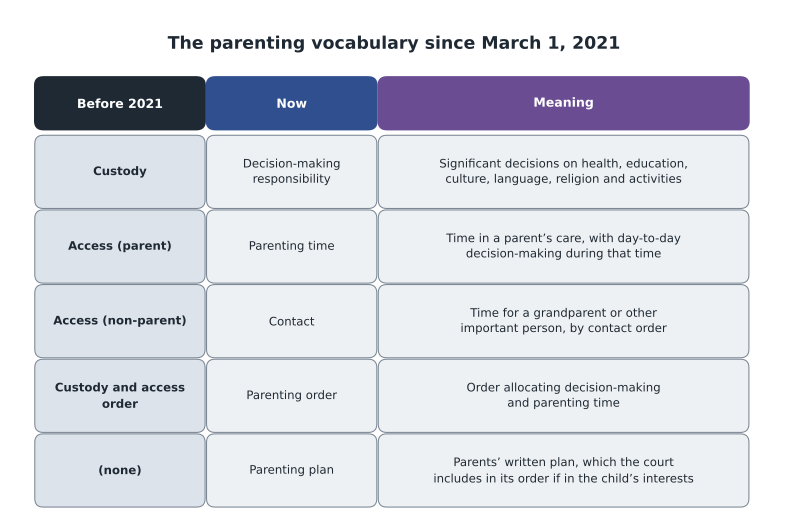
Ferreira stresses that the new words were meant to change behaviour, not just labels. The Divorce Act now encourages parents to make a parenting plan, a written document setting out parenting time, decision-making responsibility and other matters, which section 16.6 says the court shall include in its order unless it is not in the child's best interests. Courts in Ontario have been clear that older cases using the custody and access language remain useful, so long as they are read through the new statutory framework.
The best interests test
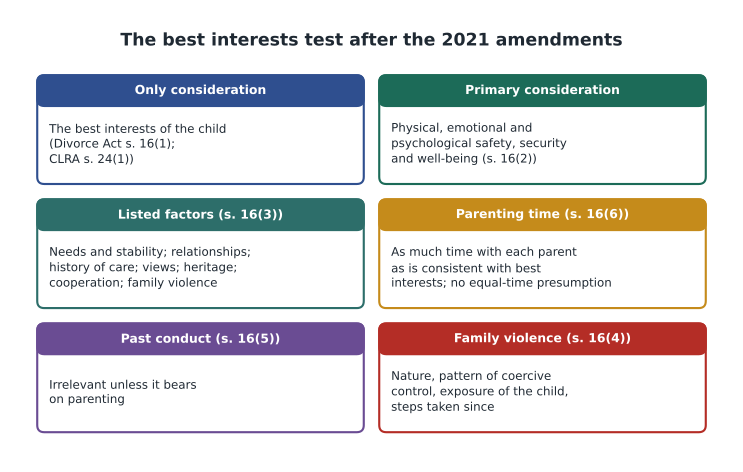
Section 16(1) of the Divorce Act says that in making a parenting order or a contact order, the court shall take into consideration only the best interests of the child. Section 16(2) then says that in considering the factors, the court shall give primary consideration to the child's physical, emotional and psychological safety, security and well-being. Section 24(1) and (2) of the Children's Law Reform Act say the same thing.
Section 16(3) lists the factors, which are not exhaustive. They include the child's needs, given their age and stage of development, such as the child's need for stability; the nature and strength of the child's relationship with each spouse, siblings, grandparents and any other important person; each spouse's willingness to support the development and maintenance of the child's relationship with the other spouse; the history of care of the child; the child's views and preferences, giving due weight to the child's age and maturity, unless they cannot be ascertained; the child's cultural, linguistic, religious and spiritual upbringing and heritage, including Indigenous upbringing and heritage; any plans for the child's care; the ability and willingness of each person to care for and meet the child's needs; the ability and willingness of each person to communicate and cooperate on matters affecting the child; any family violence and its impact; and any civil or criminal proceeding, order, condition or measure relevant to the child's safety, security and well-being.
Section 16(4) lists what the court must consider when looking at family violence, including its nature, seriousness and frequency, whether there is a pattern of coercive and controlling behaviour, whether it is directed at the child or the child was exposed to it, and any steps the person has taken to prevent further violence. Section 16(5) says the court shall not take into consideration the past conduct of any person unless it is relevant to the exercise of their parenting time, decision-making responsibility or contact. A parent's affair, for example, is irrelevant; a parent's substance use that affects their care of the children is not.
Maximum parenting time, not equal time
Section 16(6) says that in allocating parenting time, the court shall give effect to the principle that a child should have as much time with each spouse as is consistent with the best interests of the child. This replaced the old 'maximum contact' principle, which the Supreme Court had discussed in Young v. Young (1993) and Gordon v. Goertz (1996). The change was deliberate: the old wording sometimes led courts to prioritize contact over safety. The new wording ties time to best interests.
Neither the Divorce Act nor the Children's Law Reform Act creates a presumption of equal parenting time, and Ontario courts have said so repeatedly. Equal time is common, especially where parents live close together, the children are older and the parents can communicate, but it is one possible outcome, not a starting point. Many families use schedules such as alternating weeks, or a 2-2-3 rotation for younger children, or a primary residence with one parent and alternate weekends and a mid-week visit with the other. The right schedule depends on the child's age, school, activities, the distance between homes and the parents' work.
Joint decision-making responsibility is also common, but it requires parents who can communicate. The Court of Appeal in Kaplanis v. Kaplanis (2005) said joint custody should not be ordered in the hope that it will improve communication; there must be evidence that the parents can cooperate. That principle still guides courts allocating joint decision-making. Where parents cannot cooperate, courts often divide decision-making by subject, or give one parent final say after consultation, sometimes called 'final decision-making authority'. Where there is family violence, joint decision-making is often inappropriate, because it forces the survivor to negotiate with the person who harmed them.
Hearing the child
The Convention on the Rights of the Child, which Canada ratified in 1991, says children capable of forming their own views have the right to express them in matters affecting them, and the Divorce Act now lists the child's views and preferences as a factor. How those views reach the court matters. Judges rarely interview children, though some do. More often, views come through a Voice of the Child Report prepared by a clinician or lawyer, through the Office of the Children's Lawyer, or through a parenting assessment.
The Office of the Children's Lawyer, a provincial office, can be asked by a court to represent a child in a parenting case under section 89(3.1) of the Courts of Justice Act, or to investigate and report under section 112 of the Children's Law Reform Act. A lawyer from the office takes instructions from the child, where the child is old enough, and advocates for the child's views and interests. A clinical investigator may interview the parents, the children, teachers and doctors and write a report. The office decides whether to accept a case, and it does not accept every referral.
A court can also order a parenting assessment under section 30 of the Children's Law Reform Act, usually by a psychologist or social worker. Assessments are expensive, can take months and can be intrusive, so courts order them only where they will genuinely help. The weight of a child's views depends on age, maturity, independence and consistency. A teenager's firm preference will usually carry significant weight; a six-year-old's will be considered but rarely decisive. Courts are also careful about views that seem to reflect one parent's influence.
Resistance, estrangement and alienation
Sometimes a child refuses to see a parent. The reasons vary. The child may have good reason, such as the parent's harmful behaviour; this is often called justified estrangement. The child may be caught in loyalty conflicts. Or one parent may be undermining the child's relationship with the other, sometimes called alienation. These categories are contested and often overlap, and courts are wary of labels. Allegations of alienation can be raised in response to legitimate concerns about family violence, and the Divorce Act's emphasis on safety means courts must look carefully at both possibilities. Ontario courts have used a range of responses, including counselling, reunification therapy and, in serious cases, changing the child's primary residence. Ferreira's advice to students is to focus on evidence about the specific child and family rather than the label.
Culture, heritage and the child's identity
The 2021 amendments added the child's cultural, linguistic, religious and spiritual upbringing and heritage, including Indigenous upbringing and heritage, to the list of factors. This reflects a long line of cases in which courts recognized that a child's identity is part of their well-being. For an Indigenous child, the factor connects with the federal Act respecting First Nations, Inuit and Métis children, youth and families, which treats continuity of a child's connection to their community and culture as part of their best interests (lesson 11). For children of parents with different faiths or languages, courts often make orders that preserve both heritages, such as language school with one parent and religious instruction with the other, rather than choosing between them. A parent's plan to cut a child off from one side of their heritage will usually weigh against that parent. Ferreira tells the class that a good parenting plan names these matters expressly, so that the parents do not have to litigate the choice of a summer camp or a confirmation class later.
Interim orders and the status quo
Most parenting cases are shaped by a temporary order made early in the case, often on affidavit evidence. Courts are cautious about changing a stable arrangement on an interim basis without good reason, because stability is itself in the child's interests. That gives the interim arrangement weight at trial, sometimes called the 'status quo' effect. A parent who leaves the home without the children, or who agrees to a temporary schedule, should understand that the arrangement may influence the final result.
Variation
A parenting order can be varied under section 17(5) of the Divorce Act only if there has been a change in the circumstances of the child since the order was made. Gordon v. Goertz set out the test, which still applies: the change must be material, meaning it alters the child's needs or the parents' ability to meet them in a fundamental way, and it must be something that was not foreseen or could not have been reasonably contemplated when the order was made. If that threshold is met, the court looks afresh at the child's best interests. Lesson 6 explains the separate rules for a proposed relocation, which has its own notice and burden provisions. Under the Children's Law Reform Act, section 29 imposes the same threshold.
The Sandoval and Whitlow children
Ferreira returns to the file. Isla is nine and Rowan six. Since the separation they have lived mainly with Joanna in the family home, near their school, and have spent alternate weekends and Wednesday evenings with Callum in his apartment. Callum now wants equal time. He has moved to a two-bedroom apartment ten minutes from the school and has changed his work schedule. Joanna worries that Rowan, who has a speech delay and attends weekly therapy, needs a single home base. Both parents are loving and capable; there is no family violence. The parents communicate politely by text but disagree about Rowan's therapy and school choices.
Worked problem
What parenting arrangement fits Isla and Rowan?
Callum asks for equal parenting time and joint decision-making responsibility. Joanna asks for primary residence and sole decision-making about Rowan's health. Using section 16 of the Divorce Act, how should a court approach the case?
Show solution
- Starting point: the only consideration is the children's best interests, with primary consideration to their safety, security and well-being. There is no presumption of equal time.
- Factors favouring more time with Callum: strong relationships with both parents; Callum's new apartment near the school and flexible schedule; section 16(6) says children should have as much time with each parent as is consistent with their best interests.
- Factors favouring caution: Rowan's age and special needs, his need for stability, and the history of care in which Joanna has been primary since separation. Isla, at nine, can express views that deserve some weight; a Voice of the Child Report could help.
- Decision-making: the parents communicate respectfully but disagree on Rowan's health. Under Kaplanis, joint decision-making requires evidence of cooperation. A court might order joint decision-making generally, with Joanna having final say on Rowan's therapy after meaningful consultation.
- Likely outcome: an expanded schedule for Callum, for example a gradual step-up to a 2-2-3 or week-about schedule, reviewed as Rowan settles, rather than an immediate change. The parents could reach this through mediation and put it in a parenting plan under section 16.6.
Common mistakes
MistakeTelling a client there is a presumption of equal parenting time.
InsteadThere is no presumption. Section 16(6) favours as much time as is consistent with best interests.
MistakeRaising a spouse's affair as evidence against their parenting.
InsteadSection 16(5) excludes past conduct unless it is relevant to parenting.
MistakeAsking for joint decision-making to force parents to cooperate.
InsteadKaplanis requires evidence that joint decision-making can work.
MistakeUsing the words custody and access in a new pleading under the Divorce Act.
InsteadUse decision-making responsibility, parenting time and contact.
Practice problems
Work each problem on paper first, then reveal the answer to check.
A grandmother who cared for her grandchild every weekday for five years wants an order guaranteeing her time after the parents separate. What can she seek under the Divorce Act?
Show answer
A contact order under section 16.5, which requires leave of the court. The court considers the child's best interests, including the strength of the relationship with the grandmother.
What must a parent show to vary a parenting order under the Divorce Act?
Show answer
A material change in the child's circumstances since the order, not foreseen or reasonably contemplated when it was made (Gordon v. Goertz, section 17(5)). If established, the court considers the child's best interests afresh.
How can a child's views reach the court in an Ontario parenting case?
Show answer
Through a Voice of the Child Report, the Office of the Children's Lawyer (as a lawyer for the child or through a clinical investigation under section 112 of the Children's Law Reform Act), a parenting assessment under section 30, or occasionally a judicial interview.
Summary and key terms
- Since 2021, the law uses decision-making responsibility, parenting time and contact instead of custody and access.
- The best interests of the child are the only consideration, with primary consideration to safety, security and well-being.
- Section 16(3) lists factors including the child's needs, relationships, history of care, views, heritage, cooperation and family violence.
- Children should have as much time with each parent as is consistent with their best interests, but there is no presumption of equal time.
- Joint decision-making requires evidence of cooperation; it is often inappropriate where there is family violence.
- Variation requires a material change in the child's circumstances.
- Decision-making responsibility
- Responsibility for significant decisions about a child, such as health, education, culture, language, religion and significant activities.
- Parenting time
- The time a child spends in the care of a parent, including time at school, during which that parent makes day-to-day decisions.
- Contact order
- An order giving a non-parent, such as a grandparent, time with a child.
- Parenting plan
- A written plan setting out parenting time, decision-making and other parenting matters, which the court can incorporate in an order.
- Office of the Children’s Lawyer
- An Ontario office that can represent children or investigate and report in parenting cases.
- Voice of the Child Report
- A short report setting out a child’s views and preferences, prepared by a neutral professional.
Lesson quiz · 5 questions
Score 60% or more to complete this lesson.
Create a free account to save your progress, take quizzes and earn a certificate.