
LAWC-212 · Lesson 10 of 12 · 21 min
The matrimonial home, pensions and property claims of unmarried couples
▶ Video coming soon A video version of this lesson is on the way.
Professor Ferreira holds up two sets of keys. 'One is to the Sandoval and Whitlow house. The other is to the house Bridget O'Neill lived in with Yusuf Rahman for seven years. Both houses are in one partner's name only, or were at one point. But the law treats them completely differently, because one couple was married and the other was not.' This lesson covers three topics that sit at the edges of Part I. The first is the matrimonial home, which has its own rules on possession and sale in Part II of the Family Law Act. The second is pensions, which are property but need special valuation and division rules. The third is property claims by unmarried partners, who have no statutory property regime in Ontario and must rely on the law of unjust enrichment.
What is a matrimonial home
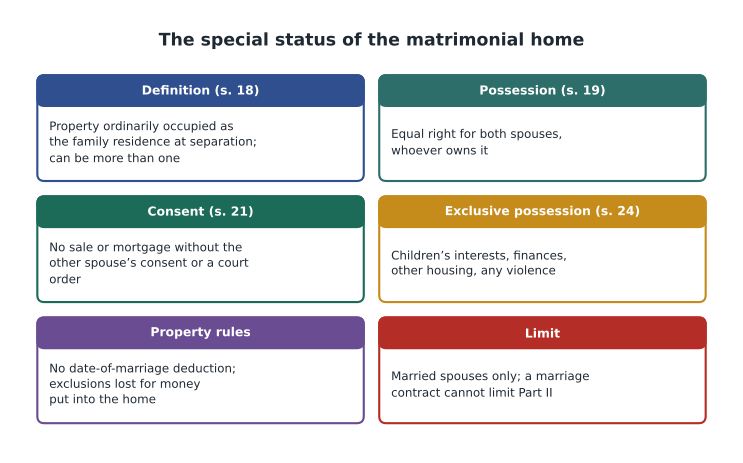
Section 18(1) defines a matrimonial home as every property in which a person has an interest and that is or, if the spouses have separated, was at the time of separation ordinarily occupied by the person and their spouse as their family residence. Three points follow. First, a couple can have more than one matrimonial home, such as a house in the city and a cottage they use regularly. Second, the property does not need to be owned by both spouses; it is enough that one has an interest. Third, section 18(2) includes shares in a corporation that owns the residence, if the spouse controls the corporation, so the rules cannot be avoided by putting the house in a company.
Section 20 lets a spouse register a designation of one property as the matrimonial home. If both spouses designate a property, any other property that was a matrimonial home loses that status. This can be useful when a couple owns several properties and wants to free one for sale. In practice designations are uncommon.
Equal possession and consent
Section 19 gives both spouses an equal right to possession of a matrimonial home, regardless of who owns it. A spouse who owns the home cannot evict the other spouse without a court order, and the non-owning spouse's right to possession ends only when they cease to be spouses, which normally happens on divorce, or under a separation agreement or court order. That makes Part II especially important for the months between separation and divorce.
Section 21 says a spouse cannot dispose of or encumber an interest in a matrimonial home, for example by selling it or taking out a mortgage, unless the other spouse joins in or consents, the other spouse has released their rights by a separation agreement, a court has authorized the transaction, or the property is no longer a matrimonial home because of a designation. A transaction in breach of section 21 can be set aside, unless the buyer or lender acted for value, in good faith and without notice that the property was a matrimonial home. Ontario's land registration system requires a statement on transfers and mortgages about the spousal status of the person transferring, which protects buyers who rely on it and makes deliberate misrepresentation risky.
Section 52(1) adds that a marriage contract cannot limit a spouse's rights under Part II (lesson 4), though a separation agreement can. The matrimonial home rules are therefore some of the few family property rules that cannot be contracted out of in advance.
Exclusive possession
Section 24 lets a court order that one spouse have exclusive possession of the matrimonial home, and of its contents, for a period. Section 24(3) lists the factors the court must consider: the best interests of the children affected; any existing orders under Part I and any existing support orders; the financial position of both spouses; any written agreement between the parties; the availability of other suitable and affordable accommodation; and any violence committed by a spouse against the other spouse or the children. Section 24(4) adds that in considering the children's best interests the court shall consider the possible disruptive effects on the children of a move to other accommodation, and the child's views and preferences, if they can reasonably be ascertained.
Exclusive possession orders are common on an interim basis, especially where there is family violence or high conflict and where the children's stability depends on staying in the home. Courts have said the threshold for interim exclusive possession is not the same as for a final order, but the moving party must show that it is necessary, and not just convenient. Where there is violence, the order is often coupled with a restraining order (lesson 11). An exclusive possession order does not change ownership, and the occupying spouse may be required to pay the mortgage, taxes and insurance, or occupation rent.
Pensions
A pension is often a family's second-largest asset after the home, and sometimes the largest. Section 4(1) includes a spouse's interest in a pension plan as property, and Part I requires it to be valued for net family property purposes. Since January 1, 2012, section 10.1 of the Family Law Act and the Pension Benefits Act have set out a standard method for Ontario-regulated plans. The plan administrator calculates the 'family law value' of the member's pension, which is the value of the pension earned during the period of the marriage, using prescribed assumptions, and issues a statement to the spouses. That value goes into the member's net family property.
The new rules also allow the pension to be divided at source. The non-member spouse can receive a lump-sum transfer of up to 50 percent of the family law value, usually into a locked-in retirement account, to satisfy all or part of an equalization payment. Alternatively, where the pension is already being paid, the payments can be divided. Federally regulated plans and federal public service pensions follow similar but separate federal rules, and courts deal with other plans case by case.
The Canada Pension Plan is treated separately. Unadjusted pensionable earnings under the Canada Pension Plan are excluded from net family property by section 4(2), because the plan has its own scheme for credit splitting. After separation, either former spouse can apply to Service Canada to split the CPP credits earned during the time they lived together. In Ontario, which has not passed legislation allowing spouses to waive credit splitting, an agreement not to split credits does not bind the federal plan.
Pensions can also lead to double recovery, as Boston v. Boston (lesson 8) shows. Where a pension has been equalized as property, the recipient spouse generally cannot also receive spousal support from the payor's pension income, unless the support is needs-based and other circumstances justify it.
Unmarried couples and property
Ontario does not give unmarried couples an equalization claim, and Walsh (lesson 2) held that this does not breach the Charter. An unmarried partner who wants a share of property in the other's name must rely on the general law. The courts have built that law over four decades in a line of Supreme Court cases.
In Pettkus v. Becker (1980), Rosa Becker had worked alongside Lothar Pettkus for almost twenty years building a beekeeping business, while he accumulated property in his name. The Supreme Court held that he had been unjustly enriched by her labour and imposed a constructive trust giving her a half interest. In Peter v. Beblow (1993), the Court held that domestic services, including child care and housekeeping, can support an unjust enrichment claim, rejecting the argument that such work is simply expected in a relationship. These cases established that unjust enrichment and the remedial constructive trust are the main tools for property claims between unmarried partners.
Unmarried partners may also have simpler ownership claims. If a house is registered in both names as joint tenants, each owns it, and either can ask for partition and sale under the Partition Act. If one partner paid for property put in the other's name, the presumption of resulting trust described in Pecore v. Pecore (2007 SCC 17) may apply, so the recipient must prove the transfer was a gift. Between married spouses, section 14 of the Family Law Act modifies these presumptions, and property held in both names as joint tenants is treated as prima facie proof that the spouses intended to own it jointly. For unmarried partners the common law presumptions apply, and the evidence about who paid, and why, can be decisive.
Kerr v. Baranow
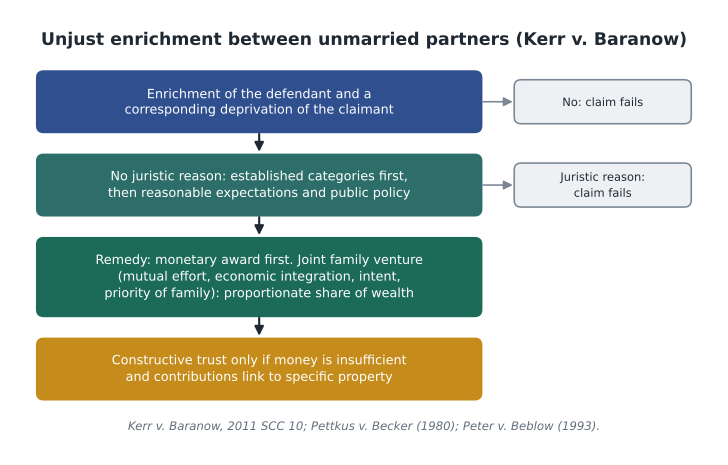
Kerr v. Baranow (2011 SCC 10) restated the law. Justice Cromwell, for a unanimous Court, held that a claim for unjust enrichment requires three elements: an enrichment of the defendant, a corresponding deprivation of the claimant, and the absence of a juristic reason for the enrichment. Following Garland v. Consumers' Gas (2004), the juristic reason analysis first asks whether the enrichment falls into an established category, such as a contract, a disposition of law, a donative intent or another valid common law, equitable or statutory obligation. If not, the court considers the parties' reasonable expectations and public policy. Mutual benefits that each partner conferred on the other are considered mainly at the defence and remedy stage, not to deny the enrichment altogether.
On remedy, Justice Cromwell held that the court should first consider whether a monetary award is sufficient. A constructive trust is available only where a monetary award would be inadequate and there is a sufficiently substantial and direct link between the claimant's contributions and the acquisition, preservation, maintenance or improvement of the specific property.
The most important part of Kerr is the joint family venture. Before Kerr, monetary awards were often calculated on a fee-for-services basis, what the claimant's work would have cost on the market, which undervalued long relationships. Kerr held that where the parties were in a joint family venture, and the claimant's contributions are linked to the accumulation of wealth, the monetary award should reflect a share of the wealth accumulated during the venture, proportionate to the claimant's contributions. The Court listed four groups of factors for identifying a joint family venture: mutual effort, such as pooling resources and raising children together; economic integration, such as shared finances and the extent to which the parties relied on each other; actual intent, including how the parties described their relationship; and priority of the family, such as one partner giving up opportunities for the family. The Court also confirmed that the common intention resulting trust has no further role in these disputes.
Bridget's claim
Ferreira applies Kerr to Bridget O'Neill and Yusuf Rahman. They lived together for seven years. Bridget left a nursing job to work unpaid in Yusuf's landscaping business, which grew from two employees to fifteen. They pooled their personal finances, described themselves to friends as partners for life and made decisions together. The house and business are in Yusuf's name. Bridget has an unjust enrichment claim: Yusuf was enriched by her unpaid work, she suffered a corresponding deprivation in lost wages and career, and there was no contract or gift that explains the transfer. The factors point strongly to a joint family venture, so her monetary award should reflect a proportionate share of the increase in value of the business and the house during the relationship, not simply wages for her work. A constructive trust over the house is possible if a monetary award would be insufficient, for example if Yusuf has no other assets, and her contributions are linked to the house.
Ferreira points out what Bridget does not have. She has no right to possession of the house under Part II, no automatic equalization, and no presumption of equal contribution. She bears the burden of proving every element. She also faces the limitation period in the Limitations Act, 2002, generally two years from when the claim was discovered, which courts usually treat as running from separation. And she will need evidence: payroll records, emails, witnesses who saw her work, and evidence of the business's growth. Bridget does, however, have a claim for spousal support under section 29 of the Family Law Act (lesson 2), which can be combined with the unjust enrichment claim, though the court will avoid double recovery.
Worked problem
Bridget and Yusuf: building the claim
Bridget O'Neill and Yusuf Rahman separated after seven years. Yusuf's landscaping business grew from a value of 100,000 dollars when they began living together to 1.1 million dollars at separation; his house rose from 400,000 dollars to 700,000 dollars. Bridget worked full-time in the business unpaid and handled the household. Yusuf says she received free housing and living expenses. What is Bridget's best argument, and what remedy might she receive?
Show solution
- Status: as unmarried partners, they have no Part I or Part II rights. Bridget can claim spousal support under section 29 and unjust enrichment under Kerr.
- Unjust enrichment: Yusuf was enriched by her unpaid work, she was deprived of wages and her nursing career, and no juristic reason applies. Free housing and expenses are mutual benefits considered at the defence and remedy stage, not a bar.
- Joint family venture: pooled finances, Bridget's full-time work in the business, their description of the relationship and her giving up her career all point to a joint family venture.
- Remedy: the wealth accumulated during the venture is about 1.3 million dollars (1,000,000 in the business and 300,000 in the house). A court would award her a share proportionate to her contributions, after accounting for the benefits she received.
- Constructive trust: only if a monetary award is insufficient and her contributions are linked to specific property. Prompt action is essential because of the Limitations Act, 2002.
Common mistakes
MistakeAdvising an owner spouse they can sell the house after separation because it is in their name.
InsteadSection 21 requires the other spouse's consent or a court order to sell or mortgage a matrimonial home.
MistakeAssuming a cottage cannot be a matrimonial home.
InsteadAny property ordinarily occupied as a family residence at separation can be a matrimonial home; there can be more than one.
MistakeValuing an unmarried partner's claim on a fee-for-services basis in a long relationship.
InsteadWhere there was a joint family venture, Kerr calls for a proportionate share of the wealth accumulated.
MistakeAssuming CPP credits are divided as part of net family property.
InsteadThey are excluded and split separately on application under the Canada Pension Plan.
Practice problems
Work each problem on paper first, then reveal the answer to check.
After separation, the spouse who owns the matrimonial home changes the locks. What can the other spouse do?
Show answer
Both spouses have an equal right to possession under section 19 regardless of ownership. The excluded spouse can apply for an order restoring possession, or for exclusive possession under section 24 if the factors support it.
How is an Ontario-regulated pension valued and divided on separation?
Show answer
The plan administrator calculates the family law value under section 10.1 of the Family Law Act and the Pension Benefits Act. That value goes into net family property, and up to 50 percent can be transferred to the non-member spouse, usually to a locked-in account, to satisfy an equalization payment.
What are the four groups of factors for a joint family venture under Kerr v. Baranow?
Show answer
Mutual effort, economic integration, actual intent and priority of the family.
Summary and key terms
- A matrimonial home is any property ordinarily occupied by the spouses as a family residence at separation, including a cottage or shares in a company owning it.
- Both spouses have equal possession rights, and the home cannot be sold or mortgaged without consent or a court order.
- Exclusive possession under section 24 considers the children's best interests, finances, accommodation and any violence.
- Ontario pensions are valued at their family law value and up to 50 percent can be transferred; CPP credits are split separately.
- Unmarried partners rely on unjust enrichment: enrichment, corresponding deprivation and no juristic reason.
- Kerr v. Baranow prefers monetary awards, with a proportionate share of accumulated wealth where there was a joint family venture.
- Matrimonial home
- Under section 18, property ordinarily occupied by spouses as their family residence at separation.
- Exclusive possession
- A court order giving one spouse sole occupation of the matrimonial home for a period.
- Family law value
- The value of a pension earned during the marriage, calculated by the plan administrator under prescribed rules.
- Unjust enrichment
- A claim requiring an enrichment, a corresponding deprivation and the absence of a juristic reason.
- Joint family venture
- A relationship in which unmarried partners worked together for common goals, entitling the claimant to a share of accumulated wealth.
- Constructive trust
- A proprietary remedy giving a claimant an interest in specific property, available when a monetary award is insufficient.
Lesson quiz · 5 questions
Score 60% or more to complete this lesson.
Create a free account to save your progress, take quizzes and earn a certificate.