
LAWC-212 · Lesson 12 of 12 · 23 min
Capstone: solving a family law problem
▶ Video coming soon A video version of this lesson is on the way.
For the last class, Professor Ferreira hands out a new file. 'Real family cases do not come labelled by lesson,' she says. 'A client sits down and tells you about their life. Your job is to turn that into a list of legal issues, put them in the right order, and give advice that holds together, because every issue affects every other.' This lesson works through a complete problem in the style of the final examination, then gives a method for organizing a written answer. The facts are invented; the method is the one practising family lawyers use.
The Tessier and Bhatt file
Aurélie Tessier, 44, and Rajan Bhatt, 46, married in Corwin fourteen years ago. Three days before the wedding, Rajan asked Aurélie to sign a marriage contract that his accountant had prepared. It excluded Rajan's shares in his dental professional corporation, and any growth in their value, from his net family property. Attached was a one-page summary listing the shares at a book value of 60,000 dollars. Aurélie, who was a teacher, asked a friend who had recently been called to the bar to read it over the phone the evening before signing. The friend told her it 'looked standard'. No certificate of independent legal advice was signed. A valuator now estimates that the shares were worth about 450,000 dollars when the contract was signed and about 2.4 million dollars today.
They have two children, Noémie, 12, and Kiran, 8. After Kiran was born, Aurélie moved to a 0.6 teaching position so she could manage the children's schedules, while Rajan expanded the practice to three locations. She earns 60,000 dollars a year. Rajan's personal income tax return shows 220,000 dollars, but his corporation has retained significant earnings each year, and his accountant confirms that the pre-tax income available to him from the corporation averages about 380,000 dollars.
Rajan bought the house they live in four years before the marriage. It has been their only home and is still in his name. Seven years ago, Aurélie inherited 120,000 dollars from her father. She deposited it in their joint account and it was spent, with the rest of that account, on a major renovation of the house. The house was worth 500,000 dollars at the date of marriage, with a 300,000 dollar mortgage, and is worth 1.6 million dollars today, with a 200,000 dollar mortgage.
The relationship has been deteriorating for two years. Aurélie says that last January she told Rajan the marriage was over and moved into the guest room, and that since then they have kept separate finances for food and have not gone out together. Rajan says they were still trying until June, when Aurélie started seeing a lawyer, and points out that they attended a family wedding together in March. The practice was valued much higher in June than in January because a new location opened in May. Both still live in the house.
Rajan wants a week-about parenting schedule and joint decision-making. Aurélie wants the children to live mainly with her, with Rajan having alternate weekends and a mid-week overnight, and wants final say on education, because the parents disagree about whether Noémie should move to a private school. Noémie has told both parents that she wants to stay at her current school and live 'mostly with Mom, but see Dad a lot'. There is no family violence; communication is tense but civil. Aurélie wants child support, spousal support, the marriage contract set aside, and her share of the property. Rajan wants to keep the house.
Step one: spot and order the issues
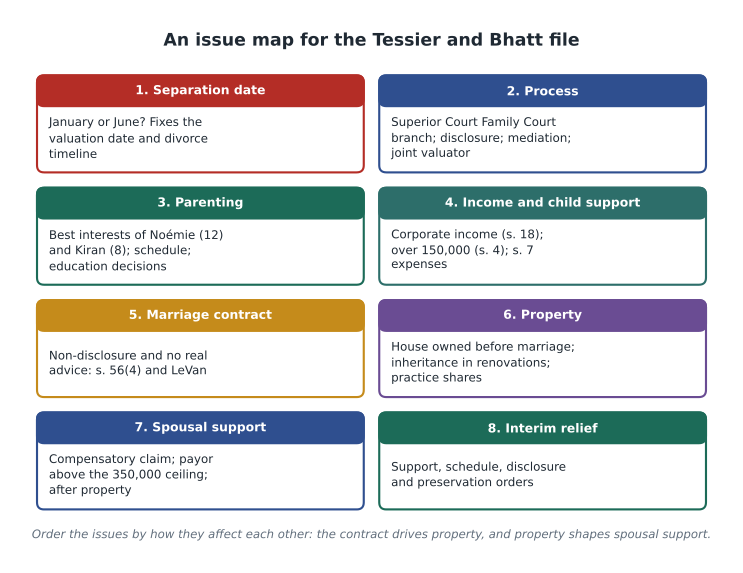
Ferreira's method begins with an issue list, in the order that issues affect each other. Process comes first, because it determines where and how everything else will be decided. Children come next, because parenting affects the support formulas and because the law puts the children's interests first. Then income, because both support calculations depend on it. Then the marriage contract, because it determines what property is in the calculation. Then property, then spousal support, because the property result affects support. For this file, the list is: the separation date; jurisdiction and process; parenting; income for support purposes; child support; the marriage contract; equalization, including the house and the inheritance; spousal support; and interim relief while the case is pending.
Step two: the separation date
The separation date is both the valuation date for property and the start of the one-year period for divorce. Here it is worth a lot of money, because the practice value rose between January and June. Courts decide the date by looking at the whole relationship, with no single factor decisive. Separation under one roof is recognized (lesson 2). Aurélie's evidence of a clear statement, moving to the guest room and separate finances points to January. Rajan's evidence of attending a wedding together points the other way, but courts have recognized that separated spouses often keep up appearances at family events. On these facts, January is the stronger date, though the evidence of each party's statements and texts will matter. A lawyer for Aurélie would gather everything that documents the change in January: messages, bank records and witnesses.
Step three: process
Both spouses live in Corwin, a unified family court location, so the Family Court branch of the Superior Court of Justice can hear every claim (lesson 1). Aurélie can claim a divorce under the Divorce Act, with parenting, child support and spousal support as corollary relief, and property under Parts I and II of the Family Law Act. She can start immediately, though the divorce cannot be granted until a year after separation. The case will begin with an application and full financial disclosure, including Rajan's corporate financial statements, which are essential for income. A case conference will come first. Under sections 7.3 and 7.7, both lawyers should consider mediation or another dispute resolution process; with no family violence and civil communication, that is appropriate. A joint business valuator would save money and time.
Step four: parenting
The only question is the children's best interests, with primary consideration to their safety, security and well-being (lesson 5). There is no presumption of equal time. Factors favouring Aurélie's proposal include the history of care, since she has been the parent managing the children's schedules, and Noémie's views. At 12, her views and preferences deserve real weight, and they are consistent and specific. A Voice of the Child Report could put them before the court without forcing her into the litigation. Factors favouring more time with Rajan include the children's strong relationship with him and section 16(6), which says children should have as much time with each parent as is consistent with their best interests.
A likely result is somewhere between the two proposals: primary residence with Aurélie during the school year, with generous time for Rajan, for example alternate weekends from Thursday to Monday and a mid-week overnight, and equal holiday time. Kiran's schedule could be the same, so the siblings stay together. On decision-making, the parents are civil but disagree about private school. Under Kaplanis, joint decision-making needs evidence of cooperation. A common outcome is joint decision-making on most subjects, with Aurélie having final say on education after good-faith consultation, which would let Noémie remain at her school.
Step five: income
Rajan's income for support purposes is not 220,000 dollars. Section 18 of the Guidelines lets the court attribute pre-tax corporate income to a shareholder where the amount shown on the tax return does not fairly reflect the money available for support. The accountant's evidence that about 380,000 dollars is available supports attributing that amount, subject to any legitimate business need to retain earnings, which Rajan would have to prove. Because corporate income is often averaged, the court may use a three-year average under section 17. Aurélie's income is 60,000 dollars. The court is unlikely to impute more to her, because her part-time position was a choice the family made for the children, and Drygala v. Pauli looks at whether a reduced income is reasonable in light of the children's needs.
Step six: child support
If the children live mainly with Aurélie and Rajan has less than 40 percent of the time, section 3 applies, using the table amount for two children at Rajan's income. Because his income exceeds 150,000 dollars, section 4 applies: the table amount is presumptive under Francis v. Baker, and Rajan would have to show it is inappropriate to depart from it. Section 7 expenses, such as the children's activities, tutoring and orthodontics, would be shared in proportion to income, about 86 percent for Rajan and 14 percent for Aurélie on incomes of 380,000 and 60,000 dollars. If the final schedule gives Rajan 40 percent or more, section 9 would apply and Contino would require a careful look at both households' budgets. Either way, child support begins at separation and is calculated first, because it has priority over spousal support under section 15.3.
Step seven: the marriage contract
The contract is in writing and presumably signed and witnessed, so section 55 is met. Aurélie's challenge is under section 56(4). On non-disclosure, the shares were listed at 60,000 dollars when they were worth about 450,000 dollars; that is a significant failure to disclose the value of the very asset the contract was about. On understanding, Aurélie had no meaningful legal advice: a phone call with a newly called friend who said the document 'looked standard' does not explain the nature and consequences of giving up a share in the growth of a business. The timing, three days before the wedding, adds pressure.
At the discretion stage under LeVan, the factors point toward setting the contract aside: the non-disclosure was substantial and concerned the central asset; Rajan controlled the information; Aurélie did not waive disclosure knowingly; and she had no independent advice. Rajan may argue that Aurélie could have asked for more information and that she lived with the contract for fourteen years. Anderson v. Anderson reminds courts to respect fair agreements, but it also tells them to stay alert to vulnerabilities, and this agreement was not reached through a fair process. A court would likely set aside the exclusion, so that the growth in the shares falls into Rajan's net family property.
Step eight: equalization
The house was owned by Rajan at the date of marriage and is still the matrimonial home. Under the matrimonial home rule (lesson 9), there is no date-of-marriage deduction for it. Its full net value on the valuation date, 1.6 million dollars minus the 200,000 dollar mortgage, or 1.4 million dollars, is in Rajan's net family property, less any disposition costs if a sale is likely. Rajan loses the benefit of the 200,000 dollars of net equity he had at marriage.
Aurélie's inheritance is not excluded. It was deposited in a joint account and spent on renovating the matrimonial home. Exclusions do not apply to property that is a matrimonial home, and the money cannot be traced into anything else. She has, in effect, shared her inheritance. She might ask for unequal division under section 5(6), but the threshold is unconscionability, and the loss of an exclusion through the ordinary operation of the statute rarely meets it.
If the contract is set aside, Rajan's shares are valued at the valuation date, net of notional tax if disposition is likely or reasonably foreseeable, and he can deduct their date-of-marriage value, about 450,000 dollars on the valuator's estimate, because the shares are not a matrimonial home. The difference between a January and a June valuation date may be significant, which is why the separation date matters so much. Rajan's other assets, such as investments and RRSPs, and Aurélie's pension, are added, debts are deducted, and the equalization payment is half the difference. On any realistic calculation Rajan will owe Aurélie a large equalization payment. He can keep the house by paying her, by transferring other assets, or by paying instalments over up to ten years with security under section 9.
Until then, Aurélie has an equal right to possession of the house under section 19, even though it is in Rajan's name, and Rajan cannot sell or mortgage it without her consent under section 21. If living together becomes unworkable, she could seek interim exclusive possession under section 24, though the factors, with no violence and both parents involved, may not support it.
Step nine: spousal support
Aurélie has a strong compensatory claim under Moge (lesson 8). She reduced her work to a 0.6 position for the children while Rajan built a three-location practice; the roles in the marriage contributed to the difference in their earning capacities. There may also be a needs-based element, though a large equalization payment will reduce need. Because there are dependent children, the with child support formula applies. Rajan's income exceeds 350,000 dollars, the Advisory Guidelines ceiling, so the formula is not presumptively applied above that level, and the court has more discretion; many courts still use the formula as a reference point. After fourteen years, duration under the with child support formula depends on the length of the marriage and the children's ages; an indefinite order, subject to review or variation as the children grow and Aurélie's earnings change, is plausible. Boston v. Boston would guard against double recovery from any pension that is equalized.
Step ten: interim relief and a settlement strategy
While the case proceeds, Aurélie should seek interim child support based on Rajan's attributed income, interim spousal support, a temporary parenting schedule close to her proposal, and an order for full corporate disclosure. A preservation order under section 12 may be appropriate if there is a risk that corporate assets will be moved. A sensible settlement might include a parenting plan reflecting Noémie's views, child support on 380,000 dollars of income, an agreed separation date, a joint valuation of the practice, the house transferred to Rajan in exchange for an equalization payment partly in cash and partly over time with security, and spousal support for a defined period with a review when Kiran finishes high school. Offers to settle under rule 18 of the Family Law Rules would protect Aurélie on costs.
Writing the answer
Ferreira closes with five rules for examination answers. First, start with a short issue list, in the order you will address them. Second, for each issue state the rule with its source, statute section or case, and then apply it to the specific facts; do not recite law you do not use. Third, deal with arguments on both sides and say which is stronger and why. Fourth, connect the issues; say how the contract affects property, how property affects spousal support, and how income affects both forms of support. Fifth, finish with practical advice: what the client should do next, what evidence to gather, and what a reasonable settlement looks like. 'You are not writing a judgment,' she says. 'You are writing the advice that lets your client make a good decision. That is what family lawyers are for.'
Worked problem
A short-form answer plan
Using the Tessier and Bhatt facts, write a one-paragraph answer plan that could open an examination answer.
Show solution
- Issues, in order: separation date (January or June); jurisdiction and process; parenting for Noémie and Kiran; Rajan's income under sections 17 and 18; child support under sections 3, 4 and 7; the marriage contract under section 56(4) and LeVan; equalization, including the matrimonial home and the inheritance; spousal support under Moge and the Advisory Guidelines; interim relief.
- Key conclusions: January is the stronger separation date; Superior Court Family Court branch; primary residence with Aurélie, generous time for Rajan, final say on education for Aurélie; income about 380,000 dollars; contract likely set aside for non-disclosure and lack of advice.
- Property: full value of the house is in Rajan's net family property with no date-of-marriage deduction; Aurélie's inheritance lost its exclusion; shares included with a date-of-marriage deduction; large equalization payment to Aurélie.
- Spousal support: strong compensatory claim; with child support formula as a reference above the 350,000 dollar ceiling; likely indefinite or long-term, subject to review.
- Next steps: corporate disclosure, joint valuator, Voice of the Child Report, interim motion, mediation and a rule 18 offer.
Common mistakes
MistakeWriting about property before parenting and income.
InsteadOrder issues by how they affect each other: process, children, income, contract, property, then spousal support.
MistakeUsing the income on the personal tax return for a business owner.
InsteadConsider attribution of pre-tax corporate income under section 18 and averaging under section 17.
MistakeAssuming an inheritance is always excluded.
InsteadAn inheritance put into the matrimonial home loses its exclusion.
MistakeTreating the separation date as a minor fact.
InsteadIt fixes the valuation date and the divorce timeline, and can change the property result significantly.
Practice problems
Work each problem on paper first, then reveal the answer to check.
Why is the separation date so important in the Tessier and Bhatt file?
Show answer
It is the valuation date for net family property, and the value of the dental practice rose between January and June because of the new location. It also starts the one-year period for divorce.
Why does Rajan lose the benefit of owning the house before marriage?
Show answer
Because the house is still the matrimonial home on the valuation date, and section 4(1) allows no date-of-marriage deduction for a matrimonial home. Its full net value is included in his net family property.
What makes the marriage contract vulnerable under section 56(4)?
Show answer
Significant non-disclosure of the value of the shares, which were the subject of the contract; no meaningful independent legal advice, raising a question about understanding; and signing three days before the wedding. Under LeVan, the discretionary factors point toward setting it aside.
Summary and key terms
- Start every family file with an ordered issue list: process, children, income, contracts, property, spousal support and interim relief.
- The separation date can change both the property result and the divorce timeline.
- Corporate income can be attributed to a shareholder for support under section 18 of the Guidelines.
- A marriage contract built on significant non-disclosure and without real advice is vulnerable under section 56(4) and LeVan.
- The matrimonial home rule removes date-of-marriage deductions and exclusions for money put into the home.
- Spousal support is shaped by compensatory claims, the Advisory Guidelines, income ceilings and the property result.
- Issue list
- An ordered list of the legal questions in a file, arranged by how each affects the others.
- Attribution of corporate income
- Treating pre-tax income retained in a corporation as income of a shareholder for support under section 18.
- Preservation order
- An order under section 12 of the Family Law Act preventing depletion of property during a case.
- Rule 18 offer
- A written offer to settle under the Family Law Rules that can have costs consequences.
- Interim relief
- Temporary orders for parenting, support or possession made while a case is pending.
- Income ceiling
- The 350,000 dollar payor income above which the Spousal Support Advisory Guidelines formulas are not presumptively applied.
Lesson quiz · 5 questions
Score 60% or more to complete this lesson.
Create a free account to save your progress, take quizzes and earn a certificate.