
LAWC-212 · Lesson 4 of 12 · 20 min
Domestic contracts
▶ Video coming soon A video version of this lesson is on the way.
'Most families do not get their law from a judge,' Professor Ferreira says. 'They get it from a contract.' She hands out an anonymized separation agreement from her old practice, forty pages long, covering parenting, child support, spousal support, the house, two pensions and a cottage. 'This is what a successful family case looks like. No trial, no judgment. Your job will usually be to negotiate one of these, or to defend or attack one that someone else negotiated.'
Ontario's Family Law Act calls these agreements domestic contracts and sets out special rules for them in Part IV. This lesson covers the three kinds of domestic contract, the formal requirements in section 55, the grounds for setting a contract aside in section 56(4), the leading Court of Appeal decision in LeVan v. LeVan, how the Supreme Court approaches spousal support terms under Miglin v. Miglin, the 2023 decision in Anderson v. Anderson, and the limits on what a domestic contract can do about children.
Three kinds of domestic contract
Section 51 defines a domestic contract as a marriage contract, separation agreement, cohabitation agreement, paternity agreement or family arbitration agreement. Three are common. A marriage contract, under section 52, is made by two people who are married or intend to marry, and can set out their rights on separation or death, including ownership and division of property, support and the right to direct the children's education and moral training. It is the Ontario version of what is commonly called a prenuptial agreement. A cohabitation agreement, under section 53, does the same for unmarried couples who are or intend to be cohabiting. If they later marry, the cohabitation agreement becomes a marriage contract. A separation agreement, under section 54, is made by spouses or cohabitants who are living separate and apart, and can cover property, support, parenting and any other matter.
Two limits apply to all of them. Section 52(1) says a marriage contract cannot limit a spouse's rights under Part II, the matrimonial home provisions, so a contract cannot stop a married spouse from claiming possession of the matrimonial home (lesson 10). And no domestic contract can bind a court on matters affecting children. Section 56(1) says a court may disregard any provision about the education, moral training or parenting of a child where it is not in the child's best interests, and section 56(1.1) lets the court disregard child support terms that are unreasonable having regard to the Child Support Guidelines.
Formal requirements
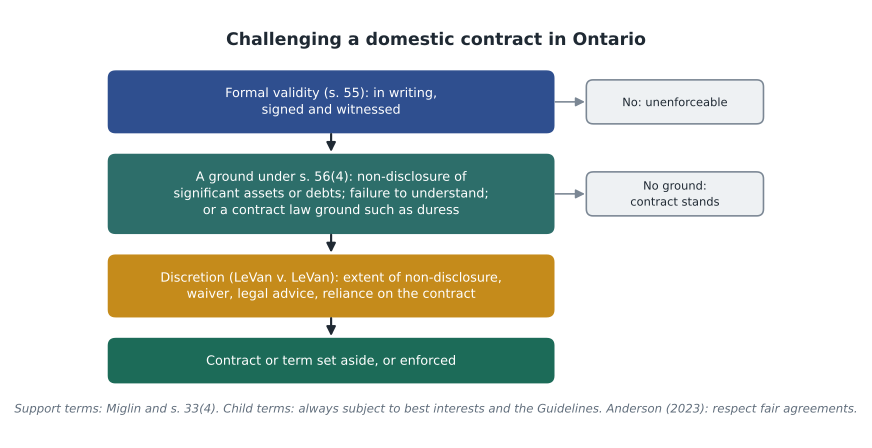
Section 55(1) says a domestic contract and an agreement to amend or rescind it are unenforceable unless made in writing, signed by the parties and witnessed. These are strict requirements, though the courts have occasionally treated an unwitnessed agreement as enforceable where there was no doubt about its authenticity and the parties had acted on it. Ontario's courts have also been willing to look at the whole history of a negotiation, so that a party who signed and then relied on an agreement for years may find it difficult to escape it on a technicality. Section 56(5) adds a special power that echoes section 21.1 of the Divorce Act (lesson 3): a court may set aside a separation agreement, or part of it, where a spouse has failed to remove barriers within their control to the other spouse's religious remarriage.
The statute does not require independent legal advice, but in practice it is essential. A contract signed without advice is much more vulnerable to the argument that a party did not understand its nature or consequences. Good practice is for each party to have a separate lawyer who explains the contract and signs a certificate of independent legal advice. The certificate is evidence, not a guarantee; a lawyer who signs one without explaining the contract may face a negligence claim if it is later set aside.
Setting aside under section 56(4)
Section 56(4) lists three grounds on which a court may set aside a domestic contract or a provision in it: if a party failed to disclose to the other significant assets, or significant debts or other liabilities, existing when the contract was made; if a party did not understand the nature or consequences of the contract; or otherwise in accordance with the law of contract, which brings in duress, undue influence, unconscionability, misrepresentation, mistake and the rest.
The leading interpretation of section 56(4) is LeVan v. LeVan (2008 ONCA 388). Mr. LeVan's family owned a successful business. Before the marriage, his father insisted on a marriage contract that excluded the business from the net family property calculation. Mrs. LeVan's lawyer advised her not to sign without full disclosure, but Mr. LeVan's lawyer refused to provide it, and she signed anyway under time pressure. The trial judge set the contract aside, and the Court of Appeal agreed. It held that section 56(4) involves two steps. First, the party challenging the contract must show that one of the grounds is met. Second, the court must decide whether it is appropriate to exercise its discretion to set the contract aside. The discretion step considers factors such as whether the challenging party sought further disclosure, the extent of the non-disclosure, whether the challenging party waived disclosure, whether they received independent legal advice, and whether they acted on the agreement.
Non-disclosure is the most common ground. 'Significant' assets or debts are judged in context, not by a fixed number. A failure to disclose a pension, a business interest or a large debt can be significant even if the other party knew roughly what the spouse earned. The duty is not satisfied by inviting the other party to ask questions; the disclosure must be meaningful. The second ground, failure to understand, focuses on whether the party understood what they were giving up, which is where independent legal advice matters most. The third ground imports the whole of contract law. Unconscionability, in the family context, asks whether there was an inequality of bargaining power and a resulting improvident bargain; the Supreme Court restated the general doctrine in Uber Technologies Inc. v. Heller (2020 SCC 16), which you studied in Contracts.
Spousal support terms: Miglin v. Miglin
Spousal support terms receive special treatment. Even if a contract survives section 56(4), the court still has jurisdiction to order spousal support despite it. Section 33(4) of the Family Law Act allows a court to set aside a support waiver and order support if the waiver results in unconscionable circumstances, if the dependant qualifies for public assistance, or if there is default in payment under the contract. Under the Divorce Act, section 15.2(4)(c) tells the court to consider any order, agreement or arrangement relating to support.
Miglin v. Miglin (2003 SCC 24) is the leading case on how much weight to give a support agreement in a Divorce Act application. The Miglins separated after fourteen years of marriage and four children and signed a separation agreement in which Mrs. Miglin released spousal support in exchange for a consulting contract and other terms. Several years later she sought support. The Supreme Court set out a two-stage test. At stage one, the court looks at the circumstances in which the agreement was negotiated and executed, asking whether there was oppression, pressure or other vulnerabilities, and whether the process, including legal advice, compensated for them. It then asks whether the substance of the agreement, at the time it was made, complied substantially with the objectives of the Divorce Act. At stage two, the court looks at the present and asks whether, viewed in light of the parties' current circumstances, the agreement still reflects their original intentions and remains in substantial compliance with the Act. A change the parties could reasonably have anticipated will not usually justify departing from the agreement. Applying the test, the Court enforced the release.
Anderson v. Anderson: respecting agreements
In Anderson v. Anderson (2023 SCC 13) the Supreme Court revisited domestic contracts, this time on property. The Andersons, from Saskatchewan, separated after a short marriage and signed a two-page agreement, without lawyers, in which each kept their own property and released any claim to the other's, including the family home, which was in the husband's name. Saskatchewan's Family Property Act, like Ontario's, allows a court to give weight to an interspousal agreement. The trial judge gave the agreement little weight because the wife had not had legal advice and the formal requirements for an enforceable contract under the Act had not been met. The Supreme Court unanimously reversed, in reasons by Justice Karakatsanis.
Three points from Anderson matter in Ontario. First, Miglin is not a universal framework for every domestic contract; its test was built for spousal support under the Divorce Act, and agreements about property must be assessed under the statute that governs them. Second, courts should generally support the autonomy of spouses to resolve their own affairs, and a domestic contract reached through a fair process deserves respect. Third, that respect is not blind. Courts must remain sensitive to the vulnerabilities that arise in family negotiations, including power imbalances, emotional stress, and the risk that one spouse will exploit the other's desire to end the conflict quickly. In Anderson there was no evidence of exploitation, the wife understood what she was signing and the terms were not unfair for a short marriage, so the agreement was given effect and the wife was ordered to make a payment to the husband to equalize their other property.
Ferreira tells the class that Anderson does not change the Ontario section 56(4) test, which comes from the statute, but it confirms the tone that Ontario courts had already been taking: start from respect for the parties' bargain, then look carefully for the specific defects that justify interfering with it.
Children and domestic contracts
Parents can agree on almost anything about their own finances, but they cannot bargain away their children's rights. Child support belongs to the child. A term that sets child support below the Guidelines can be disregarded under section 56(1.1), and a release of child support is never final. A term about parenting is subject to the child's best interests. Courts will give real weight to an agreed parenting schedule, because parents usually know their children best, but a judge is not bound by it.
This is also why separation agreements often include a review or variation clause. A good agreement sets out how child support will be updated each year based on income, how special expenses will be shared, and how parenting decisions will be made and disputes resolved. It may also say whether spousal support can be varied, and on what conditions. Courts have repeatedly said that clear language about review and variation, read with Miglin, gives the parties more certainty than silence.
Drafting with the future in mind
Many contract disputes begin with a vague clause. A marriage contract that excludes 'the business' without defining which business, a cohabitation agreement that says nothing about what happens if the couple has a child, or a separation agreement that makes spousal support 'non-variable' without saying what happens if the payor loses their job all generate litigation. Ferreira's drafting checklist is simple. Make full disclosure and attach it as a schedule. Ensure each party has independent legal advice, with a certificate. Allow enough time; a contract signed the day before a wedding is vulnerable. Define key terms. Say what happens if circumstances change. And remember that anything about children is always open to review.
In the Sandoval and Whitlow file, there is no marriage contract. The couple will negotiate a separation agreement, or the court will decide. Ferreira asks the class to keep the drafting checklist in mind for the capstone in lesson 12, where the Tessier and Bhatt file includes a marriage contract that one spouse wants to set aside.
Worked problem
Will the marriage contract survive?
Two weeks before their wedding, Pierre asked Ines to sign a marriage contract excluding his share of a family software company from his net family property. He gave her a one-page summary of his assets that valued the shares at 200,000 dollars; an expert later values them at 1.8 million dollars at the time of signing. Ines had a lawyer, who told her the disclosure was inadequate; she signed anyway. Ten years later they separate. Can Ines set the contract aside?
Show solution
- Formal validity: the contract is in writing, signed and witnessed, so it meets section 55(1).
- Ground under section 56(4)(a): Pierre failed to disclose the true value of a significant asset. A ninefold undervaluation is significant non-disclosure.
- Discretion under LeVan: the court weighs the factors. Against Ines, she had advice and was told the disclosure was inadequate, which resembles a waiver. For Ines, the asset was central to the contract, the non-disclosure was extreme, Pierre was the one who controlled the information, and the time pressure before the wedding limited her choices.
- Likely outcome: on facts similar to LeVan, where a party received advice but still signed without real disclosure, courts have set contracts aside. The scale of the undervaluation makes that likely here.
- Effect: if set aside, the shares fall into Pierre's net family property under Part I, and the equalization calculation follows the ordinary rules (lesson 9).
Common mistakes
MistakeTreating a certificate of independent legal advice as making a contract unchallengeable.
InsteadAdvice is a factor, not a shield. Non-disclosure or unconscionability can still set the contract aside.
MistakeIncluding a child support release in a separation agreement.
InsteadChild support belongs to the child; a court can disregard any term inconsistent with the Guidelines.
MistakeApplying the Miglin test to every domestic contract.
InsteadAnderson v. Anderson says Miglin is for spousal support under the Divorce Act; property agreements follow their own statute.
MistakeUsing a marriage contract to give one spouse the exclusive right to the matrimonial home.
InsteadSection 52(1) says a marriage contract cannot limit a spouse's Part II rights to possession of the matrimonial home.
Practice problems
Work each problem on paper first, then reveal the answer to check.
What are the two steps in a section 56(4) analysis according to LeVan v. LeVan?
Show answer
First, the challenging party must prove one of the statutory grounds: non-disclosure, failure to understand, or a contract law ground. Second, the court decides whether to exercise its discretion to set the contract aside, considering factors such as the extent of non-disclosure, whether disclosure was sought or waived, and whether there was legal advice.
A separation agreement releases spousal support. Five years later the recipient is on social assistance. What provisions allow a court to order support anyway?
Show answer
Under section 33(4) of the Family Law Act, a court may set aside a support waiver if the dependant qualifies for public assistance. In a Divorce Act case, the Miglin test asks whether the agreement still reflects the parties' intentions and substantially complies with the Act's objectives.
What was the key holding of Anderson v. Anderson about domestic contracts?
Show answer
Courts should generally respect agreements made through a fair process, Miglin is not a universal framework for all domestic contracts, and courts must stay alert to vulnerabilities in family negotiations. The informal property agreement was enforced.
Summary and key terms
- Domestic contracts include marriage contracts, cohabitation agreements and separation agreements, and must be in writing, signed and witnessed.
- A marriage contract cannot limit matrimonial home rights, and no contract binds the court on children's issues.
- Section 56(4) allows a contract to be set aside for non-disclosure, failure to understand or any contract law ground; LeVan adds a discretionary second step.
- Miglin's two-stage test governs spousal support terms under the Divorce Act.
- Anderson v. Anderson stresses respect for fairly negotiated agreements while watching for vulnerabilities.
- Good drafting means disclosure, independent advice, time, clear terms and provisions for change.
- Domestic contract
- A marriage contract, cohabitation agreement, separation agreement, paternity agreement or family arbitration agreement under Part IV of the Family Law Act.
- Marriage contract
- A contract between spouses or intended spouses setting out their rights on separation or death.
- Separation agreement
- A contract between spouses or cohabitants who have separated, covering support, property and parenting.
- Independent legal advice
- Advice from a lawyer acting only for one party, explaining the nature and consequences of the contract.
- Miglin test
- The two-stage test for deciding how much weight to give a spousal support agreement in a Divorce Act case.
- Unconscionability
- A contract law ground for setting aside a bargain that results from an inequality of bargaining power and is improvident.
Lesson quiz · 5 questions
Score 60% or more to complete this lesson.
Create a free account to save your progress, take quizzes and earn a certificate.