
LAWC-212 · Lesson 6 of 12 · 21 min
Relocation, habitual residence and international child disputes
▶ Video coming soon A video version of this lesson is on the way.
Professor Ferreira draws a map on the board: Corwin in the middle, and a circle around it about forty minutes' drive wide. 'Inside this circle, Isla and Rowan can live with one parent and see the other several times a week. Outside it, the schedule changes completely.' Then she adds a twist to the Sandoval and Whitlow file. Joanna has been offered a senior hospital administration job in Halifax, at almost twice her current salary. Her parents live there and could help with childcare. She wants to move with the children next summer. Callum is devastated.
Relocation cases are among the hardest in family law, because there is usually no compromise. Either the child moves or does not. This lesson covers the 2021 relocation framework in the Divorce Act and the Children's Law Reform Act, the Supreme Court's decision in Barendregt v. Grebliunas, the rules for deciding which court has jurisdiction over a child, the Hague Convention on child abduction, and the Supreme Court's 2025 decision in Dunmore v. Mehralian on children taken to or kept in non-Convention countries.
What counts as relocation
The Divorce Act distinguishes a relocation from an ordinary change of residence. Section 2(1) defines relocation as a change in residence of a child, or of a person who has parenting time or decision-making responsibility, that is likely to have a significant impact on the child's relationship with another person who has parenting time, decision-making responsibility or contact. Moving across town usually is not a relocation; moving to another province almost always is. A move that changes a child's school and doubles the travel time between homes may be.
The distinction matters because the obligations differ. Under section 16.8, a person with parenting time or decision-making responsibility who plans to change their residence, or the child's residence, must notify anyone else with parenting time, decision-making responsibility or contact. For a relocation, the stricter rules in sections 16.9 to 16.96 apply. The Children's Law Reform Act, sections 39.1 to 39.4, mirrors these rules for parents who are not divorcing.
Giving notice and objecting
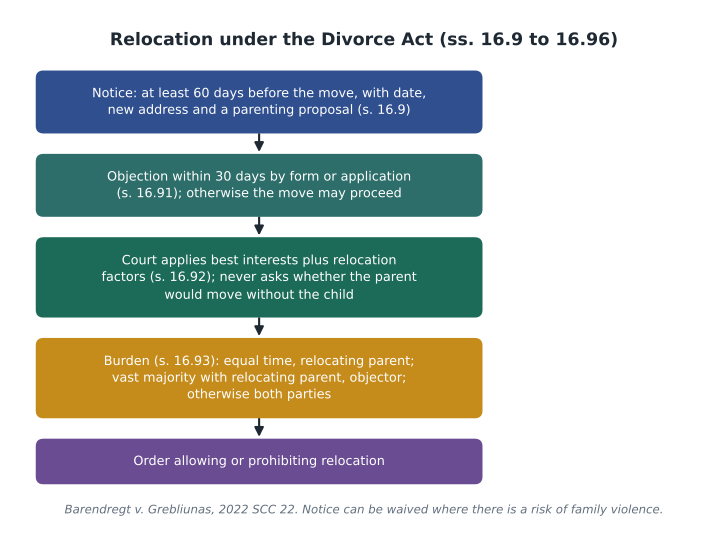
Section 16.9 requires a person who plans to relocate to give at least 60 days' notice before the expected date of the relocation, in the prescribed form or in writing with the prescribed information. The notice must include the expected date, the new address and contact information, and a proposal for how parenting time, decision-making responsibility or contact will be exercised afterward. A court can waive or modify the notice requirement where there is a risk of family violence.
Under section 16.91, the relocation may proceed if a court authorizes it, or if the other person does not object within 30 days of receiving notice, either in the prescribed objection form or by making an application, and there is no order prohibiting the relocation. The objection must set out the reasons and the person's views on the proposal. If the parties cannot agree, the court decides. Ferreira points out that a parent who simply moves without giving notice risks an order requiring the child's return and a finding, under the relocation factors, that they did not comply with their obligations.
The relocation factors
In deciding whether to authorize a relocation, the court applies the general best interests factors in section 16 and the additional factors in section 16.92. These include the reasons for the relocation; its impact on the child; the amount of time spent with the child by each person with parenting time or decision-making responsibility, and their level of involvement in the child's life; whether the relocating person complied with the notice requirement; the existence of any order, arbitral award or agreement that specifies the geographic area where the child is to reside; the reasonableness of the proposal to vary parenting arrangements, taking into account travel expenses and logistics; and whether each person has complied with their obligations under family law legislation, orders and agreements.
Section 16.92(2) adds a rule designed to end an old unfairness. The court shall not consider whether the person who intends to relocate would do so without the child, or would not relocate if the child's relocation were prohibited. Before 2021, a parent asked 'would you move without your child?' faced a trap: saying yes suggested they cared more about the move than the child; saying no suggested the move was not important.
Burdens of proof
Section 16.93 sets burdens of proof based on the existing parenting pattern, whether set by an order, award or agreement or followed in practice. If the parties have substantially equal time, the person who intends to relocate has the burden of proving the relocation would be in the child's best interests. If the child spends the vast majority of time in the care of the person who intends to relocate, the person who objects has the burden of proving the relocation would not be in the child's best interests. In any other case, the parties share the burden of proving whether the relocation is in the child's best interests.
In the Sandoval and Whitlow file, since separation the children have spent alternate weekends and Wednesday evenings with Callum. That is less than substantially equal time, but it may not be 'the vast majority' with Joanna either. Ferreira asks the class to argue it both ways. Courts have treated arrangements in the range of 70 to 80 percent with one parent in different ways, and the answer can depend on the actual pattern, not just a percentage. If Callum obtains his equal time order before Joanna gives notice, the burden shifts to Joanna.
Barendregt v. Grebliunas
The Supreme Court decided Barendregt v. Grebliunas (2022 SCC 22) under the previous law, because the case began before the 2021 amendments, but it used the occasion to modernize the approach and to align it with the new statutory factors. The parents had two young children in Kelowna, British Columbia. The mother wanted to move with them to Telkwa, about a thousand kilometres north, where she and the children could live mortgage-free near her family and away from the father, whose conduct during the litigation had included harassment and some violence. The trial judge allowed the move. The Court of Appeal admitted new evidence from the father and reversed.
Justice Karakatsanis, for the majority, restored the trial judge's decision. On procedure, she held that the Palmer test governs the admission of fresh evidence on appeal in all cases, including family cases, though its due diligence requirement can be applied flexibly where children's interests are at stake. The father's new evidence failed that test. On substance, she restated the relocation analysis. The question is always the best interests of the child, with a focus on the child's physical, emotional and psychological safety, security and well-being. Among the relevant considerations are the reasons for the move, its effect on the child, and the child's relationship with each parent. She agreed that courts should not ask the relocating parent whether they would move without the child. She held that the old 'maximum contact' principle should not be given priority over other factors; it is only one part of the analysis. And she held that family violence is a significant factor that must be considered, because it bears directly on the child's safety.
The decision also confirmed that relocation decisions are highly discretionary and that appellate courts must defer to trial judges unless there is an error of law, a palpable and overriding error of fact or a clearly wrong exercise of discretion. Justice Côté dissented in part on the treatment of the fresh evidence and the outcome.
Which court has jurisdiction over a child
Before any court can decide where a child should live, it must have jurisdiction. Under the Divorce Act, a court with jurisdiction over the divorce can make parenting orders, but the Act allows it to transfer a parenting case to another province where the child is most substantially connected. For parents who are not divorcing, Part III of the Children's Law Reform Act governs. Section 22 says an Ontario court can exercise jurisdiction to make a parenting or contact order only if the child is habitually resident in Ontario when the application is filed, or, if the child is not habitually resident in Ontario, if the child is physically present here and a list of conditions is met, including that substantial evidence about the child's best interests is available here and that the balance of convenience favours Ontario. Section 23 gives Ontario jurisdiction where a child is physically present and would suffer serious harm if returned or kept elsewhere.
Section 22(2) explains habitual residence. A child is habitually resident in the place where they resided with both parents, or, if the parents live apart, with one parent under a separation agreement, order or with the implied consent of the other, or with a person other than a parent on a permanent basis for a significant period. Section 22(3) says the removal or withholding of a child without the consent of the person having decision-making responsibility does not alter the child's habitual residence unless there has been acquiescence or undue delay in starting proceedings.
Dunmore v. Mehralian
In Dunmore v. Mehralian (2025 SCC 20) the Supreme Court interpreted section 22 in an international case. The case concerned children with ties to both Ontario and Oman, a country that has not joined the Hague Convention, and the question was which country's courts should decide parenting. Justice Martin, for the majority, held that under section 22(2)(a) the question is where the children were habitually resident at the time they last lived with both parents. Habitual residence under the provision means the place where the child was 'at home' at that time, determined by looking at all the circumstances. Parental intention is relevant but not decisive. On the facts, the majority concluded that the children's habitual residence was in Ontario, so Ontario had jurisdiction. Justice Côté dissented.
Dunmore confirms that Ontario's statute, not a general international test, governs jurisdiction in non-Convention cases, and that courts should not treat one parent's plans as conclusive about where a child's life is centred. Ferreira tells the class that it also illustrates why the facts of a family's movements, including leases, schooling, health cards and the children's daily lives, need careful evidence from the start.
The Hague Convention
Where a child is wrongfully removed to, or retained in, a country that has joined the Hague Convention on the Civil Aspects of International Child Abduction (1980), the Convention requires that country to return the child promptly to the country of habitual residence, so that its courts can decide parenting. Ontario gives the Convention force of law through section 46 of the Children's Law Reform Act. The Convention is a jurisdictional treaty: it decides where parenting will be decided, not what the outcome should be. A return can be refused only on narrow grounds, including that the left-behind parent consented or acquiesced, that there is a grave risk that return would expose the child to physical or psychological harm or otherwise place the child in an intolerable situation, or that a mature child objects.
In Office of the Children's Lawyer v. Balev (2018 SCC 16), the Supreme Court adopted a hybrid approach to habitual residence under the Convention, looking at all relevant links and circumstances, including the child's connections and the parents' intentions, rather than focusing only on parental intention. Dunmore distinguishes the statutory test in section 22 from the Convention approach, though both look at the child's actual life. Separately, the Criminal Code makes it an offence for a parent to take or keep a child in contravention of a parenting order (section 282) or, where there is no order, with intent to deprive the other parent of possession (section 283), subject to a defence where the taking was to protect the child or the parent from imminent harm.
Practical protections
Lawyers use several tools to prevent problems before they happen. A parenting order can restrict travel outside Canada, require written consent or a court order for travel, require a parent to deposit passports with the court or with a lawyer, or set out the geographic area where the child will live. A consent letter for travel, signed by the other parent, is recommended by the federal government whenever a child travels abroad with only one parent. For families with links to non-Convention countries, Ferreira recommends specific clauses dealing with jurisdiction, mirror orders in the other country where possible, and early advice from a lawyer there.
Worked problem
Can Joanna move to Halifax?
Joanna gives Callum written notice in November 2026 that she intends to move with Isla and Rowan to Halifax at the start of next July. She proposes that Callum have half of each summer, alternate March breaks and Christmas holidays, and video calls three times a week, with Joanna paying most of the travel costs. The current arrangement gives Callum alternate weekends and Wednesday evenings. Callum objects within 30 days. How will the court decide?
Show solution
- Timing: seven months exceeds the 60-day minimum under section 16.9, with the required contents, so Joanna has complied.
- Objection: Callum objected within 30 days, so the relocation cannot proceed without a court order.
- Burden: the children spend most of their time with Joanna, but Callum has regular mid-week and weekend time. If this is 'the vast majority' of time with Joanna, Callum bears the burden under section 16.93(2); otherwise both share it under section 16.93(3).
- Factors: the court weighs Joanna's reasons (a better job and family support), the impact on the children, especially Rowan's therapy and both children's close relationship with Callum, the reasonableness of the proposed long-distance schedule, and whether services for Rowan are available in Halifax. It cannot ask whether Joanna would move without the children.
- Barendregt: the focus is the children's well-being, not maximizing contact with Callum. A strong, realistic proposal, evidence about schools and therapy in Halifax and willingness to pay travel costs help Joanna. Callum's best argument is the loss of his regular involvement during the school year.
Common mistakes
MistakeMoving with a child and telling the other parent afterward.
InsteadGive at least 60 days' notice in the prescribed form for any relocation, unless a court waives it for safety.
MistakeAsking the relocating parent whether they would move without the child.
InsteadSection 16.92(2) and Barendregt forbid the court from considering that question.
MistakeTreating the Hague Convention as deciding which parent the child lives with.
InsteadIt decides where parenting is decided; the outcome is for the courts of habitual residence.
MistakeAssuming one parent's intentions settle a child's habitual residence.
InsteadDunmore says intention is relevant but not decisive; the question is where the child was at home.
Practice problems
Work each problem on paper first, then reveal the answer to check.
Two parents share time equally under a court order. One wants to move two provinces away for a new job. Who bears the burden of proof?
Show answer
Under section 16.93(1), where parents have substantially equal parenting time, the relocating parent must prove the move is in the child's best interests.
What did Barendregt v. Grebliunas decide about fresh evidence on appeal?
Show answer
The Palmer test applies in family cases, including its due diligence requirement, though it can be applied flexibly for children. The father's new evidence did not meet the test, and the trial judge's decision allowing the move was restored.
A child is taken from Ontario to a Hague Convention country without the other parent's consent. What is the main remedy?
Show answer
An application for the child's prompt return under the Convention, through the central authorities, so that the Ontario courts as the courts of habitual residence can decide parenting. Return can be refused only on narrow grounds such as grave risk of harm.
Summary and key terms
- A relocation is a move likely to have a significant impact on the child's relationship with another person with parenting time, decision-making or contact.
- The relocating parent must give 60 days' notice; the other parent can object within 30 days.
- Burdens depend on the existing parenting pattern under section 16.93.
- Barendregt focuses relocation on the child's well-being, rejects the 'would you move without the child' question and recognizes family violence as significant.
- Section 22 of the Children's Law Reform Act governs jurisdiction; Dunmore asks where the child was at home when last living with both parents.
- The Hague Convention requires prompt return to the country of habitual residence, subject to narrow exceptions.
- Relocation
- A change of residence likely to have a significant impact on a child’s relationship with another person with parenting time, decision-making or contact.
- Relocation notice
- The written notice, at least 60 days before a relocation, required by section 16.9 of the Divorce Act.
- Habitual residence
- The place where a child is at home, which determines which court has jurisdiction over parenting.
- Hague Convention
- The 1980 treaty requiring the prompt return of children wrongfully removed to or retained in a member country.
- Grave risk exception
- The Hague Convention exception allowing a court to refuse return if it would expose the child to serious harm.
- Palmer test
- The test for admitting fresh evidence on appeal, confirmed for family cases in Barendregt.
Lesson quiz · 5 questions
Score 60% or more to complete this lesson.
Create a free account to save your progress, take quizzes and earn a certificate.