
LAWC-212 · Lesson 3 of 12 · 20 min
Divorce
▶ Video coming soon A video version of this lesson is on the way.
'Joanna wants to be divorced,' Professor Ferreira says. 'Callum does not oppose it. How long will it take, and what does she have to prove?' Arjun Mehta guesses that the court must find fault. Ferreira shakes her head. 'That was true once. Before 1968 there was no federal divorce statute at all, and a divorce in Ontario required proof of adultery. Today the law asks one question: has the marriage broken down? And in almost every case the answer is proved by one fact, a year of separation.'
This lesson covers the history and structure of the Divorce Act, the single ground of marriage breakdown and the three ways to prove it, the bars to divorce, the child support check in section 11, religious divorces and section 21.1, the duties the 2021 amendments added for parties and lawyers, and how a divorce is obtained and takes effect. Divorce itself is usually the least contested part of a family case; the fights are about children, support and property. But a lawyer must understand the divorce rules to advise on timing and to avoid mistakes that delay the judgment.
From fault to breakdown
Canada's first national divorce law was the Divorce Act of 1968. Before then, divorce was a matter of pre-Confederation provincial statutes, and in Quebec and Newfoundland it required a private Act of Parliament. The 1968 Act allowed divorce on fault grounds, such as adultery and cruelty, and on the 'marriage breakdown' grounds of three or five years of separation. The current Divorce Act, passed in 1985, simplified this into a single ground, breakdown of the marriage, and cut the separation period to one year.
The 1985 Act was amended significantly in 1997, when the Federal Child Support Guidelines came into force, and again by Bill C-78, which came into force on March 1, 2021. The 2021 amendments replaced the language of 'custody' and 'access' with 'decision-making responsibility' and 'parenting time', added a list of best interests factors with a primary focus on the child's safety and well-being, defined family violence, created a framework for relocation, and placed new duties on parties and lawyers. Ontario amended the Children's Law Reform Act on the same date so that the two regimes would use the same concepts. Lessons 5, 6 and 11 cover those changes in detail.
The one ground and how to prove it
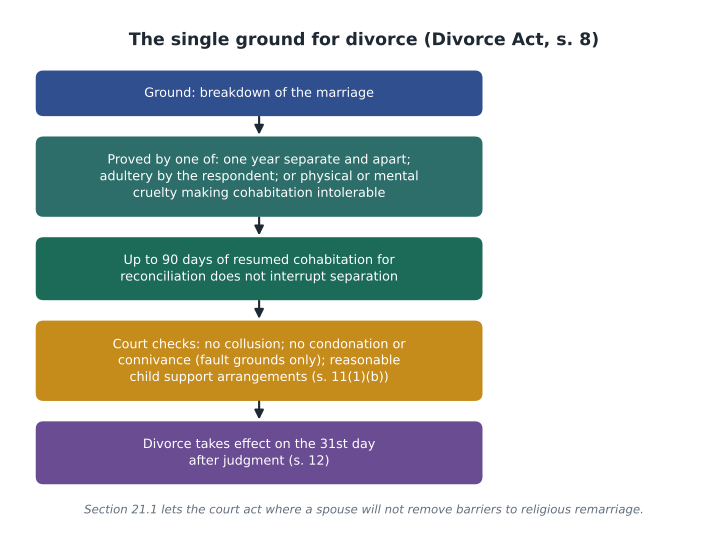
Section 8(1) of the Divorce Act says a court may grant a divorce on the ground that there has been a breakdown of the marriage. Section 8(2) says breakdown is established only if one of three things is shown. First, the spouses have lived separate and apart for at least one year immediately before the determination of the divorce proceeding and were living separate and apart when the proceeding began. Second, the spouse against whom the divorce is sought has committed adultery since the marriage. Third, that spouse has treated the other with physical or mental cruelty of such a kind as to render continued cohabitation intolerable.
In practice, almost every divorce in Canada is granted on the one-year separation ground. It requires no evidence of wrongdoing, it can be uncontested and it can be proved by affidavit. A spouse can start the proceeding immediately after separation, so long as the year has passed before the judgment. That is why Joanna can begin her case now, eight months after separation, and ask for a divorce as soon as the year is up next April.
Section 8(3) protects attempts at reconciliation. The separation period is not interrupted if the spouses resume cohabitation for a period or periods totalling not more than 90 days with reconciliation as the primary purpose. Parliament wanted to encourage couples to try again without penalizing them by restarting the clock. Separation is also not interrupted if one spouse becomes incapable of forming the intention to live apart, so long as the court thinks the separation would probably have continued.
The fault grounds are rarely used. Adultery requires proof, usually by admission, and cruelty requires conduct of a serious kind; the courts have said that mere incompatibility is not enough. A spouse might rely on a fault ground to obtain a divorce sooner than one year, but the evidence required, the cost of proving it and the fact that fault is irrelevant to support, property and parenting mean few lawyers recommend it. Section 15.2(5) of the Divorce Act says the court shall not take into consideration any misconduct of a spouse in relation to the marriage when making a spousal support order, and the same principle runs through property law. Where cruelty involves family violence, it is far more important for parenting and protection than for the divorce itself.
The bars to divorce
Section 11 places duties on the court before it grants a divorce. Under section 11(1)(a), it must be satisfied that there has been no collusion, meaning an agreement to fabricate or suppress evidence to deceive the court. Under section 11(1)(c), where the ground is adultery or cruelty, it must be satisfied that there has been no condonation (forgiving the conduct and resuming the relationship) or connivance (encouraging or permitting the conduct). Condonation and connivance do not bar a divorce based on separation.
Most important in practice, section 11(1)(b) requires the court to satisfy itself that reasonable arrangements have been made for the support of any children of the marriage, having regard to the Federal Child Support Guidelines, and to stay the divorce if they have not. This is the 'child support check'. A judge reviewing an uncontested divorce application will look for evidence that the children are being supported, normally a statement of the parents' incomes and the support being paid. If the parents have agreed to an amount below the Guidelines, the judge needs a reason: section 15.1(7) and (8) allow a lower amount if the arrangements are reasonable, for instance because of other benefits the children receive. Where the arrangements are not reasonable, the divorce waits.
The phrase 'children of the marriage' is defined in section 2(1) as a child who, at the material time, is under the age of majority and has not withdrawn from their parents' charge, or is the age of majority or over and under their charge but unable, by reason of illness, disability or other cause, to withdraw or obtain the necessaries of life. A child over 18 who is in full-time post-secondary education is commonly treated as a child of the marriage under the 'other cause' branch. The definition also includes children for whom a spouse stands in the place of a parent (section 2(2)), which can make a step-parent liable for support. Lesson 7 returns to these questions.
Religious divorce and section 21.1
A civil divorce ends the legal marriage, but in some faith traditions a religious divorce is also needed before a person can remarry within the faith. In Jewish law, for example, a husband must deliver a get, and a wife who does not receive one cannot remarry in an Orthodox ceremony. A spouse who refuses to cooperate can hold the other hostage, sometimes as leverage in the financial negotiation.
Parliament responded in 1990 with section 21.1 of the Divorce Act. A spouse can file an affidavit showing that they have removed, or will remove, the barriers within their control to the other spouse's religious remarriage, and asking the other spouse to do the same. If the other spouse does not comply, the court may dismiss that spouse's applications and strike their pleadings. In Bruker v. Marcovitz (2007 SCC 54) the Supreme Court went further and held that a husband who had promised in a settlement agreement to provide a get, and then delayed for fifteen years, was liable in damages for breach of contract. The Court said the promise was a valid civil obligation and that enforcing it did not interfere with religious freedom in a way that outweighed the public interest in equality and the right to remarry.
The 2021 duties of parties and lawyers
The 2021 amendments added sections 7.1 to 7.8, a set of duties written in plain terms. Section 7.1 requires a person to whom parenting time or decision-making responsibility is granted to exercise it in a manner consistent with the child's best interests. Section 7.2 requires a party to protect children from conflict arising from the proceeding to the best of their ability. Section 7.3, introduced in lesson 1, requires parties to try family dispute resolution where appropriate. Section 7.4 requires full, accurate and up-to-date information. Section 7.5 requires compliance with orders until they are no longer in effect.
Lawyers have their own duties in section 7.7. A legal adviser must encourage the client to try family dispute resolution, unless the circumstances are of such a nature that it would clearly not be appropriate. The adviser must inform the client of the family justice services known to them that might help, inform the client of the parties' duties under the Act, and certify in the court documents that they have done so. Ferreira points out that these are not mere courtesies; a missing certification is a defect in the application.
The duty to protect children from conflict has practical teeth. A parent who discusses the litigation with the children, criticizes the other parent in front of them, or uses them to carry messages risks findings that hurt their parenting case. Judges in Ontario regularly cite section 7.2 when making orders about communication, such as requiring parents to use a co-parenting app and to keep messages brief, informative, friendly and firm.
Getting the divorce
Under section 3, a court in a province has jurisdiction to hear a divorce proceeding if either spouse has been habitually resident in the province for at least one year immediately before the proceeding began. Joanna and Callum both live in Corwin, so the Ontario Superior Court of Justice, through its Family Court branch, has jurisdiction. If proceedings are started in two provinces, section 3(2) gives priority to the one started first. Corollary relief, meaning support and parenting orders under the Divorce Act, can be sought in the same proceeding (sections 15.1, 15.2 and 16.1).
Many divorces in Ontario are uncontested. A joint application or a simple application with no other claims can be decided on paper, using an affidavit for divorce (Form 36 under the Family Law Rules) that confirms the facts and the child support arrangements. Where the divorce is only one claim among many, the court often severs it, granting the divorce while leaving the corollary issues for later, so long as the children's support is reasonably arranged. Severance lets a spouse remarry without waiting for the whole case to finish, though a court will not sever if it would prejudice the other spouse, for example by ending their entitlement to benefits under a pension or health plan.
A divorce takes effect on the 31st day after the judgment is rendered, under section 12, unless an appeal is pending or the court shortens the period. After it takes effect, either former spouse may obtain a certificate of divorce and remarry. Section 13 says a divorce granted in Canada has legal effect throughout Canada.
The ripple effects of divorce
Divorce changes the legal status of the spouses in ways that go well beyond the family court. It can revoke gifts and appointments in a will. Since the Succession Law Reform Act was amended in 2022, Ontario also treats spouses who are separated, but not divorced, as no longer spouses for the purposes of a will or intestacy in many cases, which means a separated spouse who has not updated their will may find that their former partner is excluded anyway. Divorce may end eligibility for health or pension benefits through the other spouse's employer, which is one reason property and pension issues should be settled before the divorce takes effect. Ferreira's summary: 'The divorce is the shortest part of the file. The decisions you make around it last for decades.'
Worked problem
When can Joanna be divorced?
Joanna Sandoval and Callum Whitlow separated in April 2026, when Callum moved out. In June 2026 they tried living together again for about two months, with the aim of reconciling, but it did not work and Callum moved out again. Joanna wants to apply for divorce now, in November 2026. Can she, and when can the divorce be granted?
Show solution
- Ground: Joanna will rely on one year of separation under section 8(2)(a). No fault evidence is needed.
- Starting the case: she can start now. The spouses must be living apart when the proceeding begins, which they are, and the year must be complete by the time the court decides the divorce.
- The reconciliation attempt: under section 8(3), resumed cohabitation of not more than 90 days in total, primarily for reconciliation, does not interrupt the separation period. Two months is within the limit, so the April 2026 date still counts.
- Earliest divorce: once a full year has passed, next April, the court can grant the divorce, provided it is satisfied under section 11(1)(b) that reasonable arrangements exist for the children's support.
- Effect: the divorce takes effect 31 days after the judgment unless an appeal is pending. Joanna should settle pension and benefit issues before then, or ask the court not to sever the divorce until they are dealt with.
Common mistakes
MistakeWaiting a full year after separation before starting a divorce application.
InsteadThe application can be started immediately; the year must be complete only when the divorce is granted.
MistakePleading adultery to gain leverage in support negotiations.
InsteadMisconduct is irrelevant to spousal support under section 15.2(5); fault grounds only matter for timing.
MistakeTreating any return to cohabitation as restarting the one-year clock.
InsteadUp to 90 days in total for reconciliation does not interrupt separation under section 8(3).
MistakeIgnoring the child support check.
InsteadSection 11(1)(b) requires the court to stay the divorce unless reasonable child support arrangements exist.
Practice problems
Work each problem on paper first, then reveal the answer to check.
A spouse refuses to grant a religious divorce until the other agrees to waive spousal support. What can the other spouse do under the Divorce Act?
Show answer
File an affidavit under section 21.1 showing they have removed any barriers within their control and asking the other spouse to do the same. If the other spouse does not comply, the court may dismiss their applications and strike their pleadings. If there is a contractual promise, Bruker v. Marcovitz allows damages for breach.
Why might a court refuse to sever a divorce from the corollary issues?
Show answer
Because granting the divorce early could prejudice the other spouse, for example by ending their coverage under a pension or health benefit plan before property and support issues are resolved.
Which section of the Divorce Act requires lawyers to encourage family dispute resolution, and what must they certify?
Show answer
Section 7.7. Lawyers must encourage family dispute resolution unless it would clearly be inappropriate, inform the client of family justice services and of the client's duties under the Act, and certify in the documents that they have complied.
Summary and key terms
- The Divorce Act has one ground, breakdown of the marriage, proved by one year of separation, adultery or cruelty.
- Almost all divorces rely on one year of separation; reconciliation attempts of up to 90 days do not interrupt it.
- The court must be satisfied there is no collusion and that reasonable child support arrangements exist; condonation and connivance matter only for fault grounds.
- Section 21.1 and Bruker v. Marcovitz address religious barriers to remarriage.
- Sections 7.1 to 7.8 impose duties on parties and lawyers, including protecting children from conflict and encouraging dispute resolution.
- A divorce takes effect 31 days after judgment and has effect throughout Canada.
- Breakdown of the marriage
- The single ground for divorce under section 8 of the Divorce Act.
- Separate and apart
- The state of living apart with the intention by at least one spouse to end the marriage, which can occur under one roof.
- Collusion
- An agreement to deceive the court about the grounds for divorce, which bars the divorce.
- Condonation
- Forgiveness of adultery or cruelty followed by resumed cohabitation, which can bar a fault-based divorce.
- Corollary relief
- Support and parenting orders made under the Divorce Act alongside a divorce.
- Severance
- Granting the divorce separately before the other issues in the case are decided.
Lesson quiz · 5 questions
Score 60% or more to complete this lesson.
Create a free account to save your progress, take quizzes and earn a certificate.