
LAWC-212 · Lesson 8 of 12 · 20 min
Spousal support
▶ Video coming soon A video version of this lesson is on the way.
'Child support is about the children,' Professor Ferreira says. 'Spousal support is about the marriage, and what it did to each person's ability to support themselves.' She points to the Sandoval and Whitlow file. Before Isla was born, Joanna was a rising hospital administrator. For seven years she worked part-time, so that Callum could build his engineering firm and work long hours. Today Callum earns twice what she does. 'Is Joanna entitled to support? For how long? How much? Those are three different questions, and spousal support law answers them in a different way from child support.'
This lesson covers the statutory framework in the Divorce Act and the Family Law Act, the three bases of entitlement from Moge v. Moge and Bracklow v. Bracklow, the role of the Spousal Support Advisory Guidelines, quantum and duration, self-sufficiency, variation and review, and the relationship between spousal and child support. Unlike child support, spousal support has no binding tables. That makes it the area of family law where judgment, evidence and advocacy matter most.
The statutory framework
Under the Divorce Act, section 15.2(1) lets a court order a spouse to pay support to the other spouse. Section 15.2(4) lists the factors: the condition, means, needs and other circumstances of each spouse, including the length of time they cohabited, the functions each performed during cohabitation, and any order, agreement or arrangement about support. Section 15.2(6) lists four objectives: to recognize any economic advantages or disadvantages to the spouses arising from the marriage or its breakdown; to apportion between them any financial consequences arising from the care of any child of the marriage beyond child support; to relieve any economic hardship arising from the breakdown; and in so far as practicable, to promote the economic self-sufficiency of each spouse within a reasonable period of time. Section 15.2(5) excludes misconduct.
Ontario's Family Law Act has its own provisions in Part III. Section 30 says every spouse has an obligation to provide support for themselves and for the other spouse, in accordance with need, to the extent they are capable of doing so. Section 33(8) sets out purposes similar to the Divorce Act's objectives, and section 33(9) lists factors, including the dependant's and respondent's assets and means, their capacity to contribute, the dependant's age and health, the length of cohabitation, and contributions to the relationship and to the other spouse's career. Section 33(10) allows the court to consider a course of conduct that is so unconscionable as to constitute an obvious and gross repudiation of the relationship, but this is rarely applied. Unmarried spouses who qualify under section 29 (lesson 2) claim under Part III.
Three bases for entitlement
The Supreme Court has described three bases for spousal support. The first is compensatory. In Moge v. Moge (1992), Mrs. Moge had worked part-time cleaning offices while raising three children during a long marriage, and her support was terminated after the children grew up because she was thought to have had time to become self-sufficient. Justice L'Heureux-Dubé, for the Court, rejected that approach. She held that self-sufficiency is only one of four objectives, and not the most important; that the Act requires courts to recognize the economic disadvantages a spouse suffers because of the roles adopted in the marriage, such as lost career opportunities from childcare; and that the feminization of poverty after divorce is a real social consequence that the law must address. Compensatory support recognizes that a spouse who gave up earning power, or helped the other spouse increase theirs, is entitled to be compensated.
The second basis is non-compensatory, sometimes called needs-based. In Bracklow v. Bracklow (1999), Mrs. Bracklow became seriously ill during a seven-year marriage and could not work. Her illness was not caused by the marriage and she had not sacrificed a career for it. The Court, in reasons by Justice McLachlin, held that she was still entitled to support. Marriage is a relationship of mutual obligation, and the Divorce Act's objective of relieving economic hardship from the breakdown supports a claim based on need, even without compensation. The amount and duration were left to the trial judge, who later ordered support for a fixed term.
The third basis is contractual. Where the spouses have agreed to support, or agreed to waive it, the agreement is the starting point (lesson 4). Under Miglin, a court asks whether the agreement was negotiated fairly and substantially complies with the Act, and whether it still reflects the parties' intentions in their current circumstances.
A spouse can be entitled on more than one basis. Many long marriages produce both compensatory claims, because one spouse took on more child care, and needs-based claims, because the dependent spouse cannot maintain a reasonable standard of living on their own. Entitlement is a threshold question; amount and duration come after.
The Spousal Support Advisory Guidelines
Before 2008, spousal support amounts varied widely between judges and provinces, and lawyers found it hard to predict outcomes. The Spousal Support Advisory Guidelines, developed by Professors Carol Rogerson and Rollie Thompson with the support of the federal Department of Justice and released in final form in 2008, responded to that problem. A user's guide was published in 2016. The Guidelines are not law, but the Court of Appeal for Ontario endorsed their use in Fisher v. Fisher (2008 ONCA 11) as a useful tool to check the reasonableness of an award, and courts and lawyers across the country use them every day, usually through software.
The Guidelines do not decide entitlement. They assume it has been established and produce a range for amount and duration. The two main formulas depend on whether child support is also being paid.
The without child support formula applies where there are no dependent children. The amount ranges from 1.5 to 2 percent of the difference between the spouses' gross incomes for each year of cohabitation, up to a maximum of 50 percent of the difference (reached at 25 years). The duration ranges from half a year to one year of support for each year of cohabitation. Support becomes indefinite, meaning without a set end date but subject to variation, if the marriage lasted 20 years or more, or if the years of cohabitation plus the recipient's age at separation equal 65 or more, the 'rule of 65'.
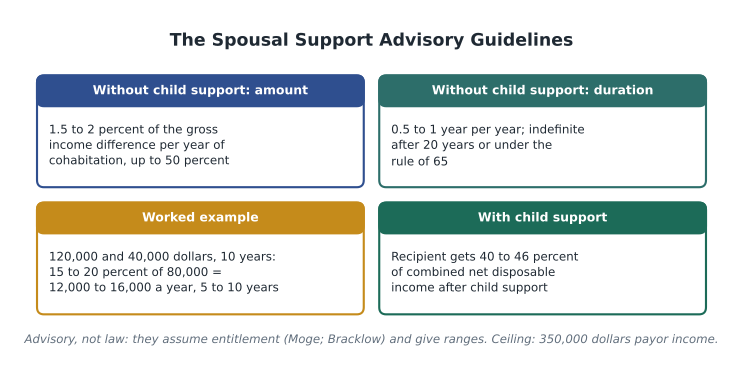
The with child support formula applies where child support is also being paid. It works with individual net disposable income, meaning each spouse's income after taxes, government benefits and child support. The range is set so that the recipient spouse ends up with between 40 and 46 percent of the combined individual net disposable income. Duration is tied both to the length of the relationship and to the age of the youngest child, reflecting the ongoing child care. Variations of the formula apply to shared and split parenting and to custodial payors.
Within the range, courts choose a point based on the strength of the compensatory claim, the recipient's needs, the payor's ability to pay, the age and number of children, and property division. The Guidelines also recognize exceptions, such as compelling financial circumstances in the interim period, debt payment, prior support obligations, illness or disability, and a compensatory claim that is unusually strong in a short marriage. Above a payor income of 350,000 dollars, the Guidelines say the formulas are no longer presumptively applied and the court has more discretion.
Quantum, duration and self-sufficiency
Self-sufficiency is one of the Divorce Act's objectives, but Moge warned against using it to cut off support prematurely. In practice, courts often order support for a defined period or until a review, expecting the recipient to retrain or return to work. A time-limited order is more common after a shorter relationship without children; indefinite support is more common after a long traditional marriage where the recipient is older and has been out of the workforce. 'Indefinite' does not mean permanent: the order continues until varied, and changes such as retirement, remarriage or a significant change in the payor's income can justify variation.
Courts distinguish review orders from variation orders. A review order sets a date for the court to look at support again without either party having to prove a material change, for example after the recipient has finished retraining. In Leskun v. Leskun (2006 SCC 25), the Supreme Court warned that review orders should be used sparingly, for specific and identified uncertainties, because they undermine finality. Variation, by contrast, requires a material change in circumstances under section 17(4.1) of the Divorce Act, as interpreted in Willick v. Willick (1994) and L.M.P. v. L.S. (2011 SCC 64): a change that, if known at the time, would likely have resulted in different terms.
Spousal support and child support together
Child support has priority. Section 15.3 of the Divorce Act says that where the court is asked to make both, it must give priority to child support, and if that leaves the payor unable to pay spousal support, the court can reduce spousal support and revisit it when child support ends. In practice, the with child support formula takes this into account by working from net disposable income after child support.
Spousal support also interacts with property. A large equalization payment can reduce the recipient's need for support, and some courts adjust support to reflect that the recipient has assets to draw on. Boston v. Boston (2001 SCC 43) addressed 'double dipping' in pensions: where a pension has been divided as property, a court generally should not order spousal support out of the same pension income, at least where the support is not needs-based. These interactions are why Ferreira insists that lawyers work out the whole financial picture before negotiating any single issue.
Interim support, lump sums and security
Most spousal support cases begin with an interim order, made on motion soon after separation, which keeps the dependent spouse afloat until trial. Interim orders are made on limited evidence, so courts focus on need and ability to pay and generally leave difficult entitlement questions for trial. The Spousal Support Advisory Guidelines are often used at this stage, sometimes at the higher end of the range to deal with the costs of setting up a second household. A payor who believes the claim is weak should still take an interim motion seriously, because the interim arrangement often shapes the settlement.
Support does not have to be periodic. Section 15.2(1) of the Divorce Act and section 34(1) of the Family Law Act allow a lump sum, which can give a clean break where the payor has assets and the relationship between the spouses is poor. Lump sums are not deductible for the payor, so they are usually calculated on an after-tax basis. Courts can also order security for support. Section 34(1)(i) of the Family Law Act allows an order requiring a spouse to maintain life insurance naming the dependant as beneficiary, and courts often require insurance for both spousal and child support so that the payments survive the payor's death. A charge on property is another option where there is a risk of default.
Imputing income applies to recipients as well as payors. A recipient who could reasonably earn more, and is not doing so for reasons connected to the children, health or reasonable retraining, may have income imputed for the purpose of the formulas. The question is reasonableness in light of the roles adopted during the marriage. Expecting a spouse who has been out of the workforce for fifteen years to earn immediately at their former level is not reasonable; expecting a gradual return over a defined period may be.
Tax and enforcement
Periodic spousal support paid under a written agreement or court order is generally deductible to the payor and taxable to the recipient under the Income Tax Act. Lump-sum payments are not. Child support paid under an agreement or order made after April 30, 1997 is neither deductible nor taxable, which is why the tables use after-tax figures. Spousal support orders are enforced, like child support, by the Family Responsibility Office.
Applying the law to Joanna
Joanna has a strong compensatory claim. For seven years she worked part-time and took primary responsibility for the children, while Callum built his firm. That arrangement benefited Callum's earning capacity and reduced hers. She is now working full-time and earns 70,000 dollars, while Callum earns 140,000 dollars. Because there are dependent children, the with child support formula applies. Ferreira notes that the outcome will depend on the property division too: if Joanna receives a significant equalization payment for Callum's share of the firm, her need may be lower, though her compensatory claim remains.
Worked problem
A without-child-support estimate
Ferreira gives the class a simpler case to practise the formula. Dev and Lucy separate after 10 years of marriage with no children. Dev earns 120,000 dollars a year; Lucy earns 40,000 dollars. Lucy is 42. Lucy gave up a promotion to move for Dev's job. Estimate the Spousal Support Advisory Guidelines range for amount and duration.
Show solution
- Entitlement: Lucy has a compensatory claim (the lost promotion and relocation) and a needs-based claim given the income gap. Entitlement is likely.
- Income difference: 120,000 minus 40,000 equals 80,000 dollars.
- Amount range: 1.5 to 2 percent for each of 10 years equals 15 to 20 percent of 80,000, or 12,000 to 16,000 dollars a year, about 1,000 to 1,333 dollars a month.
- Duration: half a year to one year per year of cohabitation equals 5 to 10 years. The rule of 65 does not apply because 42 plus 10 equals 52.
- Placement: the compensatory element supports a point in the middle or upper part of the range. The court would also consider the tax deductibility of periodic payments and any property division.
Common mistakes
MistakeTreating the Spousal Support Advisory Guidelines as deciding entitlement.
InsteadThe Guidelines assume entitlement and produce ranges; entitlement depends on the Act and the case law.
MistakeArguing that a spouse's affair reduces spousal support.
InsteadSection 15.2(5) of the Divorce Act excludes misconduct.
MistakeTelling a client indefinite support means permanent support.
InsteadIndefinite means no set end date; the order can be varied on a material change.
MistakeAsking for a review order as a matter of routine.
InsteadLeskun says review orders should be limited to specific, identified uncertainties.
Practice problems
Work each problem on paper first, then reveal the answer to check.
What were the key holdings of Moge v. Moge?
Show answer
Self-sufficiency is only one objective and not paramount; courts must recognize economic disadvantages flowing from roles in the marriage, such as child care; and the economic consequences of marriage breakdown, including the feminization of poverty, must be addressed through compensatory support.
A spouse became disabled during a short marriage for reasons unrelated to the marriage. Can they receive support?
Show answer
Yes. Bracklow recognizes a non-compensatory, needs-based basis grounded in the mutual obligation of marriage and the objective of relieving economic hardship. The amount and duration may be limited.
Apply the rule of 65 to a 55-year-old recipient after a 12-year marriage with no children.
Show answer
55 plus 12 equals 67, which is 65 or more, so under the without child support formula support would be indefinite in duration, subject to variation.
Summary and key terms
- Spousal support under the Divorce Act and the Family Law Act balances four objectives, with no priority for self-sufficiency.
- Entitlement can be compensatory (Moge), non-compensatory or needs-based (Bracklow), or contractual (Miglin).
- The Spousal Support Advisory Guidelines produce ranges for amount and duration once entitlement is established; Fisher v. Fisher endorsed them in Ontario.
- The without child support formula uses 1.5 to 2 percent of the income difference per year and half to one year of duration per year, with indefinite support after 20 years or under the rule of 65.
- The with child support formula targets 40 to 46 percent of combined net disposable income for the recipient.
- Child support has priority, and support interacts with property and tax.
- Compensatory support
- Support that recognizes economic disadvantages, such as lost career opportunities, arising from the roles in the marriage.
- Needs-based support
- Support based on economic hardship after the breakdown, even without a compensatory claim.
- Spousal Support Advisory Guidelines
- Advisory formulas, released in 2008, that produce ranges for spousal support amount and duration.
- Rule of 65
- Under the Advisory Guidelines, support is indefinite if years of cohabitation plus the recipient’s age at separation equal 65 or more.
- Indefinite support
- Support with no fixed end date, subject to variation.
- Review order
- An order setting a future date to reconsider support without proof of a material change.
Lesson quiz · 5 questions
Score 60% or more to complete this lesson.
Create a free account to save your progress, take quizzes and earn a certificate.