
LAWC-212 · Lesson 2 of 12 · 20 min
Marriage and cohabitation
▶ Video coming soon A video version of this lesson is on the way.
Professor Ferreira opens the second class with a question that sounds too simple. 'Are Joanna Sandoval and Callum Whitlow married?' The students look at each other; the file says they married eleven years ago. 'Prove it,' she says. 'What makes a marriage valid, and why would anyone care?' The answer, it turns out, matters a great deal. Only married spouses can divorce, only married spouses can claim an equalization of net family property under Part I of the Family Law Act, and only married spouses have the special matrimonial home rights in Part II. An unmarried partner can claim spousal support in Ontario, but only if the relationship meets the statutory definition. Before any other family law question, a lawyer has to know the status of the relationship.
This lesson covers the legal requirements for a valid marriage, the difference between void and voidable marriages, the definitions of 'spouse' in Ontario's Family Law Act, and the growing importance of cohabitation. Canada has one of the highest rates of unmarried cohabitation in the world, especially in Quebec, and the law has spent forty years deciding how far to treat those relationships like marriage.
Capacity and formalities
Recall from lesson 1 that the Constitution divides marriage. Parliament controls capacity, meaning who may marry whom, and the provinces control the solemnization of marriage, meaning the formalities. A marriage is valid in Ontario only if both sets of rules are met, though the consequences of failing each are different.
The federal capacity rules are now largely codified. The Civil Marriage Act, passed in 2005 after the Supreme Court's opinion in Reference re Same-Sex Marriage (2004 SCC 79), defines marriage for civil purposes as 'the lawful union of two persons to the exclusion of all others'. Section 2.1 requires the free and enlightened consent of each person. Section 2.2 sets an absolute minimum age of 16. Section 2.3 prohibits marriage while either person is still married to someone else, and the Marriage (Prohibited Degrees) Act prohibits marriage between people related lineally, or as siblings or half-siblings, whether by blood or adoption. The 2004 reference also confirmed that religious officials cannot be compelled to perform marriages contrary to their beliefs, and section 3 of the Civil Marriage Act says so expressly.
Ontario's Marriage Act supplies the formalities. A couple needs a marriage licence, or the publication of banns in a religious ceremony. The person solemnizing the marriage must be authorized: a registered religious official, a judge, a justice of the peace, or a licensed municipal officiant. The ceremony needs two witnesses. A person who is 16 or 17 needs the written consent of both parents, subject to court dispensation. Ontario requires 18 for marriage without parental consent.
Failure to meet the formalities is less serious than it sounds. Section 31 of the Marriage Act saves a marriage solemnized in good faith, with the intention to comply with the Act, if neither party was under a legal disqualification and the couple lived together as a married couple afterward. A licence error or an officiant whose registration had lapsed will not usually invalidate a marriage that the couple believed was valid and lived as one.
Void and voidable marriages
The common law distinguishes two kinds of defective marriage. A void marriage was never valid: no court order is needed to say so, although one is often sought for certainty. A marriage is void if either person was already married, if the parties are within the prohibited degrees, if either person was under 16, or if a person did not consent at all, for example because they were coerced by threats so serious that their will was overborne or because they lacked the mental capacity to understand the nature of marriage. A voidable marriage is valid until annulled by a court, and only the parties can seek to annul it. The classic ground of voidability is the inability to consummate the marriage.
Forced marriage gets particular attention. In 2015 Parliament amended the Civil Marriage Act and the Criminal Code to strengthen the consent requirement and to make it an offence to celebrate, aid or participate in a marriage knowing that a person is marrying against their will. Courts have annulled marriages where family pressure or threats removed genuine consent. Ferreira tells the class that a lawyer who meets a young client describing pressure to marry should think about safety first, and that lesson 11 covers protective orders.
Annulment matters because a void marriage does not create the status of married spouses. Even so, Ontario's Family Law Act extends some protection. The definition of 'spouse' in section 1(1) includes a person who entered into a marriage that is void or voidable in good faith on their part. A spouse who believed in the marriage can therefore claim equalization and support even though the marriage was never valid.
Foreign marriages and foreign divorces
Ontario recognizes a marriage celebrated abroad if it complied with the formalities of the place of celebration and each party had capacity under the law of their domicile, subject to Canadian public policy. A polygamous marriage, though, is not one Canada will recognize as a valid marriage, and polygamy remains a criminal offence under section 293 of the Criminal Code; the British Columbia Supreme Court upheld the prohibition in 2011 in the reference on its constitutionality. The Family Law Act's definition of spouse does include a party to a marriage that is actually or potentially polygamous if it was celebrated in a jurisdiction whose system of law recognizes it as valid, which allows support and property claims.
A foreign divorce is recognized under section 22 of the Divorce Act if either former spouse was habitually resident in the foreign country for at least one year before the proceedings began, or under the common law rules, which generally ask whether there was a real and substantial connection between the jurisdiction and either spouse. A divorce obtained without proper notice, or in breach of natural justice, may not be recognized. These questions arise more often than students expect in a city like Corwin, with many families who married abroad.
Who counts as a spouse
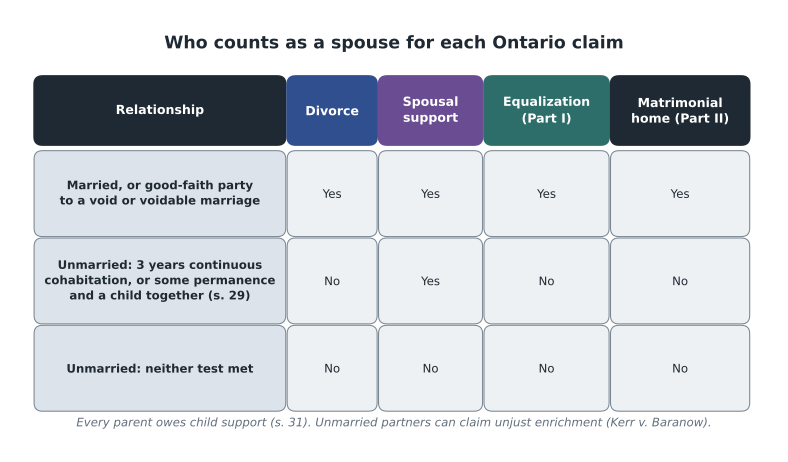
Ontario's Family Law Act uses two definitions of 'spouse'. Section 1(1) defines spouse, for most of the Act, as either of two persons who are married to each other or who have entered into a marriage that is void or voidable in good faith. That is the definition for Part I (property) and Part II (the matrimonial home). Section 29, which applies to Part III (support), extends the definition to two persons who are not married and who have cohabited continuously for a period of not less than three years, or who have cohabited in a relationship of some permanence and are the natural or adoptive parents of a child.
The result is the table in the figure below. An unmarried partner in Ontario can claim spousal support if they meet section 29, but cannot claim an equalization payment or matrimonial home rights, however long the relationship lasted. Their only property remedies are the general equitable claims of unjust enrichment and constructive or resulting trust, covered in lesson 10. Child support is different again: every parent owes support to their child under section 31 of the Family Law Act, whether or not the parents were ever spouses.
The Supreme Court upheld this distinction in Nova Scotia (Attorney General) v. Walsh (2002 SCC 83). Nova Scotia's matrimonial property law applied only to married couples, and an unmarried partner argued that this discriminated on the ground of marital status, contrary to section 15 of the Charter. The majority disagreed: the distinction respected the autonomy of couples who had chosen not to marry, and they could opt into a property regime by contract. In Quebec (Attorney General) v. A (2013 SCC 5) the Court reached a similar result about Quebec's Civil Code, though by a different and much more divided route. A majority found that the exclusion of de facto spouses from support and property rights did infringe section 15, but a different majority held the infringement justified under section 1. Quebec has since created a 'parental union' regime for unmarried parents of children born or adopted on or after June 30, 2025, but that regime is specific to Quebec and has no Ontario equivalent.
What counts as cohabiting
Cohabiting is defined in section 1(1) of the Family Law Act as living together in a conjugal relationship, whether within or outside marriage. The classic list of factors comes from Molodowich v. Penttinen (1980), an Ontario District Court decision still cited constantly: shelter, sexual and personal behaviour, services such as meals and household tasks, social activities, how the couple was seen by the community, financial support and attitudes toward children. No single factor is decisive and not all need to be present. Couples can cohabit while living in separate homes, and can live under one roof without cohabiting.
Continuity matters for the three-year test. Short breaks will not necessarily end cohabitation, but a genuine separation restarts the clock. The phrase 'relationship of some permanence' in the second branch has been read to require a stable relationship, though not necessarily one that has lasted any set time, and courts look at the same factors. Where there is a child, a brief relationship with a shared household can qualify.
The date the relationship started and the date it ended matter a great deal. Section 7(3) gives married spouses two years after a divorce, or six years after separation, to make a property claim. Section 16(1)(c) of the Limitations Act, 2002 sets no limitation period for a support claim under the Family Law Act, but delay can still limit retroactive support (lesson 7). The separation date also fixes the valuation date for property (lesson 9). The Court of Appeal's decision in Kassabian v. Marcarian (2025 ONCA 239) is a recent example of a court working through competing evidence about when a couple separated, looking at the whole of the relationship rather than one event.
Separation while living under one roof
Separation does not always mean that one spouse moves out. Housing costs, children and money mean many couples continue to live in the same home after the relationship has ended. Section 8(3) of the Divorce Act says spouses are deemed to have lived separate and apart for any period during which they lived apart and either of them had the intention to do so, and the case law accepts that spouses can be separate under one roof. Courts look at whether they still share a bedroom, meals, social life and finances, and whether they presented themselves as a couple. Evidence such as a text saying 'this is over' or a change in how bills are paid can be important. Ferreira tells the class that the separation date is one of the most fought-over facts in family law precisely because so much turns on it.
The Sandoval and Whitlow marriage
Back to the file. Joanna and Callum married in a civil ceremony at Corwin City Hall, with a licence and two witnesses, eleven years ago. Both were over 18 and single. The marriage is valid: capacity was present and the formalities were met. They separated last April, when Callum moved into a rented apartment, although they had stopped sharing a bedroom months earlier. That earlier date could matter for valuation, and Ferreira flags it as a point to develop with the client.
Ferreira adds a second couple who will reappear in lesson 10. Yusuf Rahman and Bridget O'Neill lived together in Corwin for seven years without marrying and have no children. Bridget left a nursing job to help run Yusuf's landscaping business, unpaid. When they separated, she discovered that the house and the business were both in Yusuf's name. 'Bridget is a spouse for support purposes under section 29, because they cohabited for more than three years,' Ferreira says. 'She is not a spouse for Part I, so she has no equalization claim. Her property claim has to be built on unjust enrichment. That is the gap Walsh left, and it catches clients who assumed that living together for years was the same as being married.'
Worked problem
Is Bridget a spouse?
Yusuf Rahman and Bridget O'Neill cohabited continuously for seven years in Ontario without marrying. They have no children. Bridget wants spousal support and half of the increase in value of the house and business, both in Yusuf's name. Which claims can she make under the Family Law Act?
Show solution
- Status: they are not married, so the section 1(1) definition of spouse for Parts I and II does not apply.
- Support: under section 29, two persons who have cohabited continuously for not less than three years are spouses for Part III. Seven years of cohabitation qualifies, so Bridget can claim spousal support.
- Property: she cannot claim equalization under Part I, because that is limited to married spouses. Walsh confirms that this limit does not breach the Charter.
- Alternative: her claim to share in the house and business must be framed as unjust enrichment, with a monetary award or constructive trust remedy, under Kerr v. Baranow (lesson 10).
- Timing: she should act promptly, because equitable claims are subject to the Limitations Act, 2002 and evidence fades.
Common mistakes
MistakeTelling an unmarried client they have the same property rights as a married spouse after three years.
InsteadThree years of cohabitation creates support rights only. Equalization and matrimonial home rights require marriage.
MistakeAssuming a defect in the licence or officiant makes a marriage void.
InsteadSection 31 of the Marriage Act saves a marriage solemnized in good faith where the couple lived together as married.
MistakeTreating separation as impossible while spouses share a home.
InsteadSpouses can be separate under one roof; courts look at the substance of the relationship.
MistakeAssuming Quebec's 2025 parental union regime applies in Ontario.
InsteadIt is a Quebec Civil Code regime; Ontario has no equivalent.
Practice problems
Work each problem on paper first, then reveal the answer to check.
Two people married in good faith, but one was, unknown to the other, still married to someone else. Is the second marriage valid, and can the innocent party claim equalization?
Show answer
The marriage is void because of the prior subsisting marriage. But the Family Law Act definition of spouse includes a person who entered into a void marriage in good faith, so the innocent party can claim equalization and support.
A couple dated for four years, kept separate apartments, but spent most nights together, shared holidays and finances, and were known to friends as a couple. Did they cohabit?
Show answer
Possibly. Cohabiting means living together in a conjugal relationship, and the Molodowich factors look at the whole relationship. Separate homes do not rule it out. The court would weigh shared finances, social perception and personal behaviour against the separate residences.
What did the Supreme Court decide in Walsh, and why?
Show answer
It held that excluding unmarried couples from Nova Scotia's matrimonial property regime did not violate section 15 of the Charter, because the distinction respected the choice of couples who had not married and they could still contract into property sharing.
Summary and key terms
- Parliament sets capacity to marry (consent, age 16, no prior marriage, prohibited degrees); Ontario sets formalities (licence or banns, authorized officiant, witnesses).
- A void marriage was never valid; a voidable marriage is valid until annulled. A good-faith party to a void marriage is still a spouse under the Family Law Act.
- Married spouses can claim divorce, support, equalization and matrimonial home rights.
- Unmarried partners are spouses for support only, after three years of continuous cohabitation or a relationship of some permanence with a child.
- Walsh and Quebec v. A uphold the different treatment of married and unmarried couples.
- Spouses can be separated under one roof, and the separation date drives valuation and limitation periods.
- Capacity to marry
- The federal requirements, such as consent, minimum age and the absence of a prior marriage, that determine who may marry.
- Solemnization
- The provincial formalities of the marriage ceremony, such as the licence, officiant and witnesses.
- Void marriage
- A marriage that was never legally valid, for example because one party was already married.
- Voidable marriage
- A marriage that is valid until a court annuls it at the request of a party.
- Cohabit
- Under the Family Law Act, to live together in a conjugal relationship, inside or outside marriage.
- Section 29 spouse
- An unmarried partner who qualifies for spousal support under Part III of the Family Law Act.
Lesson quiz · 5 questions
Score 60% or more to complete this lesson.
Create a free account to save your progress, take quizzes and earn a certificate.