
LAWC-212 · Lesson 1 of 12 · 22 min
Family law in Canada: jurisdiction, courts and process
▶ Video coming soon A video version of this lesson is on the way.
Professor Nadia Ferreira walks into the first class of Family Law carrying a single file folder. She spent sixteen years in family practice in Corwin, half of it at the legal clinic and half at a small firm, before joining Brannock, and she now sits as a part-time family mediator. 'Most of you will never run a murder trial,' she says. 'Almost all of you will have a friend, a client, a sibling or a parent go through a separation. Family law is the area of law that ordinary people meet most often, and usually at the worst moment of their lives.' She opens the folder. 'This term we follow one family. Joanna Sandoval and Callum Whitlow married eleven years ago, have two children, Isla, who is nine, and Rowan, who is six, and separated last spring. Everything in this file is invented. Every problem in it is real.'
Arjun Mehta asks the question everyone is thinking: is there one statute that governs all of this? Ferreira shakes her head. 'There are at least five, from two levels of government, applied by three different courts depending on where you live. Your first job as a family lawyer is to work out which law applies and which court can hear the case. Get that wrong and you can spend a year in the wrong place.'
This lesson builds the map for the rest of the course. It explains how the Constitution divides family law, which statutes do what, which Ontario courts hear family cases, how a family case moves through the Family Law Rules, and the out-of-court processes that resolve most family disputes. Later lessons apply the substantive law to the Sandoval and Whitlow file.
How the Constitution divides family law
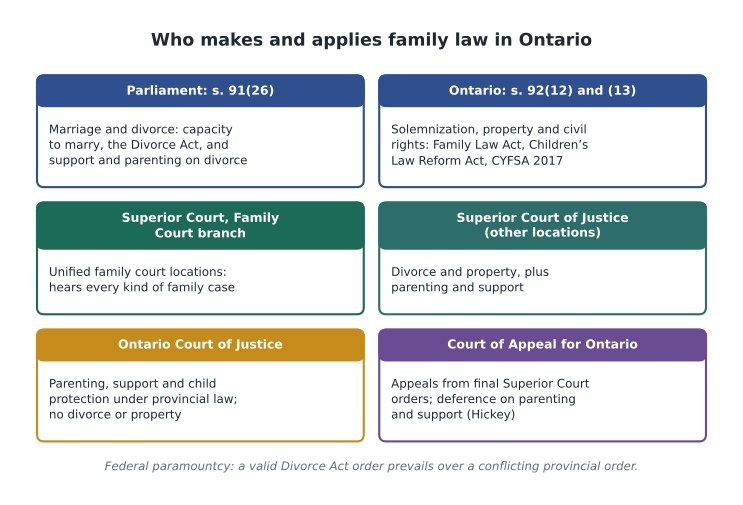
Family law is split between Parliament and the provinces. Section 91(26) of the Constitution Act, 1867 gives Parliament exclusive power over 'Marriage and Divorce'. Section 92(12) gives the provinces power over 'the Solemnization of Marriage in the Province', and section 92(13) gives them 'Property and Civil Rights in the Province'. The courts have read these heads together. Parliament controls who has the capacity to marry and the law of divorce, including the support and parenting orders that come with a divorce. The provinces control the formalities of a marriage ceremony, the division of property, support and parenting between people who are not divorcing, and child protection.
This produces two parallel systems. A married couple who divorce in Ontario will usually ask for parenting and support orders under the federal Divorce Act, and for property division under Ontario's Family Law Act, because Parliament has no general power over property. An unmarried couple, or a married couple who separate but do not ask for a divorce, will ask for parenting orders under Ontario's Children's Law Reform Act and support under Part III of the Family Law Act. The tests are now very similar, partly because both levels of government amended their statutes together in 2021, but the statute you plead still matters. It determines which court can hear the case, who counts as a spouse, and which limitation periods apply.
Where a valid federal law and a provincial law conflict, federal paramountcy means the federal law prevails. In practice, section 15 of the Divorce Act and the provincial support provisions are designed to work together: once a court makes a support order under the Divorce Act, it governs, and a provincial order on the same issue is generally stayed or superseded. You studied paramountcy in Constitutional Law I; family law is one of its most common practical settings.
The main statutes
Five statutes do most of the work in an Ontario family file. The Civil Marriage Act, passed by Parliament in 2005, defines marriage for civil purposes as 'the lawful union of two persons to the exclusion of all others'. Ontario's Marriage Act governs licences, officiants and the ceremony. The Divorce Act, a federal statute, sets the ground for divorce and governs child support, spousal support and parenting orders on or after divorce. Ontario's Family Law Act covers property division between married spouses (Part I), the matrimonial home (Part II), support for spouses, including some unmarried spouses, and for children (Part III), domestic contracts (Part IV) and claims by family members for a relative's wrongful death or injury (Part V). The Children's Law Reform Act covers parentage and parenting orders outside divorce, and the Child, Youth and Family Services Act, 2017 governs child protection.
Regulations do much of the detailed work. The Federal Child Support Guidelines set child support under the Divorce Act, and Ontario's Child Support Guidelines, which are almost identical, set it under the Family Law Act. The federal government updated the tables in the Guidelines for the first time since 2017, and the 2025 tables came into force on October 1, 2025. The Family Law Rules, a regulation under the Courts of Justice Act, govern procedure in family cases in every Ontario court. Ferreira tells the class to bookmark the consolidated versions on Justice Laws and e-Laws, because both are amended often and a summary in an old textbook may be out of date.
Two other sources matter. The first is the case law of the Supreme Court of Canada, which has shaped spousal support (Moge, Bracklow, Miglin), child support (D.B.S., Michel v. Graydon, Colucci), relocation (Gordon v. Goertz, Barendregt v. Grebliunas) and the property rights of unmarried couples (Pettkus v. Becker, Kerr v. Baranow). The second is the Spousal Support Advisory Guidelines, a 2008 academic project funded by the federal Department of Justice. They are not law, but Ontario courts use them routinely to check whether a proposed amount and duration of spousal support is reasonable (lesson 8).
Which court hears a family case
Ontario has three kinds of family court, and which one hears a case depends partly on where the family lives. In unified family court locations, the Family Court branch of the Superior Court of Justice hears every kind of family case: divorce, property, support, parenting and child protection. Unified family courts have operated in Ontario since a pilot in Hamilton in 1977 and have expanded several times; Corwin, in our fictional geography, is one of the unified locations.
Where there is no unified family court, the work is split. The Superior Court of Justice hears divorce and property claims, because those are matters for a court whose judges are appointed under section 96 of the Constitution Act, 1867. The Ontario Court of Justice, whose judges are provincially appointed, hears parenting and support claims under provincial statutes and child protection cases, but cannot grant a divorce or divide property. A family that needs both a divorce and a property order in a non-unified location must go to the Superior Court for those issues, though that court can also deal with parenting and support. Ferreira calls this 'the most avoidable jurisdictional mistake in Ontario practice': a parent who starts a support case in the Ontario Court of Justice and then realizes the property issues are worth more than the support.
Appeals follow the same divide. An appeal from a final order of the Ontario Court of Justice in a family case generally goes to the Superior Court, and an appeal from a final order of the Superior Court goes to the Court of Appeal for Ontario. Appellate courts give considerable deference to trial judges on parenting and support. In Hickey v. Hickey (1999) the Supreme Court said support orders deserve 'significant deference' because they involve the balancing of many factors, and in Barendregt v. Grebliunas (2022) it repeated that appellate intervention in parenting decisions is narrowly confined.
How a family case moves through the Family Law Rules
The Family Law Rules (O. Reg. 114/99) are written with a primary objective in rule 2: to deal with cases justly, which includes ensuring a fair procedure, saving expense and time, and dealing with cases in ways appropriate to their importance and complexity. Rule 2 also gives the court a duty to promote that objective by actively managing cases. This is very different from civil litigation, where the parties drive the pace. In family cases a judge is involved from the first conference.
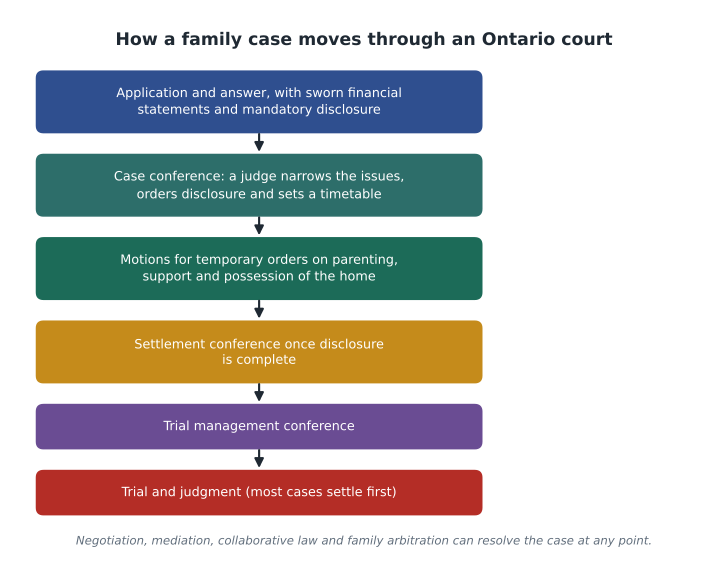
A case usually begins with an application (Form 8 or a variant), served on the other party, who files an answer. Where support or property is claimed, each party must serve a sworn financial statement and the documents the rules require, such as three years of income tax returns and notices of assessment. Financial disclosure is described by the Court of Appeal as 'the most basic obligation in family law' (Roberts v. Roberts, 2015 ONCA 450), and failure to disclose is one of the main reasons family cases drag on. The court can strike pleadings or draw adverse inferences against a party who refuses to disclose.
Before any motion other than an urgent one, the parties must attend a case conference. A judge or associate judge meets the parties, identifies the issues, explores settlement, orders disclosure and sets a timetable. Temporary orders for parenting and support are made on motion, usually on affidavit evidence, and often decide the shape of the family's life for the year or more until trial. A settlement conference follows once disclosure is complete; the judge may give a frank view of the likely outcome. A trial management conference prepares the case for trial. Offers to settle under rule 18 have costs consequences, just as rule 49 offers do in civil cases.
The rules are amended frequently. In January 2025, for example, O. Reg. 9/25 replaced rule 43 with a process for binding judicial dispute resolution in designated Superior Court locations: where a case has no significant credibility issues and can likely be decided summarily, the parties can ask a judge to hear it in a streamlined, binding process instead of a full trial. Further amendments followed in 2025 and 2026. Ferreira's advice is blunt: never rely on a form number or a rule number you remember from a course; check the current version on e-Laws.
Resolving family disputes outside court
Most family cases never reach trial. The Divorce Act now says so directly. Since the 2021 amendments, section 7.3 requires parties, to the extent appropriate, to try to resolve matters through a family dispute resolution process, and section 7.7 requires legal advisers to encourage clients to do so unless it would clearly be inappropriate because of family violence. 'Family dispute resolution process' is defined to include negotiation, mediation and collaborative law.
Negotiation between lawyers remains the most common route, usually ending in a separation agreement (lesson 4). Mediation uses a neutral third party who helps the parties reach their own agreement; it can be closed, meaning the mediator cannot later report on what was said, or open. Collaborative law is a structured negotiation in which both parties and their lawyers sign an agreement that the lawyers will withdraw if the case goes to court, which gives everyone an incentive to settle. Family arbitration, governed in Ontario by sections 59.1 to 59.8 of the Family Law Act and the Arbitration Act, 1991, produces a binding decision from a private arbitrator. Since 2007, Ontario has required family arbitrations to be conducted under the law of Ontario or another Canadian jurisdiction, so a decision based on religious law is not a valid family arbitral award, and both parties must receive independent legal advice before the arbitration agreement.
Screening for family violence and power imbalances runs through all of these processes. Mediation and arbitration assume two people who can negotiate safely; where one partner has controlled or frightened the other, a 'private' process can reproduce that control. Ontario requires family arbitrators to screen the parties separately for power imbalances and family violence before the arbitration begins, and accredited mediators do the same. Lesson 11 returns to family violence in detail.
The ethics and emotions of family practice
Family law raises professional issues that the Rules of Professional Conduct address in general terms. A family lawyer cannot act for both spouses in a separation; the interests are too directly opposed. Independent legal advice is a practical requirement for an enforceable domestic contract (lesson 4). The lawyer's duty is to the client, but the Divorce Act and the case law repeatedly tell lawyers and judges that the children's interests come first. Ferreira puts it this way: 'Your client is the parent. Your audience is a judge whose only question is what is best for the child. If you forget that, you will lose, and you will deserve to.'
Theo Marchetti, who spent ten years as a litigation law clerk, says family files were the ones his old firm dreaded. Ferreira nods. 'They are hard because people are frightened, angry and grieving at the same time. The law gives you structure. Your job is to use the structure so that people can make decisions they will still be able to live with in five years.'
Worked problem
Where should Joanna start?
Joanna Sandoval and Callum Whitlow married in Corwin and separated in April 2026. Joanna wants a divorce, a parenting order that keeps the children's main home with her, child and spousal support, and her share of the family property, which includes Callum's interest in a small engineering firm. Which statutes govern each claim, and which court can hear the case?
Show solution
- Divorce: only the federal Divorce Act can dissolve the marriage. It requires one year of separation (lesson 3), so Joanna can start her application now but cannot be divorced until the year has run, next April.
- Parenting and support: because she is asking for a divorce, she will usually claim parenting, child support and spousal support under the Divorce Act. She could instead claim under the Children's Law Reform Act and Part III of the Family Law Act, but combining everything in the divorce case is simpler.
- Property: Parliament has no power over property, so the equalization claim must be made under Part I of the Family Law Act, with the matrimonial home under Part II.
- Court: Corwin is a unified family court location, so the Family Court branch of the Superior Court of Justice can hear every claim. In a non-unified location she would need the Superior Court of Justice, because the Ontario Court of Justice cannot grant a divorce or divide property.
- Process: she will serve an application and a sworn financial statement, attend a case conference before any non-urgent motion, and, under section 7.3 of the Divorce Act, consider mediation or another family dispute resolution process if it is safe and appropriate.
Common mistakes
MistakeStarting a case that includes property in the Ontario Court of Justice.
InsteadThe Ontario Court of Justice cannot divide property or grant a divorce. Use the Superior Court of Justice, or the Family Court branch in a unified family court location.
MistakeAssuming the Divorce Act governs everything between separated spouses.
InsteadThe Divorce Act covers divorce, support and parenting. Property division is provincial and falls under the Family Law Act.
MistakeTreating the Spousal Support Advisory Guidelines as binding law.
InsteadThey are advisory. Courts use them as a reasonableness check, but they are not legislation.
MistakeRelying on a remembered form or rule number.
InsteadThe Family Law Rules are amended often, including the 2025 replacement of rule 43. Check the current version.
Practice problems
Work each problem on paper first, then reveal the answer to check.
An unmarried couple with one child separate in a non-unified family court location. One parent wants a parenting order and child support. Which statutes and which courts are available?
Show answer
Because they are not married, the Divorce Act does not apply. The parenting order is sought under the Children's Law Reform Act and child support under Part III of the Family Law Act. Both the Ontario Court of Justice and the Superior Court of Justice can hear those claims; there is no property claim under Part I because the Family Law Act's property regime applies only to married spouses.
What does section 7.3 of the Divorce Act require, and what exception does section 7.7 recognize for lawyers?
Show answer
Section 7.3 requires parties, to the extent appropriate, to try to resolve matters through a family dispute resolution process such as negotiation, mediation or collaborative law. Section 7.7 requires legal advisers to encourage this unless it would clearly not be appropriate, for example because of family violence.
Why can a decision applying religious law not be enforced as a family arbitral award in Ontario?
Show answer
Since the 2007 amendments to the Family Law Act, a family arbitration must be conducted exclusively under the law of Ontario or another Canadian jurisdiction. A decision based on other law is not a family arbitral award and has no legal effect as one, although the parties can still rely on the general law of contract for any agreement they reach.
Summary and key terms
- Parliament controls marriage capacity and divorce under section 91(26); the provinces control the solemnization of marriage and property and civil rights under section 92(12) and (13).
- Divorcing spouses usually claim parenting and support under the Divorce Act and property under the Family Law Act; unmarried parents use the Children's Law Reform Act and Part III of the Family Law Act.
- In unified family court locations the Superior Court's Family Court branch hears all family matters; elsewhere only the Superior Court can grant a divorce or divide property.
- The Family Law Rules require active case management, full financial disclosure and a case conference before non-urgent motions.
- Since 2021 the Divorce Act requires parties and lawyers to consider negotiation, mediation and collaborative law where appropriate, with screening for family violence.
- Ontario family arbitrations must apply Canadian law and require independent legal advice.
- Unified family court
- A branch of the Superior Court of Justice that hears every kind of family case in its locations.
- Case conference
- The first court event in most family cases, where a judge narrows the issues, orders disclosure and explores settlement.
- Financial statement
- The sworn statement of income, assets and debts each party must serve when support or property is claimed.
- Family dispute resolution process
- Under the Divorce Act, a process such as negotiation, mediation or collaborative law used to resolve family matters out of court.
- Collaborative law
- A negotiation process in which the lawyers agree to withdraw if the case goes to court.
- Family arbitral award
- A binding decision of a family arbitrator, valid in Ontario only if made under Canadian law after independent legal advice.
Lesson quiz · 5 questions
Score 60% or more to complete this lesson.
Create a free account to save your progress, take quizzes and earn a certificate.