
LAWC-211 · Lesson 9 of 12 · 20 min
Delay and the right to be tried within a reasonable time
▶ Video coming soon A video version of this lesson is on the way.
Castellano writes a number on the board: 30. 'Thirty months,' she says. 'If Owen Calder's manslaughter trial in the Superior Court ends more than thirty months after he was charged, and the delay is not his fault and not explained by something exceptional, the charge is stayed. Not reduced. Not adjourned. Stayed. Mark Dorey's family never gets a verdict.' Daniel Whitecloud asks whether that really happens. 'It happens in Ontario every month,' she says. 'Sexual assault cases, impaired driving cases, sometimes homicides. It is one of the most controversial rules in Canadian law, and the Supreme Court revisited it twice in 2026.'
This lesson covers section 11(b) of the Charter, the framework from R. v. Jordan, 2016 SCC 27, the refinements in Cody and K.G.K., and the 2026 decisions in Vrbanic and Jacques-Taylor. By the end you should be able to calculate delay in a real file.
The right and its purposes
Section 11(b) says that any person charged with an offence has the right 'to be tried within a reasonable time'. The right protects the accused's liberty, because pre-trial detention and bail conditions restrict freedom for as long as the case lasts; their security of the person, because a pending charge causes stress and stigma; and their right to a fair trial, because evidence and memories fade. It also protects society's interest in prompt justice, which matters to victims, witnesses and public confidence. The right begins when a person is charged, meaning when an information is sworn or an indictment preferred. Delay before the charge is not covered by section 11(b), though very long pre-charge delay may raise a section 7 issue, as R. v. Kalanj, [1989] 1 S.C.R. 1594, held.
The remedy for a breach of section 11(b) is a stay of proceedings. In R. v. Rahey, [1987] 1 S.C.R. 588, the Court held that once a trial within a reasonable time is no longer possible, a court cannot continue the proceedings. That is why the stakes are so high: the remedy is fixed, and it ends the case.
Askov, Morin and the problem Jordan addressed
The first major section 11(b) case, R. v. Askov, [1990] 2 S.C.R. 1199, led to the stay of tens of thousands of charges in Ontario after the Court found unacceptable delays in the Peel region. In R. v. Morin, [1992] 1 S.C.R. 771, the Court adopted a flexible balancing test that weighed the length of the delay, any waiver, the reasons for the delay, and prejudice to the accused, with guidelines of eight to ten months for provincial court and six to eight months more after committal for trial. Over the following two decades, the Morin framework was criticized as unpredictable and as tolerating a culture of complacency in which delays steadily grew.
The Jordan framework
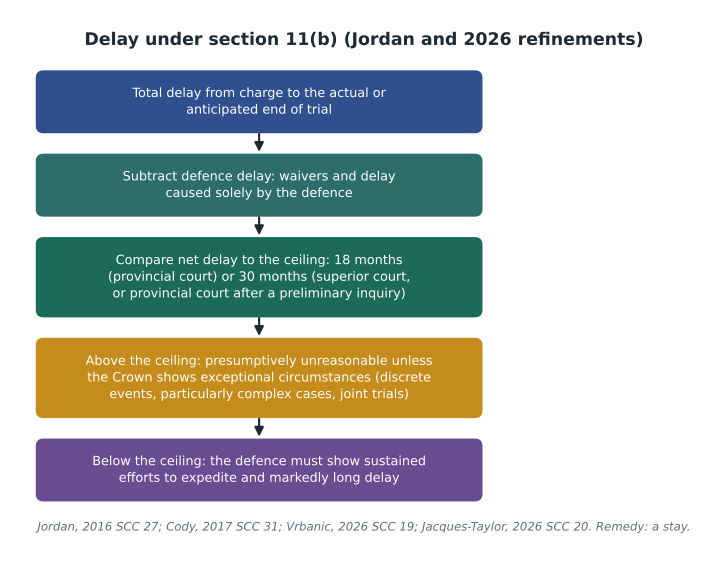
In Jordan, a five to four majority, in joint reasons by Justices Moldaver, Karakatsanis and Brown, replaced Morin with a ceiling-based framework. Jordan had been charged with drug offences in British Columbia, and his trial ended 49.5 months after the charge. The majority set presumptive ceilings: 18 months for cases going to trial in provincial court, and 30 months for cases in superior court or cases tried in provincial court after a preliminary inquiry. Delay is measured from the charge to the actual or anticipated end of trial.
The framework works in steps. First, calculate the total delay from the charge to the actual or anticipated end of the trial. Second, subtract defence delay. Defence delay has two parts: delay waived by the defence, explicitly or implicitly, as long as the waiver is clear and unequivocal and made with full knowledge of the right; and delay caused solely by the conduct of the defence, such as adjournment requests or delay caused by the defence not being ready when the court and Crown are. Third, compare the resulting net delay with the ceiling.
If the net delay exceeds the ceiling, it is presumptively unreasonable. The Crown can rebut the presumption only by showing exceptional circumstances, which are circumstances that lie outside the Crown's control, in that they are reasonably unforeseen or reasonably unavoidable, and that the Crown cannot reasonably remedy once they arise. Exceptional circumstances fall into two categories. Discrete events, such as a medical emergency of a witness, judge or lawyer, or an unexpected development at trial, are subtracted from the total. Particularly complex cases, because of the nature of the evidence or the issues, may justify the delay as a whole. The seriousness of the offence and the absence of prejudice cannot justify delay over the ceiling.
If the net delay is below the ceiling, the defence bears the onus of showing that the delay is unreasonable. It must show both that it took meaningful, sustained steps to expedite the proceedings, and that the case took markedly longer than it reasonably should have. Stays below the ceiling are expected to be rare and limited to clear cases.
The dissenting judges in Jordan, led by Justice Cromwell, would have refined the Morin framework rather than replace it, warning that ceilings would lead to stays of serious charges without proper analysis of the circumstances.
Defence delay after Cody
In R. v. Cody, 2017 SCC 31, the Court, in a unanimous decision, clarified defence delay. Defence conduct that is illegitimate, in the sense of not being taken to respond to the charges, is defence delay and should be deducted, even if it is not done in bad faith. Examples include frivolous applications and deliberate tactics aimed at causing delay. Legitimate defence conduct, such as bringing a reasonable Charter application, is not deducted. Cody also stressed that all participants, including trial judges, share responsibility for preventing delay, and that judges should use their case management powers to dismiss applications that lack merit at an early stage.
Defence counsel who are passive also take a risk. Where the defence sits back, accepts later dates without objection or fails to raise delay concerns when they could have been addressed, a court may treat the resulting delay as defence delay or find that the defence did not take meaningful steps when the delay is below the ceiling. The 2026 decisions repeated that the framework is meant to encourage all parties to act, not to reward waiting.
When the clock stops: K.G.K.
In R. v. K.G.K., 2020 SCC 7, the Court held that the Jordan ceilings apply to the end of the evidence and argument at trial, not to the end of the judge's deliberations. Time a trial judge takes to decide the case after hearing it is assessed separately. It breaches section 11(b) only if it took markedly longer than it reasonably should have, a deferential standard.
The 2026 refinements: Vrbanic and Jacques-Taylor
In 2026, after several years of high-profile stays, the Crown asked the Supreme Court to give trial judges a residual discretion to refuse a stay even where net delay exceeded the ceiling, for example in serious cases. In R. v. Vrbanic, 2026 SCC 19, the Court declined. The Jordan framework, the Court held, is flexible enough with clarification, and a residual discretion would bring back the unpredictability that Jordan was designed to remove. The ceilings of 18 and 30 months are unchanged, and a stay still follows automatically from a breach, although the Court left open whether that remedy might be reconsidered in a future case.
Vrbanic clarified the complexity exception. To justify delay over the ceiling on the basis of complexity, the case must be particularly complex, meaning its complexity is inordinate or exceptional, although such cases need not be rare; complexity is assessed holistically, looking at the case as a whole, rather than by picking out complicated features. The Crown must also show that it took reasonable, proactive steps to mitigate the delay, such as developing a plan for the case, seeking early dates and narrowing issues. And the specific delay must be justified by the complexity.
In R. v. Jacques-Taylor, 2026 SCC 20, the Court considered delay caused by a co-accused in a joint trial. It held that such delay can be deducted as a discrete exceptional circumstance if four criteria, adopted from the Court of Appeal for Ontario's decision in R. v. Tran, 2023 ONCA 532, are met: the joint trial must be in the interests of justice; the delay must have arisen from the joint trial; it must have been reasonably unforeseen or reasonably unavoidable; and the Crown must have been unable reasonably to reduce it, having taken reasonable steps to minimize the delay that proceeding jointly would cause. The Court also held that the Crown cannot be required to sever accused routinely where doing so would create delay elsewhere in the system. Discrete events need not be rare, but they must be outside the Crown's reasonable control.
Castellano summarizes the 2026 decisions for the class. 'The Court recalibrated Jordan; it did not rewrite it. Crowns now have clearer paths to justify delay in genuinely complex cases and joint trials, but only if they can show what they did to reduce the delay. The ceilings are the same, the remedy is the same, and the message to everyone is the same: manage the case from day one.'
Calculating delay in practice
Calculating delay is a practical skill. Counsel build a chart of every appearance from the charge to the scheduled end of trial, noting for each period who was responsible for it. Typical entries include the time for initial disclosure, which is usually not defence delay; adjournments at the defence's request, which are; periods where the court offered earlier dates and the defence was not available, which are often treated as defence delay under Jordan if the Crown and court were ready; and the time taken by a preliminary inquiry, which is part of the total.
Two common errors are worth noting. First, the period between the charge and the setting of a trial date is not automatically neutral. If the Crown was slow to provide disclosure needed to set a date, that time counts against the state. Second, defence counsel cannot unilaterally create delay by choosing to be unavailable for months and then complain about the result. If the court and Crown offer dates and defence counsel cannot attend, the time until the next date the defence can attend may be deducted, although the analysis is contextual and courts have recognized that defence counsel cannot be expected to hold their calendars open indefinitely.
Worked problem
Calculating delay in R. v. Calder
Calder was charged with manslaughter. Use these hypothetical intervals, counted from the date of the charge: initial disclosure took 4 months; a judicial pre-trial was held at 6 months; the preliminary inquiry was not requested; a trial date in the Superior Court was set at 8 months for a date 24 months after the charge; at 20 months the defence sought and obtained an adjournment because its pathology expert was unavailable, and the trial was rescheduled to start at month 31; the Crown's pathologist, Dr. Rao, then broke her leg a week before the new trial date, and the trial was moved to month 33. The trial is expected to last four weeks. Is the delay unreasonable?
Show solution
- Total delay: from the charge to the anticipated end of trial, about 34 months.
- Defence delay: the defence adjournment moved the trial from month 24 to month 31. The seven months caused solely by the defence request are deducted, unless the court and Crown could have offered an earlier date that the defence declined. Net delay: about 27 months.
- Discrete event: Dr. Rao's broken leg is a medical emergency outside the Crown's control, reasonably unforeseen and not reasonably remediable on a week's notice. The two months it caused are deducted as an exceptional circumstance. Remaining delay: about 25 months.
- Ceiling: a Superior Court jury trial without a preliminary inquiry is subject to the 30-month ceiling. The remaining delay is below it.
- Below the ceiling: Calder would have to show that the defence took meaningful, sustained steps to expedite and that the case took markedly longer than it reasonably should have. His own adjournment request undercuts the first requirement.
- Conclusion: no section 11(b) breach on these numbers. But if the same seven-month postponement had been caused by the court having no judge available, it would not be deducted. Net delay would then be about 34 months, or 32 after deducting the discrete event, over the ceiling, and the Crown would need further exceptional circumstances to avoid a stay. That is why counsel track who caused every month.
Common mistakes
MistakeStarting the clock at the date of the offence or the arrest.
InsteadSection 11(b) runs from the charge, usually when the information is sworn. Earlier delay may raise a section 7 issue but is not counted (Kalanj).
MistakeArguing that the seriousness of the offence justifies delay over the ceiling.
InsteadJordan held that seriousness and lack of prejudice cannot justify delay above the ceiling; only exceptional circumstances can, and Vrbanic refused a residual discretion.
MistakeTreating any complicated feature of a case as making it particularly complex.
InsteadVrbanic requires inordinate or exceptional complexity assessed holistically, plus proof that the Crown took reasonable steps to mitigate delay.
MistakeCounting the trial judge's deliberation time towards the Jordan ceiling.
InsteadK.G.K. held the ceiling ends with the evidence and argument; deliberation time is assessed separately on a deferential standard.
Practice problems
Work each problem on paper first, then reveal the answer to check.
An impaired driving case in the Ontario Court of Justice will end 20 months after the charge. The defence waived 1 month and caused 2 months of delay. Is there a presumptive breach?
Show answer
Net delay is 17 months, below the 18-month ceiling. The defence must show sustained efforts to expedite and that the case took markedly longer than reasonable, which will be difficult.
In a three-accused fraud trial, one co-accused changed lawyers twice, adding six months. Can the Crown deduct that delay for the other two accused?
Show answer
Under Jacques-Taylor, yes, if the joint trial was in the interests of justice, the delay arose from it, it was reasonably unforeseen or unavoidable, and the Crown took reasonable steps to minimize it. The Crown need not routinely sever accused.
What is the remedy for a section 11(b) breach, and did the 2026 decisions change it?
Show answer
A stay of proceedings (Rahey; Jordan). Vrbanic declined to create a residual discretion to refuse a stay, though the Court left open reconsidering the remedy in a future case.
Summary and key terms
- Section 11(b) protects liberty, security and fair trial interests from the charge to the end of trial, and the remedy for a breach is a stay (Rahey).
- Jordan sets ceilings of 18 months (provincial court) and 30 months (superior court, or provincial court after a preliminary inquiry), measured after subtracting defence delay.
- Over the ceiling, delay is presumptively unreasonable unless the Crown shows exceptional circumstances: discrete events or particular complexity.
- Below the ceiling, the defence must show sustained efforts to expedite and markedly long delay.
- Illegitimate defence conduct counts as defence delay (Cody); deliberation time is assessed separately (K.G.K.).
- In 2026, Vrbanic refused a residual discretion and tightened the complexity exception, and Jacques-Taylor allowed co-accused delay to be deducted under four criteria.
- Jordan ceiling
- The presumptive limit on net delay: 18 months in provincial court and 30 months in superior court.
- Net delay
- Total delay minus defence delay, compared with the Jordan ceiling.
- Defence delay
- Delay waived by the defence or caused solely by its conduct, deducted from total delay.
- Exceptional circumstances
- Circumstances outside the Crown's control that are reasonably unforeseen or unavoidable and cannot reasonably be remedied, such as discrete events or particular complexity.
- Discrete event
- A specific occurrence, such as illness or an unexpected trial development, whose delay is deducted as an exceptional circumstance.
- Particularly complex case
- A case whose complexity is inordinate or exceptional, assessed holistically, which may justify delay over the ceiling if the Crown mitigated it (Vrbanic).
Lesson quiz · 5 questions
Score 60% or more to complete this lesson.
Create a free account to save your progress, take quizzes and earn a certificate.