
LAWC-211 · Lesson 10 of 12 · 23 min
Pre-trial process, juries and the trial
▶ Video coming soon A video version of this lesson is on the way.
Castellano asks the class to imagine they are Calder's lawyer at the first appearance after the disclosure arrives. 'The Crown has proceeded by indictment, as it must for manslaughter. Your client has to make three decisions over the next few months. Does he want a preliminary inquiry? Does he want a judge alone or a jury? And does he want to plead guilty to anything? Your advice on each of those depends on everything you have learned so far this term, and on the procedural rules in this lesson.'
Arjun suggests the jury, because jurors might sympathize with a man who shoved someone once. Hannah suggests a judge alone, because the Charter issues are technical and the voluntariness ruling will be made by the judge anyway. Theo asks about the preliminary inquiry, which he remembers from his law clerk days as a chance to cross-examine the Crown's witnesses before trial. 'That is what it used to be for most cases,' Castellano says. 'Since 2019 it is available only for the most serious offences. Manslaughter qualifies, so you still have the choice. Let's look at why you might use it.'
This lesson covers the steps between the charge and the verdict that do not involve the Charter directly: the election, the preliminary inquiry, pre-trial conferences and applications, joinder and severance, jury selection, and the structure of a criminal trial. It ends with a brief overview of sentencing and appeals.
The election
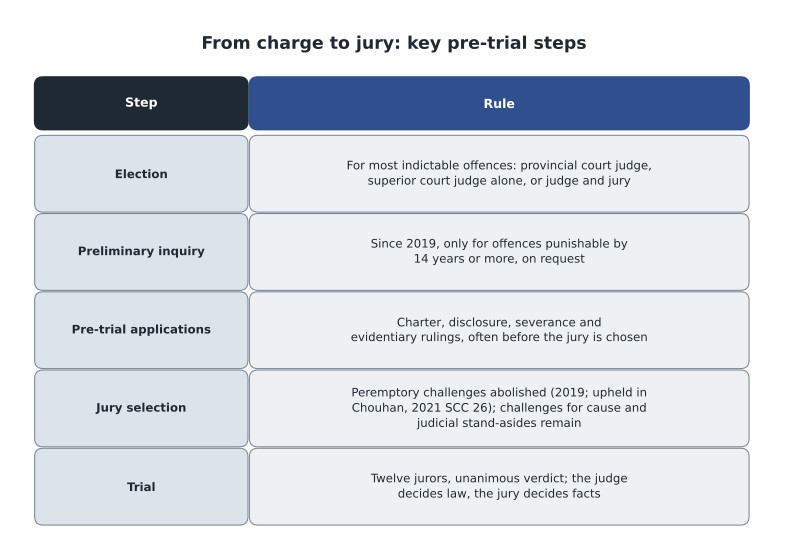
As lesson 1 explained, the mode of trial depends on the classification of the offence. For summary conviction offences and indictable offences in section 553, trial is in the Ontario Court of Justice. For section 469 offences, such as murder, trial is in the superior court with a jury, unless the accused and the Attorney General consent to a judge alone. For all other indictable offences, the accused elects under section 536: a provincial court judge, a superior court judge alone, or a superior court judge and jury. If the accused does not elect, they are deemed to have elected a judge and jury under section 565.
An accused can re-elect within the time limits in section 561, usually with the Crown's consent once a certain point has passed. The Attorney General can also require a jury trial under section 568 for an offence punishable by more than five years, even if the accused elected a judge alone, which is rare in practice.
The choice is strategic. A jury trial can take longer to schedule, involves more formal rules for the admission of evidence and for jury instructions, and leads to a verdict without reasons. A judge alone gives reasons, which can be appealed more precisely, and may be preferable when the defence turns on legal or technical arguments. Juries are sometimes preferred where the defence relies on the community's sense of fairness, or where the accused is a sympathetic figure. A provincial court trial is usually faster and less formal, but for serious charges counsel often prefer the superior court.
The preliminary inquiry
The preliminary inquiry is a hearing before a provincial court judge to decide whether there is sufficient evidence to put the accused on trial. Until 2019, an accused charged with any indictable offence who elected trial in the superior court could request one. Bill C-75, in force September 19, 2019, limited the preliminary inquiry to offences punishable by fourteen years or more, and only at the request of the accused or the Crown under section 536(4). Manslaughter, punishable by life imprisonment, qualifies. Assault causing bodily harm, punishable by ten years, does not.
At the end of the preliminary inquiry, the judge must commit the accused for trial if there is sufficient evidence, and discharge them if there is not, under section 548. The test comes from United States of America v. Shephard, [1977] 2 S.C.R. 1067: whether there is admissible evidence which could, if believed, result in a conviction, meaning evidence on which a reasonable jury properly instructed could convict. In R. v. Arcuri, 2001 SCC 54, the Court held that the preliminary inquiry judge does not weigh credibility, but where the Crown's case is circumstantial, the judge may engage in limited weighing to decide whether the evidence is reasonably capable of supporting the inferences the Crown asks the jury to draw.
The judge may receive evidence that is credible or trustworthy, including evidence that would not be admissible at trial, under section 540(7), and may limit the examination of witnesses to the issues set out at a focus hearing under section 536.4. A discharge is not an acquittal. The Crown can lay a new information, or the Attorney General can prefer a direct indictment under section 577, which sends the case straight to trial without a preliminary inquiry or after a discharge.
For the defence, the main value of a preliminary inquiry is often discovery. Cross-examining Crown witnesses under oath before trial reveals how they will testify, locks them into their evidence, and can produce inconsistencies useful at trial. It can also persuade the Crown to resolve the case. But a preliminary inquiry adds time, and under Jordan it moves a provincial court case from the 18-month ceiling to the 30-month ceiling. Calder's counsel might use it to cross-examine Leah Pruitt and Brendan Hollis about what they saw, and Dr. Rao about the thin skull and the mechanism of death.
Pre-trial conferences and case management
Ontario courts hold judicial pre-trial conferences in most criminal cases. In jury trials, a pre-trial conference with a judge is mandatory under section 625.1. The judge and counsel discuss the issues, the length of the trial, admissions that can be made, the Charter and evidentiary applications to be heard, and the possibility of resolution. Since Jordan and Cody, judges are expected to manage cases actively, to set firm dates, and to refuse to hear applications that have no reasonable prospect of success.
Under section 551.1, the court may appoint a case management judge in complex cases, and that judge can decide issues of disclosure, the admissibility of evidence and Charter applications before the trial begins. Under section 645(5), rulings made before the jury is selected bind the trial.
Joinder and severance
An indictment may include several counts and several accused. Under section 591(3), the trial judge may order severance of counts or of accused where the interests of justice require it. The leading case on severance of counts is R. v. Last, 2009 SCC 45, which identified factors including the general prejudice to the accused, the legal and factual nexus between the counts, the complexity of the evidence, whether the accused intends to testify on some counts but not others, the possibility of inconsistent verdicts, the desire to avoid a multiplicity of proceedings, the use of similar fact evidence, the length of the trial, and the potential prejudice to the accused's right to be tried within a reasonable time.
Accused charged together are presumptively tried together, especially where they are alleged to have acted together. Joint trials avoid inconsistent verdicts and the need for witnesses to testify twice, but they can cause delay, as Jacques-Taylor showed in lesson 9, and they create risks of prejudice where the evidence against one accused is much stronger or where one blames the other.
Jury selection
Jurors in Ontario are chosen under the provincial Juries Act from lists drawn largely from property assessment records, with separate efforts to include residents of First Nations reserves. The Criminal Code governs the selection process in court. Jurors are called from the panel and may be challenged.
Until 2019, each side had a set number of peremptory challenges, which allowed counsel to exclude a prospective juror without giving any reason. In 2018, Gerald Stanley, a Saskatchewan farmer, was acquitted by a jury of second degree murder in the shooting death of Colten Boushie, a young Cree man, after the defence used peremptory challenges to exclude prospective jurors who appeared to be Indigenous. The case led to widespread concern about the use of peremptory challenges to shape juries along racial lines. Bill C-75 abolished peremptory challenges and gave the judge a power under section 633 to stand aside a juror for reasons of personal hardship or any other reasonable cause, including maintaining public confidence in the administration of justice. It also provided that challenges for cause are decided by the judge rather than by two other jurors acting as triers.
In R. v. Chouhan, 2021 SCC 26, the Court held that the abolition of peremptory challenges did not violate the accused's rights under sections 7, 11(d) or 11(f). The jury remains independent and impartial through challenges for cause, judicial stand-asides, the juror's oath and the judge's instructions. The Court also held that the abolition applied to trials that began after the amendment came into force, even for offences charged earlier.
Challenges for cause remain available under section 638, most commonly on the ground that a juror is not indifferent between the Crown and the accused. In R. v. Williams, [1998] 1 S.C.R. 1128, the Court held that an accused who is Indigenous may challenge for cause on the basis of possible racial prejudice where there is evidence of widespread prejudice in the community. Challenges based on pre-trial publicity are also common in notorious cases.
The trial
A criminal jury has twelve members, and its verdict must be unanimous. The judge decides questions of law, including the admissibility of evidence, usually on a voir dire in the jury's absence; the jury decides the facts. At the end of the evidence, the judge instructs the jury on the law in a charge, including the presumption of innocence, the burden of proof beyond a reasonable doubt as explained in R. v. Lifchus, [1997] 3 S.C.R. 320, and, where the accused testifies, the instruction from R. v. W.(D.), [1991] 1 S.C.R. 742, that the jury must acquit if it believes the accused, or if it does not believe the accused but is left in reasonable doubt by that evidence, or if, on the whole of the evidence it accepts, it is not convinced beyond a reasonable doubt.
The Crown presents its case first, starting with an opening address. At the close of the Crown's case, the defence may ask for a directed verdict of acquittal if there is no evidence on which a reasonable jury properly instructed could convict, the same test as committal. The defence then decides whether to call evidence, including whether the accused will testify. The accused cannot be compelled to testify, under section 11(c). Under section 651, if the defence calls evidence, it addresses the jury first and the Crown last; if it does not, the Crown goes first. Jury deliberations are secret, and disclosing them is an offence under section 649; R. v. Pan; R. v. Sawyer, 2001 SCC 42, upheld the secrecy rule.
Judges alone follow the same order but must give reasons sufficient to allow meaningful appellate review, under R. v. Sheppard, 2002 SCC 26.
Sentencing in brief
If the accused is convicted, the judge imposes sentence under Part XXIII. The fundamental purpose of sentencing, in section 718, is to protect society and contribute to respect for the law and the maintenance of a just, peaceful and safe society by imposing just sanctions with objectives including denunciation, deterrence, separation of offenders, rehabilitation, reparation and responsibility. The fundamental principle, in section 718.1, is that a sentence must be proportionate to the gravity of the offence and the degree of responsibility of the offender. Section 718.2(e) directs attention to the circumstances of Indigenous offenders, as interpreted in Gladue and Ipeelee. Mandatory minimum sentences can be challenged under section 12, and several have been struck down, including in R. v. Nur, 2015 SCC 15. Bill C-14, discussed in lesson 8, also made changes to sentencing, which are covered in the sentencing course rather than here.
Appeals in brief
Appeals in indictable matters go to the Court of Appeal for Ontario under Part XXI. Under section 686(1)(a), the court may allow an accused's appeal against conviction if the verdict is unreasonable or cannot be supported by the evidence, if there was a wrong decision on a question of law, or if there was a miscarriage of justice. Even where there is a legal error, the court may dismiss the appeal under the curative proviso in section 686(1)(b)(iii) if no substantial wrong or miscarriage of justice occurred, meaning the error was harmless or the evidence was overwhelming. The Crown's right of appeal from an acquittal is narrower: under section 676, it is limited to questions of law alone, and under R. v. Graveline, 2006 SCC 16, the Crown must show that the error might reasonably be thought to have had a material bearing on the acquittal. Summary conviction appeals go to the Superior Court under Part XXVII. Further appeals to the Supreme Court lie as of right in some cases where a Court of Appeal judge dissents on a question of law, and otherwise with leave.
Worked problem
Advising Calder on the pre-trial choices
Calder is charged with manslaughter. The Crown's case rests on the bar video, the evidence of Pruitt and Hollis, Dr. Rao's pathology, the deleted texts, and the interview statement. The defence will challenge the phone search, the interview and the abstention condition. Advise Calder on the preliminary inquiry and the mode of trial.
Show solution
- Eligibility: manslaughter is punishable by life imprisonment, so a preliminary inquiry is available under section 536(4) on request.
- Value of the inquiry: committal is very likely given the video, so a discharge is not a realistic goal. The value is discovery: cross-examining Pruitt and Hollis under oath on what they saw, and testing Dr. Rao on causation and the thin skull, which matters to the thin skull rule and to any defence argument about foreseeability of bodily harm.
- Cost of the inquiry: it adds months. Since the case is in the Superior Court, the 30-month ceiling applies whether or not there is an inquiry, so the delay risk is about trial timing and the client's bail conditions rather than the ceiling itself.
- Mode of trial: Calder may elect a judge and jury or a judge alone in the Superior Court, or a provincial court judge. The Charter and voluntariness issues will be decided by the judge in either case.
- Jury considerations: a jury may be more receptive to the argument that a single shove did not create an objectively foreseeable risk of bodily harm. But jurors will see the video and may react strongly to the deleted texts. Counsel would consider a challenge for cause if there has been publicity in Corwin.
- Judge-alone considerations: reasons give a clearer basis for appeal, and a judge may be better at applying the subtle causation and fault principles. The defence would weigh the strength of the remaining evidence after the Charter rulings, which are usually decided first.
- Advice: request a focused preliminary inquiry on the key witnesses; defer the final election decision, within the time permitted, until the Charter rulings are likely to be known; and keep a written record of the client's instructions on each choice.
Common mistakes
MistakeAssuming every accused charged with an indictable offence can have a preliminary inquiry.
InsteadSince September 19, 2019, a preliminary inquiry is available only for offences punishable by fourteen years or more, and only on request.
MistakeSaying the preliminary inquiry judge decides whether witnesses are believable.
InsteadUnder Shephard and Arcuri, the judge asks whether there is evidence on which a reasonable jury properly instructed could convict, with only limited weighing of circumstantial evidence.
MistakeDescribing peremptory challenges as part of current jury selection.
InsteadThey were abolished in 2019, and Chouhan upheld the change. Challenges for cause and judicial stand-asides remain.
MistakeAssuming the Crown can appeal an acquittal on any ground.
InsteadThe Crown may appeal an acquittal on indictment only on a question of law alone, and must show that the error might reasonably have had a material bearing on the verdict (Graveline).
Practice problems
Work each problem on paper first, then reveal the answer to check.
An accused charged with robbery, punishable by life, wants a preliminary inquiry to test the identification evidence. Can she have one, and what is the committal test?
Show answer
Yes, robbery is punishable by life, so she may request one. The judge must commit her if there is admissible evidence on which a reasonable jury properly instructed could convict (Shephard); credibility is not weighed, and for circumstantial evidence the judge may engage in limited weighing (Arcuri).
In a jury trial, defence counsel wants to exclude a prospective juror because of a social media post showing strong views about bar fights. What tools are available?
Show answer
Counsel could challenge for cause under section 638 on the ground that the juror is not indifferent, which the judge decides, or ask the judge to stand the juror aside under section 633. Peremptory challenges are no longer available.
Two accused are charged jointly with a home invasion. One wants a separate trial because his co-accused will blame him. What test applies?
Show answer
The judge decides under section 591(3) whether severance is required in the interests of justice. Accused charged together are presumptively tried together, and a cut-throat defence is not automatically enough; the judge weighs prejudice, the strength of the evidence, the risk of inconsistent verdicts and delay.
Summary and key terms
- For most indictable offences the accused elects the mode of trial under section 536; section 553 and section 469 offences have fixed courts.
- Since 2019, a preliminary inquiry is available only for offences punishable by fourteen years or more, on request; the committal test is from Shephard and Arcuri.
- Judicial pre-trials are mandatory in jury trials, and pre-trial rulings bind the trial; case management judges handle complex cases.
- Severance of counts or accused is decided in the interests of justice (Last; section 591).
- Peremptory challenges were abolished in 2019 (upheld in Chouhan); challenges for cause and judicial stand-asides remain, and the judge decides challenges.
- A jury of twelve must be unanimous; judges alone must give adequate reasons; appeals turn on unreasonable verdict, legal error and miscarriage of justice, with narrower Crown rights.
- Preliminary inquiry
- A hearing to decide whether there is sufficient evidence to commit the accused for trial, now limited to offences punishable by fourteen years or more.
- Committal
- An order sending the accused to trial after a preliminary inquiry.
- Direct indictment
- An indictment preferred by the Attorney General under section 577 that sends a case to trial without a preliminary inquiry.
- Severance
- An order under section 591(3) for separate trials of counts or accused.
- Challenge for cause
- A challenge to a prospective juror for a stated reason, such as lack of indifference, decided by the judge.
- Stand-aside
- The judge's power under section 633 to excuse a juror temporarily for hardship or other reasonable cause.
- Curative proviso
- The power under section 686(1)(b)(iii) to dismiss an appeal despite a legal error where no substantial wrong occurred.
Lesson quiz · 5 questions
Score 60% or more to complete this lesson.
Create a free account to save your progress, take quizzes and earn a certificate.