
LAWC-211 · Lesson 1 of 12 · 28 min
The criminal process and the Charter
▶ Video coming soon A video version of this lesson is on the way.
Professor Ruth Castellano opens the first class of Criminal Procedure the way she ended Criminal Law a year earlier: with the Calder file on the screen. 'Last year you asked whether Owen Calder committed manslaughter,' she says. 'In Evidence you asked what the jury could hear. This term we ask a different question. How did the police get what they got, and were they allowed to?' She clicks to a new slide. It shows a list: the bar's security video, a phone taken from Calder's jacket at the station, a production order for his texts with Leah Pruitt, a three-hour video interview with D.C. Ian Mercer, and a bail hearing at which the Crown pointed to an assault conviction eight years old. 'Every item on this list was obtained by someone exercising a legal power. Every one of them can be challenged. And if the challenge succeeds, the remedy may be that the jury never sees it.'
Theo Marchetti, now a 2L and still the most practical person in the room, puts up his hand. 'So this is the course where guilty people go free.' Castellano smiles. 'This is the course where we decide what kind of state we want investigating us. Sometimes that means the evidence goes. Much more often it means the police learn how to do it properly next time. Prove it, element by element, applies to the state too.'
This lesson sets out the shape of the whole course. It explains where the rules of criminal procedure come from, how a case moves from the first police contact to an appeal, which Charter rights apply at each stage, and what remedies a court can give when those rights are breached. Later lessons take each stage in turn.
Where criminal procedure comes from
Criminal procedure in Canada has four main sources. The first is the Constitution. Section 91(27) of the Constitution Act, 1867 gives Parliament exclusive power over criminal law 'including the Procedure in Criminal Matters'. Section 92(14) gives the provinces power over the administration of justice, including the constitution and organization of the courts. That split explains a feature of Canadian practice that surprises students from other countries: there is one Criminal Code for the whole country, but provincial Crown attorneys prosecute most offences, and provincial courts hear most cases. Federal prosecutors in the Public Prosecution Service of Canada handle drug offences under the Controlled Drugs and Substances Act and some other federal statutes.
The second source is the Criminal Code itself. Its procedural parts govern arrest and release, search warrants, wiretaps, the jurisdiction of courts, elections, preliminary inquiries, juries, trials, sentencing and appeals. Other federal statutes add their own powers, such as the search powers in the Controlled Drugs and Substances Act and the procedures of the Youth Criminal Justice Act for young persons.
The third source is the Canadian Charter of Rights and Freedoms, in force since April 17, 1982. Sections 7 to 14, under the heading 'Legal Rights', are the core of modern criminal procedure. Section 7 protects life, liberty and security of the person and the principles of fundamental justice, which include the right to silence, the right to make full answer and defence, and the rule against self-incrimination. Section 8 protects against unreasonable search or seizure. Section 9 protects against arbitrary detention or imprisonment. Section 10 gives rights on arrest or detention: to be told the reasons promptly, to retain and instruct counsel without delay and to be told of that right, and to have the lawfulness of the detention decided by habeas corpus. Section 11 gives rights to a person charged with an offence, including the right to be tried within a reasonable time, the presumption of innocence, the right not to be denied reasonable bail without just cause, and the right to a jury trial where the maximum punishment is five years or more. Sections 12 to 14 deal with cruel and unusual punishment, self-incrimination by witnesses, and interpreters.
The fourth source is the common law. Judges created many police powers, such as the power to search incident to arrest and the power to detain for investigative purposes, and they continue to define their limits. The common law also supplies the confessions rule, the doctrine of abuse of process and the law of entrapment. Since 1982 most of these common law rules have been reshaped by the Charter, and a good deal of this course is about that interaction.
Two models of the criminal process
In 1964 the American scholar Herbert Packer described two models of criminal justice that are still a useful way to think about procedure. The crime control model treats the efficient suppression of crime as the main goal. It trusts the police to screen out the innocent early, prefers speed and finality, and sees the process as an assembly line. The due process model treats the reliability of fact-finding and the protection of the individual against the state as the main goals. It insists on formal, adversarial testing of the evidence and is willing to let some guilty people go free to keep the state within its limits. Packer called it an obstacle course.
No real system follows either model completely. Canadian criminal procedure is a negotiated settlement between them, and the Charter has pushed the settlement towards due process. But the courts have also expanded police powers where they thought public safety required it, sometimes by creating new common law powers under what is called the ancillary powers doctrine. As you read the cases this term, ask which model each judge seems to hold. Castellano tells the class that most dissents in this area can be predicted by asking that one question.
The stages of a criminal case
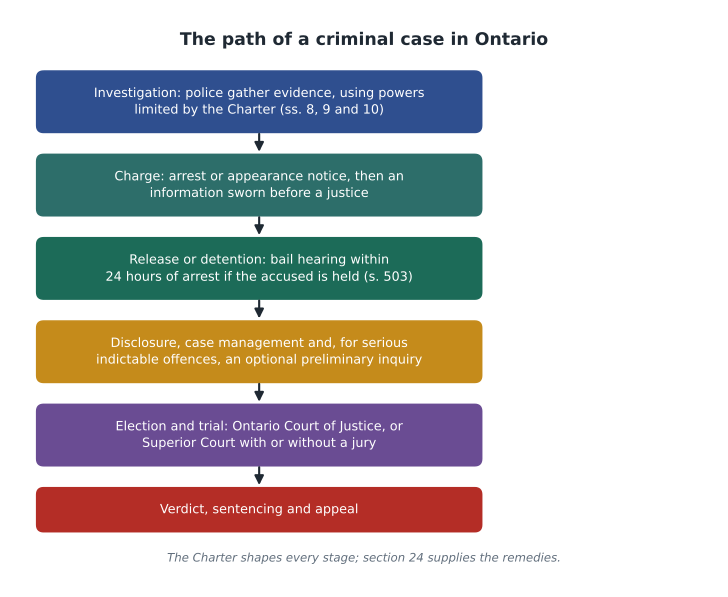
A criminal case in Ontario usually moves through six stages. They do not always come in this order, and many cases end early with a withdrawal, a diversion program or a guilty plea, but the stages give the course its structure.
The first stage is investigation. Police receive a complaint, see something themselves, or begin an investigation on their own initiative. They speak to witnesses, gather physical evidence, use databases and surveillance, and may stop, question, detain, arrest and search suspects. Every one of these powers must have a legal source, and most are limited by sections 8, 9 and 10 of the Charter. Lessons 2 to 7 cover this stage.
The second stage is the charge. A person can be brought before the court in several ways. Police may arrest the person and then release them with an appearance notice, an undertaking or a release order, or hold them for a bail hearing. Police may also issue an appearance notice without arresting. Either way, a criminal charge formally begins when an information is sworn before a justice of the peace under section 504 of the Criminal Code, alleging that the person committed an offence. The justice may confirm the process the police issued or issue a summons or warrant. In Ontario, the Crown then reviews the charge and decides whether to continue it. The Crown Prosecution Manual directs Crown attorneys to continue a prosecution only if there is a reasonable prospect of conviction and it is in the public interest.
The third stage is release or detention. A person who is arrested and not released by police must be taken before a justice without unreasonable delay, and within 24 hours if a justice is available, under section 503. At the bail hearing the justice decides whether the accused is released and on what conditions. Lesson 8 covers bail, including the Bill C-14 changes that came into force on July 15, 2026.
The fourth stage is the pre-trial phase. The Crown must disclose its case to the defence. The parties meet at judicial pre-trials to narrow issues and set dates. For the most serious indictable offences, the accused may ask for a preliminary inquiry, at which a judge decides whether there is enough evidence to send the case to trial. Lesson 8 covers disclosure; lesson 9 covers delay; lesson 10 covers the preliminary inquiry, elections and juries.
The fifth stage is trial. Depending on the offence and the accused's election, the trial takes place in the Ontario Court of Justice before a judge alone, or in the Superior Court of Justice before a judge alone or a judge and jury. Charter applications to exclude evidence are often decided at the start of the trial in a voir dire. Lesson 11 covers exclusion of evidence.
The sixth stage is verdict, sentencing and appeal. If the accused is found guilty, the judge sentences them under Part XXIII of the Criminal Code. Either side may appeal on the grounds the Code allows: to the Superior Court for summary conviction matters, and to the Court of Appeal for Ontario for indictable offences, with further appeals to the Supreme Court of Canada with leave, or as of right in some cases where a judge of the Court of Appeal dissented on a point of law.
Classifying offences
Procedure depends heavily on how an offence is classified, so the classification rules come first. Offences under federal law are either summary conviction offences, indictable offences, or hybrid offences, which the Crown may prosecute either way. Most offences in the Criminal Code are now hybrid. When the Crown elects to proceed summarily, the case is tried in the Ontario Court of Justice, the default maximum sentence is two years less a day under section 787 since the 2019 amendments, and the information must generally be laid within twelve months of the offence under section 786(2). When the Crown proceeds by indictment, there is no general limitation period, and the accused usually has an election about the mode of trial.
Indictable offences fall into three groups for jurisdiction. Offences listed in section 553, such as theft under five thousand dollars and certain mischief and fraud offences, are within the absolute jurisdiction of a provincial court judge, so there is no election. Offences listed in section 469, such as murder, treason and piracy, must be tried in the superior court, and with a jury unless the accused and the Attorney General both consent to a judge alone under section 473. All other indictable offences give the accused an election under section 536: trial by a provincial court judge, by a superior court judge alone, or by a superior court judge and jury.
The classification also matters for the Charter. Section 11(f) guarantees a jury trial for an offence punishable by five years or more, except for offences under military law. An accused can waive the right by electing a judge-alone trial. Calder, charged with manslaughter, which carries a maximum of life imprisonment, elected a judge and jury in the Superior Court, as students saw in Evidence.
The role of the Crown and the police
Police in Canada investigate and lay charges. In most provinces, including Ontario, police lay the information and the Crown then decides whether to continue. In British Columbia, Quebec and New Brunswick, Crown counsel approve charges before they are laid. Either way, the Crown has the final say on whether a prosecution continues.
The Supreme Court has described a core of prosecutorial discretion that courts will review only for abuse of process. In Krieger v. Law Society of Alberta, 2002 SCC 65, the Court identified decisions such as whether to bring or continue a prosecution, whether to accept a plea, and whether to withdraw charges as core decisions. In R. v. Anderson, 2014 SCC 41, the Court held that the Crown's decision to seek a mandatory minimum sentence by giving notice of a prior conviction was also a matter of prosecutorial discretion, reviewable only for abuse of process. By contrast, the Crown's conduct of a trial, such as how it questions witnesses, is subject to the trial judge's ordinary control.
Crown counsel are not supposed to win at any cost. In Boucher v. The Queen, [1955] S.C.R. 16, Justice Rand wrote that the purpose of a criminal prosecution is not to obtain a conviction but to lay before a jury what the Crown considers credible evidence relevant to what is alleged to be a crime. That idea of the Crown as a minister of justice, rather than a partisan, underlies the disclosure duty in lesson 8.
How Charter litigation works in a criminal case
A Charter claim in a criminal case is almost always raised by the accused as an application in the trial court. Ontario has rules of court for criminal proceedings that require written notice of the application, with a summary of the facts and the legal argument, filed in advance. A trial judge is a court of competent jurisdiction for the purpose of section 24, so the judge can decide Charter claims and grant remedies without the accused having to go to another court.
Several rules frame every Charter application. First, the accused normally bears the burden of proving a breach on a balance of probabilities. There is an important exception: when the police searched without a warrant, the search is presumed unreasonable, and the Crown must show on a balance of probabilities that it was reasonable, as held in Hunter v. Southam Inc., [1984] 2 S.C.R. 145, and R. v. Collins, [1987] 1 S.C.R. 265. Second, Charter rights are personal. An accused cannot rely on a breach of someone else's rights. In R. v. Edwards, [1996] 1 S.C.R. 128, the accused could not challenge a search of his girlfriend's apartment because he had no reasonable expectation of privacy there. Third, the Charter applies to state actors, which includes the police and other government agents, but generally not to private persons such as store security guards acting on their own.
Fourth, the accused must link the breach to a remedy. A breach alone is not enough to get anything. The court must decide what remedy, if any, the breach calls for, and the main remedies are covered next.
The remedies
Section 24 of the Charter has two parts. Section 24(1) allows anyone whose Charter rights have been infringed or denied to apply to a court of competent jurisdiction for 'such remedy as the court considers appropriate and just in the circumstances'. Section 24(2) deals specifically with evidence. Where evidence was 'obtained in a manner' that infringed a Charter right, it must be excluded if its admission 'would bring the administration of justice into disrepute'. Section 52 of the Constitution Act, 1982 adds a third remedy: a law inconsistent with the Constitution is of no force or effect to the extent of the inconsistency.
In criminal cases, the most common remedies are these. Exclusion of evidence under section 24(2) is the remedy for most search, detention and counsel breaches, decided under the test in R. v. Grant, 2009 SCC 32, covered in lesson 11. A stay of proceedings under section 24(1) ends the prosecution. It is mandatory for a breach of section 11(b), the right to be tried within a reasonable time, as lesson 9 explains, and it is available for abuse of process in the clearest cases. In R. v. Babos, 2014 SCC 16, the Court said a stay for abuse of process falls into two categories: the main category, where state conduct compromises the fairness of the trial, and the residual category, where the conduct risks undermining the integrity of the justice system. A sentence reduction is sometimes given to reflect state misconduct, as the Court accepted in R. v. Nasogaluak, 2010 SCC 6. Other remedies include costs against the Crown in rare cases, orders for further disclosure, adjournments, and a declaration that the law is of no force or effect.
Theo is not satisfied. 'So if police break the rules and find a gun, the gun usually comes in, and the accused gets a few months off his sentence?' Castellano answers carefully. 'Sometimes. Sometimes the gun goes. Lesson 11 will show you that the exclusion rate depends on how serious the police conduct was and how badly it hurt the accused's interests. And remember that exclusion is not meant to punish the police. It is meant to protect the long-term reputation of the justice system.'
Worked problem
Mapping the Calder investigation onto the Charter
Castellano asks the class to take the five pieces of police evidence in the Calder file and say which Charter rights each one engages. The evidence is: (1) the bar's security video, which the manager gave to police voluntarily; (2) Calder's phone, taken from his jacket after his arrest at the station; (3) a production order for his texts with Leah Pruitt from the phone company; (4) the three-hour video interview, in which D.C. Mercer said 'judges go easy on guys who own up'; and (5) the bail hearing, at which the Crown relied on his prior conviction.
Show solution
- The security video: police did not search anything. The bar manager handed it over. The question is whether Calder had a reasonable expectation of privacy in a video of a public sidewalk taken by a private business. He almost certainly did not, so section 8 is probably not engaged. The video still has to be authenticated as an evidence question.
- The phone: taking the phone is a seizure, and looking through it is a search. Section 8 applies. The police need a legal power, most likely search incident to arrest under R. v. Fearon, 2014 SCC 77, which limits what they may look at without a warrant (lesson 3).
- The production order: obtaining stored texts from a phone company is a search of Calder's informational privacy, because R. v. Marakah, 2017 SCC 59, recognized that a sender can have a reasonable expectation of privacy in text messages. Section 8 is engaged, and the order must meet the statutory standard in section 487.014 (lessons 3 and 4).
- The interview: Calder was under arrest, so sections 10(a) and 10(b) apply. The confessions rule applies whether or not there is a Charter breach, and Mercer's comment raises the question of an inducement under R. v. Oickle, 2000 SCC 38. The right to silence under section 7 also applies (lessons 6 and 7).
- The bail hearing: section 11(e) protects the right not to be denied reasonable bail without just cause, and the Criminal Code's bail provisions in section 515 apply. The prior conviction is relevant to the secondary ground (lesson 8).
- Conclusion: four of the five items engage Charter rights, and the video is mainly an evidence issue. A defence lawyer would file applications for the phone, the production order and the interview, and would need to know for each one who bears the burden of proof.
Thinking like counsel
Criminal procedure is taught as doctrine, but it is practised as strategy. A defence lawyer who receives disclosure reads it with a set of questions in mind. What did the police do, in what order, and on what authority? At each point where the client's liberty or privacy was touched, was there a legal power, and was it used properly? If not, what evidence flowed from that breach, and is it worth fighting about? Crown counsel read the same file with the mirror questions: what is the weakest point in the police conduct, can it be justified, and if the evidence is excluded, is there still a reasonable prospect of conviction?
Castellano asks Arjun Mehta, who likes flowcharts, to draw the investigation stage as a series of decision points. He produces a chain of boxes: first contact, detention, arrest, search, statement. 'Good,' she says, 'but put a timestamp on every box. Half of criminal procedure is about timing. When did the detention start? When were the rights given? How long before the call to counsel? How long between the charge and the trial?' Throughout the course, students will build timelines like this for every problem.
Daniel Whitecloud raises a different point. 'Most of my cousins who were charged with something never had a trial. They pleaded guilty at the first or second appearance.' Castellano agrees. Most criminal cases in Canada end with a guilty plea or a withdrawal, not a trial, and the procedure that matters most to most accused people is bail, disclosure and the pressure to resolve. She reminds the class that the Supreme Court in R. v. Gladue, [1999] 1 S.C.R. 688, and R. v. Ipeelee, 2012 SCC 13, recognized the overrepresentation of Indigenous people in Canadian prisons, and that the bail provisions now require special attention to Indigenous accused and other overrepresented groups under section 493.2. Procedure is not neutral in its effects, and good counsel notice that.
Reading criminal procedure cases
Students new to this area find the cases long. A section 8 or section 10(b) decision usually has three parts: the facts, often reconstructed in detail from the voir dire evidence; the analysis of whether there was a breach; and the analysis of remedy under section 24(2). Read the facts closely, because the outcome usually depends on them. The legal tests are mostly settled. What changes from case to case is how they apply to what this officer did on this night.
When you brief a case for this course, record five things: the police conduct being challenged; the Charter right engaged; whether the court found a breach and why; the remedy decision; and the vote, if the court was divided. The vote matters because many of the leading recent decisions were five to four, and the dissent often shows where the law may go next.
Common mistakes
MistakeAssuming that every Charter breach leads to the evidence being thrown out.
InsteadA breach is the first step. The accused must then persuade the court that admitting the evidence would bring the administration of justice into disrepute under section 24(2), applying Grant. Many breaches end with the evidence admitted.
MistakeSaying the accused must always prove the Charter breach.
InsteadThe accused usually bears the burden on a balance of probabilities, but a warrantless search is presumed unreasonable, so the Crown must prove it was reasonable (Hunter v. Southam; Collins).
MistakeRelying on a breach of a third party's rights, such as a search of a friend's home.
InsteadCharter rights are personal. The accused must show a breach of their own rights, such as their own reasonable expectation of privacy (Edwards).
MistakeTreating the Crown as the accused's opponent with an interest in winning.
InsteadThe Crown is a minister of justice whose role is to present credible evidence fairly (Boucher), which is why it owes broad disclosure.
Practice problems
Work each problem on paper first, then reveal the answer to check.
An accused is charged with assault causing bodily harm, a hybrid offence. The Crown elects to proceed by indictment. Which courts could try the case?
Show answer
Assault causing bodily harm is not listed in section 553 or section 469, so the accused may elect trial by a provincial court judge, a superior court judge alone, or a superior court judge and jury under section 536.
Police search a car without a warrant and find drugs. At the voir dire, who has to prove what?
Show answer
The search was warrantless, so it is presumed unreasonable and the Crown must prove on a balance of probabilities that it was authorized by a reasonable law and carried out reasonably. If a breach is found, the accused must show that the evidence should be excluded under section 24(2).
What is the difference between the two categories of abuse of process in Babos?
Show answer
The main category covers state conduct that compromises the fairness of the accused's trial. The residual category covers conduct that does not threaten trial fairness but risks undermining the integrity of the justice system. A stay is a last resort in both.
Summary and key terms
- Parliament controls criminal law and procedure under section 91(27); provinces administer justice under section 92(14), so provincial Crowns prosecute most Criminal Code offences.
- Sections 7 to 14 of the Charter set out the legal rights that limit police and prosecutorial power at every stage of the process.
- A case moves through investigation, charge, release or detention, pre-trial disclosure and applications, trial, and sentencing and appeal.
- Offences are summary, indictable or hybrid; sections 553 and 469 fix the jurisdiction for some indictable offences, and the accused elects the mode of trial for most others.
- The accused generally bears the burden of proving a Charter breach, but the Crown must justify a warrantless search.
- Remedies include exclusion of evidence under section 24(2), a stay under section 24(1), and a declaration of invalidity under section 52.
- Information
- The sworn document, laid before a justice under section 504, that formally begins a criminal charge.
- Hybrid offence
- An offence the Crown may prosecute either summarily or by indictment.
- Election
- The accused's choice of the mode of trial for most indictable offences under section 536.
- Prosecutorial discretion
- The Crown's core decisions about whether to bring, continue or end a prosecution, reviewable only for abuse of process.
- Stay of proceedings
- A court order that halts a prosecution, the remedy for unreasonable delay and for abuse of process in the clearest cases.
- Voir dire
- A hearing within a trial, held without the jury, to decide the admissibility of evidence such as a confession or evidence challenged under the Charter.
Lesson quiz · 5 questions
Score 60% or more to complete this lesson.
Create a free account to save your progress, take quizzes and earn a certificate.