
LAWC-211 · Lesson 6 of 12 · 23 min
Right to counsel
▶ Video coming soon A video version of this lesson is on the way.
Castellano plays the first minute of the Calder interview video. Calder sits at a small table in an interview room at the Corwin police station. D.C. Mercer reads from a card: Calder has been arrested for manslaughter in the death of Mark Dorey; he has the right to retain and instruct counsel without delay; he may call any lawyer he wishes; free advice is available from duty counsel at a toll-free number; and if he is charged he may apply for legal aid. 'Do you understand?' 'Yeah.' 'Do you want to call a lawyer now?' 'I want my lawyer. Dan Kerrigan. He did my thing before.' She stops the video. 'Now tell me everything that has to happen next,' she says, 'and in what order.'
The rest of the story, from the disclosure, is this. The officers called the lawyer's office at 7:10 in the morning and reached a voicemail. They told Calder, who agreed to speak to duty counsel instead. He spoke privately with duty counsel for six minutes and was told to say nothing. The interview began twenty minutes later. Forty minutes in, after Mercer showed him a still image from the bar video, Calder said, 'I want to talk to a lawyer again.' Mercer replied: 'You've had your call. Lawyers tell everybody to keep quiet. That's their job. It doesn't help you, and it doesn't help Mark's family.' Calder asked again twenty minutes later and got the same answer. The interview continued for another two hours.
This lesson covers section 10 of the Charter, and particularly section 10(b), the right to counsel. It is one of the most frequently litigated rights in criminal practice, and the duties it places on police are detailed and strictly enforced.
The rights in section 10
Section 10 says that everyone has the right on arrest or detention (a) to be informed promptly of the reasons therefor; (b) to retain and instruct counsel without delay and to be informed of that right; and (c) to have the validity of the detention determined by way of habeas corpus and to be released if the detention is not lawful.
Section 10(a) is the foundation for the others, because a person cannot meaningfully decide whether to get legal advice without knowing why they are being held. The detainee must be told, in substance, the reason for the arrest or detention, in language they can understand. Technical precision is not required. In R. v. Evans, [1991] 1 S.C.R. 869, police arrested the accused on a marijuana charge, but they suspected him of murder and soon began questioning him about the murders. The Court held that when the investigation shifts to a different and more serious offence, the police must tell the detainee about the change and restate the right to counsel. The idea of a change in jeopardy, introduced in Evans, recurs throughout section 10(b).
The purpose of the right to counsel
The right to counsel exists because a detained person is in the power of the state and at a legal disadvantage. The purpose, as the Court explained in R. v. Sinclair, 2010 SCC 35, is to give the detainee the opportunity to get legal advice relevant to their legal situation, and in particular advice about how to exercise the right to choose whether to cooperate with the police investigation. Section 10(b) is meant to support the detainee's free and informed choice whether to speak to the police, which links it closely to the right to silence discussed in lesson 7.
The three police duties
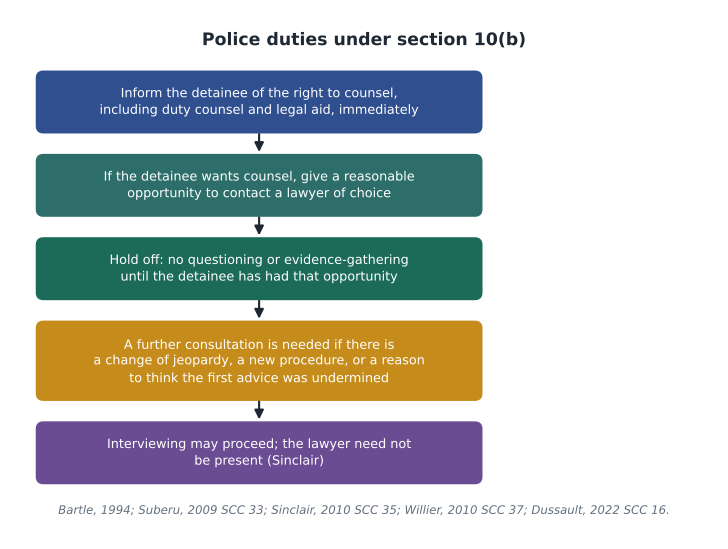
The Supreme Court has divided the police obligations under section 10(b) into an informational duty and two implementational duties. R. v. Bartle, [1994] 3 S.C.R. 173, is the leading statement. First, police must inform the detainee of the right to retain and instruct counsel without delay, and of the existence and availability of legal aid and duty counsel. Second, if the detainee indicates a wish to exercise the right, police must give them a reasonable opportunity to do so, except in urgent and dangerous circumstances. Third, police must refrain from eliciting evidence from the detainee until they have had that reasonable opportunity, again except in urgent and dangerous circumstances. The third duty is often called the duty to hold off.
The informational duty is triggered on every detention, whether or not the detainee asks. In R. v. Brydges, [1990] 1 S.C.R. 190, the Court held that the information must include the availability of legal aid and duty counsel. Bartle added that where a toll-free number for free, immediate duty counsel advice exists, the detainee must be told of it and how to access it. Most police services use a standard caution card that covers all these points.
The implementational duties arise only once the detainee says they want to speak to a lawyer. A detainee who is told of the right and declines it does not trigger them, although the police must make sure the information was understood. If the detainee seems confused, has language difficulties, or is impaired, police may need to take additional steps.
Without delay means immediately
In R. v. Suberu, 2009 SCC 33, the Court held that the words 'without delay' mean 'immediately'. As soon as a person is detained, including in an investigative detention, police must inform them of the right to counsel. The only exceptions are concerns for officer or public safety and limits that are prescribed by law and justified under section 1, such as the roadside screening exception discussed below. Suberu also held that the duties apply from the start of a detention, so questioning a detainee before informing them of the right breaches section 10(b).
The duty to give a reasonable opportunity to call a lawyer also has a timing element. In R. v. Taylor, 2014 SCC 50, the accused, arrested after a car crash, asked to speak to a lawyer at the scene but was taken to hospital, where police obtained blood samples taken for medical purposes before giving him any chance to call. The Court held that the police had to facilitate access to counsel at the first reasonable opportunity, which included the hospital, where phones were available. The blood evidence was excluded.
Counsel of choice and duty counsel
A detainee is entitled to try to reach a lawyer of their choice. In R. v. Willier, 2010 SCC 37, and R. v. McCrimmon, 2010 SCC 36, decided with Sinclair, the Court explained the limits. If the lawyer of choice is not available within a reasonable time, the detainee is expected to exercise the right by calling another lawyer, including duty counsel, or the police duty to hold off will be suspended. What is a reasonable time depends on the circumstances, such as the seriousness of the charge and any urgency in the investigation. Police are not required to keep checking whether the detainee is satisfied with the advice received from duty counsel, unless something suggests it was inadequate.
Detainees also must be reasonably diligent. In R. v. Tremblay, [1987] 2 S.C.R. 435, and R. v. Smith, [1989] 2 S.C.R. 368, the Court held that a detainee who does not take reasonable steps to contact a lawyer, such as refusing to make calls or delaying without reason, cannot later complain that the police failed to hold off.
The consultation must be private. Police must provide a setting in which the detainee can speak to counsel without being overheard. Courts have found breaches where officers remained in the room or where calls were recorded. A detainee who is told that the call will be private but is overheard has been denied the right in substance.
Prosper raises the situation where there is no duty counsel. In R. v. Prosper, [1994] 3 S.C.R. 236, the Court held that the Charter does not require governments to provide free duty counsel. But where a detainee asks for counsel and none is available, police must hold off. If a detainee who has been diligent then says they no longer want a lawyer, police must tell them of their right to a reasonable opportunity to contact one and of the police obligation to hold off in the meantime. This is often called the Prosper warning.
Waiver
A detainee may waive the right to counsel, but the standard is high. In Clarkson v. The Queen, [1986] 1 S.C.R. 383, the Court held that waiver must be clear and unequivocal and made with full knowledge of the rights being given up and the effect of giving them up. The accused in Clarkson was highly intoxicated and could not meaningfully waive. The Crown must prove a valid waiver. A detainee who first asks for a lawyer and later says they do not need one should receive a Prosper warning before the police rely on the change.
No right to have counsel present
The most important limit on section 10(b) was set in Sinclair, a five to four decision. Sinclair spoke to a lawyer twice by phone after his arrest for murder. During a lengthy interview he asked several times to speak to his lawyer again, and the officer refused, while continuing to question him. He eventually made incriminating statements. The majority, Chief Justice McLachlin and Justice Charron, held that section 10(b) does not give a detainee the right to have a lawyer present during the interview, or to stop the interview and consult a lawyer whenever they wish. Police may continue to question a detainee who has had a reasonable opportunity to consult counsel and who has said they do not want to talk.
The majority recognized that a detainee is entitled to a further consultation when there is a change in circumstances that makes the first advice inadequate. It identified three categories, which it said were not closed. A further consultation is required when police use non-routine procedures, such as a lineup or a polygraph, that counsel would not have expected at the time of the first consultation. It is required when there is a change in jeopardy, meaning the investigation has shifted to a more serious offence than the one the detainee was told about. And it is required when there is reason to question the detainee's understanding of their rights, such as when the first advice seems not to have been understood.
The dissenting judges would have held that a detainee is entitled to further consultations where reasonably necessary during an interrogation, and some would have recognized a right to have counsel present. The divide in Sinclair remains one of the sharpest in Canadian criminal procedure, and the majority rule is often criticized by defence lawyers.
Undermining the legal advice: Dussault
In R. v. Dussault, 2022 SCC 16, the Court confirmed that one situation requiring a further consultation is where police conduct undermines the legal advice the detainee received, so that the detainee may be confused about their rights or the value of that advice. Dussault, arrested for murder and arson, spoke to a lawyer by phone. The lawyer, sensing that Dussault did not understand the advice, said he would come to the station and told Dussault not to speak to anyone until he arrived. When the lawyer arrived, police did not let him see Dussault, told Dussault the lawyer was not there, and interrogated him. A unanimous Court held that the police had led Dussault to doubt his lawyer's advice and to believe the lawyer had not come, so they had to give him another opportunity to consult counsel before questioning him. The Court dismissed the Crown's appeal from the order for a new trial.
Dussault does not create a fourth formal category so much as apply Sinclair's third category, the detainee's understanding of their rights, to a common situation. Police comments that disparage the advice, suggest that the lawyer is working against the detainee's interests, or imply that following the advice will make things worse can all raise this concern.
Roadside exceptions
Some detentions do not allow immediate access to counsel. In R. v. Thomsen, [1988] 1 S.C.R. 640, the Court held that the roadside screening device scheme breaches section 10(b) because a driver is detained without being able to call a lawyer, but the limit is justified under section 1 because the scheme depends on a prompt roadside test. R. v. Orbanski; R. v. Elias, 2005 SCC 37, extended this reasoning to roadside sobriety questions and physical coordination tests. Once a driver fails the screening test and is arrested, the full section 10(b) rights apply before the evidentiary breath test at the station.
Young persons
The Youth Criminal Justice Act adds protections for young persons, aged twelve to seventeen. Under section 146, a statement by a young person to a person in authority is admissible only if it was voluntary, the person taking it clearly explained the young person's rights in language appropriate to their age and understanding, the young person had a reasonable opportunity to consult counsel and a parent or other adult, and the statement was made in the presence of that person unless the young person chose otherwise. Waivers must generally be recorded on video or audio or be in writing.
Worked problem
The Calder interview under section 10(b)
Calder asked for his own lawyer, reached only voicemail, agreed to speak to duty counsel, and was advised to say nothing. During the interview he twice asked to speak to a lawyer again. Mercer refused, saying 'Lawyers tell everybody to keep quiet. That's their job. It doesn't help you, and it doesn't help Mark's family.' Was section 10(b) breached?
Show solution
- Informational duty: Mercer read the standard caution, including duty counsel and legal aid, immediately after the arrest. That duty was met, and Calder's reply showed he understood.
- Counsel of choice: Calder named his previous lawyer. The officers called and reached voicemail early in the morning. Under Willier, they did not have to wait indefinitely, but they should have given the lawyer a reasonable time to respond. Calder then agreed to duty counsel. Unless he felt pressured to give up his choice, the switch is probably valid.
- Hold off and privacy: there is no sign that police questioned Calder before he spoke to duty counsel, and the call was private.
- Further consultation: under Sinclair, Calder's repeated requests alone did not require police to stop. The question is whether a change in circumstances made a further consultation necessary.
- Change in jeopardy or new procedure: none. He was arrested for manslaughter and questioned about manslaughter, using ordinary interview techniques. Showing a still image from video is a routine tactic.
- Undermining the advice: Mercer's comment told Calder that his lawyer's advice was a standard formula that would not help him and that silence would hurt Dorey's family. Under Dussault, police conduct that undermines legal advice can create doubt about the detainee's understanding of his rights and call for a further consultation.
- Conclusion: there is a strong argument that from the moment of Mercer's comment, Calder was entitled to a further consultation, and that refusing it breached section 10(b). Statements made afterwards, including 'he was mouthing off and I lost it', are exposed to exclusion under section 24(2). The same remarks also feed the voluntariness argument in lesson 7.
Common mistakes
MistakeSaying a detainee has a right to have a lawyer present during a police interview.
InsteadUnder Sinclair, section 10(b) does not include a right to have counsel present or to stop the interview at will; it requires a further consultation only when circumstances change.
MistakeTreating the implementational duties as arising on every detention.
InsteadThe informational duty always applies, but the duties to give a reasonable opportunity and to hold off arise only when the detainee asks to exercise the right.
MistakeAllowing police to delay the right to counsel because the detention is short.
InsteadSuberu requires that a detainee be informed immediately, subject only to safety concerns and limits justified under section 1.
MistakeAccepting a detainee's change of mind about calling a lawyer at face value.
InsteadIf a detainee who asked for counsel later says they do not want it, police must give a Prosper warning, and the Crown must prove a clear and informed waiver.
Practice problems
Work each problem on paper first, then reveal the answer to check.
A detainee arrested for robbery speaks to duty counsel. During the interview, police tell him for the first time that the robbery victim has died and he will be charged with murder. Must they stop?
Show answer
Yes. This is a change in jeopardy under Evans and Sinclair. Police must tell him of the change, restate the right to counsel, and give him a reasonable opportunity to consult counsel again before continuing.
A detainee asks to call her family lawyer at 2 a.m. Police call and leave a message. After ten minutes they start the interview without offering duty counsel. Breach?
Show answer
Yes. She asked for counsel, so police had to give a reasonable opportunity and hold off. Ten minutes at 2 a.m. is not a reasonable time, and if her choice was unavailable, police should have offered duty counsel and waited until she either consulted or validly waived.
Why is the roadside screening device scheme constitutional even though drivers cannot call a lawyer?
Show answer
Thomsen held that the limit on section 10(b) is prescribed by law and justified under section 1, because roadside screening must be prompt to be effective and is only a preliminary step.
Summary and key terms
- Section 10(a) requires that detainees be told promptly why they are held, and told again if the jeopardy changes (Evans).
- Section 10(b) imposes an informational duty and two implementational duties: a reasonable opportunity to consult counsel and a duty to hold off (Bartle; Brydges).
- The right applies immediately upon detention (Suberu) and at the first reasonable opportunity (Taylor).
- Detainees may choose counsel but must use another lawyer if their choice is not available in a reasonable time (Willier; McCrimmon), and must be reasonably diligent.
- Waiver must be clear, unequivocal and informed (Clarkson), and a change of mind triggers a Prosper warning.
- There is no right to counsel present during interrogation (Sinclair), but a further consultation is required after a change in jeopardy, a new procedure, or doubt about the detainee's understanding, including where police undermine the advice (Dussault).
- Informational duty
- The police duty to tell a detainee, immediately, of the right to counsel and of legal aid and duty counsel.
- Implementational duties
- The duties to give a reasonable opportunity to consult counsel and to hold off eliciting evidence until then.
- Duty counsel
- A lawyer, usually funded by legal aid, who gives free immediate advice to detainees.
- Duty to hold off
- The police obligation not to question or gather evidence from a detainee who has asked for counsel until they have had a reasonable opportunity to consult.
- Prosper warning
- The information police must give a detainee who, having asked for a lawyer, says they no longer want one.
- Change in jeopardy
- A shift in the investigation to a different or more serious offence, requiring a renewed caution and opportunity to consult counsel.
Lesson quiz · 5 questions
Score 60% or more to complete this lesson.
Create a free account to save your progress, take quizzes and earn a certificate.