
LAWC-211 · Lesson 2 of 12 · 25 min
Search and seizure
▶ Video coming soon A video version of this lesson is on the way.
Castellano begins the second class with a picture of a green garbage bin at the end of a driveway. 'Police suspect the man who lives here of running a drug lab. At six in the morning an officer walks up the driveway, reaches over the property line, and takes two bags out of the bin. Inside are receipts for chemicals and some residue. Was that a search?' Hannah Kowalczyk answers first. 'No. He put it out for collection. He gave it up.' Sophie Tremblay-Hart disagrees. 'Garbage says everything about you. What you eat, what medicine you take, who you write to. Why should the police get it without a warrant just because the city collects it on Tuesdays?'
Castellano lets them argue for a few minutes, then tells them the answer the Supreme Court gave in R. v. Patrick, 2009 SCC 17: on those facts, the accused had abandoned his privacy interest once the garbage was placed at or near the lot line for collection, so there was no search. 'But notice,' she says, 'that the Court got there by asking the same structured questions you will ask about every police technique this term. And notice that Sophie's point did not lose. It was weighed. It just did not win on those facts.'
This lesson covers the framework of section 8 of the Charter: what counts as a search or seizure, how to decide whether a person has a reasonable expectation of privacy, and how a court decides whether a search was reasonable. Lesson 3 applies the framework to digital evidence, and lesson 4 covers warrants and the powers to search without one.
The text and purpose of section 8
Section 8 says: 'Everyone has the right to be secure against unreasonable search or seizure.' The words are short, and almost everything about how the section works comes from case law. The starting point is Hunter v. Southam Inc., [1984] 2 S.C.R. 145, the first Supreme Court decision on section 8. Combines investigators had entered a newspaper company's offices under a statute that let a member of the competition commission authorize the search. Chief Justice Dickson, for a unanimous Court, held that the statute breached section 8.
Hunter set out the core ideas that still govern. Section 8 protects a reasonable expectation of privacy, not property as such. Its purpose is to prevent unjustified searches before they happen, not merely to compensate afterwards. That purpose requires, where feasible, prior authorization by a person capable of acting judicially, who must be neutral and impartial. And the standard for authorization, at least in the criminal context, is reasonable and probable grounds, established on oath, to believe that an offence has been committed and that there is evidence to be found at the place of the search. A warrantless search is therefore presumed to be unreasonable, and the party seeking to justify it must rebut that presumption.
The structure of a section 8 claim
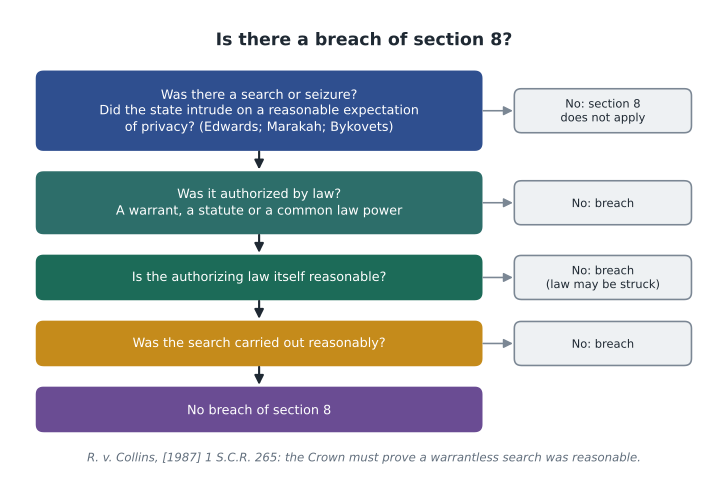
A section 8 claim is decided in two main steps. First, was there a search or seizure? That depends on whether the state intruded on the accused's reasonable expectation of privacy. If there was no reasonable expectation of privacy, the police conduct is not a search for Charter purposes, and section 8 has nothing to say about it, however intrusive it may look.
Second, if there was a search, was it reasonable? R. v. Collins, [1987] 1 S.C.R. 265, gives the test: a search is reasonable if it is authorized by law, if the law itself is reasonable, and if the manner in which the search was carried out is reasonable. Each part can fail separately. A search without any legal authority breaches section 8. A search under a statute that is itself unreasonable, as in Hunter, breaches section 8, and the statute may be declared of no force or effect under section 52. And a search under a valid warrant can still breach section 8 if it was carried out unreasonably, for example with excessive force or a needlessly destructive entry.
Collins also fixes the burden. The accused must show that there was a search, which means showing a reasonable expectation of privacy. If the search was warrantless, the Crown must then show on a balance of probabilities that it was reasonable. If the search was done under a warrant, the warrant is presumed valid, and the accused must show that it should not have been issued, a process covered in lesson 4.
Three kinds of privacy
The Court has described three overlapping zones of privacy that section 8 protects. Territorial privacy protects places, with the home at the centre of the strongest protection; vehicles, offices and other places attract less. Personal privacy protects the body, including bodily samples, so taking blood, hair or breath is a seizure. Informational privacy protects information about a person that they are entitled to control. In R. v. Dyment, [1988] 2 S.C.R. 417, a doctor collected a sample of the accused's blood for medical purposes after a car accident and gave it to police without a warrant; the Court held that this was a seizure that breached section 8, stressing that the use of a person's body without consent to obtain information about them invades an area of personal privacy essential to human dignity.
Informational privacy is now the most important of the three, because so much investigation involves data rather than places. The Court has said that it includes privacy as secrecy, privacy as control over who has the information, and privacy as anonymity, which was central in R. v. Spencer, 2014 SCC 43, discussed in lesson 3.
Deciding whether there is a reasonable expectation of privacy
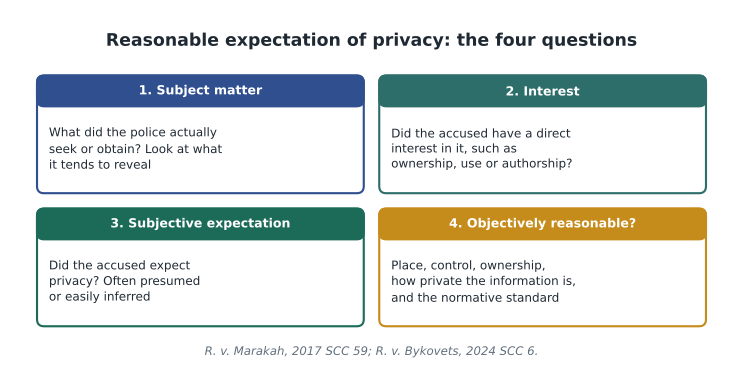
The modern test comes from R. v. Edwards, [1996] 1 S.C.R. 128, refined in R. v. Tessling, 2004 SCC 67, and set out in four questions in R. v. Marakah, 2017 SCC 59. A court looks at the totality of the circumstances and asks: what is the subject matter of the alleged search; did the accused have a direct interest in that subject matter; did the accused have a subjective expectation of privacy in it; and, if so, was that expectation objectively reasonable?
The first question, the subject matter, is often the most important, and it is framed broadly and functionally. The question is not what the police actually found but what they were looking at and what it tends to reveal. In Marakah, the subject matter was the electronic conversation between the accused and his accomplice, not just the text messages as physical data on the accomplice's phone. In R. v. Bykovets, 2024 SCC 6, the subject matter was not just a string of numbers but the information an IP address can reveal about a person's internet activity. Framing the subject matter narrowly, as a mere number or a mere object, usually leads to a finding of no privacy; framing it in terms of what it reveals usually leads the other way.
The second question, direct interest, asks whether the accused had a personal connection to the subject matter, such as being its author, owner or user. The sender of a text message has a direct interest in the conversation, as Marakah held. A visitor has little direct interest in a stranger's home.
The third question, subjective expectation, is a low bar. It can be presumed or inferred in most cases from the circumstances, and the Court has said that it is not a high hurdle. A person who uses a password on a phone, talks behind a closed door, or sends a private message usually satisfies it.
The fourth question, objective reasonableness, carries most of the weight. The factors include the place where the search occurred, whether the subject matter was in public view, whether it had been abandoned, whether it was already in the hands of third parties and on what terms, whether the police technique was intrusive in relation to the privacy interest, and how private the information was, especially whether it exposes intimate details of the person's lifestyle or personal choices. The Edwards factors, which included presence at the time of the search, possession or control, ownership, historical use and the ability to regulate access, remain relevant, especially for places.
The normative standard
The objective question is normative, not descriptive. It asks what privacy people ought to be able to expect in a free and democratic society, not what privacy they actually have given modern technology. Justice Binnie made this point in Tessling: if the state announced that all telephone calls would be monitored, people would lose any actual expectation of privacy, but that would not make the monitoring reasonable. The question is whether, if the police can do this without any judicial oversight, privacy and freedom would be diminished to a degree inconsistent with a free society.
The analysis is also content-neutral. A court does not ask whether the accused had a reasonable expectation of privacy in their drug dealing or their child pornography. It asks whether there was a reasonable expectation of privacy in the place or information, assessed without hindsight about what the police found. Otherwise section 8 would protect only the innocent, who would rarely need it. In R. v. Wong, [1990] 3 S.C.R. 36, the Court rejected the idea that a person who runs an illegal gaming operation in a hotel room has no expectation of privacy simply because the activity was illegal.
Key applications
The Supreme Court has applied the framework to many police techniques. Some results are worth knowing because they come up constantly.
Homes receive the highest protection. Entry into a home is a search, and a warrantless entry is presumptively unreasonable unless an exception applies, such as exigent circumstances or hot pursuit. The perimeter of a home also attracts protection. In R. v. Le, 2019 SCC 34, a section 9 case discussed in lesson 5, the majority accepted that a small backyard in a townhouse complex was a private space.
Police technology that captures only external information may not be a search. In Tessling, police used a forward-looking infrared camera from an airplane to detect heat coming from a house, which they thought indicated a marijuana operation. The Court held there was no reasonable expectation of privacy in the heat patterns, because the technique, as it then existed, revealed nothing about the inside of the home beyond the fact that some activity produced heat. The Court warned that a more revealing technology might be different.
Sniffer dogs are a search, but a less intrusive one. In R. v. Kang-Brown, 2008 SCC 18, and R. v. A.M., 2008 SCC 19, the Court held that a sniff of a bag at a bus station and of backpacks at a school was a search, and that police could use a dog without a warrant if they had reasonable suspicion based on objective facts that the person was carrying drugs. In R. v. Chehil, 2013 SCC 49, the Court explained that reasonable suspicion is a lower standard than reasonable grounds to believe but still requires objective facts that point to a possibility of crime, not just a hunch. In R. v. Zacharias, 2023 SCC 30, a majority held that a sniff search of a vehicle based on a suspicion that was not objectively reasonable breached section 8, but admitted the drugs under section 24(2).
Abandoned items may lose their protection. Patrick is the main example, as Castellano explained at the start of class. But abandonment is a question of fact, and the Court in Patrick said the analysis might differ if the garbage were still inside the house or close to it.
Private spaces in shared places can still be protected. In R. v. Buhay, 2003 SCC 30, the accused had a reasonable expectation of privacy in a locker at a bus depot, even though security guards had a master key. In R. v. Cole, 2012 SCC 53, a teacher had a reasonable, though diminished, expectation of privacy in personal information on a work laptop owned by his school board, because he was allowed to use it for personal purposes.
Participant surveillance by the state is a search. In R. v. Duarte, [1990] 1 S.C.R. 30, an informer wore a recording device with the consent of one party to the conversation. The Court rejected the argument that a person who speaks to another accepts the risk that the listener will report what was said. Accepting the risk that a listener will repeat what you say is very different from accepting the risk that the state is making a permanent electronic recording. Parliament responded by creating a warrant for consent interceptions in section 184.2 of the Criminal Code.
Worked problem
The Calder phone and the bar video
In the Calder file, the bar's manager gave D.C. Mercer a copy of the outdoor security video showing the shove on the Ridley Street sidewalk. Mercer also learned that the bar keeps a door log of every customer's driver's licence scanned at entry, and asked the manager to email him the entries for that night, which showed when Calder arrived and when he left. Does either step engage section 8?
Show solution
- Subject matter of the video: images of what happened on a public sidewalk outside the bar. It reveals Calder's conduct in a public place.
- Direct interest: Calder appears in the video, so he has some interest in it, but he did not create it or control it.
- Subjective expectation: a person on a public sidewalk outside a bar with cameras over the door is unlikely to expect privacy in what they do there.
- Objective reasonableness: the conduct was visible to anyone on the street, and the video was taken by a private business for its own security purposes. There is no reasonable expectation of privacy, so obtaining the video is not a search.
- Subject matter of the door log: information from Calder's government identification, plus a record of his movements. This reveals more than the video, because it ties his identity to the time he entered and left.
- Objective reasonableness of the log: a stronger argument for privacy, because personal information was collected for a limited purpose. Courts would look at the bar's privacy policy, any statute governing the collection of identification, and whether the information reveals intimate details. Even so, the information only places Calder where the video already shows him, so it is probably not highly private.
- Conclusion: the video is very unlikely to be a search. The door log raises a closer question, and a careful officer would obtain a production order. Either way, the Calder defence would spend its energy on the phone and the interview, where the stronger arguments lie.
Reasonableness: authorized by law
If there was a search, the first Collins question is whether it was authorized by law. The authority can come from a warrant or other judicial order, a statute, or a common law power. Lesson 4 covers the warrants and the main warrantless powers in detail.
The point to understand now is that the police must point to a specific source of legal authority for what they did. The fact that police generally have a duty to investigate crime is not enough. In R. v. Mann, 2004 SCC 52, the Court recognized a common law power to conduct a protective pat-down search during an investigative detention, but only where the officer has reasonable grounds to believe that their safety or the safety of others is at risk. The power did not extend to reaching into the accused's pocket after feeling something soft, because nothing suggested it was a weapon.
In R. v. Singer, 2026 SCC 8, the Court considered the implied licence that allows anyone, including police, to approach the door of a home or a vehicle to speak to the occupant. A majority held that the licence allowed officers to approach and knock, but did not authorize opening the door of the accused's truck. That act was a search without authority and breached section 8, although the evidence was admitted under section 24(2).
Reasonableness: a reasonable law
The second Collins question is whether the law that authorizes the search is itself reasonable. This is where Hunter v. Southam struck down a statute that let a non-judicial official authorize searches without a standard of reasonable grounds. The degree of protection depends on the context. In criminal investigations, the default is prior authorization on reasonable grounds, but courts accept lower standards for less intrusive techniques, such as reasonable suspicion for a sniffer dog, and accept very different standards in regulatory settings, at borders and in schools, where expectations of privacy are lower.
Reasonableness: a reasonable manner
The third Collins question looks at how the search was carried out. A strip search is the classic example. In R. v. Golden, 2001 SCC 83, the Court held that a strip search incident to arrest requires reasonable grounds to believe that it is necessary to find evidence or weapons related to the arrest, and must be carried out in a manner that respects the person's dignity, ideally at a police station, by officers of the same gender, and with as little exposure as possible. The strip search of Golden in a public sandwich shop breached section 8. Hard entries into homes and searches that cause unnecessary damage are other examples. In R. v. Cornell, 2010 SCC 31, the Court held that a hard, unannounced entry was justified on the facts, but repeated that police must normally knock and announce their presence before entering a home under a warrant unless there are reasonable grounds to depart from that rule.
Common mistakes
MistakeAsking whether the accused had a reasonable expectation of privacy in the drugs or other evidence found.
InsteadThe analysis is content-neutral. Ask whether there was a reasonable expectation of privacy in the place or information the police examined, judged without hindsight (Wong; Marakah).
MistakeConcluding there was no reasonable expectation of privacy because a third party could see or hold the information.
InsteadControl and third-party access are factors, not conclusions. Marakah held that a sender can keep a reasonable expectation of privacy in texts on the recipient's phone.
MistakeTreating every police step that intrudes on privacy as needing a warrant.
InsteadWarrantless searches are presumptively unreasonable but can be justified by a statute or common law power that is itself reasonable, such as search incident to arrest or exigent circumstances.
MistakeEnding the analysis once a warrant is found.
InsteadA search under a valid warrant can still be unreasonable if it is carried out in an unreasonable manner, such as a needless hard entry or a degrading strip search.
Practice problems
Work each problem on paper first, then reveal the answer to check.
Police fly a drone over a fenced backyard and photograph the accused tending what look like cannabis plants beyond the legal limit. Outline the analysis.
Show answer
Subject matter: images of activity in the backyard of a home. Direct interest and subjective expectation are present because it is his yard and it is fenced. Objective reasonableness turns on the place (a home's curtilage), the fence, and the intrusiveness of the technique: a drone hovering over a fenced yard is more intrusive than a view from the street. A strong argument exists that this was a search, which, being warrantless, the Crown must justify.
What is the standard for using a sniffer dog without a warrant, and where does it come from?
Show answer
Reasonable suspicion based on objective, articulable facts that the person is in possession of drugs, from Kang-Brown and A.M., explained in Chehil.
Why did Duarte hold that participant surveillance is a search?
Show answer
Because accepting the risk that a listener will repeat what you say is different from accepting the risk that the state is secretly making a permanent electronic recording. Allowing it without judicial authorization would diminish everyone's privacy.
Summary and key terms
- Section 8 protects a reasonable expectation of privacy, and its purpose, under Hunter v. Southam, is to prevent unjustified searches before they happen.
- A claim has two steps: was there a search or seizure, and was it reasonable under Collins (authorized by law, a reasonable law, carried out reasonably)?
- The reasonable expectation of privacy test looks at subject matter, direct interest, subjective expectation and objective reasonableness in the totality of the circumstances.
- The objective question is normative and content-neutral: it asks what privacy people should be able to expect in a free society, not what the police happened to find.
- Warrantless searches are presumed unreasonable; the Crown must show a statutory or common law authority that was used reasonably.
- Reasonable expectation of privacy
- The threshold for section 8: an expectation, subjectively held and objectively reasonable, that the state will not intrude on a place, the body or information.
- Collins test
- A search is reasonable if authorized by law, if the law is reasonable, and if it is carried out in a reasonable manner.
- Reasonable suspicion
- A standard below reasonable grounds to believe, requiring objective facts pointing to a possibility of criminal activity.
- Reasonable and probable grounds
- A credibly based probability, established on oath, that an offence has been committed and that evidence will be found, the default standard for a warrant.
- Participant surveillance
- Recording a conversation with the consent of one participant, which is a search when done by the state (Duarte).
- Abandonment
- Giving up a privacy interest in an item, such as garbage left at the lot line for collection (Patrick).
Lesson quiz · 5 questions
Score 60% or more to complete this lesson.
Create a free account to save your progress, take quizzes and earn a certificate.