
LAWC-211 · Lesson 11 of 12 · 23 min
Exclusion of evidence
▶ Video coming soon A video version of this lesson is on the way.
Castellano draws a table on the board with three columns, one for each piece of evidence the Calder defence wants excluded: the grey hoodie found in the bedroom drawer, the browser search found on the phone at the station, and the statement 'he was mouthing off and I lost it'. 'We have found, or at least argued, a breach for each of these,' she says. 'Now comes the question that decides most criminal Charter cases. Should the jury hear about them anyway?' Sophie says that if the police broke the rules, the evidence should go. Theo says the hoodie has blood on it, and juries should hear about blood. 'Section 24(2) says you are both asking the wrong question,' Castellano says. 'It does not ask whether exclusion is fair to the accused or whether the evidence is useful. It asks whether admitting the evidence would bring the administration of justice into disrepute.'
This lesson covers section 24(2) of the Charter: when evidence has been 'obtained in a manner' that breached the Charter, the test from R. v. Grant, 2009 SCC 32, and how the Supreme Court has applied it in recent cases. It ends by applying the test to the Calder evidence.
The text and the choice it reflects
Section 24(2) says that where a court concludes that evidence was obtained in a manner that infringed or denied any Charter right, 'the evidence shall be excluded if it is established that, having regard to all the circumstances, the admission of it in the proceedings would bring the administration of justice into disrepute'.
The provision reflects a deliberate choice. Before 1982, Canadian law followed the English rule that relevant evidence was admissible however it was obtained, as the Court held in R. v. Wray, [1971] S.C.R. 272. American law, by contrast, developed an exclusionary rule under which unconstitutionally obtained evidence is generally excluded, subject to exceptions. The drafters of the Charter chose a middle path: exclusion is neither automatic nor forbidden, and depends on the effect of admission on the reputation of the justice system. The accused bears the burden of showing on a balance of probabilities that the evidence should be excluded.
Obtained in a manner
The first question is whether the evidence was obtained in a manner that infringed the Charter. This is not a strict causation test. In R. v. Strachan, [1988] 2 S.C.R. 980, the Court held that it is enough if there is a temporal connection between the breach and the discovery of the evidence, unless the connection is too remote. R. v. Wittwer, 2008 SCC 33, confirmed that the connection may be temporal, contextual, causal or a combination. In R. v. Pino, 2016 ONCA 389, the Court of Appeal for Ontario took a generous approach, holding that evidence obtained before a breach can still be 'obtained in a manner' that infringed the Charter if the breach and the discovery are part of the same transaction or course of conduct, unless the connection is remote or tenuous.
The Court revisited the issue in R. v. Beaver; R. v. Lambert, 2022 SCC 54, which concerned statements made after an initial breach was cured. The Court held that later evidence may be sufficiently connected to an earlier breach to engage section 24(2), but that the connection can be severed where the police make a fresh start, for example by properly informing the accused of their rights and giving a genuine opportunity to consult counsel before the later statement. Whether there was a fresh start depends on the facts.
From Collins to Grant
The first framework for section 24(2), in R. v. Collins, [1987] 1 S.C.R. 265, grouped factors into three categories: trial fairness, the seriousness of the violation, and the effect of exclusion on the administration of justice. In R. v. Stillman, [1997] 1 S.C.R. 607, the Court developed the trial fairness category into a near-automatic rule: conscriptive evidence, meaning evidence the accused was compelled to create, such as statements or bodily samples, was generally excluded if it would not have been discovered without the breach. Critics argued that this made the outcome turn on a single classification rather than on all the circumstances, and that it led to the exclusion of reliable evidence for minor breaches.
In Grant, Chief Justice McLachlin and Justice Charron, for the majority, replaced the Collins and Stillman framework with a new test. The question is still whether admission would bring the administration of justice into disrepute, viewed from the long-term perspective of a reasonable person informed of all the relevant circumstances and the values underlying the Charter. The focus is prospective and societal: the aim is not to punish the police or compensate the accused, but to maintain the integrity of and public confidence in the justice system.
The three lines of inquiry
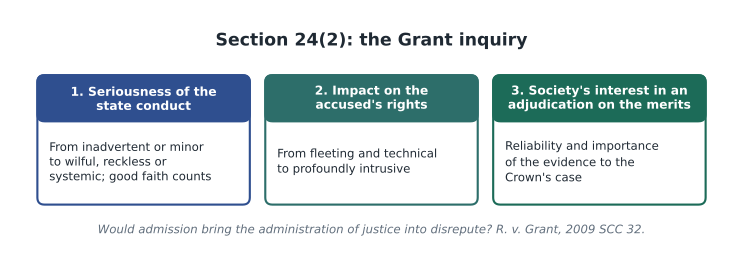
Grant directs a court to assess and balance the effect of admitting the evidence on society's confidence in the justice system having regard to three lines of inquiry.
The first is the seriousness of the Charter-infringing state conduct. The question is whether admitting the evidence would send the message that the justice system condones serious state misconduct. Conduct runs along a spectrum. At one end are inadvertent, technical or minor breaches, or breaches committed in good faith, such as reliance on a law later found unconstitutional or on unsettled law. At the other end are wilful or reckless disregard of Charter rights and conduct that is part of a systemic pattern. Good faith cannot be claimed where the police were ignorant of established Charter standards, and negligence or wilful blindness are not good faith. Extenuating circumstances, such as the need to prevent the loss of evidence, can reduce seriousness. Police misleading the court in their testimony makes the conduct more serious, as the Court held in R. v. Harrison, 2009 SCC 34.
The second is the impact of the breach on the Charter-protected interests of the accused. The question is how seriously the breach undermined the interests the right protects, from fleeting and technical to profoundly intrusive. A search of a home or a phone has a greater impact than a search of a car. A breach of section 10(b) that leads to a statement strikes at the accused's choice whether to speak, a central interest. Discoverability is relevant here: if the evidence would have been found anyway by lawful means, the impact of the breach is lessened, although R. v. Côté, 2011 SCC 46, cautioned that discoverability is not determinative, and that police who could have obtained a warrant but chose not to may be acting more seriously, not less.
The third is society's interest in the adjudication of the case on its merits. The question is whether the truth-seeking function of the trial would be better served by admitting or excluding the evidence. Reliable evidence that is important to the Crown's case pulls towards admission, and the more crucial it is, the stronger the pull. Unreliable evidence, such as a coerced statement, pulls towards exclusion. The seriousness of the offence is relevant but cuts both ways: the public has a strong interest in seeing serious charges tried on their merits, but also a strong interest in the justice system being above reproach when the stakes for the accused are high.
The court then balances the three lines of inquiry. No single factor is decisive, and there is no mathematical formula. The Court of Appeal for Ontario said in R. v. McGuffie, 2016 ONCA 365, and the Supreme Court repeated in Le, that where the first two lines of inquiry together make a strong case for exclusion, the third will seldom, if ever, tip the balance towards admission. Where the first two lines are weak, the third will usually confirm that the evidence should be admitted.
Types of evidence
Grant discussed how the test tends to apply to different types of evidence, while insisting that all the circumstances must be considered. Statements obtained in breach of the Charter tend to be excluded, because breaches that produce statements, especially of section 10(b), usually strike at the accused's interest in choosing whether to speak, and because statements obtained in breach may be unreliable. Bodily evidence, such as breath or blood samples, is assessed with attention to how intrusive the taking was; a breath sample is relatively non-intrusive, a blood sample more so. Non-bodily physical evidence, such as drugs or guns, is assessed with attention to the privacy interest intruded upon, and its reliability usually pulls strongly towards admission. Derivative evidence, physical evidence discovered because of an unlawfully obtained statement, is assessed with attention to discoverability and the seriousness of the breach that produced the statement.
In Grant itself, the gun found on the accused was admitted. The police conduct was not deliberate or egregious, since the law of detention was unsettled at the time, the impact on Grant's interests was significant but not at the most serious end, and the gun was highly reliable and important. In Harrison, by contrast, 35 kilograms of cocaine found in a car after an unlawful stop were excluded. The officer had no grounds for the stop, conducted a search he knew was unjustified, and gave misleading testimony; the Court held that the seriousness of the conduct outweighed society's interest in the reliable evidence.
Recent applications
The recent cases show the test at work across the topics of this course, and they show that outcomes are hard to predict.
In R. v. Paterson, 2017 SCC 15, the warrantless entry into the apartment, gun and all, led to exclusion: the officers could easily have issued a ticket or sought a warrant, and the intrusion into a home was serious. In R. v. Le, 2019 SCC 34, the gun and drugs were excluded because the entry into the backyard and the detention were serious breaches with a significant impact, in the context of the policing of racialized communities. In R. v. Bykovets, 2024 SCC 6, the evidence was excluded and a new trial ordered.
In other recent cases, the evidence was admitted despite the breach. In R. v. Tim, 2022 SCC 12, the arrest rested on a mistake of law about gabapentin, but the Court admitted a gun and drugs, finding the breaches not at the most serious end and the evidence reliable and important. In R. v. McColman, 2023 SCC 8, the breath evidence from the unlawful sobriety stop on a private driveway was admitted, because the officers' misunderstanding of their statutory power was not flagrant, breath samples are minimally intrusive, and the evidence was reliable and essential. In R. v. Zacharias, 2023 SCC 30, drugs found after a sniffer dog search based on an unreasonable suspicion were admitted. In R. v. Singer, 2026 SCC 8, the evidence obtained after the officers opened the truck door was admitted under section 24(2), despite the breach of section 8.
And in R. v. Wilson, 2025 SCC 32, a six to three majority excluded the evidence obtained after an arrest that the Good Samaritan provision prohibited, and the acquittals stood. The majority treated the police failure to respect a statutory immunity designed to save lives in overdose situations as serious, because undermining public trust in that provision could discourage people from calling for help.
Castellano asks the class what the cases have in common. Arjun offers a pattern: 'Exclusion when the police went into a home, or ignored clear law, or the breach was part of a pattern. Admission when the police misread a statute or the law was unsettled, and the evidence was physical and reliable.' Castellano says that is a fair summary, but warns that the divided votes in several of them, including Zacharias and Singer, show how close many of these cases are.
Exclusion under section 24(1)
Section 24(2) applies only to evidence obtained in a manner that breached the Charter. In R. v. Bjelland, 2009 SCC 38, the Court held that evidence that was not obtained through a breach, but whose admission would make the trial unfair, such as evidence disclosed so late that the defence cannot respond, may be excluded under section 24(1), but only where a less drastic remedy, such as an adjournment, would not cure the unfairness. Trial judges also have a common law discretion to exclude evidence whose prejudicial effect outweighs its probative value, as Evidence students know.
Worked problem
Applying Grant to the Calder evidence
Apply Grant to the three pieces of evidence: the hoodie found in the warrantless bedroom search (lesson 4), the browser search found in the station phone search (lesson 3), and the interview statement after Mercer refused a further consultation and disparaged the legal advice (lesson 6). Assume the statement was found voluntary.
Show solution
- The hoodie, seriousness: officers walked through a home without any reason to suspect a safety risk and opened drawers. Stairs had been decided years earlier, so this is not unsettled law. The conduct is towards the serious end, though not shown to be deliberate.
- The hoodie, impact: a search of a bedroom in a home is a significant intrusion. Discoverability lessens the impact somewhat, because police clearly had grounds for a warrant, but under Côté, choosing not to get one when it was readily available does not help the Crown much.
- The hoodie, society's interest: the hoodie is reliable physical evidence, but it adds little to the video, which shows the shove. Its importance to the Crown's case is modest.
- The hoodie, balance: the first two lines point fairly strongly to exclusion and the third is weak. Exclusion is likely.
- The search history, seriousness and impact: the station search went well beyond Fearon's limits, and the notes were inadequate, years after Fearon set the rules. The search history is highly personal information. Both lines favour exclusion. Society's interest is moderate: the search is reliable and relevant to Calder's state of mind afterwards, but not essential. Exclusion is likely.
- The statement, seriousness: disparaging the legal advice and refusing a further consultation after Dussault is a breach of an established standard, and the comments about leniency show an approach aimed at overcoming Calder's choice to stay silent.
- The statement, impact: a section 10(b) breach that produces a statement strikes at the core interest in choosing whether to speak. The impact is high.
- The statement, society's interest: the statement is important because it addresses Calder's state of mind, but statements obtained after improper pressure are less reliable. The first two lines make a strong case for exclusion, and under Le the third will seldom tip the balance. Exclusion is likely.
- Overall: if the defence succeeds on all three, the Crown's case would rest on the video, the witnesses, the pathology and the stored texts obtained under the production order, after excising any tainted information from the ITO. That is still a strong case for manslaughter, which shows that exclusion does not always end a prosecution.
Common mistakes
MistakeAsking whether excluding the evidence would be fair to the accused or would punish the police.
InsteadThe question is whether admission would bring the administration of justice into disrepute, viewed from the long-term, societal perspective (Grant).
MistakeTreating reliable physical evidence as always admissible.
InsteadReliability strengthens the third line of inquiry, but where the first two lines strongly favour exclusion, the third will seldom tip the balance (Le; Harrison; Paterson).
MistakeClaiming good faith whenever the officer did not intend to breach the Charter.
InsteadIgnorance of established Charter standards, negligence and wilful blindness are not good faith (Grant; Le).
MistakeRequiring proof that the breach caused the discovery of the evidence.
InsteadA temporal, contextual or causal connection is enough unless it is remote or tenuous (Strachan; Wittwer; Pino), subject to a fresh start (Beaver).
Practice problems
Work each problem on paper first, then reveal the answer to check.
Police stop a car without any grounds, search the trunk without consent, and find a loaded handgun. The officer testifies candidly that he 'had a feeling'. Apply Grant briefly.
Show answer
Seriousness: an arbitrary detention and warrantless search with no grounds at all, in clear breach of settled law, is serious. Impact: a car search intrudes less than a home search but is still significant, and the detention adds to it. Society's interest: a loaded handgun is reliable and crucial. Courts have gone both ways in such cases; the candour of the officer and the absence of a pattern may favour admission, while the complete lack of grounds favours exclusion.
An accused gives a statement after a section 10(b) breach. Two hours later, police properly advise him, he speaks to a lawyer, and he gives a second statement. Is the second statement 'obtained in a manner' that breached the Charter?
Show answer
Possibly. Under Beaver, the second statement may be connected to the first breach, but the proper advice and consultation may amount to a fresh start that severs the connection. The court will look at whether the police referred to the first statement and whether the accused felt the damage was already done.
Why did the Court exclude the evidence in Wilson (2025)?
Show answer
Because arresting people at an overdose scene for simple possession disregarded a statutory immunity meant to encourage people to call for help. The majority treated that conduct as serious and its impact as significant, and found that admission would bring the administration of justice into disrepute.
Summary and key terms
- Section 24(2) excludes evidence obtained in a manner that breached the Charter if admission would bring the administration of justice into disrepute; the accused bears the burden.
- 'Obtained in a manner' requires only a temporal, contextual or causal connection that is not remote (Strachan; Wittwer; Pino), subject to a fresh start (Beaver).
- Grant asks about the seriousness of the state conduct, the impact on the accused's protected interests, and society's interest in adjudication on the merits, and then balances them.
- Statements obtained in breach tend to be excluded; reliable physical evidence is more often admitted unless the first two lines strongly favour exclusion.
- Recent cases excluded evidence in Paterson, Le, Bykovets and Wilson, and admitted it in Tim, McColman, Zacharias and Singer.
- Section 24(1) can exclude evidence to protect trial fairness where no lesser remedy will do (Bjelland).
- Exclusionary rule
- A rule requiring unconstitutionally obtained evidence to be excluded; Canada uses a discretionary test under section 24(2) instead of an automatic rule.
- Grant test
- The three lines of inquiry under section 24(2): seriousness of the state conduct, impact on the accused, and society's interest in adjudication.
- Good faith
- Police conduct based on a reasonable belief that it was lawful, which reduces the seriousness of a breach; it excludes ignorance of established standards.
- Discoverability
- Whether the evidence would have been found lawfully without the breach, relevant to the impact of the breach.
- Derivative evidence
- Physical evidence found as a result of an unlawfully obtained statement.
- Fresh start
- Police conduct that severs the connection between an earlier breach and later evidence, such as proper advice and consultation before a later statement (Beaver).
Lesson quiz · 5 questions
Score 60% or more to complete this lesson.
Create a free account to save your progress, take quizzes and earn a certificate.