
LAWC-211 · Lesson 7 of 12 · 23 min
Police interrogation, confessions and entrapment
▶ Video coming soon A video version of this lesson is on the way.
Castellano plays a longer section of the Calder interview. Two hours in, Calder has said very little. D.C. Mercer leans forward. 'Owen, I've done this a long time. Judges go easy on guys who own up. They come down hard on guys who make the family sit through a trial. You can be the guy who made a mistake, or you can be the guy who lied about it. Which one is going to get you home sooner?' Calder is quiet for a long moment. Then: 'He was mouthing off and I lost it. I just pushed him. I didn't think he'd fall like that.'
Sophie says it sounds like a promise. Theo says it sounds like every interview he ever watched as a law clerk. 'You are both right,' Castellano says, 'and the question is which of you the law agrees with. Voluntariness is the oldest rule in criminal procedure, and it is still the one that decides most confession cases.' This lesson covers the common law confessions rule, the right to silence under section 7 of the Charter, the Mr. Big rule, and the defence of entrapment, which controls how far police may go in offering people the chance to commit crimes.
The confessions rule
At common law, a statement made by an accused to a person in authority is admissible against the accused only if the Crown proves beyond a reasonable doubt that it was voluntary. The rule predates the Charter by more than a century and operates independently of it. It applies whether or not the accused was detained, and whether or not any Charter right was breached. A statement that fails the test is excluded automatically; there is no balancing as under section 24(2).
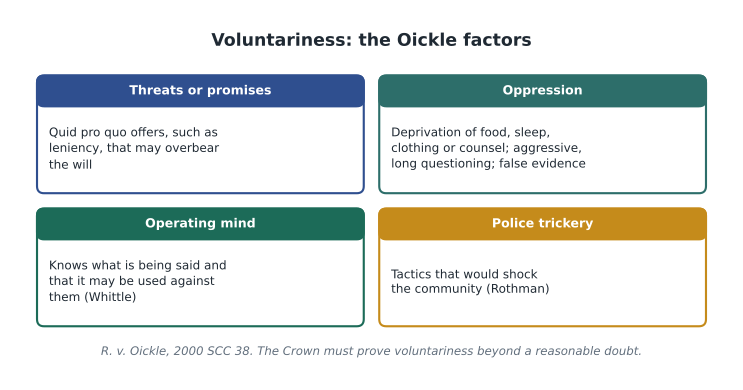
The rule rests on two concerns: reliability, because statements obtained by threats, promises or oppression may be false, and fairness, because the state should not obtain convictions through improper means. The modern statement of the rule is R. v. Oickle, 2000 SCC 38. Justice Iacobucci, for the majority, rejected a rigid checklist and directed courts to consider all the circumstances in a contextual way, with attention to several recurring factors.
Threats and promises
The first factor is threats or promises. Explicit threats of violence plainly make a statement involuntary. Subtler inducements require more analysis. Oickle explained that the most important consideration is whether there is a quid pro quo, meaning that the police offered something in return for the confession. An offer of leniency, such as a reduced charge or a lighter sentence, is a strong inducement and will often make a statement involuntary, particularly if it is explicit. Telling a suspect that 'it would be better' to confess is not automatically fatal but must be examined: it becomes improper if it suggests that the accused will receive a benefit, such as better treatment from the courts, in return for confessing.
Moral or spiritual inducements, such as appeals to the suspect's conscience or to the feelings of the victim's family, are generally not improper, because the police have no control over the benefit offered. In R. v. Spencer, 2007 SCC 11, police suggested that the accused's girlfriend might not be questioned if he cooperated, and the Court held that this inducement, in the circumstances, did not overbear his will, stressing that a quid pro quo is an important factor but not decisive in every case. The question is always whether the inducement, alone or with other factors, was strong enough to raise a reasonable doubt about whether the will of the subject was overborne.
Oppression
The second factor is oppression. An atmosphere of oppression can make a statement involuntary even without any threat or promise, because the suspect may confess simply to escape the conditions. Oickle listed examples: depriving the suspect of food, clothing, water, sleep or medical attention; denying access to counsel; excessively aggressive, intimidating questioning for a prolonged period; and confronting the suspect with fabricated evidence, which Oickle treated as a factor that can contribute to oppression, especially when combined with others. Long interviews are not automatically oppressive, but a long interview of an exhausted suspect who repeatedly asks to stop raises serious concern.
Operating mind
The third factor is the operating mind. In R. v. Whittle, [1994] 2 S.C.R. 914, the accused suffered from schizophrenia and said he confessed because voices told him to. The Court held that the operating mind requirement is limited: the accused must have sufficient cognitive capacity to understand what they are saying and that it may be used to their detriment. It does not require the capacity to make a wise or rational choice. Severe intoxication, mental illness or shock can sometimes fail this low test, but they rarely do.
Police trickery
The fourth factor is police trickery. Police may use deception in investigations. In Rothman v. The Queen, [1981] 1 S.C.R. 640, an officer posed as a truck driver in a cell and obtained admissions. Justice Lamer's concurring reasons, later adopted as the test in Oickle, held that a statement should be excluded where the trickery used is so appalling as to shock the community, such as a police officer pretending to be a chaplain or a legal aid lawyer, or injecting truth serum into a diabetic under the pretence that it was insulin. Ordinary deception, such as overstating the strength of the evidence, does not usually meet this standard on its own, but it can contribute to oppression or combine with an inducement.
Persons in authority and recording
The confessions rule applies only to statements made to a person in authority, which usually means someone involved in arresting, detaining, examining or prosecuting the accused. In R. v. Hodgson, [1998] 2 S.C.R. 449, the Court held that the test is subjective, viewed from the accused's perspective: did the accused reasonably believe that the person could control or influence the prosecution? Police officers almost always qualify. Undercover officers, whom the accused does not know to be police, do not, as the Court held in R. v. Grandinetti, 2005 SCC 5, which is why Mr. Big operations needed a different rule.
Recording matters greatly. In R. v. Moore-McFarlane (2001), 56 O.R. (3d) 737 (C.A.), the Court of Appeal for Ontario held that where a suspect is in custody, recording facilities are readily available, and police deliberately do not record the interrogation, the resulting non-recorded statement is suspect, and it may be difficult for the Crown to prove voluntariness. Oickle itself stressed the value of a complete record. A full video of the Calder interview means that the voir dire will be decided on what Mercer actually said, not on competing memories.
The right to silence
Section 7 of the Charter protects the right to silence of a detained person. In R. v. Hebert, [1990] 2 S.C.R. 151, an accused who had told police he would not make a statement was placed in a cell with an undercover officer posing as another prisoner, who actively elicited admissions. Justice McLachlin held that the right to silence protects a detainee's free choice whether to speak to the authorities, and that the state may not use a trick to subvert that choice once it has been exercised. The right is breached where the state actively elicits the statement, through an undercover agent who goes beyond passively listening. In R. v. Broyles, [1991] 3 S.C.R. 595, a friend who visited the accused in jail while wearing a police recording device and who steered the conversation towards the offence was held to be a state agent, and the statement was excluded.
In R. v. Singh, 2007 SCC 48, the accused asserted his right to silence eighteen times during an interview, and the officer kept questioning him, telling him he could choose not to speak but continuing anyway. Justice Charron, for a five to four majority, held that police may continue to question a detainee who has asserted the right to silence. In the context of a custodial interrogation by a known person in authority, the confessions rule and the section 7 right to silence are functionally equivalent: if a statement is voluntary under Oickle, there is no section 7 breach. But persistent questioning in the face of repeated assertions of the right may be relevant to whether the statement was voluntary, because it can show that the detainee's choice was overborne. The dissent would have required police to respect a clear assertion of silence.
Singh and Sinclair together mean that Canadian police may interview a detainee who has spoken to counsel and who says they do not want to talk, for hours if necessary, provided they do not cross into inducements, oppression or trickery. The protection lies in the voluntariness rule and in recording, not in any right to end the interview.
Mr. Big operations
In a Mr. Big operation, undercover officers pose as members of a criminal organization and draw the suspect into the group with paid jobs, friendship and promises of advancement, culminating in a meeting with the boss, Mr. Big, who presses the suspect to confess to the crime under investigation, often to show loyalty or so that the organization can 'take care' of the problem. Because the officers are not known to be police, the confessions rule does not apply, and the right to silence under section 7 is not engaged because the suspect is not detained.
In R. v. Hart, 2014 SCC 52, the Court created a new two-part framework. First, confessions obtained in Mr. Big operations are presumptively inadmissible under a new common law rule of evidence. The Crown can rebut the presumption by showing on a balance of probabilities that the probative value of the confession outweighs its prejudicial effect. Probative value depends on the reliability of the confession, considering the circumstances in which it was made, such as the length of the operation, the inducements offered, the threats made, and the accused's personal characteristics, along with any markers of reliability, such as details that only the killer would know and confirmatory evidence. Prejudice comes from the bad character evidence that the operation reveals, since the accused was keen to join a criminal gang. Second, the doctrine of abuse of process protects against police misconduct, such as operations that overcome the accused's will through threats of violence or prey on vulnerabilities such as mental health problems or addiction. In R. v. Mack, 2014 SCC 53, decided with Hart, the confession was admitted under the new framework.
Entrapment
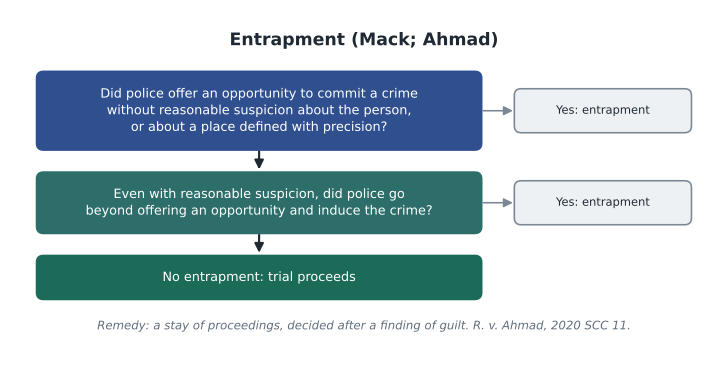
Entrapment is not a defence that negates guilt. An entrapped accused committed the offence. But the courts will not allow a conviction where the state manufactured the crime, because that would be an abuse of process. In R. v. Mack, [1988] 2 S.C.R. 903, Justice Lamer set out the doctrine. Entrapment occurs when the authorities provide a person with an opportunity to commit an offence without acting on a reasonable suspicion that the person is already engaged in criminal activity, or without acting in the course of a bona fide inquiry. It also occurs when, even with such reasonable suspicion or in a bona fide inquiry, the authorities go beyond providing an opportunity and induce the commission of the offence.
The accused must prove entrapment on a balance of probabilities. The issue is decided by the judge, not the jury, and only after the accused has been found guilty, so the accused does not have to admit guilt in advance to raise it. The remedy is a stay of proceedings.
A bona fide inquiry permits police to provide opportunities to people in a location where crime is reasonably suspected to occur. In R. v. Barnes, [1991] 1 S.C.R. 449, an undercover officer approached people on the Granville Mall in Vancouver, an area associated with drug dealing, and asked to buy drugs. The Court held that this was a bona fide inquiry into a location defined with sufficient precision, even though the officer had no suspicion about Barnes in particular.
Dial-a-dope: Ahmad
In R. v. Ahmad, 2020 SCC 11, police received unverified tips that particular phone numbers were being used to sell drugs. Officers called the numbers and, after brief conversations, asked to buy drugs. A five to four majority held that the reasonable suspicion requirement applies to a phone number as it does to a person or place. Police may not offer an opportunity to commit a crime to the person answering a phone unless they reasonably suspect, before the offer is made, that the person using that number is engaged in drug dealing. A bare tip that a number is being used to sell drugs is not enough on its own. Police may, however, develop reasonable suspicion during the call itself, if the person responds to the conversation in a way that shows familiarity with drug slang or the drug trade. In Ahmad's case, the conversation had given police reasonable suspicion before the offer, so there was no entrapment and his conviction stood. In the companion case of Williams, the officer asked to buy before any such suspicion developed, so Williams was entrapped and the proceedings were stayed.
In R. v. Ramelson, 2022 SCC 44, police posted fake advertisements for sexual services with minors in a specific online space. The Court held that an online space can be a place defined with sufficient precision for a bona fide inquiry, so long as police have reasonable suspicion that crime is occurring there and their activity is targeted, and found no entrapment on the facts.
Worked problem
Was Calder's confession voluntary?
Apply Oickle and Singh to Calder's statement, 'He was mouthing off and I lost it.' The interview lasted three hours, was fully recorded, and included Mercer's comments that judges go easy on those who own up and that a trial would make Dorey's family suffer. Calder had refused to talk for the first two hours, and Mercer had refused his requests to speak to a lawyer again.
Show solution
- Person in authority and burden: Mercer is a police officer known to Calder, so the rule applies, and the Crown must prove voluntariness beyond a reasonable doubt on a voir dire.
- Threats or promises: 'Judges go easy on guys who own up' links a confession to a lighter sentence, and 'which one is going to get you home sooner?' sharpens the link. Under Oickle, an implied offer of leniency in return for confessing is a quid pro quo and a strong inducement.
- Moral inducement: the appeal to the Dorey family's feelings is a moral inducement, which is generally not improper on its own. Here it was combined with the suggestion of leniency.
- Oppression: three hours is not extreme, and there is no suggestion of deprivation of food or sleep. But Mercer kept questioning despite Calder's silence and refused further access to counsel while disparaging the advice. Under Singh, persistence is allowed but relevant.
- Operating mind and trickery: nothing suggests Calder lacked an operating mind, and there was no trickery that would shock the community.
- Timing: the statement came right after the leniency comments, which supports a causal link between the inducement and the confession.
- Conclusion: the Crown will struggle to prove voluntariness beyond a reasonable doubt. If the statement is found involuntary it is excluded outright, without any section 24(2) balancing. If it survives, the defence still has the section 10(b) argument from lesson 6.
Common mistakes
MistakeAssuming any confession given after a long interview is involuntary.
InsteadLength is one factor. Oickle requires a contextual look at threats or promises, oppression, operating mind and trickery, and Singh allows continued questioning.
MistakeApplying section 24(2) balancing to an involuntary confession.
InsteadAn involuntary statement is excluded automatically under the common law rule; balancing applies only to evidence obtained through a Charter breach.
MistakeTreating entrapment as a defence that shows the accused is not guilty.
InsteadEntrapment is a form of abuse of process. It is decided by the judge after a finding of guilt, on a balance of probabilities, and leads to a stay.
MistakeSaying a tip about a phone number gives police reasonable suspicion to offer to buy drugs.
InsteadAhmad held that a bare tip is not enough; police need reasonable suspicion before the offer, which may develop during the call.
Practice problems
Work each problem on paper first, then reveal the answer to check.
During an interview, an officer tells a suspect: 'If you tell me where the gun is, I'll talk to the Crown about dropping the attempted murder charge.' The suspect then confesses. Voluntary?
Show answer
Very unlikely. This is an explicit quid pro quo offer of leniency, the clearest kind of inducement under Oickle, and the Crown would struggle to prove voluntariness beyond a reasonable doubt.
In a Mr. Big operation lasting four months, the accused, who is unemployed and isolated, is paid 15,000 dollars and confesses to a murder. What must the Crown show?
Show answer
Under Hart, the confession is presumptively inadmissible. The Crown must show on a balance of probabilities that its probative value, based on reliability and confirmatory evidence, outweighs the prejudice from the bad character evidence. The defence may also argue abuse of process if the operation exploited the accused's vulnerabilities.
Police receive an anonymous tip that 'Jay' sells cocaine from a certain number. An officer calls and immediately says 'I need two halves.' The person agrees. Entrapment?
Show answer
Likely yes. Under Ahmad, the bare tip did not give reasonable suspicion, and the officer made the offer before anything in the call could supply it. If the accused is found guilty, the court would stay the proceedings.
Summary and key terms
- A statement to a person in authority is admissible only if the Crown proves voluntariness beyond a reasonable doubt; an involuntary statement is excluded automatically (Oickle).
- Voluntariness considers threats or promises, especially a quid pro quo, oppression, the operating mind (Whittle) and trickery that would shock the community (Rothman).
- The section 7 right to silence prohibits the state from actively eliciting statements by undercover agents after a detainee chooses silence (Hebert; Broyles), but police may keep questioning a detainee who asserts silence (Singh).
- Mr. Big confessions are presumptively inadmissible unless probative value outweighs prejudice, with abuse of process as a further check (Hart).
- Entrapment occurs when police offer an opportunity without reasonable suspicion or a bona fide inquiry, or induce the crime; the remedy is a stay (Mack; Barnes; Ahmad; Ramelson).
- Confessions rule
- The common law rule that statements to a person in authority are admissible only if proved voluntary beyond a reasonable doubt.
- Person in authority
- Someone the accused reasonably believes can control or influence the prosecution, usually a police officer.
- Quid pro quo
- An offer of a benefit in return for a confession, the most important kind of inducement under Oickle.
- Operating mind
- Sufficient cognitive capacity to understand what one is saying and that it may be used against one (Whittle).
- Mr. Big operation
- An undercover operation in which officers posing as criminals seek a confession, governed by Hart.
- Entrapment
- State conduct offering an opportunity to commit a crime without reasonable suspicion or a bona fide inquiry, or inducing the crime, remedied by a stay.
- Bona fide inquiry
- An investigation into a place, physical or online, defined with sufficient precision and reasonably suspected of crime.
Lesson quiz · 5 questions
Score 60% or more to complete this lesson.
Create a free account to save your progress, take quizzes and earn a certificate.