
LAWC-211 · Lesson 8 of 12 · 24 min
Bail and disclosure
▶ Video coming soon A video version of this lesson is on the way.
Castellano reminds the class of the visit Section B made in 1L to the bail court at the Corwin courthouse. 'You saw thirty bail hearings in one morning, most of them in less than ten minutes. That is where the Charter's presumption of innocence meets the reality of a busy list.' She sets out Calder's bail hearing from the file. Calder was held for a bail hearing after his arrest and brought before a justice of the peace the next day. The Crown opposed release, pointing to his assault conviction eight years earlier and to the deleted texts with Leah Pruitt, which it said showed a risk of interfering with witnesses. Defence counsel proposed release with Tess Halloran, Calder's girlfriend, as surety. The justice released Calder on conditions: residence with Halloran, a curfew, no contact with Pruitt, Brendan Hollis or members of the Dorey family, and a condition that he not consume alcohol.
'Was that the right result?' Castellano asks. 'And when the defence received the disclosure six weeks later, what was it entitled to see?' This lesson covers the two parts of the pre-trial process that most affect an accused person's daily life and their ability to defend themselves: judicial interim release, usually called bail, and the Crown's duty of disclosure.
The constitutional starting point
Section 11(e) of the Charter guarantees the right of a person charged with an offence 'not to be denied reasonable bail without just cause'. Section 11(d) guarantees the presumption of innocence. The Supreme Court has read section 11(e) as containing two parts: the right to bail on reasonable terms, and the right not to be denied bail without just cause. In R. v. Pearson, [1992] 3 S.C.R. 665, and R. v. Morales, [1992] 3 S.C.R. 711, the Court held that just cause requires that denial of bail occur only in a narrow set of circumstances and be necessary to promote the proper functioning of the bail system, not be imposed for a purpose extraneous to it. Morales struck down a ground of detention based on the 'public interest' because it was vague and authorized detention without any structure.
In R. v. Antic, 2017 SCC 27, Justice Wagner, for the Court, called the right to reasonable bail a basic tenet of Canadian criminal law and stressed that release is the default position, and that release on the least onerous terms is the norm. In R. v. Zora, 2020 SCC 14, Justice Martin, for the Court, described a culture of risk aversion in bail courts, with too many people held or subjected to numerous and onerous conditions, and too many charged with breaching those conditions.
Release by police
Most people charged with offences never see a bail court. Police can release an accused at the scene or at the station with an appearance notice, a summons, or an undertaking, with or without conditions, under Part XVI of the Criminal Code, which was restructured in 2019. The principle of restraint in section 493.1, added in 2019, requires police and courts to give primary consideration to release at the earliest reasonable opportunity and on the least onerous conditions appropriate. Section 493.2 requires particular attention to the circumstances of Indigenous accused and accused from vulnerable populations who are overrepresented in the criminal justice system and disadvantaged in obtaining release.
A person who is not released by police must be brought before a justice without unreasonable delay, and within 24 hours where a justice is available, under section 503. In Myers, discussed below, the Court referred to the importance of these timelines, and courts have treated unjustified delays in bringing an accused before a justice as breaches of section 9.
The bail hearing and the ladder
At a bail hearing under section 515, the general rule is that the Crown bears the onus of showing why the accused should be detained or why conditions are necessary. Section 515(1) directs the justice to release the accused on an undertaking without conditions unless the Crown shows cause otherwise. Section 515(2) then sets out more onerous forms of release, from an undertaking with conditions, to a release order with or without conditions, to release with sureties, and finally to cash deposits. The justice must not impose a more onerous form unless the Crown shows why the less onerous form is inadequate. This step-by-step structure is called the ladder principle, and Antic confirmed it is mandatory. A justice cannot jump to a surety or cash deposit without first rejecting each lesser form. Antic also held that cash bail with sureties should be used only in exceptional cases and that the amount must not be so high that it effectively amounts to a detention order.
Bail hearings are informal. The justice may receive any evidence considered credible or trustworthy under section 518, including hearsay, police synopses and the accused's criminal record. The accused cannot be questioned about the offence charged. Most hearings in Ontario take place before justices of the peace in the Ontario Court of Justice.
The three grounds for detention
Section 515(10) sets out the only three grounds on which an accused may be detained. The primary ground is that detention is necessary to ensure the accused's attendance in court. The secondary ground is that detention is necessary for the protection or safety of the public, including any victim or witness, having regard to all the circumstances, including any substantial likelihood that the accused will, if released, commit a criminal offence or interfere with the administration of justice. The tertiary ground is that detention is necessary to maintain confidence in the administration of justice, considering all the circumstances, including the apparent strength of the prosecution's case, the gravity of the offence, the circumstances surrounding its commission, including whether a firearm was used, and the fact that the accused faces a potentially lengthy term of imprisonment.
The tertiary ground was upheld in part in R. v. Hall, 2002 SCC 64. In R. v. St-Cloud, 2015 SCC 27, the Court held that it is not limited to rare or exceptional cases or to particular offences, and that the question is whether a reasonable member of the public, informed about the philosophy of the legislative provisions, Charter values and the actual circumstances of the case, would lose confidence in the administration of justice if the accused were released. The four listed factors are not exhaustive, and no one of them is decisive.
Reverse onus
In certain situations the onus is reversed, and the accused must show why detention is not justified. Section 515(6) sets out these situations. They include an indictable offence allegedly committed while the accused was on release for another indictable offence; certain organized crime, terrorism and weapons offences; trafficking, importing and production offences under the Controlled Drugs and Substances Act punishable by life imprisonment; offences involving failing to comply with a release condition or failing to attend court; offences against an intimate partner where the accused has a previous conviction for violence against an intimate partner; and situations where the accused is not ordinarily resident in Canada. In Pearson, the Court upheld the reverse onus for drug trafficking under section 11(e), because it applied to a narrow set of offences where the ordinary process would not work, given the sophistication of drug networks and the risk of continued offending.
Section 469 offences, including murder, are a special case. Bail for those offences must be sought from a superior court judge under section 522, and the accused bears the onus.
The 2026 amendments: Bill C-14
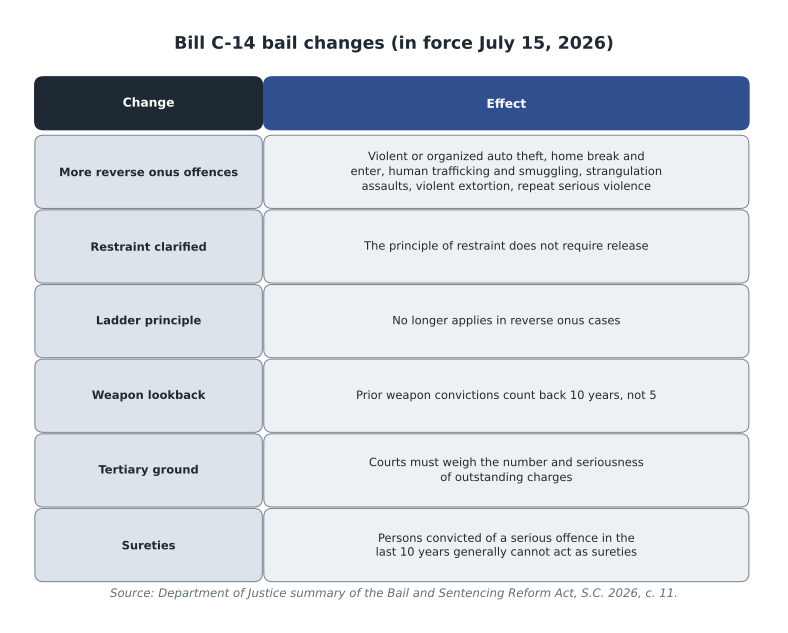
Parliament has amended the bail provisions several times in response to public concern about repeat violent offending. Bill C-48, in force January 4, 2024, created a reverse onus for accused charged with a serious violent offence involving a weapon who had a prior conviction for a similar offence within five years. The most significant recent change is the Bail and Sentencing Reform Act, introduced as Bill C-14, which received royal assent on June 15, 2026, as S.C. 2026, c. 11. Its bail provisions came into force on July 15, 2026.
Bill C-14 made several changes. It added new reverse onus situations, including violent or organized auto theft, breaking and entering a home, trafficking in persons, human smuggling, assaults involving strangulation, violent extortion, and serious violent offences where the accused has two or more prior convictions for such offences, as well as cases where release was revoked after a finding of guilt. It extended the lookback period for the weapons-related reverse onus from five to ten years. It provided that the principle of restraint does not require release, and that the ladder principle does not apply in reverse onus cases. In reverse onus cases, the accused must also clearly show that the proposed release plan addresses the risks. On the tertiary ground, courts must consider the number and seriousness of any outstanding charges, and in deciding public safety and confidence questions they must consider whether the offence involved random or unprovoked violence. A person convicted of a serious offence within the previous ten years is generally disqualified from acting as a surety. The Act also allows remote appearances without the accused's consent in compelling circumstances.
Castellano asks Hannah how the changes would affect Calder. 'Manslaughter with one prior assault eight years ago is still Crown onus,' Hannah says. 'He has one prior, not two, and no weapon. But the justice would now have to consider whether the shove was random or unprovoked, and the Crown would say it was.' Castellano agrees. 'And remember that these changes are new. Watch for constitutional challenges under section 11(e), and for appeal decisions working out what the new language means. Antic and Zora have not been overruled, but the statute around them has moved.'
Conditions: Zora
Zora concerned the offence of failing to comply with a release condition, now in section 145(4) and (5). Zora was released on drug charges with a condition that he answer the door when police checked his compliance with a curfew. He missed two checks and was charged. The Court held that the offence requires subjective fault: the Crown must prove that the accused knew of the condition, or was wilfully blind to it, and knowingly or recklessly failed to comply. More broadly, Justice Martin directed that every condition must be necessary, reasonable, least onerous in the circumstances, and sufficiently linked to the risks identified under section 515(10). Conditions should not be imposed to punish, to change behaviour unrelated to those risks, or to improve the accused's lifestyle. An abstention condition, for example, is not appropriate for an accused who does not have an alcohol problem connected to the alleged offence, and may set an accused with an addiction up to fail.
Reviews and detention review
An accused who is detained, or who objects to conditions, may apply for a bail review to a superior court judge under section 520; the Crown may seek review under section 521. In St-Cloud, the Court held that the reviewing judge may intervene only if the justice erred in law, the decision was clearly inappropriate, or there is new evidence showing a material and relevant change in circumstances.
Section 525 requires that, where an accused is detained and the trial has not started within 90 days, the jailer must apply for a hearing to determine whether continued detention is justified. In R. v. Myers, 2019 SCC 18, the Court held that the hearing is automatic and must be held whether or not the accused asks for it. The judge asks whether continued detention is justified under section 515(10), and may consider whether there has been unreasonable delay in the case. The hearing is meant to prevent people from languishing in pre-trial custody.
Disclosure: Stinchcombe
The second half of this lesson is about disclosure. Before 1991, disclosure in Canada was largely at the Crown's discretion. In R. v. Stinchcombe, [1991] 3 S.C.R. 326, a lawyer was charged with breach of trust; the Crown had interviewed a former secretary who gave evidence favourable to the defence and refused to disclose her statement. Justice Sopinka, for the Court, held that the Crown has a legal duty to disclose all relevant information in its possession to the defence, whether inculpatory or exculpatory, and whether or not the Crown intends to use it. The fruits of the investigation are not the property of the Crown for use in securing a conviction, but the property of the public to be used to ensure that justice is done. The duty is linked to the right to make full answer and defence under section 7.
The duty has limits. The Crown need not disclose information that is clearly irrelevant, or that is privileged, such as the identity of a confidential informer. The Crown has discretion about the timing of disclosure, for example to protect a witness, but that discretion is reviewable by the trial judge. Initial disclosure should be made before the accused is called on to elect the mode of trial or to plead, and the duty continues throughout the case as new information is received.
The test for relevance is generous. Information is relevant if there is a reasonable possibility that it may be useful to the defence in meeting the Crown's case, advancing a defence, or making decisions about how to conduct the defence. R. v. Egger, [1993] 2 S.C.R. 451, applied that standard to a second blood sample.
Police records and third-party records
The police must give the Crown the fruits of their investigation, so that the Crown can meet its Stinchcombe obligations. In R. v. McNeil, 2009 SCC 3, the Court held that the Crown cannot be a passive recipient of what the police choose to send, and has a duty to make reasonable inquiries. Records of serious police misconduct by an officer involved in the investigation, where the misconduct is relevant to the case, should be disclosed as part of first-party disclosure. Other records, held by other state bodies or private persons, are third-party records.
Third-party records are produced only by court order under the regime in R. v. O'Connor, [1995] 4 S.C.R. 411. The accused must first show that the records are likely relevant; the judge then examines them and decides whether to order production, balancing the accused's right to make full answer and defence against the privacy interests of the person to whom they relate. For sexual offences, Parliament enacted a stricter statutory regime in sections 278.1 to 278.91, upheld in R. v. Mills, [1999] 3 S.C.R. 668. In R. v. Gubbins, 2018 SCC 44, the Court held that maintenance records for breath-testing instruments are third-party records, not part of the Crown's first-party disclosure, because they are not part of the investigation of the particular accused and are not obviously relevant.
Remedies for non-disclosure
When the Crown fails to disclose, the usual remedy is an order for disclosure and an adjournment, with costs in some cases. If disclosure comes after a conviction, the accused may seek a new trial. In R. v. Dixon, [1998] 1 S.C.R. 244, the Court held that an accused must show a reasonable possibility that the non-disclosure affected the outcome of the trial or the overall fairness of the trial process. In R. v. Taillefer; R. v. Duguay, 2003 SCC 70, the Court applied that test and ordered a new trial, noting that a stay is reserved for the clearest cases where the trial process has been irreparably compromised.
Worked problem
Calder's bail and disclosure
Evaluate Calder's bail conditions and identify the disclosure his counsel should demand.
Show solution
- Onus: manslaughter is not a section 469 offence, and none of the section 515(6) reverse onus situations clearly applies. Calder has one prior assault conviction, not two, and no weapon was used, so the Bill C-14 additions do not shift the onus. The Crown must show cause.
- Primary ground: Calder lives locally with Halloran and has attended court before. Flight risk appears low.
- Secondary ground: the prior conviction and the deleted texts with Pruitt raise some concern about witness interference. A no-contact condition addresses it without detention.
- Tertiary ground: the Crown case is fairly strong, the offence is grave, and the Crown will say the violence was unprovoked. But there was no weapon, the shove was a single act, and Calder faces a manslaughter charge with a wide sentencing range. A reasonable, informed member of the public would probably not lose confidence in a release with conditions.
- Form of release: the justice used a surety. Under Antic, that is permissible only after rejecting less onerous forms. The record should show why a release order without a surety was inadequate. Halloran has no criminal record, so the new surety disqualification does not apply.
- Conditions under Zora: residence, no contact and a curfew are linked to the risks. The abstention condition is questionable unless the evidence shows an alcohol problem connected to the offence; drinking six beers on one night is not enough. Counsel could seek a review of that condition.
- Disclosure: counsel should demand the full interview video, Mercer's notes on the phone search, the ITO and production order for the texts, the bar video, witness statements from Pruitt and Hollis, the pathologist's report, and any records of misconduct findings against Mercer relevant to the case under McNeil. Records held by the hospital about Dorey's prior medical history are third-party records requiring an O'Connor application.
Common mistakes
MistakeStarting bail analysis by asking what conditions would make the court comfortable.
InsteadStart with onus and the ladder: release on an undertaking is the default, and each more onerous step must be justified (Antic), except that the ladder no longer applies in reverse onus cases after Bill C-14.
MistakeTreating the tertiary ground as limited to rare cases such as murder.
InsteadSt-Cloud held that the tertiary ground can apply to any offence, assessed from the perspective of a reasonable, informed member of the public.
MistakeImposing conditions to help the accused or to change unrelated behaviour.
InsteadZora requires that conditions be necessary, reasonable, least onerous and linked to a statutory risk.
MistakeAssuming the Crown need disclose only what it plans to use at trial.
InsteadStinchcombe requires disclosure of all relevant information, inculpatory or exculpatory, unless clearly irrelevant or privileged.
Practice problems
Work each problem on paper first, then reveal the answer to check.
An accused is charged with breaking into a home in August 2026 while armed with a knife. He has no record. Who bears the onus at his bail hearing?
Show answer
Since July 15, 2026, breaking and entering a home is a reverse onus situation under the Bill C-14 amendments, so the accused must show why detention is not justified, and must clearly show that his release plan addresses the risks. The ladder principle does not apply in reverse onus cases.
An accused has been detained for 95 days and no section 525 hearing has been held because his lawyer never asked. What does Myers say?
Show answer
The hearing is automatic; the jailer must apply and a judge must hold it without any request. The judge decides whether continued detention is justified under section 515(10) and may consider unreasonable delay.
Defence counsel wants records of a complainant's counselling sessions in an assault case that is not a sexual offence. What regime applies?
Show answer
The O'Connor regime for third-party records: the accused must show likely relevance, and the judge then reviews the records and balances full answer and defence against privacy. The stricter section 278 regime applies only to listed sexual offences.
Summary and key terms
- Section 11(e) guarantees reasonable bail and no denial without just cause; release on the least onerous terms is the default (Antic; Zora; section 493.1).
- The Crown usually bears the onus; section 515(6) reverses it for listed situations, now expanded by Bill C-14 (in force July 15, 2026).
- Detention is justified only on the primary, secondary or tertiary grounds in section 515(10); the tertiary ground is not limited to rare cases (St-Cloud).
- Bill C-14 also excluded the ladder principle in reverse onus cases, extended the weapons lookback to ten years, required attention to outstanding charges and random violence, and disqualified many sureties with recent serious convictions.
- Conditions must be necessary, reasonable, least onerous and linked to risk; breaching them requires subjective fault (Zora). Section 525 reviews are automatic (Myers).
- The Crown must disclose all relevant information (Stinchcombe), including relevant police misconduct records (McNeil); third-party records require an O'Connor or section 278 application.
- Judicial interim release
- The formal name for bail: release of an accused pending trial, governed by section 515.
- Ladder principle
- The rule that each more onerous form of release must be justified before it is imposed (Antic).
- Reverse onus
- A situation listed in section 515(6) in which the accused must show why detention is not justified.
- Tertiary ground
- Detention necessary to maintain confidence in the administration of justice under section 515(10)(c).
- Surety
- A person who supervises an accused on release and pledges an amount of money to ensure compliance.
- Stinchcombe disclosure
- The Crown's duty to disclose all relevant information in its possession to the defence.
- Third-party records
- Records held by persons other than the Crown and police, produced only by court order under O'Connor or section 278.
Lesson quiz · 5 questions
Score 60% or more to complete this lesson.
Create a free account to save your progress, take quizzes and earn a certificate.