
LAWC-211 · Lesson 3 of 12 · 23 min
Digital privacy and technology
▶ Video coming soon A video version of this lesson is on the way.
Castellano holds up her own phone. 'Tell me what is on this,' she says. Arjun guesses emails and photos. Sophie adds banking, health apps and location history. Daniel says, 'Every conversation you have had for five years.' Castellano nods. 'In 1990 the police would have needed to search my house, my office, my bank, my doctor's files and my post box to learn what this phone knows. Now they need to take it out of my jacket. The question for this lesson is whether the law treats that as one search or as all of them.'
She puts the next part of the Calder file on the screen. When Calder was arrested at his apartment the morning after the fight, D.C. Mercer took his phone from his jacket pocket. At the station, about two hours later, Mercer opened the phone, which was not locked, and scrolled through it for twenty minutes. He saw that Calder's message thread with Leah Pruitt had been deleted that morning, looked at the photo gallery, and checked the browser history, where he found a search for 'can you go to jail for pushing someone'. His notes say only 'phone examined, texts w Pruitt deleted, relevant search history'. Later, police obtained a production order requiring the phone company to produce the stored text messages between Calder and Pruitt.
This lesson covers how the Supreme Court has applied section 8 to digital devices and data, which is now the busiest area of search and seizure law. It ends with the 2024 decisions in Bykovets and Campbell.
Why computers and phones are different
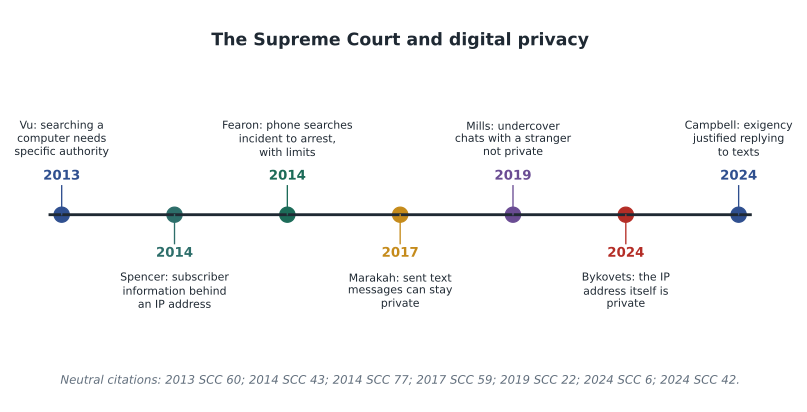
The Court's starting point is that computers and phones are unlike other containers. In R. v. Morelli, 2010 SCC 8, Justice Fish wrote that it is difficult to imagine a search more intrusive, extensive or invasive of privacy than the search and seizure of a personal computer. In R. v. Vu, 2013 SCC 60, Justice Cromwell, for the Court, explained why. Computers store immense amounts of information, much of it intimate. They contain information the user may not know is there, such as deleted files, metadata and browsing history. They retain information long after the user thinks it is gone. And they are portals to data stored elsewhere, on networks and servers.
From those features Vu drew a rule. A warrant to search a place, such as a home, does not by itself authorize police to search computers found there. If police want to search computers, they must obtain specific prior authorization to do so, either in the original warrant or in a new one. If a warrant does not authorize a computer search, police can seize the computer to preserve it but must then get a warrant before examining it. Vu also held that a warrant authorizing a computer search does not need to set out the search protocol in advance, although the search must still be conducted reasonably.
Searching phones incident to arrest: Fearon
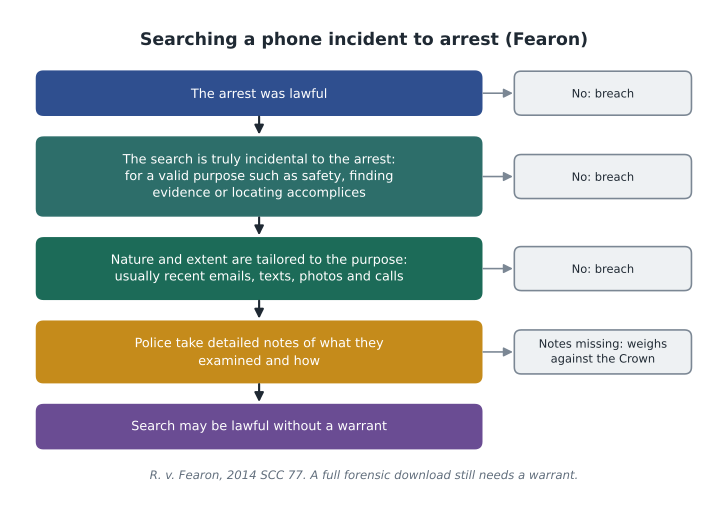
Phones carried by arrested people raise the hardest version of the problem, because police have a long-established common law power to search a person incident to arrest without a warrant. In R. v. Fearon, 2014 SCC 77, police arrested Fearon for a jewellery robbery, searched his unlocked phone at the scene and later at the station, and found a draft text about the jewels and a photo of a handgun. The Court split four to three.
Justice Cromwell, for the majority, held that the common law power to search incident to arrest extends to cell phones, but only with modifications. A phone search is lawful only if four conditions are met. First, the arrest must be lawful. Second, the search must be truly incidental to the arrest, meaning police have a valid law enforcement purpose for it, such as protecting the police, the accused or the public, preserving evidence, or discovering evidence including locating additional suspects, where the investigation would be stymied or significantly hampered without the ability to search promptly. Third, the nature and extent of the search must be tailored to that purpose, which in practice usually means only recently sent or drafted emails, texts, photos and the call log may be examined. Fourth, police must take detailed notes of what they examined and how, including the applications searched, the extent of the search, the time, its purpose and its duration.
On the facts, the majority found that the search breached section 8 because the police had not kept adequate notes and the scope had not been properly tailored, but admitted the evidence under section 24(2) because the police acted in good faith on what was then an unsettled point of law. Justice Karakatsanis, for the three dissenting judges, would have required a warrant for any meaningful phone search except in exigent circumstances, such as a reasonable belief that the search would prevent an imminent threat to safety.
Fearon also made clear that a password or the lack of one does not decide the question. Whether a phone is locked does not change the privacy interest in its contents. And Fearon only permits a limited search for a prompt law enforcement purpose. It does not permit a forensic download of the whole phone. For that, police need a warrant under section 487 that specifically authorizes the search of the device.
Text messages: TELUS, Jones and Marakah
The Court has decided three cases about text messages, each from a different angle. In R. v. TELUS Communications Co., 2013 SCC 16, police used a general warrant to require a phone company to provide copies of a customer's future text messages each day. A plurality held that this was in substance an interception of private communications, which requires a wiretap authorization under Part VI of the Criminal Code with its stricter safeguards. The method of transmission does not change the nature of the communication.
In R. v. Jones, 2017 SCC 60, police used a production order to get historical text messages stored by the phone company. The Court held that the sender had a reasonable expectation of privacy in the stored messages, but that a production order under section 487.014 was a lawful way to obtain them. Part VI applies to prospective interception, not to messages that have already been sent and stored.
In R. v. Marakah, 2017 SCC 59, decided the same day, police found texts from Marakah on the phone of his accomplice, Winchester, during a search of Winchester's phone. Marakah argued that the search breached his section 8 rights, even though the phone was not his. Chief Justice McLachlin, for the majority, held that he had standing. The subject matter was the electronic conversation between the two men. Marakah was a participant and had a direct interest in it; he expected privacy, having asked Winchester to delete the messages; and that expectation was objectively reasonable even though he had no control over Winchester's phone. Control is one factor, not a requirement. The Court stressed that this did not mean every sender will always have a reasonable expectation of privacy, but that it can exist. The evidence was excluded and Marakah was acquitted.
Online anonymity: Spencer and Bykovets
In R. v. Spencer, 2014 SCC 43, police investigating child pornography had an IP address and asked the internet service provider, without a warrant, for the name and address of the subscriber. The provider complied under a provision of federal privacy legislation that allowed disclosure to police for law enforcement. Justice Cromwell, for a unanimous Court, held that the request was a search. The subject matter was not just a name and address, but the identity of the person linked to specific online activity. Privacy includes anonymity, and people have a reasonable expectation that their online activity is not linked to their identity without lawful authority. Since nothing authorized the request, it breached section 8, though the evidence was admitted under section 24(2).
In R. v. Bykovets, 2024 SCC 6, the Court went a step further. Police investigating online fraud asked a third-party payment processor, without a warrant, for the IP addresses used in fraudulent purchases. They then used a production order to get subscriber information from the internet provider. The question was whether the IP address itself, before any link to a subscriber, attracted a reasonable expectation of privacy. Justice Karakatsanis, for a five to four majority, held that it did. An IP address is the first digital breadcrumb that can lead to a person's internet activity, and it can reveal intimate details even without the subscriber's identity, because private companies can track a person across websites through it. Requiring a warrant at the first step protects anonymity. The majority excluded the evidence and ordered a new trial. The dissenting judges would have held that an IP address alone reveals too little to be private and that the judicial check at the second step was enough.
Castellano asks the class to notice the pattern. 'Spencer and Bykovets both frame the subject matter by what it can reveal, not what it is. Once you do that, a string of numbers becomes a window into someone's life. Every digital case this term turns on that framing.'
Talking to strangers online: Mills
In R. v. Mills, 2019 SCC 22, a police officer posed online as a 14-year-old girl and chatted with Mills, who sent sexual messages and arranged to meet. The officer took screenshots of the conversations. Mills argued that the screenshots were a warrantless interception. The Court upheld the conviction, and a majority found no breach of section 8, although the judges gave different reasons. Justice Brown, writing for three judges, held that Mills had no reasonable expectation of privacy, because adults cannot reasonably expect privacy in online communications with children who are strangers to them, and the police knew from the start that the child did not exist. Justice Karakatsanis, for two judges, reasoned that there was no search because the state was simply a participant in the conversation and did not intercept anything. Mills is an important limit: undercover online investigations of this kind generally do not need a warrant.
Shared and workplace devices: Cole and Reeves
Two cases address devices that more than one person uses. In R. v. Cole, 2012 SCC 53, a high school teacher had a reasonable, though diminished, expectation of privacy in a laptop owned by his school board, because he was permitted to use it for personal purposes. The school board could lawfully access it, but that did not allow the police to search it without a warrant. In R. v. Reeves, 2018 SCC 56, Reeves's spouse consented to police taking a shared home computer. The Court held that Reeves retained a reasonable expectation of privacy in the computer, and that one co-user cannot waive another's privacy interest. Taking the computer without a warrant was a seizure that breached section 8.
Exigency and digital evidence: Campbell
In R. v. Campbell, 2024 SCC 42, police arrested a man who had a phone that kept receiving texts from a contact named 'Dew', who appeared to be a drug supplier. Without a warrant, an officer replied to the texts while posing as the phone's owner and arranged a meeting, at which Campbell arrived with heroin mixed with fentanyl. Justice Jamal, for a six to three majority, held that Campbell had a reasonable expectation of privacy in the text conversation, even though the phone was not his, applying Marakah. The police conduct was therefore a search. But it was justified by exigent circumstances under section 11(7) of the Controlled Drugs and Substances Act, which permits a warrantless search where the conditions for a warrant exist but it would be impracticable to obtain one. The police reasonably believed the drugs likely contained fentanyl, that they were about to be distributed, and that even a telewarrant could not be obtained in time. The appeal was dismissed and the conviction stood. Three judges dissented and would have found no exigency.
Campbell shows that a reasonable expectation of privacy is only the first step. Once a search is found, the question becomes whether some legal authority justified it, and exigency remains available in genuine emergencies, although the Crown must prove it.
Production orders and other investigative tools
Most digital evidence is now gathered by court order rather than by searching a device. The Criminal Code provides a set of orders, mostly added in 2014. A general production order under section 487.014 requires a person, such as a phone company or bank, to produce documents or data, if a justice or judge is satisfied by information on oath that there are reasonable grounds to believe an offence has been committed and that the documents or data will afford evidence of it. Specific orders for less sensitive information require only reasonable grounds to suspect: section 487.015 for tracing a communication, section 487.016 for transmission data, section 487.017 for tracking data and section 487.018 for certain financial data. Preservation demands and orders under sections 487.012 and 487.013 require a custodian to keep data while police seek a production order.
Tracking warrants under section 492.1 and transmission data recorder warrants under section 492.2 allow ongoing collection. A tracking warrant for a thing, such as a vehicle, requires reasonable grounds to suspect, while tracking an individual, for example through a phone's location, requires reasonable grounds to believe. Real-time interception of private communications, including texts, requires an authorization under Part VI, which has the strictest standards in the Code, including investigative necessity under section 186(1)(b) for most offences.
Worked problem
The Calder phone search
Apply Fearon to D.C. Mercer's examination of Calder's phone at the station two hours after the arrest. Was it a lawful search incident to arrest? Then consider the production order for the stored texts with Pruitt.
Show solution
- Lawful arrest: assume the arrest for manslaughter was lawful, because Mercer had the bar video and witness statements giving reasonable grounds.
- Truly incidental: the search must serve a prompt law enforcement purpose. Two hours later, at the station, with Calder in custody and no accomplice, safety is not a concern. Finding evidence is a valid purpose, but Fearon requires that the investigation be stymied or significantly hampered without a prompt search. Nothing suggests the evidence on a seized phone in police custody was at risk.
- Tailored in nature and extent: looking at recent messages might be justified, but browsing the whole photo gallery and the browser history for twenty minutes goes well beyond what Fearon contemplates.
- Notes: Mercer's single line does not record which applications he searched, for how long, or why. Fearon treats detailed notes as a condition of a lawful search.
- Conclusion on the phone: the station search very likely breached section 8. The search history evidence is vulnerable to exclusion under section 24(2). The Crown's best answer would be that it could have obtained a warrant, which goes to remedy (lesson 11), not to whether there was a breach.
- The production order: under Marakah and Jones, Calder has a reasonable expectation of privacy in the stored messages, but a section 487.014 order on reasonable grounds is a lawful way to obtain them. If the information to obtain relied on what Mercer saw in the unlawful phone search, the defence would ask the court to excise that information and decide whether the order could still have issued, a step covered in lesson 4.
Common mistakes
MistakeAssuming a warrant to search a home allows police to search any computers or phones found there.
InsteadVu requires specific prior authorization to search a computer or phone; otherwise police may seize it but must get a further warrant before examining it.
MistakeTreating Fearon as permitting a full search of any phone found on an arrested person.
InsteadFearon allows only a limited, prompt, purpose-tailored search with detailed notes. A forensic download needs a warrant.
MistakeSaying the accused has no standing because the phone or computer searched belonged to someone else.
InsteadMarakah and Campbell show that a participant in a conversation can have a reasonable expectation of privacy in it on another person's device; Reeves shows a co-user keeps a privacy interest in a shared computer.
MistakeTreating an IP address as mere numbers with no privacy interest.
InsteadBykovets held that an IP address attracts a reasonable expectation of privacy because of what it can reveal about online activity.
Practice problems
Work each problem on paper first, then reveal the answer to check.
Police arrest a suspect for a gang shooting in which a second shooter escaped. At the scene, an officer looks at the suspect's last five text messages and call log to identify the second shooter, and writes detailed notes. Is this lawful under Fearon?
Show answer
Probably yes. The arrest is lawful, the purpose of locating an accomplice who poses a public safety risk is valid and urgent, the search is limited to recent messages and calls, and notes were kept. It would breach section 8 if it extended to the photo gallery or older material without a reason tied to that purpose.
Police ask a website operator, without a warrant, for the IP addresses of users who posted threats. What does Bykovets say?
Show answer
The request is a search of information in which users have a reasonable expectation of privacy, so police need lawful authority, such as a production order on the required standard, unless an exception like exigency applies.
Why did Mills find no breach when an officer posing as a child screenshotted chats with an adult?
Show answer
The judges gave different reasons: for some, an adult has no reasonable expectation of privacy in online communications with a child who is a stranger; for others, the officer was a participant, not an interceptor, so there was no search.
Summary and key terms
- Phones and computers receive special protection because of the quantity, intimacy and persistence of the information they hold (Morelli; Vu).
- A search of a computer or phone requires specific authorization (Vu), except for the limited search incident to arrest allowed by Fearon's four conditions.
- Senders can have a reasonable expectation of privacy in text messages held by a recipient or a phone company (Marakah; Jones); prospective interception requires Part VI authorization (TELUS).
- Online anonymity is protected: subscriber information (Spencer) and IP addresses themselves (Bykovets) attract a reasonable expectation of privacy.
- Undercover chats with strangers posing as children are generally not searches (Mills), and exigent circumstances can still justify a warrantless digital search (Campbell).
- Production orders, preservation orders, tracking warrants and transmission data warrants provide graded tools with different standards of proof.
- Search incident to arrest
- A common law power to search a lawfully arrested person for safety, evidence or escape purposes, modified for phones by Fearon.
- Production order
- A court order under section 487.014 and related sections requiring a person to produce documents or data.
- Preservation order
- An order requiring a custodian to preserve computer data while police seek a production order.
- Tracking warrant
- A warrant under section 492.1 to obtain tracking data about a thing or an individual.
- Part VI authorization
- A judicial authorization to intercept private communications in real time, with the Code's strictest safeguards.
- IP address
- A number identifying a device's connection to the internet, which attracts a reasonable expectation of privacy under Bykovets.
Lesson quiz · 5 questions
Score 60% or more to complete this lesson.
Create a free account to save your progress, take quizzes and earn a certificate.