
LAWC-211 · Lesson 12 of 12 · 25 min
Capstone: solving a criminal procedure problem
▶ Video coming soon A video version of this lesson is on the way.
On the last day of the course, Castellano hands out a single page. 'This is the kind of file you will get in your first year of practice, from either side,' she says. 'It has a problem at almost every stage. Your job is not to find one brilliant argument. It is to go through the file in order, find every point where the state touched your client's liberty or privacy, ask whether it had the power to do so, and then decide what each breach is worth. Prove it, element by element. Then tell me what you would actually do.' The problem is set out below, followed by a model approach and a model answer. All names and events in it are invented.
The problem: R. v. Ferland
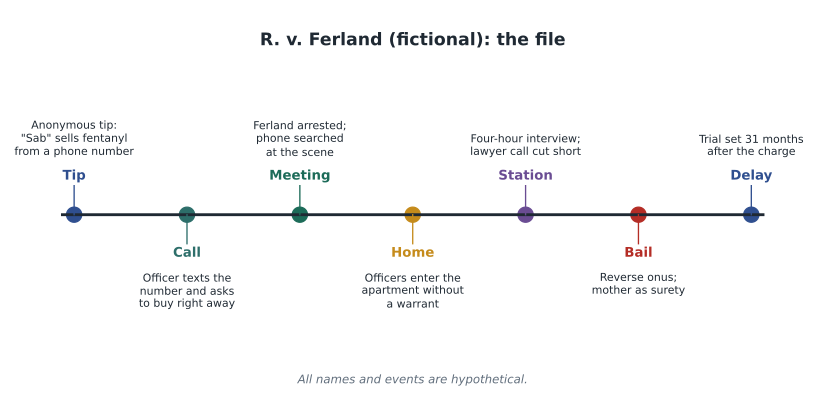
Corwin police received an anonymous tip through a crime line: 'A woman called Sab sells fentanyl from this number,' with a phone number attached. There was no other information about Sab or the number. The next evening, Constable Erin Tuckett, working in plain clothes, texted the number: 'Hey is this Sab? Buddy gave me your number.' The reply came: 'Who is this.' Tuckett replied: 'Need 2 points of fent tonight, can do 80.' After a pause, the reply was: 'Ok. Plaza on Harlow St, 9pm, blue Civic.'
At 9 p.m. a blue Honda Civic pulled into the plaza lot. Sabine Ferland, 24, was driving. Tuckett and two other officers approached and arrested her for trafficking. One officer told her the reason and read her the right to counsel, including duty counsel. Ferland said, 'I want a lawyer.' While she stood beside the car in handcuffs, Constable Pete Lavallee asked, 'How much is in the car? Anything else at home?' She said, 'Just what's in my purse. Nothing at home.' A search of her purse found about three grams of a powder later confirmed as fentanyl, a digital scale and 600 dollars in cash.
Ferland's phone was on the passenger seat and unlocked. Lavallee picked it up and, for about fifteen minutes, scrolled through her text messages going back several weeks and through her photo gallery, photographing screens that appeared to show other drug sales and a photo of a bag of pills. His notes say: 'Phone checked at scene for evidence of trafficking. Numerous messages consistent with drug sales.'
Ferland's driver's licence gave an apartment address. Two officers drove there while Ferland was taken to the station. Nobody answered their knock. Using a key from Ferland's key ring, they let themselves in, saying later that they were concerned that 'a boyfriend or associate might destroy evidence'. They had no information that anyone else lived there. On the kitchen counter they found about sixty grams of fentanyl and packaging materials. They then sought and obtained a search warrant, relying in the ITO on what they had seen in the apartment and on the phone.
At the station, Ferland asked for a named lawyer. Officers called and reached voicemail at 10:15 p.m., then put her through to duty counsel. After four minutes, an officer opened the door and said, 'Time's up, we need the room.' The call ended. Detective Constable Gavin Holt then interviewed her for four hours on video. She said twelve times that she did not want to talk. Near the end, Holt said: 'If you give me your supplier, I'll make sure the Crown knows you cooperated. That's how people get bail.' Ferland then said that the drugs in the apartment were hers and named a supplier.
Ferland was charged with possession of fentanyl for the purpose of trafficking and trafficking. At her bail hearing the next afternoon, the federal Crown relied on the reverse onus. Her mother, Monique Ferland, a hospital clerk with no criminal record, offered to act as surety. The justice of the peace released Ferland on house arrest with her mother, with a condition not to possess any phone or internet device. Ferland elected trial by judge and jury in the Superior Court, without a preliminary inquiry. Full disclosure of the phone extraction took nine months. The first trial dates offered were declined because defence counsel was in another trial, which added two months. The trial is scheduled to end 31 months after the charge.
How to approach the problem
Castellano gives the class a method she says she used in practice. First, build a timeline with every police action in order, and mark the moment of detention and arrest. Second, for each action, identify the right engaged, the legal power the state would rely on, and who bears the burden. Third, decide whether there was a breach. Fourth, list the evidence connected to each breach, using the generous 'obtained in a manner' test. Fifth, apply Grant to each piece of evidence, or the confessions rule to statements. Sixth, deal with the remedies that do not depend on evidence: entrapment, bail and delay. Finally, step back and decide what the Crown can still prove, and what you would advise.
Model answer: entrapment
Under R. v. Mack, [1988] 2 S.C.R. 903, and R. v. Ahmad, 2020 SCC 11, police may not offer a person an opportunity to commit an offence unless they have reasonable suspicion that the person, or the phone number, is engaged in the criminal activity, or are acting in a bona fide inquiry into a place defined with precision. A bare anonymous tip naming a number is not enough. Reasonable suspicion can develop during the conversation if the person responds in a way that shows familiarity with the drug trade.
Here, Ferland's only reply before the offer was 'Who is this.' That shows no familiarity with drug trafficking. Tuckett then made the offer to buy. As in Williams, the companion case to Ahmad, the offer came before reasonable suspicion existed. Ferland's agreement and her arrival at the plaza came after the offer and cannot be used to justify it. The tip came with no detail and no corroboration, so it did not supply reasonable suspicion either.
Entrapment is decided by the judge after a finding of guilt, and the accused must prove it on a balance of probabilities. The remedy is a stay of the charge arising from the entrapment, here the trafficking offence based on the arranged sale. It is less clear that a stay would reach the possession for the purpose of trafficking charge based on the apartment drugs, which Ferland had before any police offer. The defence would argue that the entire prosecution flows from the entrapment and that a stay of everything is needed to protect the integrity of the system; the Crown would argue that the stay should be limited to the offence the police manufactured. On balance, a stay of the trafficking count is very likely, and the apartment count must be analyzed separately.
Model answer: the arrest and search of the purse
A warrantless arrest requires reasonable grounds that are subjectively held and objectively reasonable under section 495 and R. v. Storrey, [1990] 1 S.C.R. 241. Leaving entrapment aside, a person who agrees by text to sell fentanyl and arrives at the agreed time and place in the described car gives officers reasonable grounds to believe she is committing or about to commit trafficking. The arrest was lawful, and section 9 was not breached. The search of her purse incident to that arrest, for evidence of the offence, was lawful under Cloutier v. Langlois and Caslake. The purse evidence is not open to challenge under section 8, though it would fall with the trafficking count if that count is stayed for entrapment.
Model answer: the questions at the car
Ferland was told of her rights and said she wanted a lawyer. From that moment, under R. v. Bartle, [1994] 3 S.C.R. 173, and R. v. Suberu, 2009 SCC 33, police had a duty to hold off from eliciting evidence from her until she had a reasonable opportunity to consult counsel. Lavallee's questions about the car and the home were designed to elicit incriminating evidence, and there was no urgent safety concern. That breached section 10(b). Her answer, 'Nothing at home', was obtained in a manner that breached the Charter. Statements obtained in breach of section 10(b) are usually excluded under Grant, and here the answer is of little value to the Crown anyway, since it was false. Its main significance is that it shows a pattern of disregard for her rights, which matters to the seriousness of later breaches.
Model answer: the phone search
Ferland had a reasonable expectation of privacy in her phone. A search incident to arrest is lawful only if it meets the four conditions in R. v. Fearon, 2014 SCC 77: a lawful arrest, a search truly incidental to the arrest for a valid purpose where the investigation would be stymied or significantly hampered without a prompt search, a search tailored in nature and extent to that purpose, usually recent messages and photos, and detailed notes. The arrest was lawful, and looking for evidence of the arranged sale could be a valid purpose. But Lavallee went back several weeks and through the whole photo gallery for fifteen minutes, which is not tailored, and his notes do not record which applications he searched, for how long, or why. With Ferland in custody and the phone in police hands, there was no reason the investigation would be hampered without a prompt search. The search breached section 8.
Under Grant, the conduct is serious, because Fearon had been settled law for over a decade, and the notes requirement was ignored. The impact is high, because a phone's contents are among the most private information a person has. The evidence is reliable and relevant, but the photographs of the screens could have been obtained by a warrant for a forensic search, which Côté suggests makes the choice to search without one more serious, not less. Exclusion of the phone evidence obtained at the scene is likely. The later forensic extraction must also be examined: if the warrant for it relied on what Lavallee saw, that information must be excised under Garofoli.
Model answer: the apartment entry
The warrantless entry into Ferland's apartment was a search of a home, the most protected place under section 8. The Crown must justify it. The only possible authority is exigent circumstances under section 11(7) of the Controlled Drugs and Substances Act, as interpreted in R. v. Paterson, 2017 SCC 15: the conditions for a warrant must exist, and it must be impracticable to obtain one because of urgency requiring immediate action to preserve evidence or protect safety. The officers had no information that anyone lived with Ferland or was inside; the concern about a boyfriend was speculation. A telewarrant was available, and the officers could have secured the outside of the apartment while they sought one. There was no exigency, and the entry breached section 8. Search incident to arrest cannot apply, because Ferland was arrested kilometres away. The implied licence allowed the officers to knock but not to enter.
The warrant obtained afterwards does not cure the breach. Under Garofoli and Araujo, the information obtained by the unlawful entry and by the unlawful phone search must be excised from the ITO. What remains is the tip, the text exchange and the drugs in the purse. A reviewing judge might find that this could support a warrant for the apartment, but even if it could, the drugs were first found through the unlawful entry, and the warrant does not change how they were obtained.
Under Grant, entering a home without a warrant on speculation, years after Paterson and Stairs, is serious. The impact on privacy is profound. The sixty grams of fentanyl are reliable and central to the possession for the purpose charge, and fentanyl is very dangerous, so society's interest in adjudication is strong. But under Le and McGuffie, where the first two lines make a strong case for exclusion, the third will seldom tip the balance, and Paterson itself excluded a gun found after an unjustified entry. Exclusion is probable, especially given the pattern of breaches in the file.
Model answer: the call and the interview
Ferland had the right to a reasonable opportunity to consult counsel. A four-minute call ended by police because they needed the room is not a reasonable opportunity, and the police did not let her finish or offer to resume. That breached the implementational duty under section 10(b). Under R. v. Willier, 2010 SCC 37, once she accepted duty counsel, police were not obliged to wait for her lawyer of choice, but they had to let the consultation run its course.
The interview raises the confessions rule. Under R. v. Singh, 2007 SCC 48, Holt was allowed to keep questioning her despite her twelve assertions of silence, but the persistence is relevant to voluntariness. Under R. v. Oickle, 2000 SCC 38, Holt's statement that cooperation 'is how people get bail', linked to an offer to tell the Crown, is a quid pro quo: it offered a benefit in liberty in exchange for information. Combined with four hours of questioning after a truncated consultation, there is at least a reasonable doubt about voluntariness. If the statement is involuntary, it is excluded automatically. If the trial judge finds it voluntary, it would still be vulnerable to exclusion under section 24(2) for the section 10(b) breach, since a statement obtained after an inadequate consultation strikes at the core interest that section protects.
Model answer: bail
Possession for the purpose of trafficking fentanyl, a Schedule I substance, is punishable by life imprisonment, so the reverse onus in section 515(6)(d) applies. Since July 15, 2026, under the Bill C-14 amendments, the ladder principle does not apply in reverse onus cases, and the accused must clearly show that the proposed release plan addresses the risks. Ferland's plan, with a surety who has no criminal record and who lives with her, house arrest and a no-phone condition, addressed the secondary ground risk of further trafficking, which was the Crown's main concern.
Under R. v. Zora, 2020 SCC 14, every condition must still be necessary, reasonable, least onerous and linked to a risk. A total ban on phones and internet devices is closely linked to the alleged method of trafficking, but it is very broad and prevents Ferland from working, studying or contacting her lawyer. Defence counsel could seek a review under section 520 to narrow it, for example to a single phone whose number is given to police. Zora also reminds counsel to explain each condition carefully to the client, because breaching it is an offence requiring subjective fault, and new breach charges can make a later bail far harder to obtain.
Model answer: delay
The trial is in the Superior Court, so the 30-month ceiling under R. v. Jordan, 2016 SCC 27, applies. Total delay is 31 months. The two months caused by defence counsel's unavailability when the court and Crown were ready are defence delay and are deducted, leaving net delay of 29 months, below the ceiling. The nine months for disclosure of the phone extraction count against the state, but they are already included in the total.
Below the ceiling, Ferland must show that the defence took meaningful, sustained steps to expedite the proceedings and that the case took markedly longer than it reasonably should have. A simple fentanyl case with one accused is not complex, and nine months for a phone extraction is long. But the defence declined the first dates offered, and the file does not show repeated requests for disclosure or early dates. A section 11(b) application is unlikely to succeed. The lesson for counsel is that the defence should have pressed for disclosure in writing from the start and kept a record, as Cody and the 2026 decisions encourage.
Worked problem
Bringing it together: what the Crown can still prove
Assume the trial judge rules as the model answer predicts. What is left of the Crown's case, and what would you advise Ferland?
Show solution
- Trafficking count: likely stayed for entrapment after any finding of guilt. Even before that, the defence can tell the Crown that an entrapment application will be brought.
- Possession for the purpose count: the sixty grams from the apartment are likely excluded under section 24(2), and the statement admitting they were hers is likely excluded as involuntary or under section 10(b).
- Remaining evidence: the purse contents (three grams, a scale and cash) were lawfully seized, but they relate to the arranged sale. If the trafficking count is stayed, the Crown might try to use them to prove possession for the purpose on the date of arrest. The defence would say that this evidence, too, was obtained only because of the entrapment and should not be used to avoid the stay.
- Phone evidence: the scene search is likely excluded, and the forensic extraction may fall if the warrant cannot stand after excision.
- Advice: the defence should bring the Charter applications and the entrapment application, put the Crown on notice early, and be prepared to discuss resolution, for example a plea to simple possession of the purse contents, if the Crown recognizes the weaknesses. The final decision is Ferland's, after full advice on the risks of going to trial.
- From the Crown's side: the federal Crown must assess whether there is still a reasonable prospect of conviction after the likely rulings. If not, the charge should be withdrawn or resolved, consistent with the Crown's role as a minister of justice.
Writing the answer
Castellano closes with advice on how to write an answer to a problem like this on an exam or in a memo. Use headings for each issue, in the order the events happened. For each issue, state the rule with its source, apply it to the facts, deal with the other side's best argument, and reach a conclusion. Keep the breach analysis and the remedy analysis separate. Do not stop at the breach: a breach without a remedy analysis is half an answer. And end with practical advice, because clients do not want to know only what the law is; they want to know what to do. 'You now know more about criminal procedure than most people who will ever arrest your clients,' she tells the class. 'Use it carefully, on both sides.'
Common mistakes
MistakeSpotting one strong issue, such as the apartment entry, and ignoring the rest of the file.
InsteadWork through the file in order. Several moderate breaches can, together, show a pattern that makes each more serious under Grant, and some remedies, like entrapment and delay, do not depend on evidence at all.
MistakeTreating a later warrant as curing an earlier unlawful entry.
InsteadInformation from an unlawful search is excised from the ITO, and evidence first found through an unlawful entry was still obtained in a manner that breached section 8.
MistakeAssuming that persistent questioning after assertions of silence is itself a breach.
InsteadSingh allows continued questioning; the persistence is relevant to voluntariness, especially when combined with an inducement like an offer of bail.
MistakeCalculating delay without deducting defence delay or checking which ceiling applies.
InsteadIdentify the court and ceiling, subtract waiver and delay caused solely by the defence, then apply the above or below ceiling analysis under Jordan.
Practice problems
Work each problem on paper first, then reveal the answer to check.
Change one fact: before making the offer, Constable Tuckett received the reply 'depends what u need, I got fent and down.' Is there still entrapment?
Show answer
Probably not. Under Ahmad, a response showing familiarity with the drug trade can give reasonable suspicion during the conversation, before the offer. The offer would then be a permissible opportunity, not entrapment, unless the officer went on to induce the offence.
Change another fact: when officers knocked at the apartment, they heard a toilet flushing repeatedly and a man shouting 'get rid of it.' Does the analysis of the entry change?
Show answer
Yes. Those facts give a real basis to believe evidence is being destroyed, creating urgency that may make obtaining even a telewarrant impracticable under Paterson and CDSA section 11(7). The entry could then be justified, provided the search was limited to preserving the evidence until a warrant was obtained.
Suppose the trial were in the Ontario Court of Justice with the same delay. Would the result change?
Show answer
Yes. The 18-month ceiling would apply, and net delay of 29 months would be far above it. The Crown would have to show exceptional circumstances, and a simple fentanyl case with a slow phone extraction would not qualify, so a stay would be likely.
Summary and key terms
- Solve a criminal procedure problem in chronological order, marking the moments of detention, arrest and charge.
- For each state action, identify the right, the claimed legal power, the burden, and whether there was a breach.
- Link evidence to breaches using the generous 'obtained in a manner' test, then apply Grant to each item and the confessions rule to statements.
- Treat entrapment, bail and delay as separate remedies that do not depend on the exclusion of evidence.
- Finish by assessing what the Crown can still prove and giving practical advice from the side you represent.
- Issue spotting
- Systematically identifying every legal issue a set of facts raises, in a logical order.
- Pattern of breaches
- Repeated Charter breaches in one investigation, which increase the seriousness of each under the first Grant line of inquiry.
- Reasonable prospect of conviction
- The charge screening standard Crown counsel apply in deciding whether to continue a prosecution.
- Resolution
- A negotiated end to a case, such as a plea to a lesser charge, reached after both sides assess the risks.
Lesson quiz · 5 questions
Score 60% or more to complete this lesson.
Create a free account to save your progress, take quizzes and earn a certificate.