
LAWC-211 · Lesson 5 of 12 · 22 min
Detention and arrest
▶ Video coming soon A video version of this lesson is on the way.
Castellano puts a hypothetical on the screen that she says comes, in its outline, from a dozen files she handled as defence counsel. At eleven on a Friday night, Malik Boateng, a nineteen-year-old Black university student, is walking home past Riverside Park in Corwin. A police car pulls up beside him and two officers get out. One stands in front of him on the sidewalk; the other stands slightly behind. 'Where are you coming from? Got any ID? Anything on you we should know about?' Malik hands over his student card. The officer keeps it while he runs Malik's name. 'Keep your hands where I can see them,' the second officer says. Malik, nervous, says he has a small knife in his backpack for opening boxes at work. They arrest him for carrying a concealed weapon.
'When was Malik detained?' Castellano asks. Theo says when the officer said to keep his hands visible. Hannah says when they kept his ID. Daniel says when the car pulled up and two officers boxed him in. 'All three are defensible,' Castellano says. 'The answer matters, because the moment of detention is the moment the Charter's detention rights switch on. If he was detained before he mentioned the knife, the police needed a lawful basis for the detention, and they had to tell him he could call a lawyer before asking him anything else.'
This lesson covers section 9 of the Charter, the protection against arbitrary detention, and the police powers to detain and arrest. Lesson 6 takes up section 10, the rights on arrest or detention.
Section 9 and the meaning of arbitrary
Section 9 says: 'Everyone has the right not to be arbitrarily detained or imprisoned.' In R. v. Grant, 2009 SCC 32, the Court held that a detention is arbitrary if it is not authorized by law, if the law that authorizes it is itself arbitrary, or if it is carried out in an arbitrary manner. The structure mirrors Collins for section 8. A detention without any legal power is the commonest breach. A detention under a power that has no rational connection to its purpose, or one carried out for an improper purpose such as racial profiling, is also arbitrary.
What is a detention?
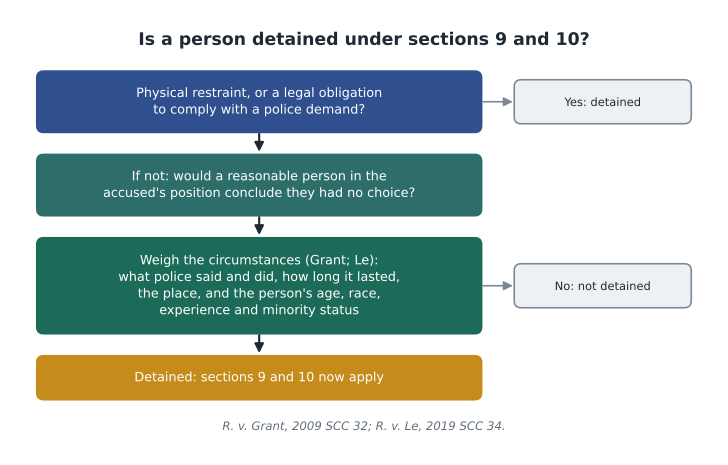
Not every encounter with police is a detention. Police can talk to people, ask questions and request cooperation without detaining anyone, and people are free to walk away. The Court has recognized that a broad definition of detention would make ordinary policing impossible, while a narrow one would leave people without Charter protection when they most need it. Grant set out the governing test.
Detention refers to a suspension of the individual's liberty interest by a significant physical or psychological restraint. Physical detention is the obvious case: handcuffs, being held in a police car, or being told to stop and physically prevented from leaving. Psychological detention exists in two situations. The first is where the person is under a legal obligation to comply with a police demand, such as a demand for a breath sample under section 320.27 of the Criminal Code. The second is where there is no legal obligation, but a reasonable person in the individual's position would conclude, from the state conduct, that they had no choice but to comply.
The second category requires an objective assessment of all the circumstances. Grant identified three groups of factors. The first is the circumstances giving rise to the encounter as the person would reasonably perceive them: whether the police were providing general assistance, maintaining order, making general inquiries about an event, or singling out the person for focused investigation. The second is the nature of the police conduct: the language used, physical contact, the place, the presence of others, and how long it lasted. The third is the particular characteristics of the individual, where relevant, including age, physical stature, minority status and level of sophistication.
In Grant itself, three officers in Toronto noticed an eighteen-year-old Black man walking near a school. One officer stood in his path, asked him what was going on, and told him to keep his hands in front of him. Two other officers took up positions behind the first. The Court held that Grant was detained once the encounter changed from general questioning to focused investigation, signalled by the instruction about his hands and the positioning of the officers. Because the police had no reasonable suspicion to detain him at that point, the detention was arbitrary. When questioned, Grant admitted he had a small bag of marijuana and a firearm. The firearm was nevertheless admitted under section 24(2), for reasons discussed in lesson 11.
Race and detention: Le
In R. v. Le, 2019 SCC 34, three officers entered the small fenced backyard of a townhouse in a Toronto housing co-operative where five young racialized men were standing and talking. The officers had no warrant and no reasonable suspicion of any offence. They questioned the men, asked for identification and told one to keep his hands visible. Le, who was carrying a gun and drugs, fled and was arrested. A three to two majority held that Le was detained the moment the officers entered the yard and began questioning, and that the detention was arbitrary.
Justices Brown and Martin, for the majority, held that the reasonable person in the detainee's position must be taken to know about the relationship between police and racialized communities, including the documented experience of over-policing. That knowledge is part of how a reasonable person would perceive a police encounter. The analysis is not about the subjective feelings of the particular accused, nor is it a separate test for racialized people. It asks how a reasonable person in the accused's position, with that background understanding, would perceive the encounter. The majority excluded the evidence and entered acquittals.
Racial profiling is also relevant to whether a detention is arbitrary. The Court of Appeal for Ontario in R. v. Dudhi, 2019 ONCA 665, explained that racial profiling occurs when race or racial stereotypes about offending, consciously or unconsciously, to any degree, are used in selecting or treating a suspect, unless the race is part of a suspect description. A detention tainted by racial profiling is arbitrary, even if there were other grounds for it.
Investigative detention: Mann
Police have a common law power to detain someone briefly for investigative purposes, recognized in R. v. Mann, 2004 SCC 52. Officers responding to a reported break-in stopped Mann, who matched the description of the suspect, a few blocks from the scene. The Court held that police may detain a person for investigative purposes if there are reasonable grounds to suspect, in all the circumstances, that the person is connected to a particular crime and that detention is reasonably necessary. The standard requires a clear nexus between the individual and a recent or still unfolding crime. A hunch is not enough.
An investigative detention must be brief. It does not oblige the person to answer questions. It does not justify a full search. The officer may do a protective pat-down search if they have reasonable grounds to believe their safety or the safety of others is at risk. And the detainee must be told promptly why they are detained and, under R. v. Suberu, 2009 SCC 33, informed of the right to counsel immediately. An investigative detention is not an arrest, but it is a detention for Charter purposes.
Traffic stops and statutory detentions
Many detentions are authorized by statute. Under section 48 of Ontario's Highway Traffic Act, police may stop drivers to check sobriety, and under section 216 police may require a driver to stop. In R. v. Ladouceur, [1990] 1 S.C.R. 1257, the Court held that random traffic stops for highway safety purposes are arbitrary detentions under section 9 but justified under section 1. Police may check licences, insurance, vehicle fitness and sobriety at such stops, but they may not use them as a pretext for a general criminal investigation.
The limits of these powers are enforced strictly. In R. v. McColman, 2023 SCC 8, officers followed a driver onto his parents' private driveway and conducted a random sobriety check there. The Court held that section 48 of the Highway Traffic Act did not authorize random sobriety stops on private property, so the detention breached section 9. The breath evidence was nevertheless admitted under section 24(2), a theme lesson 11 will develop.
Arrest without a warrant
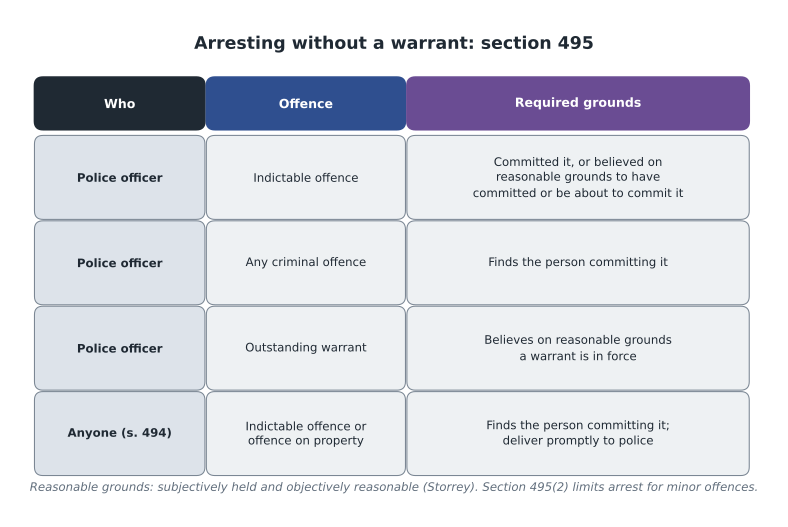
An arrest is the most serious form of detention. Police may arrest with a warrant issued by a justice under section 511 of the Criminal Code, or without a warrant under section 495. Section 495(1) allows a peace officer to arrest without a warrant a person who has committed an indictable offence, or who the officer believes on reasonable grounds has committed or is about to commit an indictable offence; a person the officer finds committing any criminal offence; or a person for whom the officer believes on reasonable grounds a warrant of arrest or committal is in force. Hybrid offences are treated as indictable for this purpose.
The standard of reasonable grounds was explained in R. v. Storrey, [1990] 1 S.C.R. 241. The officer must subjectively believe that there are reasonable grounds for the arrest, and those grounds must be justifiable from an objective point of view, meaning that a reasonable person in the officer's position would have believed there were reasonable grounds. The officer does not need to establish a prima facie case for conviction.
Section 495(2) restricts the power. For summary conviction offences, hybrid offences and offences within the absolute jurisdiction of a provincial court judge, an officer should not arrest without a warrant if the public interest, including the need to establish identity, secure or preserve evidence, prevent the continuation or repetition of the offence, and ensure the person attends court, can be satisfied without arrest. In practice, police then issue an appearance notice. An arrest made in breach of section 495(2) is still deemed lawful for some purposes by section 495(3), but courts have accepted that it can be relevant to section 9.
Mistakes of law are not reasonable grounds. In R. v. Tim, 2022 SCC 12, an officer arrested a driver for possessing a pill he believed was a controlled substance. It was gabapentin, which is not controlled. The Court held that the arrest was unlawful because it rested on a mistake of law, and that searches incident to it breached section 8. The evidence, including a gun and drugs, was nevertheless admitted, and the convictions stood.
Statutory immunity also limits arrest. In R. v. Wilson, 2025 SCC 32, police responded to a call reporting an overdose. Under the Good Samaritan provision in section 4.1(2) of the Controlled Drugs and Substances Act, people at the scene of an overdose emergency are exempt from charges of simple possession. A six to three majority held that the provision also protects them from arrest for simple possession, so the arrest of Wilson on that basis breached section 9, and the search that followed breached section 8. The evidence was excluded, and the acquittals stood.
Citizen's arrest and use of force
Section 494 allows anyone to arrest without a warrant a person they find committing an indictable offence, or a person who, on reasonable grounds, they believe has committed a criminal offence and is escaping from and freshly pursued by persons with lawful authority to arrest. The owner or person in lawful possession of property may arrest a person found committing a criminal offence on or in relation to that property, and since 2013 may do so within a reasonable time after the offence if police are unlikely to be able to make the arrest. A person making a citizen's arrest must deliver the arrested person to a peace officer forthwith.
Section 25 of the Criminal Code protects a person authorized by law to do something in the administration or enforcement of the law, including making an arrest, who acts on reasonable grounds and uses as much force as is necessary for that purpose. Lethal force is subject to stricter limits under sections 25(3) and 25(4).
Entering a home to arrest
In R. v. Feeney, [1997] 2 S.C.R. 13, police entered a trailer without a warrant, roused the sleeping accused and arrested him for murder. The Court held that, under the Charter, warrantless arrests in a dwelling are generally prohibited. Police must obtain a warrant to enter, now available under sections 529 and 529.1, unless there is hot pursuit or exigent circumstances under section 529.3. Police must also normally announce themselves before entering. That rule explains why, in the Calder file, the officers were careful to arrest Calder only after he opened his own front door. Arresting someone who comes to the door does not require a Feeney warrant, but stepping inside to arrest them may.
Worked problem
Detaining Malik Boateng
Apply Grant and Le to the stop of Malik Boateng. When was he detained, was the detention lawful, and what follows?
Show solution
- Physical or legal compulsion: at first there was neither. The officers had not touched him and had made no demand he was legally required to obey.
- Circumstances of the encounter: two officers left their car specifically to approach Malik. Nothing suggests general assistance or order maintenance. Their questions ('anything on you we should know about?') signal that he was singled out for investigation.
- Nature of the police conduct: one officer in front, one behind, his identification kept while they ran his name, and an instruction to keep his hands visible. Under Grant and Le, positioning and directions of this kind are strong signs of detention.
- Characteristics of the individual: a young Black man at night near a park. Under Le, the reasonable person in his position is taken to be aware of the experience of racialized communities with police, which makes the perception of compulsion stronger.
- Conclusion on timing: Malik was detained no later than when the officers kept his card and boxed him in, and arguably when they first stepped out and blocked his path. The instruction about his hands removes any doubt.
- Lawful authority: there is no report of a crime nearby and no information linking Malik to any offence. Without reasonable suspicion under Mann, the detention was arbitrary and breached section 9.
- Consequences: Malik was detained without being told the reason (section 10(a)) or his right to counsel (section 10(b)) before he was asked whether he had anything on him. His statement about the knife and the knife itself were obtained in a manner connected to those breaches. Defence counsel would apply to exclude both under section 24(2).
Common mistakes
MistakeTreating every police conversation as a detention.
InsteadPolice may ask questions and seek cooperation. Detention requires physical restraint, a legal obligation, or circumstances in which a reasonable person would conclude they had no choice but to comply (Grant).
MistakeAsking how the accused personally felt about the encounter.
InsteadThe test is objective: how a reasonable person in the accused's position, including relevant characteristics such as age and race, would perceive it (Le).
MistakeEquating investigative detention with arrest.
InsteadInvestigative detention requires reasonable suspicion of a clear nexus to a recent or ongoing crime and must be brief; arrest requires reasonable grounds to believe (Mann; Storrey).
MistakeSaying an officer's honest belief justifies an arrest even when based on a mistake about the law.
InsteadA mistake of law cannot provide reasonable grounds; an arrest for something that is not an offence is unlawful (Tim).
Practice problems
Work each problem on paper first, then reveal the answer to check.
Police receive a report of a man in a red jacket breaking car windows on Main Street. Five minutes later, two blocks away, they see a man in a red jacket with a cut hand. May they detain him?
Show answer
Yes. Under Mann, the description, the proximity in time and place, and the cut hand give reasonable grounds to suspect a clear nexus to a recent crime. The detention must be brief, he must be told why and of his right to counsel, and a pat-down requires reasonable grounds to believe there is a safety risk.
An officer follows a car into a private driveway and asks the driver to blow into an approved screening device, purely as a random check. Is this lawful in Ontario?
Show answer
No. McColman held that section 48 of the Highway Traffic Act does not authorize random sobriety stops on private property, so the detention breaches section 9. Whether the evidence is excluded is a separate section 24(2) question.
What does Storrey require for an arrest on reasonable grounds?
Show answer
The officer must subjectively believe there are reasonable grounds, and that belief must be objectively justifiable to a reasonable person in the officer's position. A prima facie case is not required.
Summary and key terms
- A detention is arbitrary under section 9 if it is not authorized by law, the law is arbitrary, or it is carried out arbitrarily (Grant).
- Detention means significant physical or psychological restraint; psychological detention arises from a legal obligation or when a reasonable person would feel they had no choice (Grant).
- The reasonable person is taken to know about the relationship between police and racialized communities (Le); racial profiling makes a detention arbitrary (Dudhi).
- Investigative detention requires reasonable suspicion of a clear nexus to a recent or ongoing crime and must be brief (Mann).
- Arrest without a warrant requires reasonable grounds that are subjectively held and objectively justified (Storrey; section 495), and cannot rest on a mistake of law (Tim) or a statutory immunity (Wilson).
- Statutory detention powers, such as traffic stops, are read strictly (Ladouceur; McColman), and warrantless entry into a home to arrest is generally prohibited (Feeney).
- Detention
- A suspension of liberty by significant physical or psychological restraint that triggers sections 9 and 10.
- Psychological detention
- Detention arising from a legal obligation to comply or from circumstances in which a reasonable person would feel they had no choice.
- Investigative detention
- A brief detention on reasonable suspicion of a clear nexus to a recent or ongoing crime (Mann).
- Arbitrary detention
- A detention that is not authorized by law, rests on an arbitrary law, or is carried out arbitrarily.
- Racial profiling
- The use, consciously or unconsciously, of race or racial stereotypes in selecting or treating a suspect, outside a suspect description.
- Feeney warrant
- A warrant under section 529 or 529.1 authorizing entry into a dwelling to make an arrest.
Lesson quiz · 5 questions
Score 60% or more to complete this lesson.
Create a free account to save your progress, take quizzes and earn a certificate.