
LAWC-211 · Lesson 4 of 12 · 23 min
Warrants and warrantless searches
▶ Video coming soon A video version of this lesson is on the way.
Castellano writes two numbers on the board: 487 and 11(7). 'Section 487 of the Criminal Code is the ordinary search warrant. Section 11(7) of the Controlled Drugs and Substances Act lets police search without one when it would be impracticable to get one. A great deal of litigation happens in the gap between them.' She tells the class the next part of the Calder file. When officers arrived at Calder's apartment the morning after the fight, he opened the door, and they arrested him in the front hall. While D.C. Mercer handcuffed him, another officer walked down the hall to the bedroom, opened the closet and a dresser drawer, and found a grey hoodie with what looked like blood on the cuff. The officers did not have a warrant. 'Was that lawful?' she asks. 'Before you answer, you need to know what the officers could have done instead.'
This lesson covers the two ways police lawfully search: with prior judicial authorization, and without it under a recognized exception. It also explains how defence counsel attack a warrant, which is one of the most common applications in criminal practice.
The ordinary search warrant
Section 487(1) of the Criminal Code allows a justice to issue a warrant to search a building, receptacle or place for things, if the justice is satisfied by information on oath that there are reasonable grounds to believe that the things will afford evidence of an offence, or are things on or in respect of which an offence has been committed, or are intended to be used to commit certain offences. The sworn document is called an information to obtain, almost always shortened to ITO. The officer who swears it is the affiant.
The standard is reasonable grounds to believe, sometimes called reasonable and probable grounds. It requires a credibly based probability, not a certainty, and not a mere possibility or suspicion. The ITO must set out facts from which the justice can independently conclude that the standard is met. Conclusions such as 'I believe the accused is trafficking' are not enough without the facts on which they are based.
The warrant must describe the place to be searched and the things to be seized with enough particularity that the officers executing it know what they are authorized to do. It is executed by day unless the justice authorizes otherwise under section 488. Things seized must be reported back to a justice, and their detention is supervised under sections 489.1 and 490. A warrant can be obtained by telephone or other means of telecommunication under section 487.1, the telewarrant, where it would be impracticable for the officer to appear in person. That provision matters, as Campbell showed in lesson 3, because the availability of a telewarrant weakens any claim that a warrant was impracticable.
Other warrants and orders
The Code contains many specialized warrants, each with its own standard. A general warrant under section 487.01 allows a judge to authorize any device, technique or procedure that would otherwise be an unreasonable search, if there are reasonable grounds to believe an offence has been or will be committed, it is in the best interests of the administration of justice, and no other provision provides for a warrant or order authorizing the technique. It cannot authorize interference with bodily integrity. Courts have held that police cannot use the general warrant to get around the stricter conditions of another provision, such as the wiretap provisions in Part VI, as the plurality in TELUS held.
DNA warrants under section 487.05 authorize taking bodily substances for DNA analysis for designated offences. Impression warrants under section 487.092 cover fingerprints, footprints and similar impressions. Warrants to enter a dwelling house to arrest someone, often called Feeney warrants, are available under section 529 after the Supreme Court in R. v. Feeney, [1997] 2 S.C.R. 13, held that police generally need prior authorization to enter a home to make an arrest. The Controlled Drugs and Substances Act has its own search warrant in section 11(1). And the production orders, tracking warrants and wiretap authorizations described in lesson 3 complete the toolkit.
Attacking a warrant: Garofoli and Araujo
A warrant is presumed valid. An accused who wants to challenge it must persuade the reviewing judge that it should not have been issued. The governing case is R. v. Garofoli, [1990] 2 S.C.R. 1421. The reviewing judge does not decide whether they would have issued the warrant. The question is whether, on the record before the issuing justice, as amplified on review, the justice could have issued it. This is a deferential standard.
Challenges come in two forms. A facial challenge argues that the ITO, read as it stands, does not disclose reasonable grounds. A sub-facial challenge argues that the ITO was misleading or incomplete, and that the record, once corrected, does not support the warrant. On a sub-facial challenge, the reviewing judge excises information that was erroneous or obtained unconstitutionally, and may allow the Crown to amplify the record with information the police had at the time but left out through an honest error, as long as the amplification corrects minor or technical errors rather than adding new grounds. R. v. Araujo, 2000 SCC 65, confirms this approach and stresses that an affiant must make full, frank and fair disclosure of material facts, including those that undermine the application.
A sub-facial challenge often requires cross-examining the affiant. Leave is required, and under Garofoli and R. v. Pires; R. v. Lising, 2005 SCC 66, the accused must show a reasonable likelihood that the cross-examination will elicit testimony tending to discredit the existence of a precondition for the warrant. Leave is not granted for fishing expeditions.
Information from confidential informers raises its own issues. The ITO must give enough detail to allow the justice to assess the tip, and courts use the factors from R. v. Debot, [1989] 2 S.C.R. 1140: was the information compelling, was the source credible, and was it corroborated by police investigation? Because informer privilege protects the informer's identity, the Crown often provides a redacted ITO, and Garofoli sets out a procedure in which the judge can consider a judicial summary of the redacted parts.
When an ITO relies on information obtained through an earlier Charter breach, that information is excised. In the Calder file, if Mercer's unlawful search of the phone in lesson 3 produced the information that Calder deleted his messages, and Mercer included that fact in the ITO for the production order, the reviewing judge would remove it and decide whether what remained could support the order. In R. v. Morelli, 2010 SCC 8, the Court found that once misleading and inaccurate statements were removed from the ITO, it could not support the warrant, and the evidence was excluded.
Why warrantless searches need justification
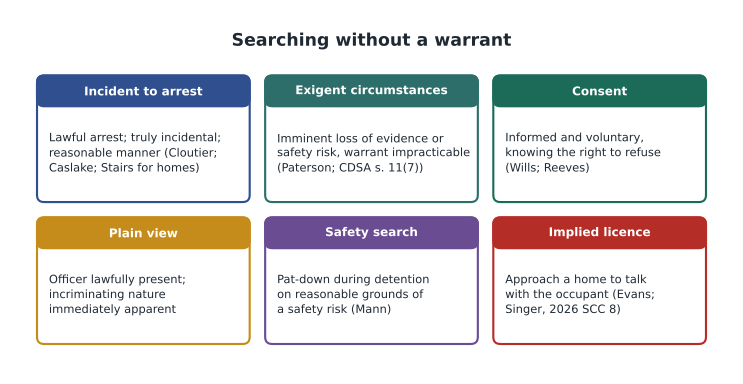
Hunter v. Southam set prior authorization as the default, so a warrantless search is presumed unreasonable. But many situations make a warrant impossible or pointless, and the law recognizes several exceptions. Each one has conditions, and the Crown must prove that they were met. Some exceptions are statutory, some are judge-made, and some are a combination.
Judge-made police powers come from the ancillary powers doctrine, which originated in the English case R. v. Waterfield, [1963] 3 All E.R. 659. A court asks whether the police were acting in the course of a lawful duty, and whether the conduct involved a justifiable use of powers associated with that duty, considering whether it was reasonably necessary. In Fleming v. Ontario, 2019 SCC 45, the Court refused to recognize a power to arrest a person who was acting lawfully in order to prevent a breach of the peace by others, and warned that courts should be cautious about creating new police powers that intrude on liberty.
Search incident to arrest
The power to search incident to arrest is a common law power, recognized in Cloutier v. Langlois, [1990] 1 S.C.R. 158. Police may search a lawfully arrested person and the area within their immediate control, without a warrant and without separate reasonable grounds, for a valid purpose connected to the arrest: ensuring safety, preventing escape, and finding and preserving evidence of the offence for which the person was arrested. In R. v. Caslake, [1998] 1 S.C.R. 51, the Court added that the officer must actually have had one of those purposes in mind, and that the purpose must be reasonable. An inventory search of a car six hours after an arrest, for the officer's own record-keeping purposes, was not incident to the arrest.
The power has limits. It does not permit taking bodily samples for DNA, which requires a warrant, as the Court held in R. v. Stillman, [1997] 1 S.C.R. 607. It does allow some intrusive searches, such as the penile swab upheld in R. v. Saeed, 2016 SCC 24, where the swab was needed to preserve evidence of the complainant's DNA that would otherwise be lost, provided it is done in a reasonable manner. And it is modified for phones by Fearon, as lesson 3 explained, and for strip searches by Golden, as lesson 2 explained.
Searching a home incident to arrest: Stairs
Homes raise special concern. In R. v. Stairs, 2022 SCC 11, police responded to a 911 call reporting a man hitting a woman in a car. They entered the house, found the man in the basement and arrested him, and then did a quick visual check of the basement living area, where they saw drugs in plain view. A majority of the Court held that the common law power to search incident to arrest extends to a home, but is modified to reflect the heightened privacy of a home. Where the search is of the home and outside the arrested person's physical control at the time of arrest, police must have reason to suspect that there is a safety risk to the police, the accused or the public that the search would address; the search must be tailored to that purpose, limited to areas and items related to it; and police should keep a record. On the facts, the officers reasonably suspected that someone else, possibly the injured woman, might be in danger, so the quick visual check was lawful.
Exigent circumstances
Section 487.11 of the Criminal Code and section 11(7) of the Controlled Drugs and Substances Act allow police to search without a warrant where the conditions for obtaining one exist but, by reason of exigent circumstances, it would be impracticable to obtain one. In R. v. Paterson, 2017 SCC 15, the Court interpreted section 11(7). Exigent circumstances denote urgency, arising from circumstances calling for immediate police action to preserve evidence, officer safety or public safety. Impracticable means that obtaining a warrant would be impossible in practice or would make the police unable to deal with the emergency, not merely that it would be inconvenient. Paterson had told officers he had a small amount of marijuana in his apartment; the officers entered to get it rather than issue a ticket. The Court held there was no exigency, and the evidence, which included a gun, was excluded under section 24(2).
The common law also recognizes a power to enter a home in response to an emergency call. In R. v. Godoy, [1999] 1 S.C.R. 311, police responded to a disconnected 911 call, and Godoy refused to let them in. The Court held that police could enter to ensure the safety of the caller, because the importance of the duty to protect life justified the intrusion, but that the power was limited to finding the caller and determining the reason for the call. It did not authorize a general search of the home.
Consent
A search is reasonable if the person with the relevant privacy interest validly consents to it. In R. v. Wills (1992), 7 O.R. (3d) 337 (C.A.), the Court of Appeal for Ontario set out the requirements. There must be consent, express or implied. The person giving it must have authority to do so. It must be voluntary, not the product of police oppression, coercion or other conduct that negates freedom of choice. The person must be aware of the nature of the police conduct and of the right to refuse, and of the potential consequences of giving consent. The Crown bears the burden of proving valid consent. Reeves added that one person cannot waive another's privacy interest in a shared space or item.
Plain view
The plain view doctrine allows police to seize an item without a warrant if they are lawfully in the place where they see it, and the incriminating nature of the item is immediately apparent. It is a power to seize, not to search. Police cannot move things around or open containers to bring something into plain view. In Stairs, the drugs were in plain view once the officers were lawfully in the basement living area.
Safety searches and implied licence
Mann recognized a protective pat-down search during an investigative detention where the officer has reasonable grounds to believe that their safety or that of others is at risk. Lesson 5 discusses investigative detention in more detail.
The implied licence doctrine allows anyone, including a police officer, to approach the door of a home to knock and speak to the occupant. In R. v. Evans, [1996] 1 S.C.R. 8, the Court held that officers who knocked on a door intending to sniff for marijuana when it opened exceeded the implied licence, because the licence covers communicating with the occupant, not gathering evidence against them. In R. v. Singer, 2026 SCC 8, the Court applied the doctrine to a vehicle parked at a residence. A five to four majority held that the officers could approach to speak with the occupant, but that opening the door of the truck went beyond the licence and was a warrantless search that breached section 8. The evidence was admitted under section 24(2), and the Crown's appeal was allowed.
Worked problem
The hoodie in Calder's bedroom
Police arrested Calder in the front hall of his apartment. Without a warrant, another officer walked to the bedroom, opened the closet and a dresser drawer, and found a hoodie with blood on the cuff. The officer testifies that he was 'looking for the clothes from last night'. Was the search lawful?
Show solution
- Burden: the search was warrantless, so the Crown must prove on a balance of probabilities that it was authorized by law and reasonable.
- Possible authority: search incident to arrest, as modified for homes by Stairs. The arrest was lawful, and finding evidence of the offence is a valid purpose for a search of the person and the area within his immediate control.
- The bedroom was outside Calder's physical control when he was arrested in the hall. Under Stairs, a search of that area requires reason to suspect a safety risk that the search would address. The officer's stated purpose was finding evidence, not safety, and there was no suggestion that anyone else was in the apartment.
- Exigent circumstances: the Crown might argue that Calder could have destroyed the clothes. But he was under arrest and in handcuffs, and the officers could have secured the apartment while they obtained a warrant or telewarrant. Under Paterson, inconvenience is not impracticability.
- Consent and plain view do not apply: Calder did not consent, and the hoodie was not visible until the officer opened a drawer.
- Conclusion: the search breached section 8. The hoodie is real evidence that would likely have been found with a warrant, which matters at the section 24(2) stage, but the intrusion into a home without authority is a serious breach. Lesson 11 returns to how a court would weigh that.
Common mistakes
MistakeAsking on a Garofoli review whether the reviewing judge would have issued the warrant.
InsteadThe question is whether the issuing justice could have issued it on the record as corrected by excision and amplification.
MistakeTreating search incident to arrest as permitting a search of the whole home.
InsteadStairs limits searches of areas outside the arrested person's immediate control to cases where police reasonably suspect a safety risk, tailored to that risk.
MistakeSaying exigent circumstances exist whenever getting a warrant would take time.
InsteadPaterson requires real urgency and impracticability, meaning that obtaining a warrant would be impossible in practice or would defeat the police response, not merely inconvenient.
MistakeTreating a person's agreement as valid consent without more.
InsteadUnder Wills, consent must be voluntary and informed, including knowledge of the right to refuse and of the potential consequences, and the Crown must prove it.
Practice problems
Work each problem on paper first, then reveal the answer to check.
An ITO says: 'A reliable confidential source told me that the accused keeps cocaine in his garage.' Nothing else is said about the source or any corroboration. Could the warrant have issued?
Show answer
Probably not. Under Debot, the justice must be able to assess whether the tip was compelling, the source credible, and the information corroborated. A bare conclusion about reliability, with no detail and no corroboration, is unlikely to support reasonable grounds.
Police enter a home after a 911 call is disconnected. They find the caller safe in the kitchen and then search the upstairs bedrooms, finding stolen goods. Lawful?
Show answer
The entry was lawful under Godoy to check on the caller's safety, but once the caller was found and the reason for the call determined, the power ended. The search of the bedrooms exceeded it and breached section 8, unless some other authority applied.
What did Singer (2026) decide about vehicles parked at a home?
Show answer
Police may approach under the implied licence to speak with the occupant, but opening the vehicle's door exceeded the licence and was a warrantless search in breach of section 8. The evidence was nonetheless admitted under section 24(2).
Summary and key terms
- A section 487 warrant requires sworn information showing reasonable grounds to believe that the things sought will afford evidence of an offence at the place to be searched.
- The Code also provides general warrants, DNA and impression warrants, Feeney warrants, telewarrants, production orders and other tools, each with its own conditions.
- Under Garofoli and Araujo, a reviewing judge asks whether the warrant could have issued on the record as corrected, excising improper information and allowing limited amplification.
- Warrantless searches must fit a recognized exception: incident to arrest (Cloutier; Caslake; Stairs), exigent circumstances (Paterson; Godoy), consent (Wills), plain view, safety searches (Mann) or implied licence (Evans; Singer).
- Courts are cautious about creating new police powers under the ancillary powers doctrine (Fleming).
- Information to obtain
- The sworn document, abbreviated ITO, setting out the grounds on which police seek a warrant or order.
- Telewarrant
- A warrant obtained by telephone or other telecommunication under section 487.1 where appearing in person is impracticable.
- General warrant
- A warrant under section 487.01 authorizing a technique not otherwise provided for in the Code.
- Excision
- Removing erroneous or unconstitutionally obtained information from an ITO on review.
- Amplification
- Adding information the police had but left out through honest error, to correct minor or technical defects in an ITO.
- Exigent circumstances
- Urgent circumstances requiring immediate police action, in which obtaining a warrant would be impracticable.
- Plain view
- A power to seize an item seen by an officer who is lawfully present, when its incriminating nature is immediately apparent.
Lesson quiz · 5 questions
Score 60% or more to complete this lesson.
Create a free account to save your progress, take quizzes and earn a certificate.