
LAWC-204 · Lesson 9 of 12 · 29 min
Shareholder rights
▶ Video coming soon A video version of this lesson is on the way.
In the hypothetical, by November 2026 Simon Bellamy has lost confidence in his mother's management of Lakeshore. The Tamarack purchase has gone badly, Tamarack's tax arrears are being dealt with, and Simon has heard nothing about the Norland licence since the board meeting. He holds 15 percent of Lakeshore's shares, all of them Class A voting common shares; Margot holds 55 percent, Claire 20 percent and Raj Gill holds the 10 percent of Class B non-voting shares. Margot has just told the board she wants to amend Lakeshore's articles to make the Class B shares redeemable at the board's option, so that Raj can be bought out when he retires. Simon asks Professor Okwuosa what he can actually do as a minority shareholder. 'More than you think,' says Okwuosa, 'and less than you want. You cannot run the company. But you can make it account to you.'
This lesson surveys what shareholders are entitled to under the OBCA, which governs Lakeshore, with the CBCA's parallel provisions noted. The next lesson turns to the remedies a shareholder has when those rights are not enough: the oppression remedy and the derivative action.
What shareholders are, and are not
A shareholder owns shares, not the corporation's assets. Lesson 4's discussion of Salomon and Kosmopoulos showed that the corporation is a separate person, and its property is its own. Shareholders do not manage the business; the directors do, under section 115(1) of the OBCA and section 102(1) of the CBCA, unless a unanimous shareholder agreement says otherwise. And shareholders generally cannot sue for wrongs done to the corporation, even if the value of their shares falls as a result. In Hercules Managements Ltd. v. Ernst & Young, [1997] 2 S.C.R. 165, shareholders sued the corporation's auditors for negligently prepared audits. The Supreme Court held that the auditors' duty in preparing statutory audit reports was owed to the corporation, so that shareholders as a body could oversee management, and that a claim for the loss in value of shares was in substance the corporation's claim. The rule, which goes back to Foss v. Harbottle (1843), means that corporate wrongs are pursued by the corporation, or by a shareholder with leave in a derivative action, not by individual shareholders suing for themselves.
What shareholders have instead is a set of rights attached to their shares and given to them by statute. The rights fall into four groups: economic rights, voting rights, information rights, and exit rights.
Economic rights and classes of shares
Lesson 3 explained that where a corporation has only one class of shares, those shares carry the right to vote, to receive dividends declared, and to receive the remaining property on dissolution (OBCA section 22(3); CBCA section 24(3)). Where there are two or more classes, each of those rights must be attached to at least one class, but not every class need have them all. Lakeshore's Class A shares have all three rights; its Class B shares have the economic rights but no vote at ordinary shareholder meetings. Dividends are declared by the directors, in their discretion, subject to the solvency tests in OBCA section 38(3) and CBCA section 42. A shareholder has no right to insist on a dividend, though a pattern of withholding dividends to squeeze a minority can be oppressive, as the next lesson explains.
Shareholders also have no automatic pre-emptive right to buy newly issued shares in proportion to their holdings. Under OBCA section 26 and CBCA section 28, such a right exists only if the articles or a unanimous shareholder agreement provide for it. Without one, the directors can dilute a minority by issuing shares to others, subject to their fiduciary duties and the oppression remedy. Lawyers acting for minority investors in private companies often negotiate pre-emptive rights in a shareholder agreement for this reason.
Voting rights
Unless the articles provide otherwise, each share carries one vote (OBCA section 102(1); CBCA section 140(1)). Most decisions are made by ordinary resolution, a resolution passed by a majority of the votes cast. Some require a special resolution, passed by at least two thirds of the votes cast at a meeting, or consented to in writing by all shareholders entitled to vote (OBCA section 1(1); CBCA section 2(1)). Shareholders elect the directors by ordinary resolution at the first meeting and each annual meeting (OBCA section 119(4); CBCA section 106(3)), appoint the auditor, and may remove a director by ordinary resolution at a special meeting (OBCA section 122(1); CBCA section 109(1)). Fundamental changes, such as amending the articles, amalgamating, continuing into another jurisdiction, selling all or substantially all of the property outside the ordinary course of business, or dissolving, require a special resolution.
Voting power follows share ownership, so a majority shareholder can usually elect the whole board. Some corporations provide for cumulative voting, under which each shareholder has as many votes as the number of their shares multiplied by the number of directors to be elected, and may cast them all for one candidate; this lets a sizeable minority elect at least one director. Cumulative voting is available only if the articles provide for it (OBCA section 120; CBCA section 107). Lakeshore's articles do not, so Margot's 55 percent elects every director, and Simon remains on the board only because his mother keeps nominating him.
Holders of a class of shares have a separate class vote on amendments to the articles that affect their class in specified ways: for example, a change to the rights, privileges, restrictions or conditions attached to the class, or the creation of a new class with rights equal or superior to theirs. Under OBCA section 170 and CBCA section 176, the class votes separately, whether or not its shares otherwise carry the right to vote, and the amendment must be approved by a special resolution of the class. This is why Margot's plan to make the Class B shares redeemable is not as simple as she thinks. Making shares redeemable at the corporation's option changes the rights attached to the class. Raj, as the only Class B holder, is entitled to vote separately as a class, and his vote alone can defeat the amendment, even though his shares are otherwise non-voting.
For distributing corporations under the CBCA, amendments in force since August 31, 2022 changed how directors are elected. Directors must be elected individually and annually, and in an uncontested election each candidate is elected only if the number of votes cast in their favour is greater than the number cast against them (CBCA section 106(3.4)). A candidate who fails to obtain a majority may not be appointed to the board afterwards except in limited circumstances, such as to satisfy residency or independence requirements. Before 2022, shareholders in many corporations could only vote for or withhold their vote, so a candidate could be elected with a single vote in favour. The Toronto Stock Exchange already required listed issuers to adopt a majority voting policy; the CBCA amendment made majority voting a statutory rule. The OBCA has no equivalent provision.
Meetings
Directors must call an annual meeting of shareholders not later than eighteen months after the corporation comes into existence and then not later than fifteen months after the last preceding annual meeting (OBCA section 94(1)); the CBCA (section 133) adds that the meeting must be held no later than six months after the end of the financial year. At the annual meeting, the directors present the financial statements, the shareholders elect directors and appoint the auditor, and any other business may be raised. Directors may call a special meeting at any time. Shareholders must receive notice within the time limits in the Act (for a non-offering OBCA corporation, at least ten days and not more than fifty days before the meeting), and the notice of a meeting at which special business will be transacted must state its nature in enough detail to let shareholders form a reasoned judgment and include the text of any special resolution.
In a private corporation, shareholders often act by written resolution instead. A resolution in writing signed by all the shareholders entitled to vote on it is as valid as if passed at a meeting (OBCA section 104(1); CBCA section 142(1)). This is how small companies such as Lakeshore usually handle annual business. It also gives every voting shareholder an effective veto over the written procedure: if Simon refuses to sign, Lakeshore must hold a real meeting, with notice and a vote.
Proposals and requisitions
A shareholder entitled to vote may submit notice of a proposal, a matter they wish to raise at an annual meeting, and the corporation must include it in the management information circular or the notice of meeting, along with a short supporting statement if requested (OBCA section 99; CBCA section 137). Under the CBCA, the proponent must meet ownership conditions set by regulation, broadly a minimum holding held for a minimum period, and the proposal and statement together are limited in length. The corporation may refuse to circulate a proposal in specified cases, for example if it is submitted too late, if it is primarily for the purpose of enforcing a personal claim or redressing a personal grievance, or if it does not relate in a significant way to the business or affairs of the corporation. A proposal may include nominations for the election of directors if it is signed by holders of at least five percent of the shares entitled to vote.
Holders of at least five percent of the issued voting shares may requisition the directors to call a meeting for the purposes stated in the requisition (OBCA section 105(1); CBCA section 143(1)). If the directors do not call the meeting within twenty-one days after receiving the requisition, any shareholder who signed it may call the meeting, and the corporation must reimburse the reasonable expenses unless the shareholders resolve otherwise at the meeting. A court may also order a meeting to be called, held and conducted in the manner it directs, where it is impracticable to call or conduct one in the ordinary way (OBCA section 106; CBCA section 144). With 15 percent, Simon is well above the five percent threshold. He could requisition a special meeting to consider, for example, a resolution asking the board to commission an independent review of the Tamarack purchase. He would lose the vote against Margot's 55 percent, but the meeting would put the issue on the record, which may matter if he later applies for an oppression or derivative remedy.
Proxies let shareholders vote without attending. A shareholder may appoint a proxyholder, who need not be a shareholder, by a signed proxy (OBCA section 110; CBCA section 148). In a distributing corporation, management must send a form of proxy with the notice of meeting, and anyone soliciting proxies must send a circular containing prescribed information, subject to exemptions, including one for solicitations by public broadcast (CBCA sections 149 to 150). Proxy contests, where dissident shareholders solicit votes to replace the board, are a major part of corporate governance in public companies.
Information rights
Shareholders are entitled to information that lets them monitor the directors. A corporation must keep at its registered office the articles and by-laws, any unanimous shareholder agreement, minutes of meetings and resolutions of shareholders, a register of directors, and a securities register (OBCA section 140(1); CBCA section 20(1)). Shareholders and creditors may examine these records during the usual business hours and take extracts free of charge (OBCA section 145; CBCA section 21(1)). The corporation must also keep the minutes of directors' meetings and resolutions and adequate accounting records, but shareholders do not have a statutory right to inspect those; access to directors' minutes is limited to the directors themselves. A shareholder seeking board minutes usually needs a shareholder agreement providing access, or must obtain them through production in litigation, such as an oppression application.
Shareholders are also entitled to receive the financial statements. The directors must place comparative financial statements and the auditor's report before every annual meeting (OBCA section 154; CBCA section 155), and send copies to shareholders who ask for them (or, for an offering or distributing corporation, to all shareholders, subject to opt-outs). The statements must be audited unless the corporation is exempt. Under OBCA section 148, a corporation that is not an offering corporation may be exempt from appointing an auditor in respect of a financial year if all of the shareholders consent in writing, including shareholders not otherwise entitled to vote; the CBCA (section 163) has a similar rule for non-distributing corporations. For a family company, this exemption saves a good deal of money, and Lakeshore has relied on it for years. But because consent must be unanimous, Simon can withdraw his consent for the coming year and force Lakeshore to appoint an auditor. Raj, whose shares are non-voting, has the same power. It is one of the most practical levers a minority shareholder in a private company has.
Exit rights: dissent and appraisal
A minority shareholder who disagrees with a fundamental change cannot stop it if the majority has the votes. But the Act lets the shareholder leave, and be paid fair value for their shares. Under OBCA section 185(1) and CBCA section 190(1), a shareholder entitled to vote may dissent if the corporation resolves to amend its articles to add, remove or change restrictions on the issue, transfer or ownership of shares of a class, or restrictions on the business the corporation may carry on; to amalgamate with another corporation (other than in certain short-form amalgamations); to continue under the laws of another jurisdiction; or to sell, lease or exchange all or substantially all its property other than in the ordinary course of business. Holders entitled to a separate class vote on an amendment affecting their class may also dissent, subject to exceptions (OBCA section 185(2); CBCA section 190(2)). Dissent is also available in other transactions, such as plans of arrangement where the court order provides for it, and going-private transactions.
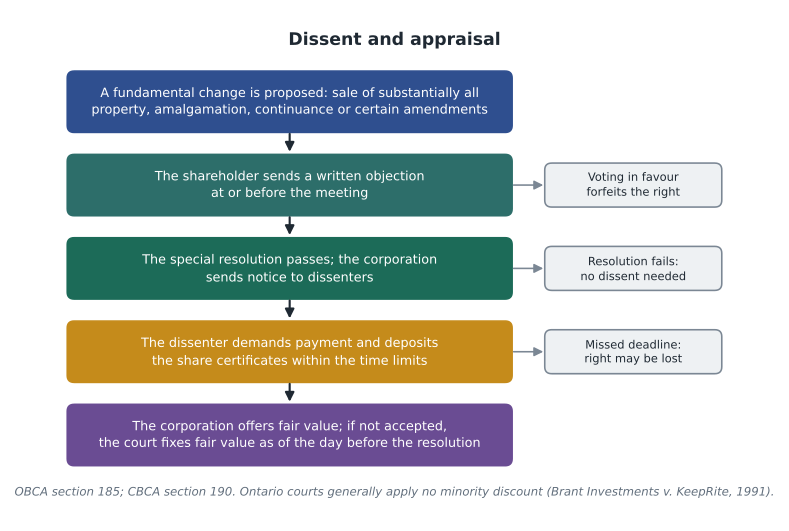
The procedure is strict. The shareholder must send the corporation a written objection at or before the meeting at which the resolution is to be voted on. Voting in favour of the resolution forfeits the right. After the resolution is adopted, the corporation must send notice to dissenters, and each dissenter must then send a written demand for payment of fair value within the time set by the Act and deposit their share certificates. From then on, the dissenter ceases to have any rights as a shareholder other than the right to be paid. The corporation must offer to pay an amount the directors consider fair value, and if the dissenter does not accept, either side may apply to the court to fix fair value. Fair value is determined as of the close of business on the day before the resolution was adopted. Ontario courts have generally refused to apply a minority discount in fixing fair value in this context, reasoning that the dissenter is being compelled to give up their shares and should receive a proportionate share of the value of the whole enterprise; see Brant Investments Ltd. v. KeepRite Inc. (1991), 3 O.R. (3d) 289 (C.A.).
Dissent is a useful exit in a private corporation, where there is no market for the shares and a minority shareholder may otherwise be locked in. But it is limited to the triggering events. Simon cannot dissent simply because he dislikes his mother's decisions. If Lakeshore later proposed to sell its whole hardwood furniture business, or to continue from Ontario to another jurisdiction, Simon could object and demand to be paid out. Until then, his remedies for ordinary mismanagement lie in the oppression remedy and the derivative action.
Compulsory acquisition and going private
The statutes also give rights in the other direction. Where a take-over bid for all the shares of a class is accepted by holders of at least ninety percent of the shares of that class, other than those held by the bidder and its affiliates, the bidder may acquire the remaining shares on the same terms (OBCA section 188; CBCA section 206). Shareholders who are squeezed out in this way may demand fair value from the court instead of accepting the bid price. And a shareholder who holds shares in a corporation where a take-over bidder has reached ninety percent but has not exercised the right may require the bidder to acquire their shares (CBCA section 206.1). Going-private and squeeze-out transactions under securities law are discussed in lesson 11.
Advising Simon
Okwuosa summarizes Simon's position. Simon cannot outvote Margot, cannot remove her from the board and cannot see the board's minutes as a matter of right. But he can refuse to sign written resolutions, forcing real meetings with proper notice; withdraw his consent to the audit exemption, so Lakeshore's next financial statements are audited; inspect the shareholder records; requisition a special meeting to air the Tamarack purchase and the Norland licence; and, if Lakeshore proposes a fundamental change such as a sale of substantially all its business, dissent and demand fair value. Raj, for his part, can block the proposed amendment to his Class B shares through his separate class vote. 'These rights do not win you control,' Okwuosa tells Simon. 'They give you information and a record. Lawyers build oppression cases out of exactly those things.'
Worked problem
Margot's plan to make the Class B shares redeemable
In the hypothetical, in November 2026 Margot Bellamy proposes that Lakeshore, an OBCA corporation, amend its articles so that its Class B non-voting common shares, all held by Raj Gill, become redeemable at the board's option at a price set by the board. The Class A holders are Margot (55 percent of all shares), Claire (20) and Simon (15). Margot asks whether she can pass the amendment with the votes of the Class A holders, by written resolution, without involving Raj.
Show solution
- Identify the corporate act: adding a redemption right is an amendment to the articles, which requires a special resolution of the shareholders under OBCA section 168.
- Check for a class vote: OBCA section 170 gives a class a separate vote on an amendment that changes the rights, privileges, restrictions or conditions attached to its shares, whether or not the shares otherwise carry the right to vote.
- Apply it: a new redemption right at the board's option changes the Class B shares' conditions, so the amendment needs a special resolution of the Class B holders voting separately; Raj, holding all of them, can veto it.
- Written resolution route: a written special resolution must be signed by all shareholders entitled to vote on it, which includes Raj on the class vote and Simon on the Class A vote; either can force a meeting instead.
- Dissent: if the amendment did pass with a class vote, OBCA section 185(2) would give Raj a right to dissent and be paid fair value, subject to the Act's exceptions.
- Advice: Margot should negotiate with Raj, for example a buy-sell agreement setting a price formula on retirement, rather than attempt an amendment he can block and that might also be challenged as oppressive.
Common mistakes
MistakeSaying non-voting shareholders never vote.
InsteadUnder OBCA section 170 and CBCA section 176, holders of a class vote separately on amendments affecting their class, even if their shares are otherwise non-voting.
MistakeTelling a shareholder they have a right to inspect directors' minutes.
InsteadShareholders may inspect the articles, by-laws, USAs, minutes of shareholder meetings and the registers, but not directors' minutes or accounting records.
MistakeAssuming a dissenting shareholder can vote for the resolution and still dissent.
InsteadA dissenter must send a written objection at or before the meeting and must not vote in favour.
MistakeSaying shareholders can sue personally for a fall in share value caused by a wrong to the corporation.
InsteadHercules Managements confirms that such a loss is the corporation's; the remedy is a derivative action or, in some cases, oppression.
MistakeTreating the CBCA majority voting rule as applying to every corporation.
InsteadIt applies to uncontested elections in CBCA distributing corporations since August 31, 2022; the OBCA has no equivalent.
Practice problems
Work each problem on paper first, then reveal the answer to check.
What is a special resolution under the OBCA and CBCA?
Show answer
A resolution passed by at least two thirds of the votes cast at a meeting, or signed by all shareholders entitled to vote on it.
What percentage of voting shares is needed to requisition a shareholder meeting?
Show answer
At least five percent of the issued voting shares (OBCA section 105; CBCA section 143).
How can a single minority shareholder in a private OBCA corporation force an audit?
Show answer
By withholding consent to the audit exemption, which under OBCA section 148 requires the written consent of all shareholders.
Name three corporate acts that trigger a right of dissent.
Show answer
Any three of: certain amendments to the articles (share restrictions or restrictions on business), amalgamation, continuance, and sale, lease or exchange of all or substantially all the property outside the ordinary course.
As of what date is fair value fixed for a dissenting shareholder?
Show answer
The close of business on the day before the resolution was adopted.
What did Hercules Managements decide about shareholders' claims against auditors?
Show answer
The auditors' statutory audit duty was owed to the corporation, and losses in share value were the corporation's claim, not the individual shareholders'.
Summary and key terms
- Shareholders own shares, not corporate assets, do not manage the business, and generally cannot sue personally for wrongs to the corporation (Hercules Managements; Foss v. Harbottle).
- Shares carry economic, voting, information and exit rights; pre-emptive rights and cumulative voting exist only if the articles provide for them.
- Ordinary resolutions need a majority of votes cast; special resolutions need two thirds; classes vote separately on amendments affecting them, even if non-voting.
- CBCA distributing corporations have had majority voting in uncontested director elections since August 31, 2022.
- Shareholders may submit proposals, and holders of five percent of voting shares may requisition a meeting.
- Shareholders may inspect shareholder minutes and registers and receive financial statements; all shareholders must consent to an audit exemption.
- Dissent and appraisal let shareholders who object to specified fundamental changes be paid fair value, under a strict procedure.
- Ordinary resolution
- A resolution passed by a majority of the votes cast by shareholders who voted on it.
- Special resolution
- A resolution passed by at least two thirds of votes cast, or signed by all shareholders entitled to vote.
- Class vote
- A separate vote of the holders of a class of shares on an amendment affecting that class.
- Cumulative voting
- A system letting shareholders concentrate their votes on one or a few director candidates.
- Shareholder proposal
- A matter a shareholder gives notice of to be raised at an annual meeting and circulated by the corporation.
- Requisition
- A demand by holders of five percent of voting shares that directors call a shareholder meeting.
- Dissent and appraisal
- The right of a shareholder who objects to certain fundamental changes to be paid the fair value of their shares.
- Proxy
- A document appointing someone to attend and vote on a shareholder's behalf.
Lesson quiz · 5 questions
Score 60% or more to complete this lesson.
Create a free account to save your progress, take quizzes and earn a certificate.