
LAWC-204 · Lesson 7 of 12 · 30 min
The duty of care and the business judgment rule
▶ Video coming soon A video version of this lesson is on the way.
In the hypothetical, Lakeshore's board meets on a Friday afternoon in March 2026 to approve the purchase of all the shares of Tamarack Millwork Ltd., a fictional cabinet maker in a town an hour north of Corwin. Margot Bellamy has known Tamarack's founder, Arne Halvorsen, for thirty years. Arne wants to retire, and he has offered his shares for 4.2 million dollars if the deal closes within a month. Margot presents a two-page summary with Tamarack's revenue for the last three years. There is no valuation, no review of Tamarack's contracts, and no look at its leased factory, which sits beside a creek. The meeting lasts forty minutes. Harriet Castonguay, the independent director, asks for an adjournment to obtain advice. Margot says the chance will be gone by then. The board votes four to one in favour, with Harriet opposed. Six months later, Lakeshore discovers that Tamarack's largest customer gave notice before the closing, and that the factory site needs an environmental clean-up. Tamarack is worth perhaps a third of what Lakeshore paid. Simon Bellamy, who voted yes, asks Professor Okwuosa whether the directors can be sued. 'Everyone makes bad deals,' Simon says. 'Surely that is not a breach of duty.' 'It is not,' says Okwuosa. 'But a bad process might be.'
The statutory standard
Section 122(1)(b) of the CBCA and section 134(1)(b) of the OBCA require every director and officer, in exercising their powers and discharging their duties, to exercise the care, diligence and skill that a reasonably prudent person would exercise in comparable circumstances. This is the duty of care. It sits beside the fiduciary duty studied in the last lesson, but it asks a different question. The fiduciary duty asks about loyalty: whose interests was the director serving? The duty of care asks about competence and attention: did the director do the job with the care a sensible person would bring to it?
At common law, the standard was low and subjective. In the old English case of Re City Equitable Fire Insurance Co. (1925), the court said a director need not show a greater degree of skill than may reasonably be expected from a person of their knowledge and experience. An inexperienced or inattentive director was judged by their own limited abilities. Directors were not bound to attend every meeting and could leave the business largely to officers. That approach suited a time when boards were often ornamental, but it gave almost no protection to the corporation or those who dealt with it.
Canadian statutes replaced it with an objective test. In Peoples Department Stores Inc. (Trustee of) v. Wise, 2004 SCC 68, the Supreme Court of Canada confirmed that the standard in section 122(1)(b) is objective. The question is not what this particular director thought was reasonable, but what a reasonably prudent person would have done in comparable circumstances. The words 'comparable circumstances' let the court take account of the setting: the size and nature of the business, the urgency of the decision, the information available and the director's role. A director who is a chartered accountant on the audit committee may be expected to notice problems in the financial statements that a director with no financial training would not. But the floor is the same for everyone. A director cannot avoid liability by saying they did not understand the business or did not read the materials.
Peoples: the facts and the result
Peoples is worth knowing in some detail because it shapes the whole law of directors' duties in Canada. Wise Stores Inc. bought Peoples Department Stores from Marks and Spencer in 1992. The three Wise brothers were the directors of both companies. The two chains had trouble coordinating their inventory, and the brothers adopted a new procurement policy under which Peoples bought most inventory from North American suppliers and Wise bought overseas inventory, with Wise then supplying Peoples and owing it the cost. In practice Peoples ended up extending large amounts of trade credit to Wise, which was in financial difficulty. Both companies went bankrupt in 1994. The trustee in bankruptcy of Peoples sued the brothers, arguing that they had breached their fiduciary duty and their duty of care by favouring Wise over Peoples and its creditors.
The Supreme Court rejected both claims. On the fiduciary duty, it found that the brothers had acted honestly and in good faith in trying to solve a real inventory problem, and had no personal interest in shifting value from Peoples to Wise. On the duty of care, the Court made three points that matter for every later case. First, the standard is objective, as noted above. Second, the duty of care, unlike the fiduciary duty, is not owed only to the corporation; the statute does not limit who may rely on it, so creditors could in principle bring a claim based on a lack of care. Third, the procurement policy, although it turned out badly, was a reasonable business decision made in response to a real problem, and the brothers were entitled to the protection of the business judgment rule. The Court noted that directors are not required to be perfect, and that the law does not ask for perfection, only for prudence and diligence.
The business judgment rule
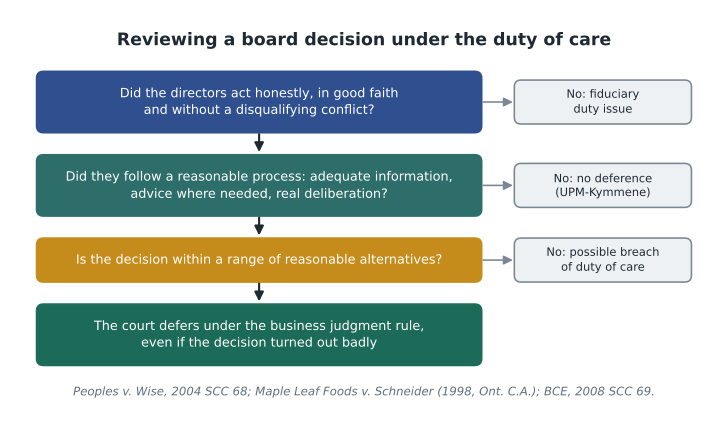
The business judgment rule is a principle of judicial deference. Courts are reluctant to second-guess business decisions made by directors with the benefit of hindsight. Judges are not business experts, risk-taking is part of commerce, and a rule that punished every failed venture would make directors so cautious that corporations would stop taking the risks on which growth depends. So a court will not substitute its own view for that of the board as long as the decision was within a range of reasonableness and was made through a reasonable process.
The leading Ontario statement is Maple Leaf Foods Inc. v. Schneider Corp. (1998), 42 O.R. (3d) 177 (C.A.). The case arose from a contested take-over of Schneider, a meat packer controlled by the Schneider family. A special committee of independent directors ran an auction and supported a bid from Smithfield Foods, which the family was prepared to accept, over a bid from Maple Leaf. Maple Leaf argued that the committee had favoured the family. The Court of Appeal held that the committee had acted reasonably and that its decision deserved deference. Weiler J.A. said that the court looks to see that the directors made a reasonable decision, not a perfect one; provided the decision taken is within a range of reasonableness, the court ought not to substitute its opinion for that of the board even though subsequent events may have cast doubt on the board's determination.
In Peoples, the Supreme Court adopted the same approach, and in BCE Inc. v. 1976 Debentureholders, 2008 SCC 69, it confirmed that the business judgment rule applies when courts assess whether directors met their duties in a change-of-control transaction. Three conditions emerge from the cases. The directors must have acted honestly and in good faith, without a conflict of interest that taints the decision. They must have followed a reasonable process: gathering adequate information, taking advice where the matter called for it, and actually deliberating. And the decision itself must fall within a range of reasonable alternatives. When these conditions are met, the court defers. A bad outcome alone proves nothing.
When deference is lost: UPM-Kymmene
The rule protects informed judgment, not the absence of judgment. The clearest Canadian illustration is UPM-Kymmene Corp. v. UPM-Kymmene Miramichi Inc., [2002] O.J. No. 2412 (S.C.J.), affirmed by the Ontario Court of Appeal in 2004. Repap Enterprises, a struggling paper company, recruited a new chairman, Berg, and its board approved an extraordinarily rich employment contract for him, including very large share option grants and payments triggered if he left or the company changed hands. When UPM-Kymmene later acquired Repap, it challenged the agreement.
The court refused to apply the business judgment rule. The board had relied on the recommendation of its compensation committee, but the committee lacked the time and the expertise to review the contract, and its members did not understand its key components. Lax J. found that the approval process fell far short of the exercise of prudent judgment. She also held that Berg had breached his own fiduciary duty and that the contract was oppressive under section 241 of the CBCA. The judge held that the business judgment rule only protects decisions reached through a process that is itself reasonable. Where directors simply rubber-stamp terms they have not examined, there is no business judgment to defer to. The contract was set aside, and the Court of Appeal agreed that the board's decision fell outside the range of reasonableness.
UPM-Kymmene teaches a practical lesson that lawyers repeat to boards constantly. The protection the law gives depends on the record the board creates. Minutes that show the materials received, the questions asked, the advice obtained and the alternatives considered are the best evidence that the process was reasonable. A board that receives a two-page summary, meets for forty minutes and votes under artificial time pressure is building the opposite record.
What a reasonable process looks like
No statute lists the steps of a prudent process, and what is reasonable depends on the decision. But the cases and practice point to recurring elements. Directors should receive the information they need, in time to read it. For a significant transaction, that usually means professional advice: a valuation or fairness opinion from a financial adviser, legal due diligence on contracts, employment matters and litigation, and specialist reviews where the business calls for them, such as an environmental assessment of real property. Directors should ask questions and test the assumptions management presents. Where some directors have a conflict, a special committee of independent directors with its own advisers is often used, as in Maple Leaf Foods. And the board should consider alternatives, including doing nothing.
Urgency is relevant but not decisive. Real business opportunities sometimes require quick decisions, and the 'comparable circumstances' language allows for that. But a deadline set by the other side is a negotiating position, not a law of nature, and courts look sceptically at boards that let a seller's timetable replace their own judgment. A board that truly must act quickly can still take reasonable steps: a short adjournment for a call with counsel, a condition allowing the deal to be terminated if due diligence reveals problems, or a price adjustment or indemnity from the seller.
Directors also have a continuing duty to stay informed about the business and to oversee management. A director who never attends meetings, never reads the financial statements and never asks questions is not exercising the care of a reasonably prudent person, however honest they are. Modern boards increasingly treat oversight of risk, including cyber security, legal compliance and climate-related risk, as part of this duty, typically through committees that report to the full board.
Reliance and due diligence
Directors cannot do everything themselves, and the law lets them rely on others. Under section 123(4) and (5) of the CBCA, a director is not liable under certain provisions of the Act, and has complied with the duties in section 122, if the director relied in good faith on financial statements of the corporation represented to the director by an officer or in a written report of the auditor to fairly reflect the corporation's financial condition, or on a report of a person whose profession lends credibility to a statement made by them, such as a lawyer, accountant, engineer or appraiser. Section 123(4) also provides a due diligence defence for certain statutory liabilities, discussed in the next lesson: a director who exercised the care, diligence and skill of a reasonably prudent person in comparable circumstances is not liable. Section 135(4) of the OBCA is to similar effect.
Reliance must be in good faith. A director who has reason to doubt a report, or who knows that the person who prepared it was not given the facts, cannot hide behind it. And reliance requires that there be something to rely on. The Lakeshore directors had no valuation, no legal review and no environmental report. They relied on a summary prepared by the director who was most eager for the deal, which is hardly reliance on an expert.
Dissent: how a director avoids being bound
A director who is present at a meeting is deemed to have consented to any resolution passed or action taken there unless the director requests that a dissent be entered in the minutes, sends a written dissent to the secretary before the meeting is adjourned, or sends a dissent by registered mail or delivers it to the registered office immediately after the meeting: CBCA section 123(1). A director who was absent is deemed to have consented unless, within seven days after becoming aware of the resolution, the director has a dissent placed with the minutes or sent to the registered office: section 123(3). The OBCA, in section 135, has equivalent rules. A director who votes for a resolution cannot later file a dissent.
These provisions matter most where the Act imposes liability on directors who vote for or consent to particular resolutions, such as an unlawful dividend or redemption of shares when the solvency tests are not met (CBCA section 118). But a recorded dissent is also strong evidence that a director exercised care in a contested decision. Harriet Castonguay's insistence that her opposition and her request for an adjournment be minuted is exactly what a careful director does.
No contracting out
Section 122(3) of the CBCA provides that no provision in a contract, the articles, the by-laws or a resolution relieves a director or officer from the duty to act in accordance with the Act or the regulations, or relieves them from liability for a breach. Section 134(3) of the OBCA is similar. Unlike some American states, which allow a corporation's charter to eliminate directors' monetary liability for breaches of the duty of care, Canadian corporate statutes do not permit that kind of exculpation. The main exception is a unanimous shareholder agreement: where a USA transfers powers of the directors to the shareholders, the shareholders take on the directors' duties and liabilities to that extent, and the directors are relieved of them (CBCA section 146(5); OBCA section 108(5)).
Indemnification and insurance
Because directors face real litigation risk, corporate statutes let the corporation protect them, within limits. Under section 124(1) of the CBCA, a corporation may indemnify a director or officer, a former director or officer, or another person who acts at the corporation's request as a director or officer of another entity, against all costs, charges and expenses, including an amount paid to settle an action or satisfy a judgment, reasonably incurred in a civil, criminal, administrative or investigative proceeding in which they are involved because of that association. The corporation may advance defence costs, but the individual must repay them if they do not meet the conditions (section 124(2)).
The conditions are in section 124(3): the individual must have acted honestly and in good faith with a view to the best interests of the corporation or other entity, and, in a criminal or administrative action enforced by a monetary penalty, must have had reasonable grounds for believing their conduct was lawful. Indemnification is not available to a director who acted dishonestly or in bad faith; a corporation cannot pay its directors to breach their loyalty. Where the action is brought by or on behalf of the corporation itself, such as a derivative action, indemnification requires court approval (section 124(4)). And an individual who was not judged by a court to have committed any fault or omitted to do anything they ought to have done, and who meets the good faith conditions, is entitled to indemnification as of right (section 124(5)). Section 136 of the OBCA contains parallel rules.
Corporations also buy directors' and officers' liability insurance, which section 124(6) of the CBCA and section 136(4) of the OBCA expressly permit. A typical policy has three parts. Side A covers directors and officers directly when the corporation cannot or will not indemnify them, for example because it is insolvent. Side B reimburses the corporation when it does indemnify them. Side C, sometimes called entity coverage, protects the corporation itself, usually for securities claims. Policies exclude fraud and deliberate wrongdoing, and their limits can be exhausted quickly in large cases, so a careful director asks to see the policy before joining a board, particularly that of a small private company that may not have one at all.
Applying the law to Tamarack
Okwuosa walks the class through Simon's question. The directors had no personal conflict in the Tamarack deal, apart from Margot's friendship with Arne, which is not a financial interest but might colour her judgment. The difficulty is process. A board acquiring a business for more than four million dollars, a large sum relative to Lakeshore's size, would ordinarily obtain at least a basic valuation, review the target's major contracts and customer relationships, and investigate any real property, especially one beside a creek. The only reason given for skipping these steps was the seller's deadline. Like the compensation committee in UPM-Kymmene, the board approved terms on thin information prepared by an interested party, and there is a real argument that its decision is not protected by the business judgment rule.
If the business judgment rule does not apply, the court will ask whether a reasonably prudent person in comparable circumstances would have approved the purchase on this record. Lakeshore's directors would point to the 'comparable circumstances' of a family company making a quick decision about a long-trusted counterparty. The claimant would answer that the basic due diligence that would have revealed the lost customer and the contaminated site was cheap and quick relative to the price. Who might sue? Lakeshore itself, but its board is unlikely to sue its own majority; a shareholder such as Simon could seek leave to bring a derivative action in Lakeshore's name, as lesson 10 will explain. Harriet, who dissented and asked for an adjournment, is in a far stronger position than the four who voted yes.
Worked problem
Advising Harriet Castonguay before the Tamarack vote
Suppose Harriet had called Professor Okwuosa the night before the March 2026 board meeting, in the hypothetical. She has the two-page summary and knows Margot wants a vote the next day. What should Harriet do to discharge her duty of care, and to protect herself if the deal goes badly?
Show solution
- Identify the standard: CBCA section 122(1)(b) and OBCA section 134(1)(b) require the care, diligence and skill of a reasonably prudent person in comparable circumstances, judged objectively under Peoples.
- Identify the gap in the process: there is no valuation, no contract or customer review, and no environmental assessment of a creek-side factory, and the only source is an interested director's summary.
- Recommend steps that make the process reasonable: ask the board to retain a financial adviser and counsel, to make the purchase agreement conditional on satisfactory due diligence, and to seek representations, warranties and an indemnity from Arne Halvorsen, or a price holdback.
- Address the deadline: a seller's timetable is a negotiating position; a short adjournment or a conditional agreement can preserve the opportunity while allowing diligence.
- If outvoted, record a dissent: under CBCA section 123(1), ask that the dissent and reasons be entered in the minutes, or deliver a written dissent before the meeting adjourns.
- Check her protections: confirm Lakeshore's by-laws or an indemnity agreement provide indemnification under section 124, and ask whether the company carries directors' and officers' insurance.
Common mistakes
MistakeTreating the duty of care as a subjective test based on the director's own skill and experience.
InsteadPeoples confirms the CBCA standard is objective: a reasonably prudent person in comparable circumstances.
MistakeSaying the business judgment rule protects any decision made honestly.
InsteadIt protects honest decisions made through a reasonable, informed process and falling within a range of reasonableness; UPM-Kymmene shows a flawed process loses its protection.
MistakeAssuming a director who voted for a resolution can later file a dissent.
InsteadA director present at the meeting must have the dissent minuted or delivered at or immediately after the meeting; one who voted in favour cannot dissent later.
MistakeBelieving a corporation's by-laws can excuse directors from liability for carelessness.
InsteadCBCA section 122(3) and OBCA section 134(3) forbid contracting out, except to the extent a unanimous shareholder agreement transfers the directors' powers.
MistakeSaying a corporation may indemnify a director for anything.
InsteadIndemnity under section 124 requires that the director acted honestly and in good faith, and, in penal matters, reasonably believed the conduct was lawful.
Practice problems
Work each problem on paper first, then reveal the answer to check.
What is the standard of care for directors under section 122(1)(b) of the CBCA?
Show answer
The care, diligence and skill that a reasonably prudent person would exercise in comparable circumstances, an objective standard.
Did Peoples hold that the duty of care is owed only to the corporation?
Show answer
No. Unlike the fiduciary duty, the statutory duty of care is not limited to the corporation, so creditors can in principle rely on it.
State the business judgment rule as expressed in Maple Leaf Foods v. Schneider.
Show answer
The court asks whether the directors made a reasonable decision, not a perfect one; if it is within a range of reasonableness, the court will not substitute its opinion, even if later events cast doubt on it.
Why was the business judgment rule unavailable in UPM-Kymmene?
Show answer
The board approved the chairman's contract on the recommendation of a committee that lacked the time and expertise to review it and did not understand its key terms, so there was no informed business judgment to defer to.
On what may a director rely in good faith under section 123 of the CBCA?
Show answer
Financial statements represented by an officer or in a written auditor's report to fairly reflect the financial condition, and reports of professionals such as lawyers, accountants, engineers and appraisers.
When is a director entitled to indemnification as of right under section 124(5)?
Show answer
When the director was not judged by a court to have committed any fault or omission and acted honestly and in good faith in the corporation's best interests, with reasonable grounds in a penal matter.
Summary and key terms
- Directors and officers must exercise the care, diligence and skill of a reasonably prudent person in comparable circumstances: CBCA section 122(1)(b) and OBCA section 134(1)(b).
- Peoples v. Wise (2004) confirms the standard is objective and that the duty of care, unlike the fiduciary duty, is not owed only to the corporation.
- Under the business judgment rule (Maple Leaf Foods; Peoples; BCE), courts defer to honest, informed decisions within a range of reasonableness, even if they turn out badly.
- UPM-Kymmene shows that a flawed, uninformed process loses the rule's protection.
- Directors may rely in good faith on financial statements and professional reports (CBCA section 123(4) and (5)).
- A director present at a meeting is deemed to consent unless a dissent is recorded or delivered as the Act requires.
- No contract, article or by-law can relieve directors of their statutory duties, except through a unanimous shareholder agreement.
- Corporations may indemnify directors who acted honestly and in good faith and may buy D&O insurance (CBCA section 124; OBCA section 136).
- Duty of care
- The duty to exercise the care, diligence and skill of a reasonably prudent person in comparable circumstances.
- Business judgment rule
- The principle that courts defer to informed, good-faith business decisions within a range of reasonableness.
- Special committee
- A committee of independent directors formed to consider a transaction in which other directors have a conflict.
- Fairness opinion
- A financial adviser's opinion that a transaction is fair, from a financial point of view, to the corporation or its shareholders.
- Deemed consent
- The rule that a director present at a meeting consents to resolutions passed unless a dissent is properly recorded.
- Indemnification
- The corporation's payment of a director's or officer's costs, settlements or judgments arising from their role.
- D&O insurance
- Insurance protecting directors and officers, and often the corporation, against liability claims arising from their role.
Lesson quiz · 5 questions
Score 60% or more to complete this lesson.
Create a free account to save your progress, take quizzes and earn a certificate.