
LAWC-204 · Lesson 11 of 12 · 32 min
Securities regulation, mergers and acquisitions
▶ Video coming soon A video version of this lesson is on the way.
In the hypothetical, on November 18, 2026, the chief executive of Norland Home Corp., the national furniture retailer that licensed Lakeshore's table designs through Lakeshore Direct, telephones Margot Bellamy. Norland is a fictional public company, incorporated under the CBCA and listed on the Toronto Stock Exchange. It wants to buy all of Lakeshore, paying each shareholder partly in cash and partly in newly issued Norland shares, and it wants to sign a deal before its next quarterly results. Margot, who days earlier was thinking about buying out her son, is suddenly thinking about selling. Simon, who has been preparing an oppression application, asks whether Norland can buy the company without him. That evening, Claire mentions the call to Rohan Iyer, her partner in Lakeshore Direct, who buys 2,000 Norland shares the next morning. Professor Okwuosa calls this 'the lesson where every topic in the course arrives at once.'
This lesson has two parts. The first is a short overview of securities regulation, which governs how corporations raise money from investors and how public companies behave. The second covers how corporations are bought and combined: share purchases, take-over bids, amalgamations and plans of arrangement. Both are large specialties, and this lesson aims at the core principles a generalist lawyer needs.
Who regulates securities in Canada
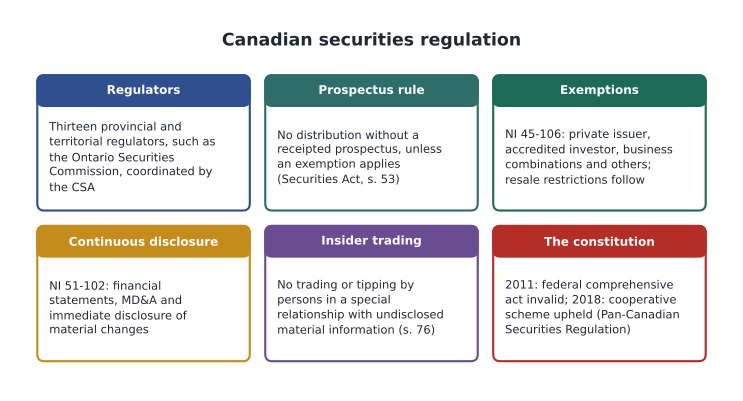
Securities regulation in Canada is provincial. Each province and territory has its own statute and regulator; in Ontario, the Securities Act and the Ontario Securities Commission. Since 2022, the OSC's regulatory functions and its adjudicative functions have been separated, with contested enforcement hearings conducted by the Capital Markets Tribunal under the Securities Commission Act, 2021. The thirteen regulators coordinate through the Canadian Securities Administrators, which develops national instruments that each jurisdiction adopts, so that most of the detailed rules are the same across the country. Outside Ontario, a passport system lets an issuer deal mainly with its principal regulator.
Canada is unusual among major economies in not having a national securities regulator. In Reference re Securities Act, 2011 SCC 66, the Supreme Court held that a proposed comprehensive federal securities statute was beyond Parliament's trade and commerce power, because the day-to-day regulation of securities trading is essentially a matter of property and civil rights in the provinces. The Court left room for federal legislation directed at genuinely national concerns such as systemic risk. In Reference re Pan-Canadian Securities Regulation, 2018 SCC 48, it upheld a cooperative scheme in which participating provinces would enact uniform legislation and Parliament would enact a Capital Markets Stability Act limited to systemic risk and criminal matters, as students saw in constitutional law. The Court held that the scheme did not unconstitutionally fetter provincial legislatures, which remained free to amend or withdraw from their laws, and that the draft federal act fell within the general branch of the trade and commerce power. The cooperative system has not yet been fully implemented, and provincial regulation remains the reality.
The prospectus requirement
The central rule of securities law is that no person may distribute securities unless a prospectus has been filed and receipted by the regulator, or an exemption applies (Securities Act (Ontario), section 53). A prospectus is a disclosure document that must provide full, true and plain disclosure of all material facts relating to the securities. Directors, the issuer, underwriters and certain experts are liable to purchasers for misrepresentations in it, subject to defences such as due diligence (section 130). A 'security' is defined very broadly, including shares, bonds and investment contracts. In Pacific Coast Coin Exchange of Canada Ltd. v. Ontario Securities Commission, [1978] 2 S.C.R. 112, the Supreme Court adopted a purposive approach under which an arrangement is an investment contract if investors put money into a common enterprise with an expectation of profit from the efforts of others. A 'distribution' generally means a trade in securities of an issuer that have not been previously issued, and certain resales by control persons.
A full prospectus is expensive, so most capital raising by private companies relies on exemptions in National Instrument 45-106 Prospectus Exemptions. The private issuer exemption allows a corporation whose securities are subject to transfer restrictions and owned by not more than fifty persons, excluding employees, to issue securities to a defined group, including directors, officers, employees, their close family members and close personal friends and business associates, and accredited investors. The accredited investor exemption permits sales to institutions and to individuals who meet financial thresholds based on financial assets, net income or net assets, on the theory that they can fend for themselves. Other exemptions cover offering memoranda, crowdfunding and, importantly for this lesson, securities issued in connection with an amalgamation, merger, arrangement or reorganization under a statutory procedure and in a take-over bid. Securities acquired under an exemption are generally subject to resale restrictions, so that the exemption is not a backdoor to a public distribution.
When Lakeshore issued shares to Raj Gill years ago, it relied, knowingly or not, on the private issuer exemption. When Norland issues new shares to the Bellamys and Raj as part of the acquisition price, it will need an exemption too, and the structure of the deal will determine which one applies.
Continuous disclosure
An issuer that has filed a prospectus or is listed becomes a reporting issuer, subject to ongoing disclosure obligations under National Instrument 51-102. These include annual audited and interim financial statements, management's discussion and analysis, an annual information form for larger issuers, and an information circular for each shareholder meeting. Most importantly, a reporting issuer must immediately issue and file a news release when a material change occurs, and file a material change report within ten days (Securities Act (Ontario), section 75). A material change is a change in the business, operations or capital of the issuer that would reasonably be expected to have a significant effect on the market price or value of its securities, including a decision to implement such a change made by the board, or by senior management who believe board approval is probable. Confidential filing is allowed in limited circumstances, such as where immediate disclosure would be unduly detrimental to the issuer's interests.
The distinction between a material change and a material fact matters. A material fact is any fact that would reasonably be expected to have a significant effect on the market price or value of the securities, a broader category. In Kerr v. Danier Leather Inc., 2007 SCC 44, the Supreme Court held that the timely disclosure obligation after a prospectus is filed applies to material changes, not to every material fact; a change in external circumstances, such as unusual weather hurting sales, was not a change in the issuer's business, operations or capital. Since 2005, Part XXIII.1 of the Securities Act (Ontario) has given investors in the secondary market a statutory right of action against issuers, directors and officers for misrepresentations in continuous disclosure and for failures to make timely disclosure, subject to liability caps and a requirement to obtain leave of the court, which the Supreme Court interpreted in Theratechnologies Inc. v. 121851 Canada Inc., 2015 SCC 18, as requiring a reasonable possibility of success at trial.
For Norland, a signed agreement to acquire Lakeshore may or may not be a material change depending on Lakeshore's size relative to Norland. Negotiations alone are usually not, but if Norland's board decides to proceed and the deal is significant, disclosure will be required.
Insider trading and tipping
Section 76(1) of the Securities Act (Ontario) prohibits any person or company in a special relationship with an issuer from purchasing or selling its securities with knowledge of a material fact or material change that has not been generally disclosed. Section 76(2) prohibits informing another person of such information, which is called tipping, other than in the necessary course of business. 'Special relationship' is defined widely in section 76(5): it includes insiders, affiliates and associates, directors, officers and employees, persons engaging in or proposing to engage in any business or professional activity with or on behalf of the issuer, and persons who learn of the information from someone they know or ought reasonably to know is in a special relationship. Insider trading is also a criminal offence under section 382.1 of the Criminal Code, and the Securities Act provides for fines, imprisonment and administrative sanctions. Insiders of reporting issuers must separately report their trades on the System for Electronic Disclosure by Insiders within five days.
Rohan's purchase is a textbook problem. Lakeshore is proposing to engage in a business transaction with Norland, so its directors, including Claire, are in a special relationship with Norland. Norland's proposal to acquire Lakeshore, not yet disclosed, may well be a material fact about Norland. Claire's comment to Rohan was not made in the necessary course of business, and Rohan learned of the proposal from someone he knew was in a special relationship. If the information is material, Claire may have tipped and Rohan may have traded illegally, whatever his intentions. Okwuosa makes the class say it aloud: never tell anyone outside the deal team about a pending transaction.
Buying a corporation: the options
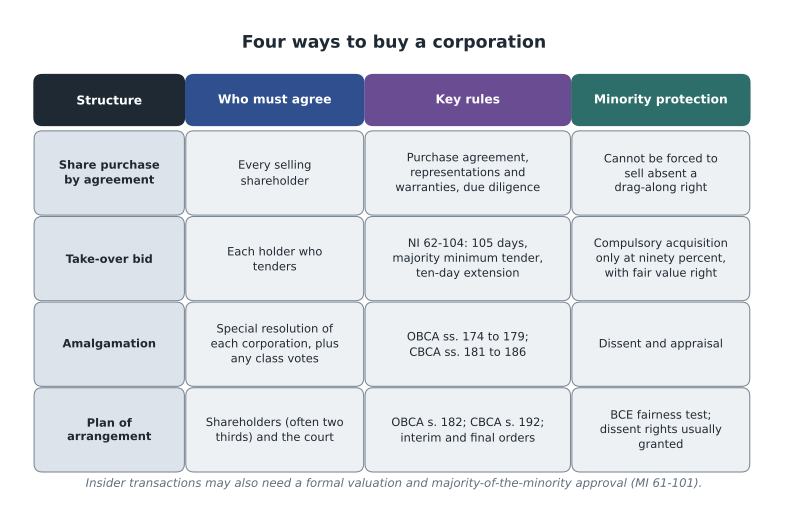
A corporation can be acquired in several ways, each with different consents and protections. The buyer may buy the corporation's assets, buy its shares, or combine with it by amalgamation or arrangement. An asset purchase, if it involves all or substantially all of the seller corporation's property outside the ordinary course of business, requires a special resolution of the seller's shareholders and gives dissent rights, as lesson 9 explained (OBCA section 184(3) and section 185). A share purchase transfers ownership of the corporation itself, with all its liabilities, and needs each selling shareholder to agree. Amalgamations and arrangements are statutory procedures that bind all shareholders if the required majorities approve.
Share purchases and private agreements
For a private company like Lakeshore, the simplest route is a share purchase agreement signed by every shareholder. The agreement sets the price and any adjustments, and the sellers give representations and warranties about the company, backed by indemnities, escrows or holdbacks, and increasingly by representations and warranties insurance. The buyer carries out due diligence, the investigation that Lakeshore so conspicuously failed to do when it bought Tamarack. The problem for Norland is that a share purchase requires every seller to sign. Simon and Raj could each refuse. Many private companies address this in advance with a shareholder agreement containing a drag-along right, which lets holders of a specified majority require the others to sell on the same terms, and a tag-along right, which lets minority holders join a sale by the majority. Lakeshore has no shareholder agreement, so neither exists.
Take-over bids
For a public target, a buyer can make a take-over bid: an offer to acquire outstanding voting or equity securities that would bring the bidder's holdings to twenty percent or more of the class. Take-over bids are governed in all provinces by National Instrument 62-104 Take-Over Bids and Issuer Bids, together with the provincial statutes. The bid must be made to all holders of the class in the local jurisdiction, on identical terms, with a bid circular containing prescribed information, and the target's board must issue a directors' circular with its recommendation. Since amendments effective May 9, 2016, a bid must remain open for at least 105 days, unless the target board agrees to a shorter period of not less than thirty-five days or an alternative transaction triggers a shorter period; must be subject to a mandatory minimum tender condition requiring that more than fifty percent of the securities held by persons other than the bidder and its joint actors be deposited; and, once that condition is met, must be extended for at least ten days so remaining holders can tender. If the bid reaches ninety percent, the bidder may compulsorily acquire the rest under the corporate statute (CBCA section 206; OBCA section 188). Exemptions exist for bids for non-reporting issuers with few shareholders and for private agreements with a small number of sellers.
Defensive tactics are policed by securities regulators under National Policy 62-202, which says that regulators may intervene against tactics that are abusive of shareholders, such as shareholder rights plans (poison pills) kept in place only to block a bid. Since the 2016 amendments gave target boards 105 days to respond, regulators have rarely let pills stand longer. Canadian corporate law, unlike Delaware's Revlon doctrine, does not impose a special duty on directors to maximize the sale price once a company is for sale. In BCE, the Supreme Court held that the duty remains to act in the best interests of the corporation, treating affected stakeholders fairly, although in practice a board recommending a sale will seek the best value reasonably available and a fairness opinion.
Transactions involving insiders get extra protection under Multilateral Instrument 61-101, adopted in Ontario and Quebec and followed by some other provinces. For insider bids, issuer bids, business combinations that squeeze out minority holders, and some related party transactions, MI 61-101 generally requires a formal valuation by an independent valuator and approval by a majority of the minority, excluding votes of interested parties, subject to exemptions.
Amalgamation
An amalgamation combines two or more corporations into one, which continues the property, rights, liabilities and obligations of each (OBCA section 179; CBCA section 186). Corporations under the same statute may amalgamate. In a long-form amalgamation, the corporations enter an amalgamation agreement, which must be approved by a special resolution of the shareholders of each corporation, with a separate class vote where the agreement would affect a class in a way that would trigger one on an amendment of the articles (OBCA sections 175 and 176; CBCA sections 182 and 183). Dissenting shareholders may demand fair value. In a short-form amalgamation, a holding corporation and its wholly owned subsidiary, or two wholly owned subsidiaries of the same parent, may amalgamate by directors' resolutions alone (OBCA section 177; CBCA section 184), because no outside shareholders are affected.
Amalgamation is often used to complete an acquisition after a bid, and in a 'three-cornered' amalgamation the buyer forms a subsidiary that amalgamates with the target, the target's shareholders receiving cash or buyer shares. Since Norland is a CBCA corporation and Lakeshore an OBCA corporation, they cannot amalgamate directly unless one first continues under the other's statute; Norland would likely form an Ontario subsidiary for the purpose. An amalgamation of Lakeshore with Norland's subsidiary would require a special resolution of Lakeshore's Class A shareholders, which Margot and Claire together could pass with 75 percent of the votes, and a separate class vote of the Class B holders if their shares were affected, which Raj alone could block.
Plans of arrangement
The most flexible acquisition tool is the plan of arrangement, a court-supervised procedure under OBCA section 182 and CBCA section 192. An arrangement can include almost any reorganization: an exchange of securities for cash or other securities, an amalgamation, a transfer of property, a change in share capital, or a combination of these in a single transaction. Most large Canadian public company acquisitions are done this way, because the process can be tailored and the court order provides certainty.
The process has two court stages. First, the corporation applies for an interim order, which sets the procedure for the shareholder meeting: who votes, in what classes, by what majority (usually two thirds of votes cast), what information must be sent, and whether dissent rights apply. Under the CBCA, a corporation may use section 192 only if it is not insolvent and the arrangement is not practicable under another provision. After the shareholders approve, the corporation seeks a final order. The court must be satisfied that the arrangement is fair and reasonable.
In BCE, the Supreme Court set out the test for the final order. The corporation must show that the statutory procedures have been complied with, that the application has been put forward in good faith, and that the arrangement is fair and reasonable. Fairness and reasonableness have two parts: the arrangement must have a valid business purpose, and it must resolve the objections of those whose legal rights are being arranged in a fair and balanced way. The court considers factors such as the necessity of the arrangement for the corporation's continued operations, the approval of the shareholder vote, the proportionality of the impact on affected groups, the access of shareholders to dissent and appraisal remedies, and the presence of a fairness opinion or special committee review. Only security holders whose legal rights are being arranged are normally entitled to vote; in BCE, the debentureholders' legal rights were not being changed, only their economic interests, so they were not entitled to vote, and the Court approved the arrangement. The buyout itself later failed for other reasons: it did not close because a required solvency opinion could not be delivered.
For Norland, an arrangement may be the best way to acquire Lakeshore if Simon or Raj will not sell. The interim order would set separate votes for Class A and Class B holders; the court would ask whether the arrangement treats each class fairly; and dissent rights would let Simon and Raj be paid fair value if they objected. Raj's power to block a class vote would still matter, but a court might in some circumstances approve an arrangement on terms reasonable to the class.
Competition and foreign investment approvals
Large acquisitions also require regulatory clearance. Under the Competition Act, transactions exceeding prescribed size thresholds must be notified to the Commissioner of Competition before closing, and the Competition Tribunal may block or remedy mergers that prevent or lessen competition substantially. The Act was significantly amended in 2023 and 2024. The efficiencies defence, which had allowed anti-competitive mergers to proceed if efficiency gains outweighed harm, was repealed in December 2023. Amendments in force on June 20, 2024 created a rebuttable presumption that a merger substantially lessens competition if it results in a combined market share above thirty percent, or significantly increases concentration, and extended the period in which the Commissioner may challenge a non-notified merger from one year to three years after closing. The Investment Canada Act separately requires review of certain acquisitions of control of Canadian businesses by non-Canadians, under a net benefit test and a national security review. Norland is Canadian, so the Investment Canada Act would not apply, and the acquisition of a regional furniture maker is unlikely to raise competition concerns, but in a larger deal these approvals shape the timetable.
Directors' duties in a sale
Every topic in the course returns at this point. Lakeshore's directors must act in Lakeshore's best interests as a good corporate citizen, considering shareholders, employees and other stakeholders (BCE; CBCA section 122(1.1) by analogy). They must follow a reasonable process to earn business judgment deference: obtain advice, perhaps a valuation, consider alternatives such as other buyers or no sale, and record their reasoning (Maple Leaf Foods; UPM-Kymmene). Claire has a conflict, as a partner in a business that licenses designs to Norland, and must disclose it and abstain (OBCA section 132). Margot may have a conflict if Norland offers her an employment or consulting arrangement after the sale, which must also be disclosed. And if the transaction is structured to squeeze out Simon at an unfair price, the oppression remedy, dissent rights and the court's fairness review under BCE are all available to him.
Worked problem
Structuring Norland's offer for Lakeshore
In the hypothetical, Norland Home Corp., a CBCA corporation listed on the TSX, proposes in November 2026 to acquire all of Lakeshore's shares for cash and Norland shares. Margot (55 percent) and Claire (20 percent) want to accept. Simon (15 percent, Class A) is hostile. Raj (10 percent, Class B non-voting) is undecided. Advise on structure and on the immediate securities law issues.
Show solution
- Share purchase: a private agreement requires every seller to sign; with no shareholder agreement and no drag-along right, Simon or Raj can refuse.
- Take-over bid: Lakeshore is not a reporting issuer and has few shareholders, so the bid rules may be avoided by exemption, but a bid still cannot force Simon or Raj to sell unless ninety percent tender and compulsory acquisition applies.
- Amalgamation: a three-cornered amalgamation with an Ontario subsidiary of Norland requires a Lakeshore special resolution, which Margot and Claire can pass, but Raj may have a class vote if his shares are affected; dissenters may demand fair value.
- Plan of arrangement: under OBCA section 182, an interim order would set class votes and dissent rights, and the final order requires the BCE showing of compliance, good faith and a fair and reasonable arrangement with a valid business purpose.
- Securities law: Norland's issue of shares to Lakeshore's shareholders needs a prospectus exemption, such as the NI 45-106 exemption for securities issued in a statutory amalgamation or arrangement.
- Disclosure and insider trading: Norland must consider whether a signed deal is a material change requiring a news release; Claire's comment to Rohan and his purchase of Norland shares raise tipping and insider trading issues under section 76 of the Securities Act (Ontario).
- Duties: Lakeshore's directors need a reasonable process (advice, valuation, alternatives), Claire must disclose and abstain, and the terms must not be oppressive to Simon or Raj.
Common mistakes
MistakeSaying Canada has a national securities regulator.
InsteadSecurities regulation is provincial; the 2011 Reference rejected a comprehensive federal act, and the cooperative system upheld in 2018 has not been fully implemented.
MistakeTreating every material fact as requiring immediate disclosure by a reporting issuer.
InsteadTimely disclosure is required for material changes in the business, operations or capital; Kerr v. Danier Leather distinguishes material facts.
MistakeThinking only directors and officers can commit insider trading.
InsteadSection 76(5) includes those doing business with the issuer and tippees who learn from someone they know is in a special relationship.
MistakeApplying a Revlon-style duty to maximize price once a Canadian company is for sale.
InsteadBCE holds the duty remains to the corporation, treating stakeholders fairly, although boards normally seek the best value reasonably available.
MistakeStating that take-over bids in Canada stay open for thirty-five days.
InsteadSince 2016, bids must stay open for 105 days unless the target board agrees to shorten it to no less than thirty-five, with a mandatory majority minimum tender.
Practice problems
Work each problem on paper first, then reveal the answer to check.
What did Reference re Pan-Canadian Securities Regulation (2018) decide?
Show answer
That a cooperative scheme of uniform provincial laws and a federal Capital Markets Stability Act limited to systemic risk was constitutional and did not fetter legislatures.
What is the prospectus requirement?
Show answer
No one may distribute securities without a filed and receipted prospectus unless an exemption, for example under NI 45-106, applies.
What is the difference between a material fact and a material change?
Show answer
A material change is a change in the issuer's business, operations or capital that would reasonably be expected to significantly affect the market price; a material fact is any fact with that expected effect.
State the three main features of Canada's take-over bid regime since 2016.
Show answer
A 105-day minimum deposit period (reducible to thirty-five days), a mandatory minimum tender of more than fifty percent of securities not held by the bidder, and a mandatory ten-day extension once that condition is met.
What must a corporation show to obtain a final order approving a plan of arrangement under BCE?
Show answer
Compliance with the statutory procedures, good faith, and that the arrangement is fair and reasonable, with a valid business purpose and objections resolved in a fair and balanced way.
What changes to merger review took effect on June 20, 2024?
Show answer
A presumption of substantial lessening of competition above a thirty percent combined share, and a three-year period to challenge non-notified mergers; the efficiencies defence had been repealed in December 2023.
Summary and key terms
- Securities regulation is provincial, coordinated through the Canadian Securities Administrators; the 2011 Reference rejected a comprehensive federal act, and the 2018 Reference upheld a cooperative scheme.
- Distributions require a prospectus unless an exemption applies, commonly under NI 45-106 (private issuer, accredited investor, business combinations).
- Reporting issuers must make continuous disclosure and immediately disclose material changes (Kerr v. Danier Leather); investors have a statutory secondary market action with a leave requirement (Theratechnologies).
- Insider trading and tipping by persons in a special relationship, including tippees, are prohibited.
- Corporations can be acquired by share purchase, take-over bid, amalgamation or plan of arrangement, each with different approval and protection mechanisms.
- Take-over bids since 2016 require a 105-day period, a majority minimum tender and a ten-day extension; MI 61-101 protects minorities in insider transactions.
- Plans of arrangement need shareholder approval and a court finding of fairness and reasonableness under BCE.
- Competition Act amendments in 2023 and 2024 repealed the efficiencies defence, created a thirty percent market share presumption and extended the challenge period for non-notified mergers to three years.
- Prospectus
- A disclosure document providing full, true and plain disclosure of all material facts about securities being distributed.
- Reporting issuer
- An issuer subject to continuous disclosure obligations, typically because it has filed a prospectus or is listed.
- Material change
- A change in an issuer's business, operations or capital reasonably expected to significantly affect the market price of its securities.
- Tipping
- Informing another person of undisclosed material information other than in the necessary course of business.
- Take-over bid
- An offer to acquire voting or equity securities that would bring the bidder to twenty percent or more of a class.
- Plan of arrangement
- A court-approved corporate reorganization or acquisition under OBCA section 182 or CBCA section 192.
- Drag-along right
- A shareholder agreement right letting a majority require minority holders to sell on the same terms.
- Majority of the minority
- Approval by shareholders other than interested parties, required by MI 61-101 for certain insider transactions.
Lesson quiz · 5 questions
Score 60% or more to complete this lesson.
Create a free account to save your progress, take quizzes and earn a certificate.