
LAWC-204 · Lesson 10 of 12 · 30 min
Oppression remedy
▶ Video coming soon A video version of this lesson is on the way.
In the hypothetical, on November 16, 2026, a week after Simon Bellamy withdrew his consent to Lakeshore's audit exemption and asked for a special meeting about the Tamarack purchase, Margot Bellamy dismisses him as Lakeshore's sales manager, a job he has held for eleven years. That evening she emails the shareholders to say that Simon will not be nominated for re-election to the board, and that Lakeshore will pay no dividend this year 'given the costs of the Tamarack situation'. Lakeshore has paid a dividend every December since 2010, and the family has always treated it as part of each member's income. The same week, the board approves a 300,000 dollar bonus for Margot, with Claire voting in favour. Simon comes to Professor Okwuosa's office with a printout of the email. 'Can she do this?' he asks. 'Each step,' says Okwuosa, 'is probably within her legal powers. The question the oppression remedy asks is whether the steps, taken together, are fair.'
Corporate law gives the majority wide power, and the last lesson showed how little a minority shareholder can do to override it. The oppression remedy is the counterweight. It lets a court look beyond the formal legality of corporate acts and ask whether they have defeated the reasonable expectations of shareholders, creditors, directors or officers. It is the broadest shareholder remedy in the common law world, and Canadian courts use it constantly. Alongside it sits the derivative action, which lets a complainant sue, with leave, to enforce the corporation's own rights.
The statutory remedy
Section 248(2) of the OBCA and section 241(2) of the CBCA provide that where, on an application by a complainant, the court is satisfied that, in respect of a corporation or any of its affiliates, any act or omission of the corporation effects a result, the business or affairs of the corporation are carried on or conducted in a manner, or the powers of the directors are exercised in a manner, that is oppressive or unfairly prejudicial to, or that unfairly disregards the interests of, any security holder, creditor, director or officer, the court may make an order to rectify the matters complained of. The OBCA adds that the remedy may be sought for threatened conduct as well.
A 'complainant' is defined broadly (OBCA section 245; CBCA section 238). It includes a registered holder or beneficial owner, or a former one, of a security of the corporation or its affiliates; a director or officer, or a former one; the Director appointed under the Act, in the CBCA; and any other person who, in the discretion of the court, is a proper person to make the application. That last category has allowed creditors, employees and others to apply where their interests are affected, though courts do not let it become a means of turning every contract claim into an oppression case.
The words 'oppressive', 'unfairly prejudicial' and 'unfairly disregards' describe a range. Oppression in the narrow sense suggests conduct that is burdensome, harsh and wrongful, often involving bad faith. Unfair prejudice is less culpable: it covers conduct that has an unfair, detrimental effect on the claimant's interests, such as squeezing out a minority or preferring some shareholders. Unfair disregard is the least culpable: it covers ignoring an interest as being of no importance. No bad faith or intent to harm is required. The remedy turns on the effect of the conduct, judged against what the claimant was reasonably entitled to expect.
BCE: reasonable expectations
In BCE Inc. v. 1976 Debentureholders, 2008 SCC 69, the Supreme Court of Canada set out the framework now used across Canada. Holders of debentures issued by Bell Canada, BCE's subsidiary, objected to the leveraged buyout described in lesson 6, which would add enormous debt to Bell Canada and cause the market value of their debentures to fall, although the debentures would still be paid in full. They argued that the transaction was oppressive.
The Court held that the oppression remedy asks two questions. First, does the evidence support the reasonable expectation the claimant asserts? Second, does the evidence establish that the reasonable expectation was violated by conduct falling within the terms 'oppression', 'unfair prejudice' or 'unfair disregard' of a relevant interest? Reasonable expectations are judged objectively; the question is not what the claimant subjectively hoped for, but what they could reasonably have expected in the circumstances. The Court listed factors that help determine whether an expectation is reasonable: general commercial practice; the nature of the corporation; the relationship between the parties; past practice; steps the claimant could have taken to protect itself; representations and agreements; and the fair resolution of conflicting interests between corporate stakeholders.
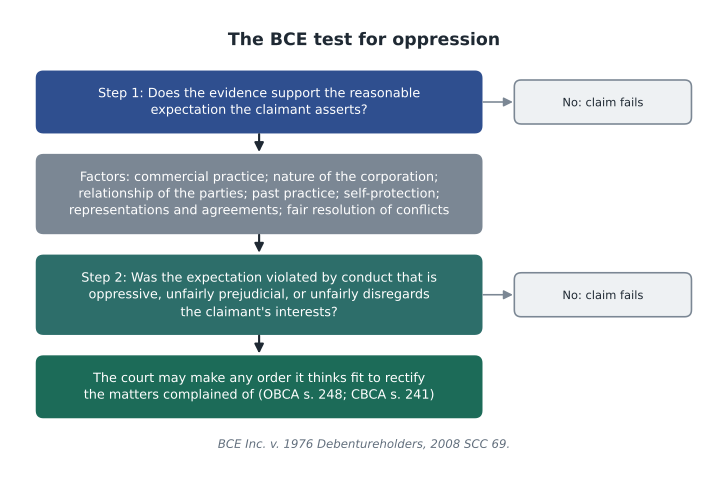
The debentureholders failed. Their reasonable expectation was that BCE's directors would consider their interests, which they had done; there was no reasonable expectation that the directors would protect the market value of the debentures, which was not a contractual right, especially since sophisticated investors could have negotiated covenants against a change of control or increased leverage and had not done so. The Court also confirmed that directors may need to choose between competing stakeholder interests, and that they discharge their duty if they resolve the conflict fairly, in the best interests of the corporation as a good corporate citizen. Where the board's decision falls within a range of reasonable choices, the court will not find oppression simply because one group's interests were preferred.
Closely held corporations
The oppression remedy is used most often in small, closely held corporations, especially family businesses and companies formed by a few individuals who expect to work in the business. There, shareholders' reasonable expectations often go well beyond the strict terms of the articles. Courts recognize that a shareholder in such a company may reasonably expect to participate in management, to be employed, to receive a share of the profits through salary or dividends, and to be consulted about important decisions, because that is the understanding on which they invested or remained.
In Ferguson v. Imax Systems Corp. (1983), 43 O.R. (2d) 128 (C.A.), a founder's former wife, who had helped build the company and held shares in it, was subjected to a series of steps by her ex-husband and his associates designed to force her out, including a proposed reorganization to eliminate her shares. The Ontario Court of Appeal held the conduct oppressive. The court emphasized that, in a closely held company, the history and the relationship between the parties are central to what each can fairly expect.
Courts are also careful about the scope of the remedy. In Naneff v. Con-Crete Holdings Ltd. (1995), 23 O.R. (3d) 481 (C.A.), a son was excluded from a family business after a family quarrel. The trial judge found oppression and ordered the parents and other family members to sell the business on the open market. The Court of Appeal upheld the finding of oppression but changed the remedy. The son's reasonable expectation was to be treated fairly as a shareholder, not to inherit control of the business; the appropriate order was for the majority to buy out his shares at fair value. The case states a principle that all later courts follow: the oppression remedy is meant to rectify the oppression, not to give the claimant more than they could reasonably have expected.
Simon's case
Okwuosa works through Simon's claim with the class using the BCE framework. What could Simon reasonably expect? Several factors point in his favour: Lakeshore is a family company; Simon received his shares from his grandfather; he has worked in the business for eleven years and sat on the board; the company has paid an annual dividend for sixteen years, which the family treated as income; and there is no shareholder agreement saying otherwise. Simon could plausibly assert expectations that he would be treated fairly as a shareholder, that profits would continue to be shared in the established way unless there were genuine business reasons, and that he would not be punished for exercising his statutory rights as a shareholder.
Were those expectations violated by conduct that was oppressive, unfairly prejudicial or unfairly disregarded his interests? Taken separately, Margot's acts are within her powers: an employer may dismiss an employee, subject to employment law; the majority may decline to renominate a director; and directors have discretion over dividends. But the timing, a week after Simon invoked his shareholder rights, the stopping of a long-established dividend while the board approved a large bonus for the majority shareholder, and the exclusion from both management and the board together tell a story of a minority being frozen out. Ontario courts have repeatedly treated that pattern as unfairly prejudicial. Margot will argue that Tamarack's losses justified suspending the dividend, and that the bonus reflected her work. A court would weigh those explanations against the evidence, including Lakeshore's actual financial position.
Remedies
The court may make any interim or final order it thinks fit (OBCA section 248(3); CBCA section 241(3)). The statutes give a long, non-exhaustive list: an order restraining the conduct complained of; appointing a receiver or receiver-manager; regulating the corporation's affairs by amending the articles or by-laws or creating or amending a unanimous shareholder agreement; directing an issue or exchange of securities; appointing directors in place of or in addition to existing ones; directing the corporation or any other person to purchase a security holder's securities; directing the corporation or any other person to pay a security holder any part of the money paid for securities; varying or setting aside a transaction or contract and compensating any party; requiring financial statements or an accounting; compensating an aggrieved person; directing rectification of the corporation's records; winding up the corporation; and directing an investigation.
In closely held companies, the most common final remedy is a buyout: the court orders the majority or the corporation to buy the claimant's shares at fair value, determined as of a date the court chooses. Courts usually value the shares without a minority discount, because the claimant is being compensated for being forced out, not selling in the market. In Simon's case, a court might order Lakeshore or Margot to buy his 15 percent at fair value, perhaps as of a date before the oppressive conduct began, or, if the business relationship can be repaired, might order the dividend restored and Simon given a seat on the board.
Personal liability of directors: Wilson v. Alharayeri
Can a court make an oppression order against directors personally, rather than the corporation? In Wilson v. Alharayeri, 2017 SCC 39, the Supreme Court said yes, in appropriate cases. Alharayeri held convertible preferred shares in a Canadian public company, Wavefront Technology Solutions Inc. The conversion of his shares into common shares depended on the company meeting financial targets, but the board, on the recommendation of a committee chaired by Wilson, did not approve the conversion of his shares, while other convertible shares were converted before a private placement that benefited some directors. The Quebec Superior Court found oppression and held two of the directors, Wilson among them, personally and solidarily liable to compensate Alharayeri; the Court of Appeal of Quebec upheld the decision.
The Supreme Court upheld the order and set out a two-pronged approach, drawing on the Ontario Court of Appeal's decision in Budd v. Gentra Inc. (1998), 43 B.L.R. (2d) 27. First, the oppressive conduct must be properly attributable to the director because of their implication in it; the director must have exercised, or failed to exercise, their powers so as to effect the oppressive result. Personal benefit or bad faith is not required, though either strongly supports an order. Second, the imposition of personal liability must be fit in all the circumstances. The Court described four general principles for that second prong: the order must be a fit remedy to rectify the oppression; it should go no further than necessary to rectify it; it should vindicate the reasonable expectations of the security holders, creditors, directors or officers affected; and a personal order should not be a substitute for other statutory or common law relief that would be more fitting, keeping in mind the general principles of corporate law such as separate legal personality. Personal benefit, increased control and bad faith are indicators that a personal order may be fit, but none is required. In Wilson, the two directors held liable had played leading roles in the board's decisions and had benefited from the private placement.
For Simon, Wilson means the court could order Margot personally to compensate him, for example for the lost dividend, if it found her implicated in the oppressive conduct and an order against her was fit. Since she controls the company and directed the conduct, and since she arguably benefited through the bonus, the first prong would likely be satisfied. The court would then ask whether an order against her rather than Lakeshore best rectifies the oppression, keeping in mind that a payment by Lakeshore would also come partly from Simon's own share of the company's value.
Creditors as complainants
Creditors may apply as proper persons, but courts are cautious. A creditor who is simply unpaid on a contract normally sues for the debt. The oppression remedy is available where the conduct goes further, for example where directors cause the corporation to strip itself of assets, prefer themselves or related parties, or otherwise act in a way that defeats the creditor's reasonable expectations. In Sidaplex-Plastic Suppliers Inc. v. Elta Group Inc. (1998), 40 O.R. (3d) 563 (C.A.), a director who caused an insolvent company to pay debts personally guaranteed by him, ahead of a trade creditor, was ordered to compensate that creditor. BCE confirms that creditors' expectations are assessed by the same objective framework, including the steps the creditor could have taken to protect itself by contract.
The derivative action
The derivative action addresses a different problem. When a wrong is done to the corporation, such as a director diverting a corporate opportunity or acting carelessly, the corporation is the proper plaintiff (Foss v. Harbottle; Hercules Managements). But the people who control the corporation may be the wrongdoers, or friendly to them, and will not cause it to sue. Section 246 of the OBCA and section 239 of the CBCA let a complainant apply to the court for leave to bring an action in the name and on behalf of the corporation, or to intervene in an action to which the corporation is a party.
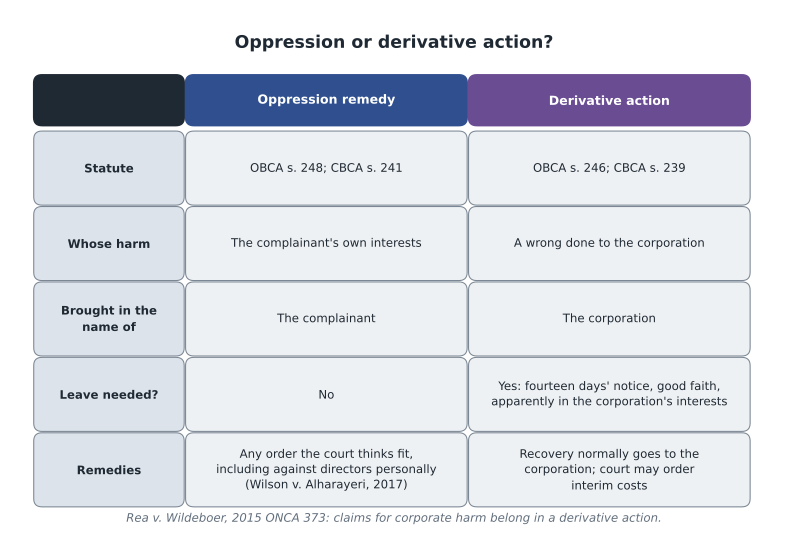
The court may grant leave if it is satisfied that the complainant has given fourteen days' notice to the directors of their intention to apply if the directors do not bring, diligently prosecute or defend the action, or discontinue it; that the complainant is acting in good faith; and that it appears to be in the interests of the corporation that the action be brought, prosecuted, defended or discontinued (OBCA section 246(2); CBCA section 239(2)). The court may dispense with the notice in some circumstances. At the leave stage, the court does not try the merits; it asks whether there is a reasonable or arguable case and whether, considering costs, likely recovery and the corporation's situation, the action appears to be in the corporation's interests. Good faith is presumed absent evidence that the complainant is pursuing a personal vendetta or an ulterior purpose.
Once leave is granted, the court may make any order it thinks fit, including authorizing the complainant to control the conduct of the action, directing the defendant to pay amounts recovered to former and present security holders instead of the corporation, and requiring the corporation to pay the complainant's reasonable legal fees, including interim costs (OBCA section 247; CBCA section 240). An action brought with leave may not be stayed or dismissed merely because the breach of a right or duty has been, or may be, approved by the shareholders, although the court may take that approval into account, and it cannot be discontinued, settled or dismissed without court approval (OBCA section 249; CBCA section 242).
Choosing the route
Because the oppression remedy is so flexible, complainants sometimes use it to pursue what are really wrongs to the corporation, avoiding the leave requirement. Ontario courts have pushed back. In Rea v. Wildeboer, 2015 ONCA 373, the Court of Appeal held that a claim that is in substance about harm to the corporation, where the complainant suffers no harm separate and distinct from that of other shareholders, should be brought as a derivative action, not as an oppression application, unless the complainant has a particular, individual interest that was harmed. Courts will allow both kinds of claims in one proceeding where appropriate, but the distinction matters for who controls the claim, who receives any recovery and whether leave is needed.
For Simon, the dismissal, the end of the dividend and his exclusion from the board affect him personally and fit the oppression remedy. Claire's diversion of the Norland licence and the board's careless approval of the Tamarack purchase are wrongs to Lakeshore: the claims belong to Lakeshore, and any recovery would go to it. If the board will not pursue them, Simon could give fourteen days' notice and apply for leave to bring a derivative action against Claire, and possibly against the directors who approved the Tamarack purchase. Oppression claims seeking monetary relief are also subject to the general two-year limitation period under Ontario's Limitations Act, 2002, so Simon should not wait.
Worked problem
Advising Simon after November 16, 2026
In the hypothetical, Simon Bellamy, who holds 15 percent of Lakeshore's shares, was dismissed as sales manager on November 16, 2026, told he would not be renominated as a director, and informed that the long-standing December dividend would not be paid, while the board approved a large bonus for Margot. Simon also believes Claire diverted the Norland licence from Lakeshore and that the Tamarack purchase was approved without care. Outline his remedies.
Show solution
- Characterize the harms: the dismissal, the dividend and the exclusion from the board affect Simon personally; the Norland licence and the Tamarack purchase are wrongs to Lakeshore.
- Oppression, step one (BCE): identify reasonable expectations based on the family nature of the company, his long role in management, sixteen years of dividends, and the absence of any agreement to the contrary.
- Oppression, step two: show that the expectations were defeated by conduct that was unfairly prejudicial or unfairly disregarded his interests, emphasizing the timing after he exercised his rights and the bonus paid while dividends stopped.
- Remedy: seek a buyout of his shares at fair value without a minority discount (Naneff), or restoration of the dividend and a board seat; consider an order against Margot personally under Wilson v. Alharayeri.
- Derivative action: give the directors fourteen days' notice, then apply under OBCA section 246 for leave to sue Claire for the Norland profits, showing good faith and that the action appears to be in Lakeshore's interests.
- Procedure and timing: bring the oppression application promptly, within the two-year limitation period, and ask for production of board minutes and the Tamarack file; the employment claim for wrongful dismissal is a separate action.
Common mistakes
MistakeRequiring proof of bad faith for an oppression remedy.
InsteadThe remedy turns on the effect of the conduct on reasonable expectations; unfair prejudice and unfair disregard do not require bad faith.
MistakeTreating the claimant's subjective hopes as reasonable expectations.
InsteadBCE judges reasonable expectations objectively, using factors such as past practice, the relationship between the parties and self-protection.
MistakeSaying directors can never be personally liable under the oppression remedy.
InsteadWilson v. Alharayeri allows personal orders where the conduct is attributable to the director and a personal order is fit.
MistakeUsing an oppression application for a wrong done only to the corporation.
InsteadRea v. Wildeboer requires a derivative action, with leave, where the complainant suffers no separate and distinct harm.
MistakeAssuming a derivative action can be brought without the court's permission.
InsteadLeave is required after fourteen days' notice to the directors, with good faith and a finding that the action appears to be in the corporation's interests.
Practice problems
Work each problem on paper first, then reveal the answer to check.
What are the two steps of the BCE test for oppression?
Show answer
First, whether the evidence supports the reasonable expectation asserted; second, whether that expectation was violated by conduct that is oppressive, unfairly prejudicial or that unfairly disregards a relevant interest.
Name four of the factors BCE identified for assessing reasonable expectations.
Show answer
Any four of: commercial practice, nature of the corporation, relationship between the parties, past practice, steps the claimant could have taken to protect itself, representations and agreements, and fair resolution of conflicting stakeholder interests.
What principle about remedies did Naneff v. Con-Crete Holdings establish?
Show answer
The order should rectify the oppression and go no further; the claimant should not receive more than their reasonable expectations, so a buyout rather than a forced sale was ordered.
State the two prongs of Wilson v. Alharayeri.
Show answer
The oppressive conduct must be properly attributable to the director because of their implication in it, and personal liability must be fit in all the circumstances.
What must a complainant show to obtain leave to bring a derivative action under OBCA section 246?
Show answer
That fourteen days' notice was given to the directors, that the complainant is acting in good faith, and that the action appears to be in the corporation's interests.
Why did the debentureholders lose in BCE?
Show answer
They had no reasonable expectation that the market value of their debentures would be protected; the directors had considered their interests, and they could have bargained for protective covenants.
Summary and key terms
- The oppression remedy (OBCA section 248; CBCA section 241) lets a court rectify conduct that is oppressive, unfairly prejudicial or that unfairly disregards the interests of security holders, creditors, directors or officers.
- Complainants include current and former security holders, directors and officers, and other proper persons, which can include creditors.
- Under BCE (2008), the court asks whether a reasonable expectation is supported by the evidence and whether it was violated by conduct within the statutory terms.
- Family and closely held corporations generate broad expectations, but remedies must only rectify the oppression (Ferguson v. Imax; Naneff).
- The court may make any order it thinks fit, commonly a buyout at fair value without a minority discount.
- Wilson v. Alharayeri (2017) permits personal orders against directors where the conduct is attributable to them and the order is fit.
- The derivative action (OBCA section 246; CBCA section 239) lets a complainant sue for the corporation with leave, after fourteen days' notice, in good faith and in the corporation's interests.
- Wrongs to the corporation belong in a derivative action, not an oppression claim, absent separate and distinct harm (Rea v. Wildeboer).
- Oppression remedy
- A statutory remedy for corporate conduct that is oppressive, unfairly prejudicial or unfairly disregards a stakeholder's interests.
- Complainant
- A person entitled to apply for an oppression remedy or leave for a derivative action.
- Reasonable expectations
- What a stakeholder could objectively expect of the corporation, given the relationship and circumstances.
- Unfair prejudice
- Conduct with an unfair, detrimental effect on a stakeholder's interests, without need for bad faith.
- Unfair disregard
- Ignoring a stakeholder's interests as if they were of no importance.
- Derivative action
- An action brought by a complainant, with leave, in the name and on behalf of the corporation.
- Freeze-out
- Conduct by a majority excluding a minority from management, income or information in a closely held corporation.
Lesson quiz · 5 questions
Score 60% or more to complete this lesson.
Create a free account to save your progress, take quizzes and earn a certificate.