
LAWC-204 · Lesson 6 of 12 · 21 min
Directors' duties
▶ Video coming soon A video version of this lesson is on the way.
In October 2026, in the hypothetical, Norland Home, a national furniture retailer, invites Lakeshore to license six of its dining table designs for a new mass-market line. The approach comes to Claire Bellamy, Lakeshore's vice-president of design and a director, because she designed four of the tables. Claire is also president of Lakeshore Direct Inc., the online venture she started with Rohan Iyer. Two weeks later, the board learns that Norland has signed the licence with Lakeshore Direct, not Lakeshore. Claire says the designs were hers, that Lakeshore makes heavy hardwood furniture and would never sell through a big-box chain, and that she told her mother about it at dinner. Margot is furious. Simon, Claire's brother, says quietly that he wants to know who else on the board has side deals. 'Welcome,' says Okwuosa, 'to the most litigated question in corporate law: what do directors owe, and to whom?'
Directors have broad power to manage the corporation. The law balances that power with two core duties set out in section 122(1) of the CBCA and section 134(1) of the OBCA. Every director and officer, in exercising their powers and discharging their duties, must act honestly and in good faith with a view to the best interests of the corporation, which is the fiduciary duty, and must exercise the care, diligence and skill that a reasonably prudent person would exercise in comparable circumstances, which is the duty of care. This lesson covers the fiduciary duty. Lesson 7 covers the duty of care and the business judgment rule.
The nature of the fiduciary duty
A fiduciary is a person who has power over the interests of another and is required to use it for that other person's benefit, not their own. Directors and officers are fiduciaries of the corporation. The duty has two aspects. Directors must act in good faith with a view to the corporation's best interests, not for some other purpose. And they must avoid conflicts between their personal interests and their duty to the corporation, and must not profit from their position without the corporation's informed consent. The duty is owed by every director and by officers, including senior employees who are officers. It applies equally to directors nominated by a particular shareholder: a nominee director owes their duty to the corporation, not to the shareholder who nominated them.
Peoples v. Wise: to whom is the duty owed?
The Supreme Court of Canada addressed the content and beneficiary of the duty in Peoples Department Stores Inc. (Trustee of) v. Wise, 2004 SCC 68. Wise Stores, a Quebec retailer controlled by three brothers, had acquired Peoples, a chain of department stores. To fix an inventory system that was not working, the brothers, as directors of both companies, adopted a new procurement policy under which Peoples bought most inventory from North American suppliers and Wise bought it from overseas, with Peoples then extending large amounts of trade credit to Wise. Both companies became bankrupt. Peoples' trustee in bankruptcy sued the brothers, arguing they had breached their fiduciary duty and duty of care to Peoples' creditors.
The Court, in a unanimous judgment by Justices Major and Deschamps, held that the brothers had not breached either duty. On the fiduciary duty, the Court held that the duty is owed to the corporation, and only to the corporation. It does not shift to creditors when a corporation is near insolvency. The best interests of the corporation are not simply the best interests of shareholders or of any one group; in determining them, directors may legitimately look to the interests of shareholders, employees, suppliers, creditors, consumers, governments and the environment. The brothers had acted honestly and in good faith to solve a genuine business problem, so they had not breached the fiduciary duty. The Court noted that creditors who are wronged have other remedies, including the oppression remedy, under which they may apply as 'complainants' at a court's discretion.
BCE: the duty and the reasonable expectations of stakeholders
Four years later, in BCE Inc. v. 1976 Debentureholders, 2008 SCC 69, the Court considered the duty again in the context of the largest leveraged buyout in Canadian history. A group of private equity investors agreed to acquire BCE Inc., the parent of Bell Canada, in a deal valued at about fifty-two billion dollars including debt, financed largely by borrowing that Bell Canada would guarantee. Shareholders would receive a large premium for their shares. But the guarantee would load Bell Canada with debt, causing the market value of its existing debentures to fall by roughly a fifth and their credit rating to drop below investment grade. Debentureholders challenged the plan of arrangement used to carry out the deal, arguing that the directors had breached their duties by ignoring their interests and that the arrangement was oppressive.
The Court, in a unanimous per curiam judgment, upheld the arrangement. It reaffirmed that the fiduciary duty is owed to the corporation, not to any stakeholder. Directors must treat affected stakeholders fairly, commensurate with the corporation's duties as a responsible corporate citizen, and may consider their interests, but there is no rule that one set of interests, such as shareholders' interests, must prevail over others. When interests conflict, directors must resolve the conflict in accordance with their fiduciary duty to act in the best interests of the corporation, viewed as a good corporate citizen. In BCE, the directors had considered the debentureholders' interests and had acted reasonably. The debentureholders' contractual rights were preserved; what they lost was market value, and they had no reasonable expectation that the directors would protect it, especially since the debentures did not include protections against changes of control that sophisticated investors could have bargained for. Lesson 10 returns to BCE's oppression analysis.
The 2019 CBCA amendment
In 2019, Parliament added subsection 122(1.1) to the CBCA, which codifies the approach in Peoples and BCE. When acting with a view to the best interests of the corporation, directors and officers may consider, but are not limited to, the interests of shareholders, employees, retirees and pensioners, creditors, consumers and governments; the environment; and the long-term interests of the corporation. The OBCA has no equivalent provision, but because the common law from Peoples and BCE applies to OBCA corporations too, the practical position in Ontario is similar. The provision is permissive: it lets directors consider these interests; it does not create duties owed to those groups or give them a right to sue.
Conflicts of interest and disclosure
The old equitable rule was strict: a fiduciary could not enter into a transaction in which they had a personal interest unless the beneficiary consented, and any such contract was voidable. Corporate statutes replaced that rule with a disclosure regime. Under section 120 of the CBCA and section 132 of the OBCA, a director or officer who is a party to a material contract or transaction, or proposed one, with the corporation, or who is a director or officer of, or has a material interest in, a party to it, must disclose in writing or have entered in the minutes the nature and extent of the interest. The disclosure must be made at specified times, generally at the first meeting at which the matter is considered or as soon as the director becomes aware of the interest.
A director who must disclose may not vote on any resolution to approve the transaction, subject to narrow exceptions, such as transactions relating primarily to their own remuneration or to indemnity or insurance. If the director has disclosed properly, the directors have approved the transaction, and it was reasonable and fair to the corporation when approved, the contract is not void or voidable, and the director is not accountable for any profit, because of the conflict. Shareholders can also confirm a transaction by special resolution after full disclosure, if it was reasonable and fair. If the rules are not followed, a court may set aside the contract or order the director to account for any profit.
At Lakeshore, the plant on Cobourg Road is leased from a company owned by Margot's husband, Graham Ellery. Margot is therefore interested in the lease, through her spouse, and should disclose that interest whenever the lease is renewed or amended, and should not vote on the renewal. When the board approved the most recent renewal in 2023, the minutes record Margot's disclosure and abstention and a report from independent director Harriet Castonguay that the rent was at market rates. That is what compliance looks like.
Corporate opportunities
A director or officer who takes for themselves a business opportunity that belongs to the corporation breaches the fiduciary duty, even if the corporation suffered no loss and even if the person resigned before taking it. The leading Canadian case is Canadian Aero Service Ltd. v. O'Malley, [1974] S.C.R. 592. O'Malley and Zarzycki, the president and executive vice-president of Canaero, an aerial mapping company, had worked on preparing a bid for a topographical mapping contract in Guyana. They resigned, formed their own company and won the contract. The Supreme Court held them liable to account for their profits. Justice Laskin explained that senior officers who are fiduciaries may not take a 'maturing business opportunity' that the corporation was actively pursuing, and may not resign to take it where their resignation was prompted by a wish to acquire the opportunity or where it was their position that led them to it.
The Court in Canaero rejected a mechanical rule. Relevant factors include the officer's position, the nature of the opportunity and how ripe or specific it was, the officer's relation to it, how the officer learned of it, the amount of time between the resignation and the taking of the opportunity, and the circumstances of the departure. In contrast, in Peso Silver Mines Ltd. v. Cropper, [1966] S.C.R. 673, a mining company's board, acting in good faith and for sound business reasons, rejected an offer of mineral claims. A director then joined others in acquiring the claims for himself. The Supreme Court held he was not liable, because the corporation had considered and rejected the opportunity in good faith, and he had acquired it as a member of the public, not by using information that belonged to the company.
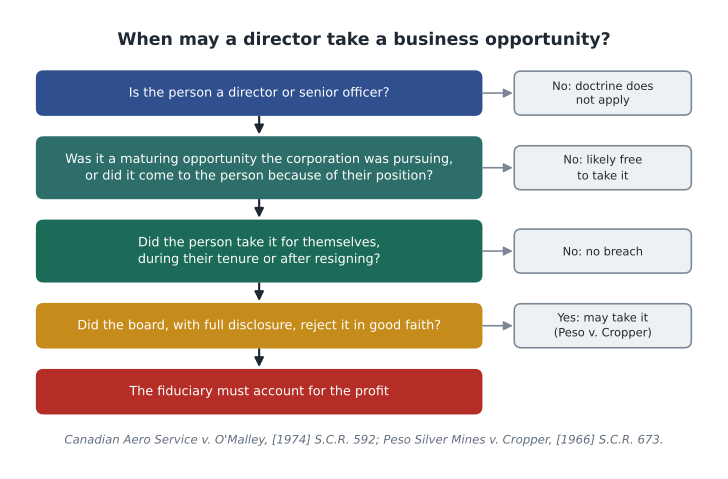
Applying these cases to Claire, the Norland licence came to her because of her position as Lakeshore's vice-president of design and a director. The designs were created while she was employed by Lakeshore, and are likely Lakeshore's intellectual property, as most employee designs belong to the employer. The opportunity was in Lakeshore's line of business, even if Lakeshore had not sold through big-box chains before; that Lakeshore might have declined it is not a defence unless the board actually considered and rejected it with full disclosure. A conversation at a family dinner is not board consideration. Claire is likely in breach, and Lakeshore could ask a court to declare that Lakeshore Direct holds the licence on a constructive trust for Lakeshore or to order Claire and Lakeshore Direct to account for the profits.
Other aspects of the duty
The fiduciary duty also prohibits directors and officers from using the corporation's confidential information for personal benefit, from competing with the corporation in ways that harm it while in office, and from using their powers for an improper purpose, such as issuing shares to entrench themselves in control rather than to raise capital. Departing executives who are fiduciaries remain bound by duties not to solicit the corporation's clients using confidential information, and by any contractual restrictions in their employment agreements. The remedies for breach include an account of profits, damages for losses caused, rescission of transactions, constructive trusts over property obtained in breach, and injunctions. Because the duty is owed to the corporation, the corporation is the proper plaintiff; a shareholder who wants to enforce the duty must usually bring a derivative action with the court's leave, as lesson 10 explains.
Worked problem
Advising the Lakeshore board on the Norland licence
In the hypothetical, Lakeshore's board meets in November 2026 to decide what to do about the Norland licence signed by Lakeshore Direct Inc. Claire Bellamy is a director of Lakeshore and president of Lakeshore Direct. Independent director Harriet Castonguay chairs the discussion.
Show solution
- Conflict: Claire has a material interest in Lakeshore Direct, a party to the matter. Under OBCA s. 132 she must disclose and should not vote; she should leave the meeting for deliberations.
- Opportunity: under Canaero, the licence came to Claire because of her position, involved Lakeshore's designs and was within its line of business. There was no informed board rejection as in Peso, so she is likely accountable.
- Options: the board could (a) claim the licence and profits through a constructive trust or account, (b) negotiate with Lakeshore Direct for a royalty or assignment, or (c) after full disclosure, decide in good faith not to pursue it and approve Lakeshore Direct's use of the designs on fair terms.
- Duty: whatever it chooses, the remaining directors must act in Lakeshore's best interests, considering shareholders (including Simon and Raj), employees and the company's long-term interests; they should obtain independent advice and record their reasoning.
- Next step: put any arrangement with Lakeshore Direct in writing, approved by the disinterested directors, with a fairness assessment.
Common mistakes
MistakeSaying directors owe their fiduciary duty to shareholders.
InsteadUnder Peoples and BCE, the duty is owed to the corporation; shareholders' interests are one of several directors may consider.
MistakeClaiming the duty shifts to creditors when a corporation nears insolvency.
InsteadPeoples rejected that view; creditors' interests may be considered, and creditors can seek the oppression remedy.
MistakeAssuming a director who resigns is free to take an opportunity the company was pursuing.
InsteadCanaero holds that resigning to take a maturing opportunity, or one obtained through the position, is a breach.
MistakeTreating informal family knowledge as the board's consent to a director's side deal.
InsteadConsent requires full disclosure to and approval by the board or shareholders under the statute.
Practice problems
Work each problem on paper first, then reveal the answer to check.
State the fiduciary duty in section 122(1)(a) of the CBCA.
Show answer
To act honestly and in good faith with a view to the best interests of the corporation.
What did BCE say directors must do when stakeholder interests conflict?
Show answer
Resolve the conflict in accordance with their fiduciary duty to act in the best interests of the corporation, viewed as a good corporate citizen, treating affected stakeholders fairly; no group's interests automatically prevail.
What must an interested director do under CBCA s. 120 or OBCA s. 132?
Show answer
Disclose in writing or have entered in the minutes the nature and extent of the interest, and generally not vote on the transaction.
Why was the director in Peso Silver Mines not liable?
Show answer
The board had considered and rejected the opportunity in good faith, and he acquired it later as an outsider, not by misusing the company's information.
Summary and key terms
- Directors and officers must act honestly and in good faith with a view to the best interests of the corporation (CBCA s. 122(1)(a); OBCA s. 134(1)(a)).
- Peoples (2004) held the duty is owed to the corporation alone, not to creditors, though directors may consider many stakeholders.
- BCE (2008) held no stakeholder's interests automatically prevail; directors resolve conflicts in the corporation's best interests as a good corporate citizen.
- CBCA s. 122(1.1), added in 2019, lists interests directors may consider, including employees, pensioners, creditors, consumers, the environment and long-term interests.
- Interested directors must disclose and abstain; properly disclosed, approved, fair transactions stand.
- Under Canaero, fiduciaries may not take maturing corporate opportunities or ones obtained through their position, even after resigning; Peso allows taking opportunities the board rejected in good faith.
- Fiduciary duty
- The duty to act honestly and in good faith in the best interests of the corporation and to avoid conflicts of interest.
- Nominee director
- A director appointed at a shareholder's request, who still owes duties to the corporation.
- Corporate opportunity
- A business opportunity belonging to the corporation that its fiduciaries may not take for themselves.
- Account of profits
- A remedy requiring a fiduciary to pay over profits made in breach of duty.
- Constructive trust
- A remedy declaring that property obtained in breach of duty is held for the person wronged.
- Good corporate citizen
- BCE's description of the corporation whose best interests directors serve, treating stakeholders fairly.
Lesson quiz · 5 questions
Score 60% or more to complete this lesson.
Create a free account to save your progress, take quizzes and earn a certificate.