
LAWC-204 · Lesson 4 of 12 · 21 min
Corporate personality and piercing the veil
▶ Video coming soon A video version of this lesson is on the way.
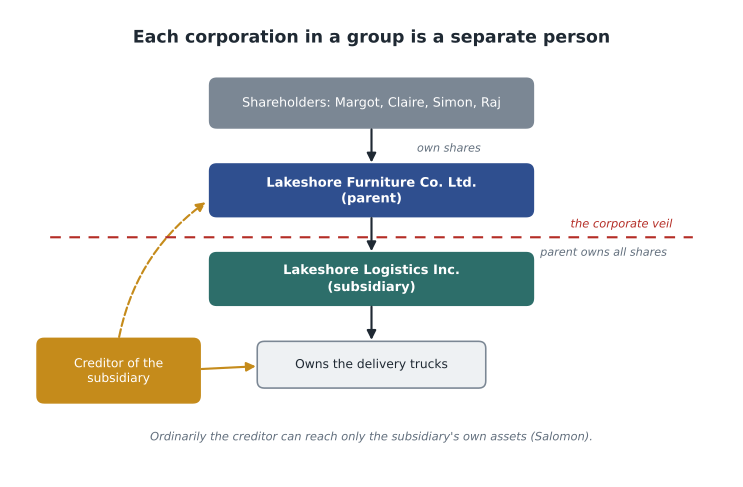
On a grey morning in the hypothetical, a Lakeshore delivery truck runs a red light on Wellington Street in Corwin and hits a cyclist, Paloma Reyes-Whitmore, who suffers serious injuries. The truck is owned by Lakeshore Logistics Inc., a company Lakeshore Furniture Co. Ltd. set up in 2018 to own its three trucks and employ its two drivers. Lakeshore Logistics has the trucks, a small bank account and an insurance policy with a two million dollar limit. Paloma's lawyer estimates her claim at more than three million. 'So who else can she sue?' Okwuosa asks. 'The parent company, which has a plant and a building? Margot, who owns most of the parent? The driver, certainly. But can she reach past the subsidiary into its parent's pockets?' Hannah Kowalczyk answers: 'Not unless she can pierce the veil. And that's hard.' 'Very hard,' Okwuosa says. 'Let's see why.'
Separate legal personality is the foundation of corporate law. Everything else in this course, from directors' duties to shareholder remedies, assumes that the corporation is a person distinct from the people who own and run it. This lesson traces that principle from the 1890s to the 2018 decision of the Court of Appeal for Ontario in the Chevron enforcement litigation, and examines the narrow circumstances in which courts will disregard it.
Salomon: the corporation as a separate person
The foundational case is Salomon v. A. Salomon and Co., [1897] A.C. 22 (H.L.). Aron Salomon, a leather merchant and boot maker in London, incorporated his business as a limited company under the English Companies Act of 1862. The Act required seven subscribers, so Salomon, his wife and five of his children each took one share; Salomon received 20,000 more shares and a secured debenture as payment for selling his business to the company. When the company failed a year later, its unsecured creditors argued that the company was merely Salomon's agent or a sham, so Salomon should be personally liable for its debts and his debenture should rank behind them.
The House of Lords unanimously rejected that argument. Once a company is validly incorporated, it is a separate legal person, distinct from its members, with its own rights and liabilities. The company was not Salomon's agent or trustee. That Salomon held almost all the shares and controlled the company did not matter. As a secured creditor, he was entitled to be paid ahead of the unsecured creditors. The Lords emphasized that the statute permitted exactly what Salomon had done, and that creditors who dealt with a limited company knew, or should have known, that its members' liability was limited.
Salomon has been followed across the common law world, including in Canada. A related case, Lee v. Lee's Air Farming Ltd., [1961] A.C. 12 (P.C.), drove the point home. Mr. Lee incorporated a crop-spraying company, held all but one share, was its governing director, and was also employed as its chief pilot. When he died in a crash, his widow claimed workers' compensation. The Privy Council held that Lee and his company were different persons, so Lee could be both its controlling shareholder and its employee, and the claim succeeded.
The consequences of separate personality
Separate personality has many practical consequences. The corporation owns its property; the shareholders own only their shares. The corporation's debts are its own, and its shareholders are not liable for them beyond what they agreed to pay for their shares. The corporation can sue and be sued, including by its own shareholders. It survives changes in ownership. Contracts are made by the corporation, not its members. And the corporation pays tax as a separate taxpayer.
The principle also explains some uncomfortable results. In Macaura v. Northern Assurance Co., [1925] A.C. 619 (H.L.), a man who owned all the shares of a timber company insured the timber in his own name. When it burned, the insurers refused to pay because he had no insurable interest in property that belonged to the company. Canada departed from that result in Kosmopoulos v. Constitution Insurance Co., [1987] 1 S.C.R. 2. Andreas Kosmopoulos was the sole shareholder and director of a company that ran his leather goods business, but he had insured its assets in his own name. The Supreme Court held that he could recover. Justice Wilson declined to 'lift the corporate veil', reaffirming that the company and its sole shareholder were distinct, but held that a person has an insurable interest in property if they would benefit from its existence and be harmed by its destruction. As sole shareholder, Kosmopoulos had such an interest.
Kosmopoulos is often cited for its statement that the separate personality of a corporation is to be respected, and that courts disregard it only where it would yield a result 'too flagrantly opposed to justice', such as where the corporation is used as a means of fraud. That statement remains a touchstone in Canadian law.
Corporate personality also affects constitutional rights. A corporation can challenge a law on the ground that it violates the Charter if the law is invalid, as in R. v. Big M Drug Mart Ltd., [1985] 1 S.C.R. 295, and it can claim some rights directly, such as freedom of expression. But some rights protect only human beings. The Supreme Court held in Irwin Toy (1989) that a corporation cannot claim the section 7 right to life, liberty and security of the person, and in Quebec (Attorney General) v. 9147-0732 Québec inc., 2020 SCC 32, that the section 12 protection against cruel and unusual treatment or punishment does not protect corporations.
Corporate groups
Most large businesses and many small ones operate through groups of corporations, with a parent company owning subsidiaries that in turn own others. Each corporation in the group is a separate person. Lakeshore created Lakeshore Logistics so that the risks of operating trucks would sit in a separate company, with its own insurance, and would not threaten the parent's plant and building. This is lawful and common. A parent company is not liable for the debts of its subsidiaries merely because it owns and controls them. Canadian courts have generally rejected the idea that a corporate group should be treated as a single enterprise for liability purposes.
When will a court disregard the corporation?
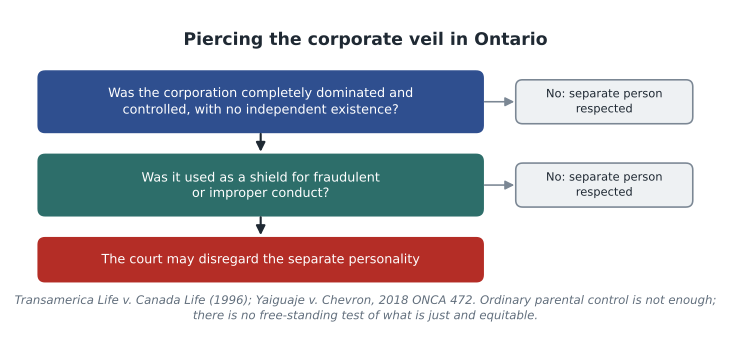
Canadian courts describe this as 'piercing' or 'lifting' the corporate veil, and they do it rarely. The leading Ontario statement is from Justice Robert Sharpe, then of the Ontario Court (General Division), in Transamerica Life Insurance Co. of Canada v. Canada Life Assurance Co. (1996), 28 O.R. (3d) 423, affirmed by the Court of Appeal. Courts will disregard the separate legal personality of a corporation only when it is completely dominated and controlled and being used as a shield for fraudulent or improper conduct. Both elements are needed. Control alone is not enough, because every wholly owned subsidiary is controlled by its parent. And the improper conduct must relate to the use of the corporation itself: setting it up or using it to evade an existing obligation, defeat creditors or perpetrate a fraud.
Examples of cases where courts have disregarded the corporation include a person who transfers assets into a company to avoid an existing judgment or a contractual promise not to compete, a company used as a vehicle for a fraud, and a corporate structure designed to hide that the real party to a transaction is someone else. Courts have also sometimes treated a corporation as the agent of its controller where, on the facts, it actually acted as an agent, though this is an application of agency law rather than a true exception to Salomon.
Yaiguaje v. Chevron: the bedrock principle
The most important recent Canadian case is Yaiguaje v. Chevron Corporation, 2018 ONCA 472. Villagers from the Lago Agrio region of Ecuador had obtained a judgment in Ecuador for about 9.5 billion US dollars against Chevron Corporation, the American parent, for environmental damage caused by oil operations there. Because Chevron had no assets in Ecuador and American courts refused to enforce the judgment, the villagers sued in Ontario to enforce it. In 2015, the Supreme Court of Canada held in Chevron Corp. v. Yaiguaje, 2015 SCC 42, that Ontario courts had jurisdiction to hear the enforcement action. The plaintiffs then sought to seize the shares and assets of Chevron Canada Limited, an indirect subsidiary seven levels removed from the parent, to satisfy the judgment.
The Court of Appeal refused. The majority, Justices Hourigan and Huscroft, held that Chevron Canada was a separate legal person and not the judgment debtor. Its shares and assets were not exigible to satisfy a judgment against its ultimate parent. The court applied the Transamerica test and found no complete domination and no use of Chevron Canada as an instrument of fraud: there was only the ordinary oversight a parent exercises over a subsidiary, and the plaintiffs did not allege wrongdoing by Chevron Canada. The majority called corporate separateness a 'bedrock principle' of corporate law and rejected the arguments that courts should pierce the veil whenever it is 'just and equitable' to do so, or should adopt a different test in enforcement proceedings, or should treat the Chevron group as a single enterprise. Any such change, the majority said, would be for the legislature.
Justice Nordheimer concurred in the result but would have left room, in rare cases, for disregarding separate personality on equitable grounds where it was needed to ensure that a judgment creditor is not left without a remedy. He agreed that this was not such a case, in part because American courts had found that the Ecuadorian judgment was obtained by fraud. The Supreme Court of Canada denied leave to appeal on April 4, 2019.
Statutes that look through the corporation
While courts rarely pierce the veil, legislatures often do it by statute for specific purposes. The Income Tax Act treats related and associated corporations as connected for many purposes, so that a family cannot multiply small business deductions by creating several companies. Employment standards legislation, including section 4 of Ontario's Employment Standards Act, 2000, can treat associated or related businesses as one employer, so a worker can recover from a sister company. Environmental statutes impose orders on persons who have management or control of a contaminated property. Corporate statutes make directors personally liable for specific debts, as lesson 8 explains. And the oppression remedy, studied in lesson 10, lets courts make orders against individuals and related companies when the corporation's affairs are conducted oppressively.
Back to Paloma
Paloma's lawyer has several options that do not depend on piercing the veil. She can sue the driver personally for negligence. She can sue Lakeshore Logistics, the owner and employer, which is liable as owner under Ontario's Highway Traffic Act and vicariously as employer. She can look at whether Lakeshore Furniture Co. Ltd. is itself liable as a matter of tort law, for example because it directed the delivery schedules that pushed drivers to rush or because the driver was in fact its employee. And she can investigate whether the logistics company was undercapitalized and insured below what any reasonable trucking operation carries. Undercapitalization alone does not justify piercing the veil in Canada, but if the structure were used to strip assets out of the subsidiary after the accident, that could be improper conduct within the Transamerica test, and it could also be challenged under the Fraudulent Conveyances Act.
Worked problem
Margot's non-compete
In the hypothetical, in 2010 Margot Bellamy sold a small cabinetry line to a competitor and personally promised not to compete in cabinetry within 100 kilometres of Corwin for five years. In 2012, she had a new numbered company, owned by her, open a cabinetry shop in Corwin. The buyer sues Margot and the numbered company. The numbered company argues that it never promised anything.
Show solution
- Start with Salomon: the numbered company is a separate person and was not a party to Margot's promise.
- Apply Transamerica: Margot completely dominated and controlled the numbered company, which she owned and ran.
- Was the company used as a shield for improper conduct? Yes, on these facts: she set it up to do what she had personally promised not to do, to evade an existing obligation.
- Conclusion: a court would likely disregard the separate personality of the numbered company and enjoin it, as well as holding Margot liable for breach.
- Contrast Yaiguaje: there, the subsidiary was set up for legitimate business purposes, not to evade the parent's obligation, so the veil held.
Common mistakes
MistakeSaying a parent company is liable for its subsidiary's debts because it owns and controls it.
InsteadOwnership and control alone are not enough; Transamerica also requires that the corporation be used as a shield for fraudulent or improper conduct.
MistakeRelying on a "just and equitable" test to pierce the veil in Ontario.
InsteadThe Court of Appeal in Yaiguaje rejected a freestanding just-and-equitable test; any change is for the legislature.
MistakeReading Kosmopoulos as a veil-piercing case.
InsteadThe Court refused to lift the veil; it decided the case by redefining insurable interest.
MistakeForgetting statutory routes, such as related-employer provisions or director liability, when the common law veil holds.
InsteadMany statutes look through corporate structures for specific purposes.
Practice problems
Work each problem on paper first, then reveal the answer to check.
What did Salomon decide?
Show answer
That a validly incorporated company is a legal person separate from its members, so even a controlling shareholder is not liable for its debts and may be its secured creditor.
What is the two-part Transamerica test?
Show answer
The corporation must be completely dominated and controlled, and it must be used as a shield for fraudulent or improper conduct.
Why could the Yaiguaje plaintiffs not seize Chevron Canada's assets?
Show answer
Chevron Canada was a separate person and not the judgment debtor; there was no complete domination and no use of it as an instrument of fraud, and the Court of Appeal rejected just-and-equitable, enforcement-specific and group enterprise approaches.
Give two examples of statutes that look through the corporate form.
Show answer
The related-employer provisions of employment standards law, associated corporation rules in the Income Tax Act, director liability provisions in corporate statutes, and environmental orders against persons in control.
Summary and key terms
- Salomon established that a validly incorporated company is a separate legal person from its shareholders, even a controlling one.
- The corporation owns its property, owes its debts and can contract with its own shareholders, as Lee's Air Farming showed.
- Kosmopoulos reaffirmed separate personality while allowing a sole shareholder an insurable interest in the company's assets.
- Each corporation in a group is separate; Canadian courts do not treat groups as single enterprises for liability.
- Under Transamerica, courts disregard a corporation only if it is completely dominated and used as a shield for fraudulent or improper conduct.
- Yaiguaje v. Chevron (2018 ONCA 472) called separateness a bedrock principle and rejected broader tests; statutes, not courts, are the main tools for looking through corporations.
- Separate legal personality
- The principle that a corporation is a legal person distinct from its shareholders, directors and officers.
- Piercing the corporate veil
- Disregarding a corporation's separate personality to impose liability on those behind it.
- Subsidiary
- A corporation controlled by another corporation, usually through ownership of a majority of its voting shares.
- Alter ego
- A corporation so dominated by another person that it has no independent existence.
- Insurable interest
- An interest in property such that the insured benefits from its existence and suffers from its loss.
- Enterprise liability
- The rejected idea that all corporations in a group should be liable as one enterprise.
Lesson quiz · 5 questions
Score 60% or more to complete this lesson.
Create a free account to save your progress, take quizzes and earn a certificate.