
LAWC-204 · Lesson 3 of 12 · 21 min
Incorporation
▶ Video coming soon A video version of this lesson is on the way.
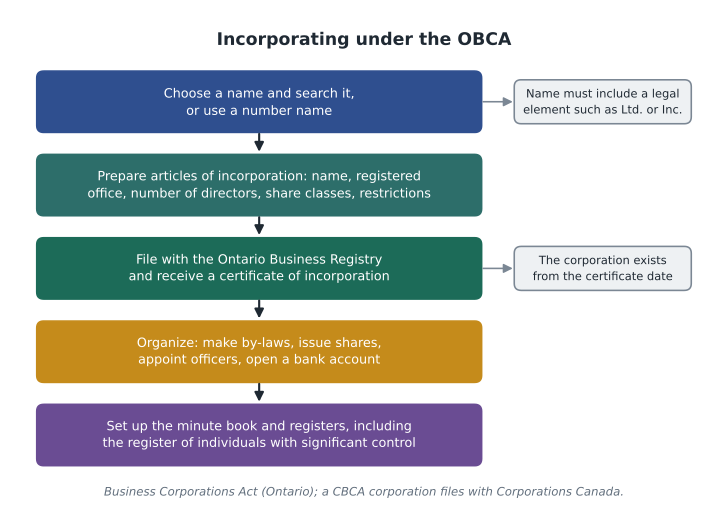
Okwuosa brings an actual binder to class: a three-ring minute book with a black cover. 'Every corporation in Ontario is supposed to have one of these,' he says, 'or its electronic equivalent. Most small business owners have never opened theirs. When something goes wrong, the first thing a lawyer does is open it.' The binder is a teaching prop, filled with the invented records of Lakeshore Furniture Co. Ltd.: its 2004 articles of incorporation, its by-laws, the registers of directors, officers and shareholders, the minutes of its meetings, and a thick document labelled 'Unanimous Shareholder Agreement, 2019'. Arjun Mehta, who likes processes, starts sketching a flowchart before Okwuosa has finished speaking.
This lesson covers how a corporation comes into existence and what its founding documents contain. Incorporation in Canada is a matter of filing, not of permission: anyone who meets the statutory requirements is entitled to incorporate. That was not always so. Until the twentieth century, many corporations were created by special acts of the legislature or by letters patent issued at the discretion of the Crown. The modern statutes, starting with the Canada Business Corporations Act (CBCA) in 1975 and the Ontario Business Corporations Act (OBCA) in its current form in 1982, adopted the 'articles of incorporation' model, under which incorporation is a right exercised by filing a standard form.
Who may incorporate, and how
Under both the CBCA and the OBCA, one or more individuals or corporations may incorporate a corporation by signing articles of incorporation and filing them, together with the required notices and fees, with the government. Ontario filings go through the online Ontario Business Registry, and federal filings go to Corporations Canada. The government issues a certificate of incorporation, and the corporation comes into existence on the date shown on the certificate. Incorporators are usually the founders or their lawyers. The certificate is conclusive proof that the corporation has been incorporated.
The articles must set out the corporation's name, the province in which its registered office is situated (and for the OBCA, the address), the classes and any maximum number of shares it is authorized to issue, the rights, privileges, restrictions and conditions attached to each class, any restrictions on the transfer of shares, the number of directors or the minimum and maximum, the names and addresses of the first directors, and any restrictions on the business the corporation may carry on. Many small corporations have no restrictions on their business at all.
The corporate name
A corporation's name must not be confusingly similar to the name of another business, must not be deceptive, and must not contain prohibited words. It must also end with a legal element that tells the public it is a corporation with limited liability: 'Limited', 'Limitée', 'Incorporated', 'Incorporée', 'Corporation' or the abbreviations 'Ltd.', 'Ltée', 'Inc.' or 'Corp.' That is why the receipt Okwuosa showed in the first class said 'Lakeshore Furniture Co. Ltd.' and not just 'Lakeshore Furniture Co.' The word 'Co.' alone is not a legal element. The business may still operate under a trade name, but in Ontario that name must be registered under the Business Names Act and the corporation's legal name must appear on contracts, invoices and orders.
A business can also incorporate with a number name, such as 1234567 Ontario Inc., which avoids the name search and is common for holding companies. Before choosing a name, prudent lawyers also search trademark databases, because a name accepted for incorporation can still infringe someone else's registered trademark.
By-laws and organizational steps
Once incorporated, the corporation must be organized. The first directors hold an organizational meeting or sign written resolutions in place of a meeting. They make by-laws, which are the internal rules on matters like the quorum and calling of meetings, the appointment of officers, signing authority, the financial year and banking arrangements. They issue shares to the founders in exchange for money, property or past services, appoint officers such as a president and secretary, adopt forms of share certificates (or decide to issue shares in uncertificated form), and appoint an auditor or arrange for the shareholders to exempt the corporation from an audit where the statute permits. By-laws made by the directors take effect immediately but must be submitted to the shareholders at the next meeting, who may confirm, reject or amend them.
Every corporation must keep records at its registered office or another permitted place: its articles and by-laws, minutes of meetings and resolutions of directors and shareholders, a register of directors, a register of officers where the statute requires it, a securities register showing who holds which shares, and accounting records. The minute book is the official memory of the corporation. Okwuosa tells students that a lawyer who inherits a client with a neglected minute book should 'rectify' it by preparing and having the proper people sign the missing resolutions, rather than pretending everything was done right.
Share structure
Shares are the units of ownership in a corporation. Under the CBCA and OBCA, shares have no par or nominal value; each share simply carries the rights set out in the articles. If a corporation has only one class of shares, the shares carry three basic rights: to vote at all meetings of shareholders, to receive any dividend declared, and to receive the remaining property of the corporation on dissolution. If the articles create more than one class, these three rights must each be attached to at least one class, though not necessarily to the same class. A corporation can therefore have voting and non-voting shares, or shares with preferential rights to dividends, so long as somebody holds each basic right.
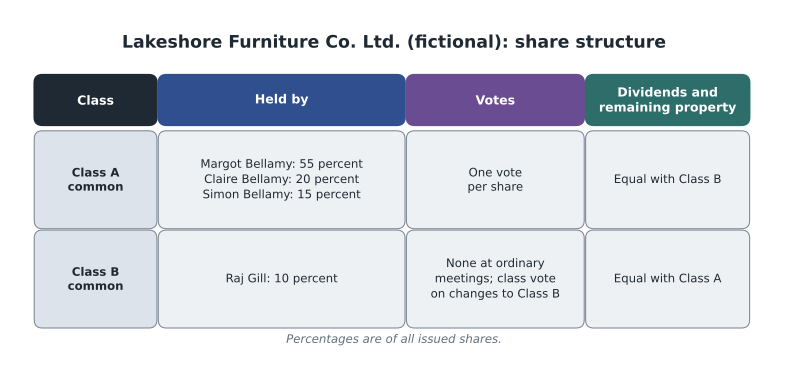
Lakeshore's articles create two classes. Class A common shares are voting, participating shares. Class B common shares are non-voting but rank equally with Class A for dividends and on dissolution. In 2004, Henry and Margot each received Class A shares. Over time, Henry transferred his shares to his grandchildren, Claire and Simon, and Margot issued Class B shares to Raj Gill, Lakeshore's production manager of twenty-five years, as a reward for his service. Today Margot holds 55 percent of all issued shares, Claire 20 percent, Simon 15 percent and Raj 10 percent, though Raj cannot vote at ordinary shareholder meetings.
Shares are issued by the directors, for consideration in money, property or past services that is not less in value than the fair equivalent of money the corporation would have received had the shares been issued for money. Shares cannot be issued until they are fully paid. The amount received for a class of shares is recorded in a stated capital account for that class, which matters for later rules on dividends, purchases of shares and reductions of capital.
Private companies and share transfer restrictions
Most small corporations include a restriction on the transfer of shares in their articles, such as a requirement that the directors approve every transfer. The restriction keeps ownership within a known group and also lets the corporation rely on the private issuer exemption under securities law, which allows it to sell shares to a limited circle of people, such as founders, employees, family and accredited investors, without filing a prospectus. Lesson 11 returns to securities law. Lakeshore's articles provide that no shares may be transferred without the approval of the board.
Unanimous shareholder agreements
Shareholders often sign an agreement among themselves covering matters like who will be a director, how disputes will be resolved, who may buy shares when another shareholder wants to sell or dies, and how the business will be valued. An ordinary shareholders' agreement is a contract binding only its parties. But the CBCA (section 146) and the OBCA (section 108) recognize a special kind of agreement: a unanimous shareholder agreement, which is an agreement among all the shareholders, or in some cases a single shareholder's declaration, that restricts in whole or in part the powers of the directors to manage or supervise the management of the business and affairs of the corporation.
A unanimous shareholder agreement has unusual effects. To the extent it removes powers from the directors, the shareholders who are given those powers take on the rights, powers, duties and liabilities of directors, and the directors are relieved of them to the same extent. A person who becomes a shareholder is deemed to be a party to an existing unanimous shareholder agreement, even if they did not sign it. Lakeshore's 2019 agreement, signed by all four shareholders, requires unanimous shareholder approval for any sale of the business, any borrowing over two million dollars and any new issue of shares, gives Margot a right to nominate three of five directors, and contains a buy-sell clause triggered on a shareholder's death or departure from the company. Lesson 10 shows why that buy-sell clause became so important.
Individuals with significant control
Since 2019, the CBCA has required private corporations to keep a register of individuals with significant control, and Ontario added a similar requirement to the OBCA effective January 1, 2023. An individual has significant control if they hold, directly or indirectly, shares carrying 25 percent or more of the votes or 25 percent or more of the fair market value of all shares, or if they have direct or indirect influence that would give them control in fact. The register records names, dates of birth, addresses, residency for tax purposes and a description of how each individual has significant control, and must be updated within fifteen days of learning of a change.
The two regimes differ on access. Under the OBCA, the register is kept by the corporation and is not public; it is available to police, tax and certain regulatory authorities for investigative purposes. Under amendments made by Bill C-42, since January 22, 2024 CBCA corporations must file their individuals-with-significant-control information with Corporations Canada, and some of it, including an individual's name, address for service and a description of their control, is available to the public in a searchable registry. The goal of both regimes is to make it harder to hide ownership of corporations used for money laundering, tax evasion and other illicit purposes. Lakeshore, an OBCA corporation, lists Margot and Claire in its private register.
Directors, residency and extra-provincial registration
A CBCA corporation must have at least one director, and at least three if it is a distributing corporation (one whose securities are publicly traded), at least two of whom are not officers or employees. The CBCA still requires that at least 25 percent of the directors be resident Canadians, subject to exceptions. The OBCA removed its resident Canadian director requirement in 2021. Directors must be individuals at least eighteen years old who have not been found incapable by a court and who do not have the status of a bankrupt.
A corporation incorporated in one jurisdiction that carries on business in another must usually register there. When Lakeshore began selling to retailers in Quebec in 2015, it had to register in Quebec as an extra-provincial corporation. The same would apply if it opened a showroom in Manitoba.
Contracts made before incorporation
Founders often sign contracts on behalf of a corporation that does not yet exist. At common law, such contracts caused problems, because a non-existent principal cannot be bound. Section 14 of the CBCA and section 21 of the OBCA solve this. A person who enters into a contract in the name of or on behalf of a corporation before it exists is personally bound by the contract and entitled to its benefits. Within a reasonable time after incorporation, the corporation may adopt the contract, after which it is bound and the person who signed is released. The statutes also allow the signer to exclude personal liability expressly in the contract.
Worked problem
Incorporating Lakeshore Direct
In the hypothetical, Claire Bellamy and Rohan Iyer decide to incorporate their online venture under the OBCA. Rohan has already signed a one-year lease for a small warehouse in the name of 'Lakeshore Direct Inc.', which does not yet exist. Lakeshore Furniture Co. Ltd. will invest 50,000 dollars. What must they decide and do?
Show solution
- Name: "Lakeshore Direct Inc." includes a legal element. They need Lakeshore Furniture Co. Ltd.'s written consent to use the Lakeshore name and should check trademarks.
- Articles: set the number of directors (say three), share classes (common voting shares for Claire and Rohan; perhaps a separate class for Lakeshore's investment) and a restriction on share transfers.
- Pre-incorporation lease: under OBCA section 21, Rohan is personally bound until the new corporation adopts the lease within a reasonable time after incorporation.
- Organization: by-laws, issue shares for money (Lakeshore's 50,000) and for past services (Rohan's website), with directors determining value; appoint officers; set up the minute book and registers, including the register of individuals with significant control.
- Agreement: a unanimous shareholder agreement covering board seats, approvals, vesting of Rohan's shares and a buy-sell clause.
Common mistakes
MistakeUsing a name ending only in "Co." for an Ontario corporation.
InsteadThe name must include a legal element such as Limited, Ltd., Incorporated, Inc., Corporation or Corp.
MistakeAssuming a unanimous shareholder agreement binds only those who signed it.
InsteadA person who becomes a shareholder is deemed a party to an existing unanimous shareholder agreement.
MistakeTreating the OBCA register of individuals with significant control as public.
InsteadThe OBCA register is private, available to certain authorities; the CBCA regime requires filing and partial public access since January 22, 2024.
MistakeBelieving a founder who signs a contract for a corporation not yet incorporated has no personal liability.
InsteadUnder CBCA s. 14 and OBCA s. 21, the signer is personally bound until the corporation adopts the contract, unless liability was expressly excluded.
Practice problems
Work each problem on paper first, then reveal the answer to check.
What must articles of incorporation include?
Show answer
The name, the province (and for the OBCA, address) of the registered office, the classes and any maximum number of shares, the rights attached to each class, any restrictions on share transfers, the number of directors and first directors, and any restrictions on the business.
What three basic rights must attach to at least one class of shares?
Show answer
The right to vote at shareholder meetings, the right to receive dividends declared, and the right to receive remaining property on dissolution.
What is the effect of a unanimous shareholder agreement that removes a power from the directors?
Show answer
The shareholders who take the power assume the rights, powers, duties and liabilities of directors for it, and the directors are relieved of them to that extent.
When does someone have significant control of an OBCA corporation?
Show answer
When they hold, directly or indirectly, 25 percent or more of the votes or of the fair market value of all shares, or have influence giving control in fact.
Summary and key terms
- Incorporation is a right exercised by filing articles; the corporation exists from the date on its certificate.
- Articles set out the name, registered office, share classes and rights, transfer restrictions, directors and any business restrictions; the name needs a legal element.
- Directors make by-laws, issue shares, appoint officers and keep the minute book and statutory registers.
- Shares have no par value; the voting, dividend and dissolution rights must each attach to at least one class.
- Unanimous shareholder agreements can move directors' powers and liabilities to shareholders and bind future shareholders.
- CBCA and OBCA corporations must keep registers of individuals with significant control; CBCA information is filed and partly public since January 22, 2024.
- Articles of incorporation
- The constating document filed to create a corporation, setting out its name, shares, directors and restrictions.
- By-law
- An internal rule of a corporation made by its directors and confirmed by its shareholders.
- Minute book
- The corporation's official record of its constating documents, resolutions, minutes and registers.
- Stated capital
- The account recording the amount received for each class of shares.
- Unanimous shareholder agreement
- An agreement among all shareholders that restricts the powers of the directors.
- Individual with significant control
- A person who holds 25 percent or more of the votes or value of a corporation's shares, or controls it in fact.
Lesson quiz · 5 questions
Score 60% or more to complete this lesson.
Create a free account to save your progress, take quizzes and earn a certificate.