
LAWC-204 · Lesson 1 of 12 · 22 min
Choosing a business form
▶ Video coming soon A video version of this lesson is on the way.
Professor Desmond Okwuosa begins the first Business Associations class of the fall with a slide that shows nothing but a receipt. It is from Lakeshore Furniture Co., the Corwin furniture maker the class has followed since first-year contracts, for a white oak dining table sold for 2,400 dollars. 'Last year you learned who bears the risk when Lakeshore's oak arrives warped,' he says. 'This year we ask a different question. Who is Lakeshore? When the customer pays 2,400 dollars, whose money is it? When a delivery truck runs a red light, who pays? When the company borrows from the bank, whose house is on the line? And when the family that owns it starts to fight, who decides?' He clicks to the next slide, which shows the same receipt with a single word circled: 'Ltd.' 'Three letters,' he says, 'and a hundred and thirty years of law behind them.'
Okwuosa practised corporate and commercial law in Toronto for nineteen years, first at a large firm and then as general counsel of a mid-sized manufacturer, before joining Brannock. He teaches with a question he calls 'the four Ps': Who are the players? What is the pot of money? What powers does each person have? And what protects each of them when things go wrong? The running file this term is the business side of Lakeshore. For the course, the company has a history and an owner. It began in 1979 when Henry Bellamy, a cabinetmaker, started building tables in a rented garage. His daughter Margot Bellamy runs it now as president. Its legal name is Lakeshore Furniture Co. Ltd., it employs sixty-two people, and its shares are held by members of the Bellamy family and one long-serving employee. All of these people and companies are invented, and anything said about their future is hypothetical.
Why the form matters
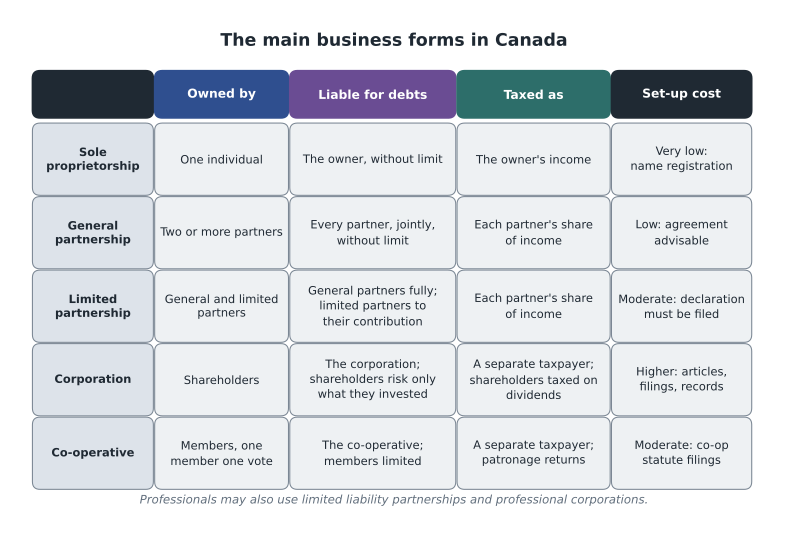
A business form is the legal structure through which people carry on a business together. The choice of form decides five things that matter to every client: who owns the business and its assets; who is personally liable for its debts and wrongs; who has the power to make decisions and bind it; how its income is taxed; and what it costs to set up and maintain. The choice is rarely permanent. Many businesses begin in the simplest form and move to a more complex one as they grow, take on investors or face larger risks. Lakeshore did exactly that, and its history is a tour of the main options.
The form is not always chosen deliberately. Two people who start working together for profit may have formed a partnership without knowing it, and with all the unlimited liability that comes with it. One of the first jobs of a business lawyer is to identify what form a client is already in, and only then to discuss what form the client should be in.
The sole proprietorship
A sole proprietorship is a business owned and run by one individual with no separate legal structure. Henry Bellamy was a sole proprietor when he built tables in his garage. Legally, there was no 'business' apart from Henry. The tools, the lumber and the customer accounts were his property. The contracts were his contracts. The debts were his personal debts, and his creditors could seize his house, his car and his savings to collect them. The income was his income, reported on his personal tax return and taxed at his personal marginal rates.
The sole proprietorship is simple and cheap. There is nothing to file except, in Ontario, a registration under the Business Names Act if the business operates under any name other than the owner's own name. Henry had to register 'Lakeshore Furniture' because it was not his name. The owner has complete control and keeps all the profit. The disadvantages are the mirror image: unlimited personal liability, no way to bring in co-owners without changing form, and difficulty raising capital beyond what the owner can borrow personally. When the owner dies, the business, as a legal matter, dies too; its assets pass through the owner's estate.
The general partnership
In 1991, Henry brought Margot into the business. They agreed to share the profits equally and to make decisions together, but they signed no formal agreement and filed nothing except an updated business name registration. In law, they had formed a general partnership. Under the Ontario Partnerships Act, a partnership is the relation that subsists between persons carrying on a business in common with a view to profit. No filing or written agreement is required. Lesson 2 examines that definition closely, because whether a partnership exists can decide who is liable for millions of dollars.
A general partnership is not a separate legal person in the way a corporation is, although it can sue and be sued in the firm name under the rules of court. Each partner is an agent of the firm and of the other partners for the purpose of the business, so each can bind the others to contracts within the usual course of business. Each partner is liable, jointly with the others, for all the debts and obligations of the firm incurred while they are a partner, and jointly and severally for wrongs committed by any partner in the ordinary course of the business. The partnership itself pays no income tax; its income is allocated to the partners, who report their shares on their own returns.
Partnerships are flexible and cheap to form, and they let several people pool money and skill. But every general partner faces unlimited personal liability, including liability for a co-partner's mistakes. When Margot signed a lease for a larger shop in 1993 without asking her father, Henry was bound by it and personally liable for the rent.
The limited partnership and the limited liability partnership
Two variations soften the partnership's liability rule. A limited partnership, governed in Ontario by the Limited Partnerships Act, has at least one general partner with unlimited liability and one or more limited partners whose liability is limited to what they contributed. Unlike a general partnership, a limited partnership exists only once a declaration is filed. Limited partners are passive investors. If a limited partner takes part in the control of the business, it can lose its limited liability and be treated as a general partner. Limited partnerships are common in real estate, resource and investment ventures, often with a corporation as the general partner so that no individual has unlimited liability.
A limited liability partnership, or LLP, is a general partnership in which partners are protected from personal liability for the negligence of other partners and of people they did not supervise, though each remains liable for their own negligence and for the firm's ordinary debts in some respects. In Ontario, an LLP is available only to members of professions whose governing statute or regulatory body allows it, such as lawyers and chartered professional accountants. That is why so many law firms have 'LLP' after their names. A furniture company could not become an LLP.
The corporation
In 2004, after a customer threatened to sue over a collapsed bookcase and the bank asked for larger loans, Henry and Margot incorporated under the Ontario Business Corporations Act. They transferred the business assets to the new corporation, Lakeshore Furniture Co. Ltd., in exchange for shares. From that moment, the corporation was a separate legal person. It owned the tools, the lumber and the customer accounts. It signed the contracts. It owed the debts. Henry and Margot became shareholders, directors and officers, three distinct roles that lessons 3, 6 and 9 examine in turn.
The corporation's great advantage is limited liability: shareholders risk only what they invested in their shares, and the corporation's creditors cannot normally reach their personal assets. Corporations also have perpetual existence, so the business survives the death or departure of any owner. Shares can be sold or passed on without dissolving the business, which makes it far easier to bring in investors, transfer ownership between generations and raise capital. And for tax purposes, a Canadian-controlled private corporation can benefit from the small business deduction on active business income up to a limit, which can let owners defer tax by leaving profits in the company.
The disadvantages are cost and formality. A corporation must be incorporated by filing articles, must keep records and registers, hold or document annual meetings, file annual returns and corporate tax returns, and follow the procedures in its statute and by-laws. Limited liability is also less complete than it looks. Banks routinely require owners of small corporations to sign personal guarantees, so Margot is personally liable for the line of credit anyway. Directors face personal statutory liabilities for things like unpaid wages and source deductions, studied in lesson 8. And the corporation offers no protection to an individual against liability for their own torts.
Co-operatives and other forms
A co-operative is a corporation owned and controlled by its members, who usually use its services, such as a farm marketing co-op, a housing co-op, a credit union or a retail co-op. Co-operatives in Ontario are incorporated under the Co-operative Corporations Act, and federally under the Canada Cooperatives Act. Their defining feature is democratic control on a one-member, one-vote basis, regardless of how much capital each member has invested, and surpluses are often returned to members in proportion to their use of the co-op rather than their investment. When Lakeshore's workers once floated buying the company from the family, a worker co-operative was one of the structures they considered.
Other forms exist for particular purposes. Not-for-profit corporations, governed in Ontario by the Not-for-Profit Corporations Act, 2010, and federally by the Canada Not-for-profit Corporations Act, cannot distribute profits to members. Professional corporations let regulated professionals, such as doctors and lawyers, incorporate their practices within limits set by their regulators. Joint ventures are contractual arrangements, sometimes using a corporation or partnership as the vehicle, for a specific project. And trusts, including income trusts, have been used to hold businesses, though tax changes have made them less common.
Federal or provincial incorporation
A business that incorporates in Canada can choose between federal incorporation under the Canada Business Corporations Act (CBCA) and incorporation under the statute of a province or territory, such as the Ontario Business Corporations Act (OBCA). Both are constitutionally valid: the federal power to incorporate companies with objects other than provincial comes from the peace, order and good government power, and provinces have express power over the incorporation of companies with provincial objects under section 92(11) of the Constitution Act, 1867. As LAWC-101 showed, this is one of the oldest areas of division-of-powers law.
In practice, the choice turns on a few factors. A CBCA corporation has its name protected across Canada and the right to carry on business in every province, though it must still register extra-provincially in each province where it operates. The CBCA requires that at least a quarter of directors be resident Canadians in some cases, a rule the OBCA dropped in 2021. CBCA corporations must file information about individuals with significant control with Corporations Canada, which makes some of it public; OBCA corporations keep that register privately. A business that operates only in Ontario, like Lakeshore did in 2004, will often choose the OBCA for simplicity. The two statutes are very similar in structure, and this course cites both.
The factors a lawyer weighs
When a client asks which form to use, the business lawyer usually works through the same list. How much risk does the business carry, and can insurance cover it? How many owners are there now, and will outside investors be needed? Do the owners want to share control equally, or does one want to run things? How will profits be used: paid out each year or reinvested? What are the tax consequences now and on a future sale, which requires advice from a tax professional? How much administration can the owners handle? And how will an owner leave: by retirement, death, disagreement or sale?
The answer is often a combination. A family may hold its business through a corporation, with each family member holding shares through a personal holding company or a family trust. Investors in a real estate project may buy units of a limited partnership whose general partner is a corporation. A professional may practise through a professional corporation that is itself a partner in an LLP. Okwuosa tells students that the forms are building blocks, and the art lies in putting them together.
Worked problem
Advising Claire Bellamy on an online spin-off
In September 2026, in the hypothetical, Claire Bellamy, Margot's daughter and Lakeshore's vice-president of design, wants to launch an online business selling flat-pack versions of Lakeshore designs. Her university friend Rohan Iyer, a software developer, would build and run the website, and Lakeshore would make the furniture. Claire and Rohan have already started taking pre-orders under the name 'Lakeshore Direct' and splitting the profits. What form are they in, and what should they choose?
Show solution
- Identify the current form. Claire and Rohan are carrying on a business in common with a view to profit and sharing profits. Under the Partnerships Act, they are very likely already a general partnership, whether they intended it or not.
- Identify the risks. As general partners, each is personally liable for the firm's debts and for the other's wrongs in the ordinary course of business, including product liability claims if a flat-pack chair collapses.
- Consider the name. "Lakeshore Direct" uses Lakeshore's name. Lakeshore Furniture Co. Ltd. must consent, and the business name must be registered.
- Consider the options. A corporation would give limited liability, a structure for Lakeshore to invest, and a way for Rohan to receive shares for his work. A limited partnership would suit passive investors but not two active founders.
- Recommend. Most likely a new corporation, with a shareholders' agreement covering control, vesting of Rohan's shares, Lakeshore's licence of its designs and what happens if Claire and Rohan fall out, plus tax advice before anything is transferred.
Common mistakes
MistakeAssuming a partnership exists only if the partners sign an agreement or register it.
InsteadA general partnership arises from the relationship itself: carrying on a business in common with a view to profit. No filing is needed.
MistakeTelling a small business client that incorporating protects their house from all business debts.
InsteadLimited liability is real but limited in practice: banks demand personal guarantees, directors have statutory liabilities, and individuals stay liable for their own torts.
MistakeTreating an LLP as available to any business.
InsteadIn Ontario, LLPs are available only to professions whose governing law permits them, such as law and accounting.
MistakeBelieving a limited partner can help run the business while keeping limited liability.
InsteadA limited partner who takes part in the control of the business risks being treated as a general partner.
Practice problems
Work each problem on paper first, then reveal the answer to check.
What five matters does the choice of business form decide?
Show answer
Ownership of the business and its assets, personal liability for its debts and wrongs, who can make decisions and bind it, how its income is taxed, and the cost of setting up and maintaining it.
Why did Henry Bellamy need to register "Lakeshore Furniture" as a sole proprietor?
Show answer
Ontario's Business Names Act requires an individual carrying on business under a name other than their own to register that name.
What is the main difference between a general partner and a limited partner?
Show answer
A general partner has unlimited liability and can manage the business; a limited partner's liability is limited to its contribution, but only if it does not take part in control.
Give two reasons a business might choose CBCA incorporation over OBCA incorporation.
Show answer
Name protection across Canada and a clearer basis for operating in several provinces; some businesses also prefer federal incorporation for investors or lenders familiar with the CBCA.
Summary and key terms
- A business form decides ownership, liability, control, taxation and cost; many businesses move to more complex forms as they grow.
- A sole proprietorship has no separate existence from its owner, who has unlimited personal liability.
- A general partnership arises from the relationship itself; every general partner has unlimited liability and can bind the firm.
- Limited partnerships protect passive investors; LLPs protect professionals from liability for other partners' negligence and are limited to permitted professions.
- A corporation is a separate legal person with limited liability and perpetual existence, at the cost of formality, though guarantees and statutory liabilities narrow the protection.
- Businesses may incorporate federally under the CBCA or provincially, such as under the OBCA; co-operatives and not-for-profit corporations serve other purposes.
- Sole proprietorship
- A business owned and run by one individual with no separate legal existence.
- General partnership
- The relation between persons carrying on a business in common with a view to profit, with unlimited liability for each partner.
- Limited partnership
- A partnership with at least one general partner and one or more limited partners whose liability is limited to their contribution.
- Limited liability partnership
- A partnership of professionals in which partners are shielded from liability for other partners' negligence.
- Limited liability
- The principle that shareholders risk only what they invested in their shares.
- Co-operative
- A corporation owned and democratically controlled by its members on a one-member, one-vote basis.
Lesson quiz · 5 questions
Score 60% or more to complete this lesson.
Create a free account to save your progress, take quizzes and earn a certificate.