
LAWC-204 · Lesson 12 of 12 · 29 min
Capstone: advising a business from start-up to sale
▶ Video coming soon A video version of this lesson is on the way.
Professor Okwuosa's last class is a problem day. 'Corporate law is not a list of topics,' he tells the class. 'It is a set of tools for one client's life story, and the story keeps going while you work.' He hands out a file about a fictional business, Corran Cider Works Inc., and asks the students to advise its co-founder, who has come to the class's clinic. The facts below are entirely hypothetical. Students work in teams, each team taking several issues, and then the class assembles a single advice letter. This lesson sets out the file, walks through each issue with the analysis the class developed, and closes with a short guide to writing the advice.
The file
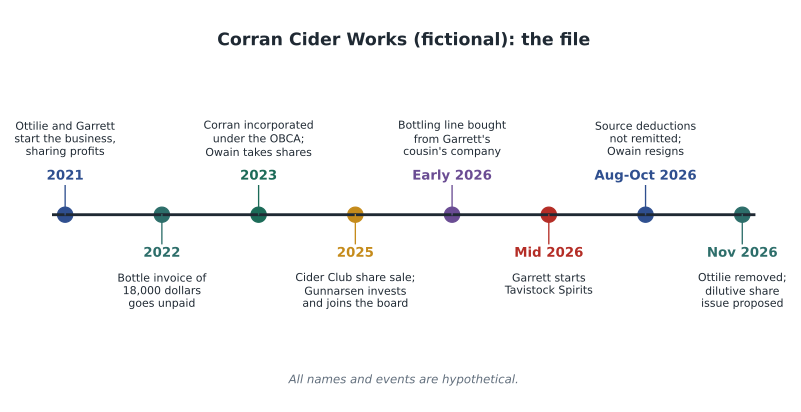
In 2021, Ottilie Pellew and Garrett Tavistock, friends from university, start making cider in a rented barn in Prince Edward County, Ontario. They pool savings, buy a press and sell at farmers' markets under the name Corran Cider. They have no written agreement. They split the profits equally and both sign supply contracts. In 2022, a glass supplier, Lakeview Glass (fictional), delivers 40,000 bottles on credit, ordered by Garrett; the 18,000 dollar invoice is never paid, and the supplier is still chasing it.
In 2023, on their accountant's advice, they incorporate Corran Cider Works Inc. under the OBCA. The articles create one class of common shares with no transfer restrictions beyond the standard private company restriction requiring directors' approval, and no pre-emptive rights. Ottilie and Garrett each take 40 percent. Owain Draycott, who owns the orchard that supplies their apples, takes 20 percent in exchange for a ten-year apple supply contract at fixed prices. The three are the directors; Garrett is president, Ottilie vice-president of production. Their lawyer drafts a shareholder agreement with a buy-sell clause and pre-emptive rights, but nobody signs it. Corran has never prepared an individuals with significant control register.
In 2025, Corran needs money to expand. It runs an online 'Cider Club founders' campaign, selling common shares at 500 dollars each to sixty customers, raising about 200,000 dollars; no prospectus is filed and no exemption is considered. Later that year, Gunnarsen Capital Partners LP (fictional) invests 1.5 million dollars for preferred shares carrying a fixed cumulative dividend and a right to convert into common shares, and its managing partner, Henrik Gunnarsen, joins the board. The articles are amended to create the preferred class.
In early 2026, Garrett proposes buying a bottling line for 900,000 dollars from Tavistock Machinery Ltd., a company owned by his cousin. He circulates a single quote. On a thirty-minute video call, the board approves the purchase three to one, Ottilie dissenting and asking for her dissent to be minuted. Garrett does not mention that he holds a 30 percent stake in Tavistock Machinery. The line breaks down repeatedly. In mid 2026, Garrett incorporates Tavistock Spirits Ltd., which makes apple brandy from Corran's leftover pressings, bought from Corran at a price Garrett sets. A craft spirits distributor that approached Corran about a brandy line in 2025 signs with Tavistock Spirits instead.
Cash runs short. From August to October 2026, Corran pays its twelve employees but does not remit their source deductions. Owain, worried, sends Garrett an email on October 1, 2026 saying 'I am done, take me off the board,' and stops attending meetings, though he still signs a cheque in late October when Garrett is away. On November 6, 2026, after Ottilie asks for the Tavistock Machinery file, the board, with Garrett and Henrik voting and Ottilie opposed, removes her as vice-president and proposes to issue new common shares to Gunnarsen at a price well below what the Cider Club members paid, which would cut Ottilie's stake from about 34 percent to under 20 percent. Garrett also tells the board that a large national brewer has expressed interest in buying Corran. On November 20, 2026, Ottilie comes to the clinic.
Issue 1: the 2022 bottle invoice and the partnership
Theo Marchetti's team starts with the oldest problem. Before incorporation, was there a partnership? Under section 2 of Ontario's Partnerships Act, partnership is the relation that subsists between persons carrying on a business in common with a view to profit. Ottilie and Garrett pooled money, ran the cider business together, shared profits equally and both signed contracts. On Backman v. Canada, 2001 SCC 10, that is a business carried on in common with a view to profit; the absence of a written agreement is irrelevant. Under sections 6 and 10 of the Act, each partner is an agent of the firm and every partner is jointly liable for its debts incurred while a partner. So Ottilie is personally liable, with Garrett, for the 18,000 dollar invoice, even though Garrett placed the order.
Did incorporation change that? No. The corporation did not exist in 2022, and a debt incurred by the partnership is not transferred to a later corporation unless the creditor agrees. Ottilie can seek contribution from Garrett for his share. The team also notes the limitation question: under the Limitations Act, 2002, the basic period is two years from discovery of the claim, so the supplier's claim may already be out of time depending on when the debt fell due and whether there were acknowledgments in writing. Ottilie should not acknowledge the debt in writing until that is checked.
Issue 2: incorporation housekeeping
Sophie Tremblay-Hart's team reviews the incorporation. The articles and organizational resolutions appear valid, but two problems stand out. First, Corran has not kept a register of individuals with significant control, which OBCA corporations have had to maintain since January 1, 2023. An individual who holds 25 percent or more of the voting rights or of the fair market value of the shares, or who has direct or indirect influence that would result in control, must be recorded; Garrett and Ottilie each held 40 percent, and Gunnarsen's investment may create further entries. The register must be kept up to date and an update made within fifteen days of learning of a change. The fix is to prepare the register now. Second, the unsigned shareholder agreement means Corran has no buy-sell clause, no pre-emptive rights and no agreed valuation formula. That gap shapes almost every later issue.
Issue 3: can Lakeview Glass pierce the veil?
Lakeview Glass, still unpaid, has heard about Tavistock Spirits and asks whether it can sue Garrett personally on the theory that Corran is his alter ego. Arjun Mehta's team says the veil-piercing route is weak. Under Salomon and Kosmopoulos, the corporation is a separate person, and Ontario courts pierce the veil only when it is completely dominated and used as a shield for fraudulent or improper conduct (Transamerica Life Insurance Co. of Canada v. Canada Life Assurance Co. (1996), 28 O.R. (3d) 423). Lakeview's debt is not even Corran's; it is the partnership's, so Lakeview should sue Ottilie and Garrett as partners, which needs no piercing. If Corran later fails to pay its own suppliers while Garrett moves value into Tavistock Spirits, a creditor might have an oppression claim as a proper complainant (Sidaplex-Plastic Suppliers), or a claim under fraudulent conveyance or preference laws, which are more promising than piercing.
Issue 4: Garrett's conflicts and the corporate opportunity
Daniel Whitecloud's team takes the fiduciary duty. Two transactions are in question. The first is the bottling line. Garrett held 30 percent of Tavistock Machinery, the seller, and did not disclose it. Under OBCA section 132, a director who is a party to a material contract or transaction, or is a director or officer of, or has a material interest in, a party, must disclose the nature and extent of the interest in writing or have it entered in the minutes, and must not vote except in limited cases. Garrett both failed to disclose and voted. Under section 132(9), the court may, on application by the corporation or a shareholder, set aside the contract and require the director to account for any profit or gain. Approval by the other directors does not cure non-disclosure.
The second is Tavistock Spirits. A spirits distributor approached Corran about a brandy line in 2025, and Garrett later signed that distributor for his own company, using Corran's pressings at a price he set. Under Canadian Aero Service Ltd. v. O'Malley, [1974] S.C.R. 592, a director or senior officer may not take for themselves a maturing business opportunity of the corporation, or one obtained through their position. The brandy line came to Corran, was in its line of business and was taken by its president. There was no informed board rejection as in Peso Silver Mines v. Cropper. Garrett is likely accountable to Corran for the profits of Tavistock Spirits, and the sales of pressings at a price he set are a further undisclosed self-dealing transaction. Peoples and BCE confirm that the duty is owed to Corran itself; the remedy belongs to Corran.
Issue 5: the duty of care and the bottling line
Hannah Kowalczyk's team considers whether the directors who approved the bottling line breached their duty of care. Under OBCA section 134(1)(b), directors must exercise the care, diligence and skill of a reasonably prudent person in comparable circumstances, judged objectively (Peoples). A 900,000 dollar purchase, large for a business of Corran's size, approved on one quote from a related supplier on a thirty-minute call, does not look like a reasonable process. On UPM-Kymmene, a board that approves terms it has not examined forfeits the business judgment rule's deference. Owain and Henrik voted in favour and are exposed; Ottilie dissented and had it minuted, which under OBCA section 135 means she is not deemed to have consented and stands in a far better position. Henrik, though a nominee of Gunnarsen, owes the same duty to Corran as any director.
Issue 6: unremitted source deductions and Owain's resignation
The whole class works on this issue because it carries the most immediate personal risk. Under section 227.1 of the Income Tax Act, the directors of Corran at the time of the failures to remit source deductions in August, September and October 2026 are jointly and severally liable with Corran, subject to the CRA first attempting to collect from Corran. That includes Ottilie, Garrett, Henrik and, at least for August and September, Owain.
Did Owain's email end his directorship on October 1? Under OBCA section 121(2), a director's resignation becomes effective when a written resignation is received by the corporation or at a later time specified. An email to the president may well count as a written resignation received by the corporation, though the class debates whether 'take me off the board' is clear enough. But Owain then signed a cheque in late October. Under Corsano, a person who continues to act as a director may be a director in fact, so Owain may be liable for October too. The two-year limitation in section 227.1(4) will run from the date he last ceased to be a director, in law and in fact.
Do any directors have a due diligence defence? Under Buckingham, the defence requires objectively reasonable steps to prevent the failure before it occurred. Ottilie had no role in payroll, but she knew cash was short after the bottling line failed. A reasonably prudent director in that situation would ask for confirmation that remittances were being made. If she did ask and was given false assurances by Garrett, she may have a defence; if she did nothing, probably not. The team advises Ottilie to gather every email and minute that shows what she asked and was told.
Issue 7: Ottilie's shareholder rights
Ottilie has meaningful rights even as a minority shareholder. Because Corran's articles contain no pre-emptive rights and the shareholder agreement was never signed, she has no automatic right to participate in the new share issue to Gunnarsen (OBCA section 26). But she may inspect the shareholder records, including the securities register, and the minutes of shareholder meetings (OBCA sections 140 and 145), though not the directors' minutes as of right; as a director, however, she is entitled to see the board's own records, and she should insist on them. Corran has presumably relied on the audit exemption; with sixty Cider Club members and a preferred class, unanimous written consent of all shareholders under OBCA section 148 is unlikely to have been obtained properly, and Ottilie can in any event refuse consent for the current year. With roughly 34 percent of the common shares, she can requisition a shareholder meeting (OBCA section 105), and she may dissent from any fundamental change, such as a sale of substantially all of Corran's property or an amalgamation, and be paid fair value (OBCA section 185).
Issue 8: oppression and the derivative action
Ottilie's strongest remedies are in the next two provisions. Her removal as vice-president shortly after she asked for the Tavistock Machinery file, and the proposed share issue to Gunnarsen at a price well below recent issues, which would cut her stake by almost half, are classic signs of a freeze-out. Under BCE, the questions are whether Ottilie had reasonable expectations, judged objectively, and whether they were defeated by oppressive or unfairly prejudicial conduct, or conduct that unfairly disregarded her interests. As a co-founder who built the business, held a senior management role and was part of a three-person board in a closely held corporation, she can plausibly claim expectations of continued participation, of not being diluted at an undervalue, and of not being punished for asking questions (Ferguson v. Imax). Interim relief restraining the share issue is the urgent step (OBCA section 248(3)(a)).
Remedies could include setting aside the share issue, an order that Corran or Garrett buy her shares at fair value without a minority discount (Naneff), or an order against Garrett personally if the conduct is attributable to him and a personal order is fit (Wilson v. Alharayeri). Gunnarsen's role matters too: if Henrik participated in the oppressive conduct and Gunnarsen benefits from the cheap shares, an order affecting Gunnarsen's position may be fit.
The wrongs to Corran, namely Garrett's undisclosed interest in the bottling line, the diversion of the brandy opportunity and the self-dealing in pressings, belong in a derivative action (Rea v. Wildeboer). Ottilie must give the directors fourteen days' notice of her intention to apply for leave under OBCA section 246, and then show good faith and that the action appears to be in Corran's interests. Given the board's composition, with Garrett conflicted and Henrik aligned with him, the directors are unlikely to sue, and the court is likely to grant leave. An application can combine her personal oppression claim with a request for leave for the derivative claims, and ask for an order that Corran pay her interim legal costs (section 247).
Issue 9: the Cider Club and securities law
The 2025 Cider Club campaign is a securities law problem. Corran sold common shares, which are securities, to sixty members of the public over the internet without a prospectus. Was there an exemption? The private issuer exemption under NI 45-106 requires, among other things, that the issuer's securities be held by not more than fifty persons, excluding employees and former employees, and that the purchasers belong to defined categories such as close personal friends, business associates or accredited investors. Sixty customers who answered an online campaign are unlikely to qualify, and the crowdfunding exemption in National Instrument 45-110 requires a specific offering document and procedure that Corran did not follow. The distribution was likely made in breach of section 53 of the Securities Act (Ontario).
The consequences include possible OSC enforcement, and purchasers may have rights of action, depending on the circumstances, such as a claim for rescission or damages. A distribution made without a prospectus or exemption can also affect any later sale of Corran, because a buyer's lawyers will discover it in due diligence. The fix is to obtain securities advice promptly, consider a rescission offer to the Cider Club members, and report to the regulator. Those members are also now shareholders whose interests the board must consider, and whose consents matter for the audit exemption and any written resolutions.
Issue 10: the brewer's interest
Finally, the brewer. If it makes an offer, Corran's directors must act in its best interests, treating stakeholders fairly, and follow a reasonable process (BCE; Maple Leaf Foods). Garrett is conflicted on multiple fronts and should not lead the process; a committee of the directors without conflicts, if there are any left, should retain advisers. The structure will matter: a share purchase needs every seller, including sixty Cider Club members; an amalgamation needs special resolutions and gives dissent rights; and a plan of arrangement under OBCA section 182 would need court approval as fair and reasonable. Each of the unresolved problems above, including the derivative claims against Garrett, the unremitted source deductions and the Cider Club distribution, will affect the price and must be disclosed. Ironically, a sale might be the cleanest way for Ottilie to exit at fair value, if her claims are addressed in the deal.
Writing the advice
Okwuosa closes with advice about advice. A letter to Ottilie should begin with what she most needs to know: that she faces personal exposure on the partnership debt and the source deductions, that she has strong claims against Garrett and the board, and that one step is urgent, an application to stop the share issue. It should then set out the issues in order of urgency rather than in the order of the course. Each issue should state the rule, apply it to the facts and say plainly how likely the outcome is and what it will cost. It should flag the facts the lawyer still needs: the exact wording and date of Owain's email, what Ottilie asked about remittances, the terms of the Gunnarsen investment, the dates of the bottle invoice and any acknowledgments, and the details of the Cider Club campaign. And it should end with a short list of next steps with dates.
'Every case in this course began with someone like Ottilie sitting across from a lawyer,' Okwuosa says. 'Salomon, Peoples, BCE, Wilson: they were all business people who wanted to know where they stood. Your job is to tell them, clearly, in time for it to matter.'
Worked problem
An advice outline for Ottilie Pellew
Using the Corran Cider Works file (entirely hypothetical), prepare an outline of advice to Ottilie Pellew as of November 20, 2026, ranking the issues by urgency and identifying the governing rules and the next step for each.
Show solution
- Urgent: the proposed share issue to Gunnarsen at an undervalue; seek an interim order under OBCA section 248 restraining it, relying on BCE reasonable expectations and the freeze-out pattern.
- Urgent: personal exposure for unremitted source deductions under Income Tax Act section 227.1; gather evidence of any steps she took (Buckingham), press the board to remit now and get tax advice.
- Near term: derivative claims against Garrett for the undisclosed interest in Tavistock Machinery (OBCA section 132) and the brandy opportunity (Canaero); give fourteen days' notice and seek leave under section 246, with interim costs under section 247.
- Near term: securities law exposure from the 2025 Cider Club distribution without a prospectus or exemption; get securities advice and consider a rescission offer.
- Ongoing: exercise shareholder and director rights to records, refuse consent to the audit exemption, consider a requisition, and preserve dissent rights in any fundamental change.
- Background: partnership liability for the 2022 bottle invoice under the Partnerships Act and Backman, subject to a limitation defence; contribution from Garrett.
- Housekeeping: prepare the ISC register, and record that a written shareholder agreement with buy-sell and pre-emptive terms should be part of any settlement.
- Facts still needed: Owain's email wording and date, Ottilie's communications about remittances, the Gunnarsen subscription terms, the invoice dates and the Cider Club records.
Common mistakes
MistakeOrganizing advice by course topic rather than the client's priorities.
InsteadLead with urgent risks and remedies, such as an interim order and personal tax exposure, then work outward.
MistakeAssuming incorporation ended the founders' liability for the earlier business debt.
InsteadThe 2022 debt was a partnership debt; partners remain personally liable unless the creditor agrees otherwise.
MistakeBringing Garrett's diversion of the brandy opportunity as a personal oppression claim.
InsteadWrongs to the corporation belong in a derivative action with leave, absent separate and distinct harm to Ottilie.
MistakeTreating Owain's resignation email as ending all liability.
InsteadLiability for earlier failures remains, and continuing to act may make him a director in fact.
MistakeIgnoring the Cider Club campaign because it raised a small amount.
InsteadAny distribution without a prospectus or exemption breaches securities law and can affect enforcement exposure and any sale.
Practice problems
Work each problem on paper first, then reveal the answer to check.
Why were Ottilie and Garrett partners before incorporation?
Show answer
They carried on a business in common with a view to profit, sharing profits and signing contracts together (Partnerships Act section 2; Backman).
What must Garrett have done under OBCA section 132 before the bottling line vote?
Show answer
Disclosed in writing or in the minutes the nature and extent of his interest in Tavistock Machinery and refrained from voting.
Which test governs whether Garrett must account for Tavistock Spirits' profits?
Show answer
The Canaero corporate opportunity doctrine: a maturing opportunity of the corporation, or one obtained through his position, taken without informed board rejection.
What protects Ottilie from being deemed to consent to the bottling line resolution?
Show answer
Her dissent was entered in the minutes, as OBCA section 135 permits.
What is the first remedy Ottilie should seek against the share issue?
Show answer
An interim order under OBCA section 248(3) restraining the issue pending an oppression application.
Why does the Cider Club campaign raise a securities law problem?
Show answer
Corran distributed shares to sixty members of the public without a prospectus, and the private issuer and crowdfunding exemptions likely do not apply.
Summary and key terms
- A single business history can raise every topic in business associations, from partnership liability to securities law.
- Pre-incorporation partnership debts remain the partners' personal obligations.
- Incorporation housekeeping, including the ISC register and a signed shareholder agreement, prevents many later disputes.
- Undisclosed conflicts and diverted opportunities are breaches of fiduciary duty owed to the corporation and are pursued derivatively.
- Approving a major purchase on thin information loses business judgment deference; a minuted dissent protects the careful director.
- Directors face personal liability for unremitted source deductions; resignation must be clear, and acting afterwards can make a person a director in fact.
- A freeze-out and dilutive share issue are the core of an oppression claim, with interim relief as the urgent step.
- Distributions without a prospectus or exemption create securities law exposure that affects any later sale.
- Good advice ranks issues by urgency, states the rule and the likely outcome, and lists the facts still needed.
- Issue map
- A structured list of the legal questions in a fact pattern, used to plan analysis and advice.
- Interim order
- A court order granted before the final hearing to preserve the parties' positions.
- Freeze-out
- Majority conduct that excludes a minority from management, income or influence.
- Rescission offer
- An offer by an issuer to buy back securities sold in breach of securities law at the original price.
- Director in fact
- A person who acts as a director without valid appointment or after resigning, and may bear a director's liabilities.
Lesson quiz · 5 questions
Score 60% or more to complete this lesson.
Create a free account to save your progress, take quizzes and earn a certificate.