
LAWC-204 · Lesson 2 of 12 · 22 min
Partnerships
▶ Video coming soon A video version of this lesson is on the way.
Okwuosa starts the second class with a question that sounds easy. 'Between 1991 and 2004, Henry and Margot Bellamy ran Lakeshore together. They never signed a partnership agreement. They never called themselves partners. Henry once told the bank that Margot was "helping out". Were they partners?' Theo Marchetti, now a 2L, answers before anyone else can. 'Yes. They split the profits and both ran the shop. The Act doesn't care what you call it.' Okwuosa nods. 'Good. Now the harder question. In 1997 Henry's brother Walter lent the business 40,000 dollars, and instead of interest he took ten percent of the profits for five years. Was Walter a partner? Because if he was, he was personally liable for every debt Lakeshore ran up in those five years.' The room goes quiet.
Partnership law is old, compact and important. The Ontario Partnerships Act is closely modelled on the English Partnership Act of 1890, and partnership statutes across the common-law provinces follow the same model. Its rules apply whenever two or more people go into business together without incorporating, which means they catch many people who never meant to form a partnership at all. This lesson covers when a partnership exists, how partners bind one another, what liability they share, the default rules that govern their relationship, and how partnerships end.
The definition of partnership
Section 2 of the Partnerships Act defines partnership as 'the relation that subsists between persons carrying on a business in common with a view to profit'. The definition has three elements. There must be a business, which the Act defines broadly to include every trade, occupation and profession. The business must be carried on in common by two or more persons, which means they are in it together, usually sharing control or at least sharing the rights and obligations of the business. And the business must be carried on with a view to profit.
The leading Supreme Court of Canada decisions on the definition came in two tax cases decided together in 2001. Both involved Canadian taxpayers who bought interests in partnerships that had run up large losses elsewhere, hoping to deduct those losses in Canada. In Backman v. Canada, 2001 SCC 10, the Court held that no partnership existed, because the arrangement had been put together solely to transfer tax losses and the parties had no real intention of carrying on business with a view to profit. In Spire Freezers Ltd. v. Canada, 2001 SCC 11, decided the same day, the Court reached the opposite result: the taxpayers had acquired interests in a real business that was carrying on activities with a view to profit, and the presence of a tax motive did not prevent a partnership from existing.
The cases establish several points. Whether a partnership exists is a question of fact, decided by looking at the whole of the parties' arrangements and conduct. The parties' own label is relevant but not decisive. The court looks for evidence such as contributions of money or skill, joint control, a joint bank account, filing of partnership tax returns and holding out as partners. A view to profit means an ancillary purpose of profit is enough; profit need not be the only or main motive, but there must be a genuine intention to make a profit, not merely to create a tax benefit. And the partnership must actually be carrying on the business; a plan to start one is not enough.
Section 3: the rules for determining existence
Section 3 of the Act gives courts rules for borderline cases. Joint tenancy, tenancy in common or other co-ownership of property does not of itself create a partnership, even if the co-owners share any profits from the property. The sharing of gross returns does not of itself create a partnership, which is why a landlord who takes a percentage of a tenant's gross sales as rent is not the tenant's partner. But the receipt of a share of the profits of a business is evidence that the recipient is a partner, though it does not of itself make the recipient one.
Section 3 then lists situations in which receiving a share of profits does not by itself make someone a partner. These include receiving a debt or other liquidated amount out of profits by instalments; an employee or agent paid by a share of profits; a widow or child of a deceased partner receiving an annuity out of profits; a lender whose interest varies with profits under a written contract signed by the parties; and the seller of a business's goodwill paid by a share of profits. These are protections, not automatic exemptions. A lender who takes a share of profits and also helps run the business may still be found to be a partner.
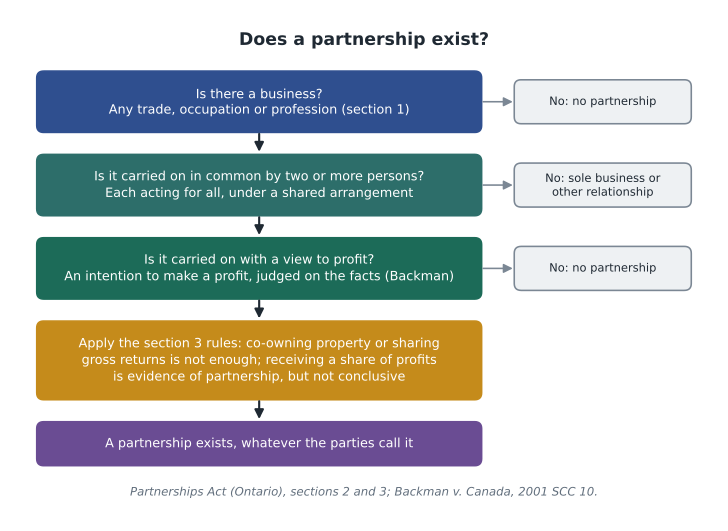
Walter's loan to Lakeshore is a classic section 3 problem. He received a share of profits, which is evidence of partnership. Whether he falls within the protection for a lender depends on whether there was a written contract signed by the parties and whether he took part in running the business. If he simply received a cheque each year and stayed out of the shop, a court would probably hold he was a lender. If he attended meetings, chose suppliers and introduced himself to customers as an owner, the evidence would point the other way. Okwuosa tells the class to read the facts before reaching for the rule.
Partners as agents: binding the firm
Under section 6 of the Act, every partner is an agent of the firm and of the other partners for the purpose of the business of the partnership. The acts of a partner who does any act for carrying on, in the usual way, business of the kind carried on by the firm bind the firm and the other partners. There are two exceptions: where the partner in fact has no authority to act for the firm in the particular matter, and the person dealing with the partner either knows that the partner lacks authority or does not know or believe them to be a partner.
The rule protects people who deal with partners in the ordinary way. When Margot signed the 1993 lease for a larger shop, she was acting in the usual way of a furniture business, so the firm and Henry were bound even though Henry had not agreed. Internal restrictions on a partner's authority bind third parties only if they know of them. Conversely, a partner who acts outside the usual course of the business, such as by guaranteeing a friend's personal loan in the firm's name, does not bind the firm unless the other partners actually authorized it.
The liability of partners
Under section 10, every partner is liable jointly with the other partners for all debts and obligations of the firm incurred while they are a partner. Under sections 11 to 13, where loss or injury is caused to a person not a partner by the wrongful act or omission of a partner acting in the ordinary course of the firm's business, or with the authority of the co-partners, the firm is liable to the same extent as the partner who acted, and the partners are liable jointly and severally. The same applies where a partner, acting within their apparent authority, receives and misapplies money or property of a third person.
In practical terms, a creditor or injured person usually sues the firm in the firm's name and the partners individually. Firm assets are used first, and if they are not enough, the creditor can enforce against the personal assets of the partners. A partner who pays more than their share can seek contribution from the others. A new partner is not liable for debts incurred before joining, and a retiring partner remains liable for debts incurred while they were a partner. A retiring partner can also remain liable for debts incurred after retirement to people who dealt with the firm before and did not receive notice of the change, which is why departing partners give notice to clients and publish it.
Section 15 adds liability by holding out. Anyone who, by words or conduct, represents themselves, or knowingly allows themselves to be represented, as a partner is liable as a partner to anyone who has given credit to the firm on the faith of that representation. When Henry told the bank in 1997 that Walter was 'our new partner', he created a holding-out problem for Walter regardless of what the loan agreement said.
The relations of partners to one another
The partnership agreement, whether written or oral, governs the relations of the partners among themselves, and it can be changed by the consent of all partners, express or inferred from a course of dealing. Where the agreement is silent, section 24 of the Act supplies default rules. All partners share equally in capital and profits and contribute equally to losses. The firm must indemnify a partner for payments and personal liabilities incurred in the ordinary and proper conduct of the business. A partner who advances money beyond their agreed capital is entitled to interest. Every partner may take part in management. No partner is entitled to remuneration for acting in the business. No new partner may be introduced without the consent of all existing partners. Ordinary matters are decided by a majority of the partners, but no change in the nature of the business may be made without the consent of all.
The default rule of equal sharing surprises many clients. If Henry contributed the shop, the tools and twenty years of goodwill, and Margot contributed only her labour, they would still share profits equally in the absence of an agreement to the contrary. That is one of the strongest reasons for a written partnership agreement.
Partners also owe each other duties of good faith. Sections 28 to 30 require partners to render true accounts and full information of all things affecting the partnership, to account for any benefit derived from any transaction concerning the partnership or from use of its property, name or business connection, and not to compete with the firm without the consent of the other partners. Courts describe the relationship as fiduciary. A partner who secretly diverts a firm opportunity to themselves must account to the firm for the profit.
Dissolution
A partnership is dissolved, subject to any agreement between the partners, on the expiry of a fixed term, on the completion of the single venture for which it was formed, and, if the partnership is for an undefined time, by any partner giving notice to the others of an intention to dissolve. It is also dissolved by the death or insolvency of any partner, unless the agreement provides otherwise, and by any event that makes it unlawful for the business to be carried on. A court may order dissolution on application in cases such as a partner's permanent incapacity, conduct prejudicial to the business, persistent breach of the agreement, the business being carried on only at a loss, or where it is just and equitable to dissolve.
On dissolution, the partners' authority continues so far as necessary to wind up the firm's affairs. Firm property is applied first to paying the firm's debts to outsiders, then to repaying partners' advances, then to returning partners' capital, and any remainder is divided in the proportion in which profits were divisible. Because the death of a partner dissolves a partnership by default, a well-drafted agreement provides for continuation and for buying out the deceased partner's estate, often funded by life insurance.
When Henry and Margot incorporated in 2004, the partnership was dissolved by agreement. They transferred its assets to the new corporation in exchange for shares, using a provision of the Income Tax Act that allows such transfers to be made on a tax-deferred basis if the proper election is filed. A lawyer and an accountant handled the transfer together.
Worked problem
Was Rohan a partner in Lakeshore Direct?
In the hypothetical, Claire Bellamy and Rohan Iyer took 180 pre-orders for flat-pack chairs under the name 'Lakeshore Direct' between July and September 2026, splitting the profits equally. Rohan signed a one-year contract with a web-hosting company in the firm's name. Claire then decides to stop and asks whether she is bound by the hosting contract, and whether she is liable to a customer whose chair broke.
Show solution
- Existence: Claire and Rohan carried on a business in common (both worked on it and shared control) with a view to profit (they split profits). A partnership almost certainly exists under section 2, regardless of labels.
- The hosting contract: under section 6, Rohan was an agent of the firm. Signing a web-hosting contract is done in the usual way of an online business, so the firm and Claire are bound unless the host knew Rohan lacked authority.
- Liability: under section 10, Claire is jointly liable for the firm's contracts, including the hosting contract. For the customer's injury, if it arises from a wrongful act in the ordinary course of business, both partners are jointly and severally liable under sections 11 and 13.
- Ending it: the partnership is for an undefined time, so either partner may dissolve it by notice. Authority continues for winding up; Claire should give notice to suppliers and customers to limit post-dissolution liability.
- Advice: document the dissolution in writing, settle the hosting contract, notify customers, and check insurance for the broken chair claim.
Common mistakes
MistakeConcluding that no partnership exists because the parties never used the word "partner".
InsteadLabels are relevant but not decisive; the court looks at whether the statutory definition is met on all the facts.
MistakeTreating receipt of a share of profits as automatically making someone a partner.
InsteadUnder section 3 it is evidence of partnership, and some recipients, such as lenders under a written contract or employees, are protected.
MistakeAssuming partners share profits in proportion to what they contributed.
InsteadAbsent agreement, section 24 provides that partners share capital and profits equally.
MistakeThinking a retiring partner escapes all later liability once they leave.
InsteadA retiring partner can remain liable to people who dealt with the firm before and had no notice of the change.
Practice problems
Work each problem on paper first, then reveal the answer to check.
State the three elements of the statutory definition of partnership.
Show answer
A business, carried on in common by two or more persons, with a view to profit.
Why did the Supreme Court find no partnership in Backman but find one in Spire Freezers?
Show answer
In Backman the arrangement existed only to transfer tax losses, with no genuine intention to carry on business for profit; in Spire Freezers there was a real business carried on with a view to profit, and an additional tax motive did not defeat the partnership.
When does a partner's act fail to bind the firm under section 6?
Show answer
When the partner had no actual authority in the matter and the third party knew of the lack of authority, or did not know or believe the person to be a partner; also when the act is outside the usual course of the firm's business.
Name three events that dissolve a partnership by default.
Show answer
Expiry of a fixed term or completion of the venture; notice by a partner where the partnership is for an undefined time; and the death or insolvency of a partner.
Summary and key terms
- A partnership is the relation between persons carrying on a business in common with a view to profit; no agreement or filing is required.
- Backman and Spire Freezers make existence a question of fact; a genuine intention to profit is needed, though profit can be an ancillary purpose.
- Section 3 says co-ownership and sharing gross returns do not by themselves create a partnership, while sharing profits is evidence of one.
- Every partner is an agent of the firm; acts in the usual course of business bind the firm and the other partners.
- Partners are jointly liable for firm debts and jointly and severally liable for wrongs in the ordinary course of business; holding out can create liability.
- Absent agreement, partners share equally, may all manage and owe fiduciary duties; partnerships dissolve on notice, death, insolvency or court order.
- Partnership
- The relation between persons carrying on a business in common with a view to profit.
- View to profit
- A genuine intention to make a profit from the business, which may be an ancillary rather than the main purpose.
- Holding out
- Representing, or allowing oneself to be represented as, a partner, creating liability to those who rely on it.
- Joint liability
- Liability shared by all partners together for the firm's debts and obligations.
- Joint and several liability
- Liability under which each partner can be held responsible for the whole of a loss caused by a partner's wrong.
- Dissolution
- The end of the partnership relation, followed by the winding up of the firm's affairs.
Lesson quiz · 5 questions
Score 60% or more to complete this lesson.
Create a free account to save your progress, take quizzes and earn a certificate.