
LAWC-204 · Lesson 5 of 12 · 22 min
Corporate capacity, agents and liability
▶ Video coming soon A video version of this lesson is on the way.
Two events in the hypothetical keep Lakeshore's lawyers busy one autumn. First, Lakeshore's sales manager, Deepak Arora, signs a three-year exclusive supply contract with a hotel chain to furnish 400 rooms, at prices below Lakeshore's costs. Lakeshore's by-laws say contracts over 250,000 dollars need two signatures, one of them the president's. Margot never signed. The hotel chain wants the contract performed. Second, a maintenance worker, Lyle Pettigrew, loses two fingers to an unguarded saw in the finishing shop. A supervisor had disabled the guard to speed up production, and the plant manager had been told about it twice. The Ministry of Labour is investigating, and the police have asked questions about criminal negligence. 'One company, two kinds of liability,' Okwuosa says. 'Both come down to the same puzzle. A corporation has no hands and no mind. It can only act through people. So whose acts count as the corporation's?'
This lesson covers how a corporation acquires rights and obligations through its agents, when the people who act for it become personally liable, and how the criminal law attributes fault to a corporation.
Capacity: the end of ultra vires
Under section 15 of the CBCA and section 15 of the OBCA, a corporation has the capacity and the rights, powers and privileges of a natural person. Older corporate law used the doctrine of ultra vires: a company incorporated for stated objects had no capacity to do anything outside them, and contracts outside those objects were void. The modern statutes abolished that doctrine. A corporation's articles may restrict the business it carries on, but section 16 of the CBCA and section 17 of the OBCA provide that no act of a corporation, including a transfer of property, is invalid by reason only that it is contrary to its articles, by-laws or a unanimous shareholder agreement. A restriction binds the directors, who may be liable for breaching it, and shareholders can seek to restrain a proposed act, but outsiders are protected.
The statutes also abolished the doctrine of constructive notice, under which outsiders were deemed to know the contents of a company's public documents. Section 17 of the CBCA and section 18 of the OBCA provide that no person is affected by or deemed to have notice or knowledge of the contents of a document concerning a corporation merely because it has been filed or is available for inspection.
Directors, officers and agents
A corporation's structure divides power among three groups. Shareholders elect directors, approve fundamental changes and receive the financial benefits of ownership, but they do not manage the business. Directors manage, or supervise the management of, the business and affairs of the corporation, subject to any unanimous shareholder agreement (CBCA section 102; OBCA section 115). Directors usually delegate day-to-day management to officers, such as the president, chief financial officer and secretary, whom they appoint and whose duties they define. Officers in turn direct employees.
When officers and employees deal with outsiders, they act as agents of the corporation. The corporation is bound by acts within an agent's actual authority, which may be express (given by the board or a superior) or implied (incidental to the agent's position). It is also bound by acts within the agent's apparent or ostensible authority, which arises when the corporation represents to the outsider, by words or conduct, that the agent has authority, and the outsider relies on that representation. The leading English case, Freeman and Lockyer v. Buckhurst Park Properties (Mangal) Ltd., [1964] 2 Q.B. 480 (C.A.), held a company bound by contracts made by a director the board had allowed to act as managing director, though he was never appointed. Canadian courts apply the same principles. Appointing someone to a position, such as sales manager, represents that they have the authority usually held by people in that position.
The indoor management rule
Outsiders cannot see inside a corporation to check whether every internal procedure was followed. The indoor management rule, which began in Royal British Bank v. Turquand (1856) and is now codified in section 18 of the CBCA and section 19 of the OBCA, protects them. A corporation may not assert against a person dealing with it, or with someone who acquired rights from it, that its articles, by-laws or any unanimous shareholder agreement were not complied with, that a person held out as a director, officer or agent was not properly appointed or lacked the authority usually incidental to the position, or that a document issued by an officer with actual or usual authority is not valid. The protection does not apply where the person had, or ought to have had, knowledge to the contrary because of their position with or relationship to the corporation.
Applying these rules to the hotel contract, the question is whether a sales manager in a furniture business would usually have authority to sign a contract of this size and kind. If the hotel chain had no reason to know of the two-signature by-law, the indoor management rule prevents Lakeshore from relying on it. But a three-year exclusive contract worth more than two million dollars, at below-cost prices, might be outside the authority usually incidental to a sales manager's position, and a sophisticated hotel chain might be expected to ask who could sign. The answer turns on the facts, including how Lakeshore had dealt with the chain before. If Deepak exceeded his authority, Lakeshore is not bound, and the hotel chain may sue Deepak personally for breach of warranty of authority.
Personal liability of directors and officers in tort
Directors and officers who act for a corporation are not normally personally liable for the corporation's contracts. But they do not escape liability for their own torts just because they acted in the course of their duties. Two decisions of the Court of Appeal for Ontario frame the law. In ScotiaMcLeod Inc. v. Peoples Jewellers Ltd. (1995), 26 O.R. (3d) 481, the court held that officers and directors who act in good faith within the scope of their authority are not personally liable unless their conduct is itself tortious or exhibits a separate identity or interest from that of the corporation, so as to make the act their own. In ADGA Systems International Ltd. v. Valcom Ltd. (1999), 43 O.R. (3d) 101, the court made clear that this does not shield directors and officers from liability for torts they personally commit: a director or employee who personally commits a tort, such as deceit, negligent misrepresentation, conversion or inducing breach of contract with a third party, is liable even if they acted in what they believed was the corporation's best interests.
There is a narrow exception from Said v. Butt, [1920] 3 K.B. 497. Officers and directors who cause their own corporation to breach a contract with a third party, while acting in good faith within the scope of their authority, are generally not personally liable for inducing that breach. The rationale is that the corporation can act only through them, and holding them liable would make every decision not to perform a contract a personal tort.
For Lyle's injury, the supervisor who disabled the guard could be personally liable in negligence, though in Ontario a worker covered by the Workplace Safety and Insurance Act generally cannot sue the employer or co-workers and instead receives benefits from the workplace insurance system. That statutory bar is a reminder that tort principles often operate inside a regulatory framework.
Corporate criminal liability: the identification doctrine
Criminal law usually requires a guilty mind. How can a corporation have one? The Supreme Court of Canada answered in Canadian Dredge and Dock Co. v. The Queen, [1985] 1 S.C.R. 662, a bid-rigging case arising from dredging contracts in the Great Lakes. The Court adopted the identification doctrine: the acts and state of mind of a person who is a 'directing mind' of the corporation, meaning someone with authority to set policy in the relevant area of the corporation's operations, are treated as the acts and mind of the corporation itself. A directing mind could be a director, an officer or even a manager with policy-making authority over a region or function.
The Court also set limits. The corporation is not liable if the directing mind's actions were totally in fraud of the corporation, intended to benefit only the individual, and of no benefit to the corporation. The doctrine was criticized as too narrow for large organizations, because it often failed to reach crimes committed by middle managers who did not set policy, and as poorly suited to crimes of negligence committed through the combined failures of many employees.
The Westray reforms: sections 22.1 and 22.2
On May 9, 1992, an explosion at the Westray coal mine in Plymouth, Nova Scotia, killed twenty-six miners. A public inquiry found that management had ignored obvious and repeated safety hazards. Criminal charges against the company and two managers collapsed. In response, Parliament enacted Bill C-45, which came into force on March 31, 2004 and amended the Criminal Code to replace the identification doctrine for 'organizations', a term that includes corporations, partnerships, trade unions and other associations.
The Code now distinguishes between two kinds of offences. Under section 22.1, for offences of negligence, an organization is a party if a representative (which includes directors, partners, employees, members, agents and contractors), or two or more representatives together, commit the act or omission, and the senior officer responsible for that aspect of the organization's activities departs markedly from the standard of care that could reasonably be expected to prevent it. Under section 22.2, for offences requiring fault other than negligence, such as fraud, an organization is a party if, with intent at least in part to benefit the organization, a senior officer is a party to the offence, or directs representatives so that they commit it, or knowing a representative is or is about to be a party, fails to take all reasonable measures to stop them. A 'senior officer' is a representative who plays an important role in establishing the organization's policies or is responsible for managing an important aspect of its activities, and in the case of a corporation includes directors, the chief executive officer and the chief financial officer.
Bill C-45 also added section 217.1, which provides that everyone who undertakes, or has the authority, to direct how another person does work or performs a task is under a legal duty to take reasonable steps to prevent bodily harm to that person, or any other person, arising from that work or task. Breach of that duty can ground a charge of criminal negligence. The Code also added sentencing factors for organizations in section 718.21 and allows courts to impose probation orders requiring organizations to adopt policies and appoint officers to oversee compliance.
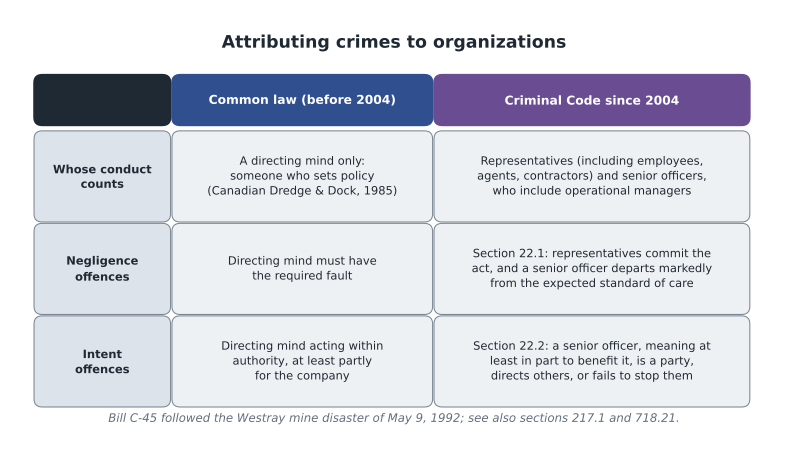
In Lyle's case, the plant manager is likely a senior officer, because he is responsible for managing an important aspect of Lakeshore's activities. If the supervisor's disabling of the guard and the plant manager's failure to act after two warnings amount to a marked departure from the standard of care, Lakeshore could face a charge of criminal negligence causing bodily harm under section 22.1, and the supervisor and plant manager could face charges personally under section 217.1. Far more commonly, the province would prosecute under the Occupational Health and Safety Act, a regulatory offence of strict liability for which, as LAWC-103 explained, due diligence is a defence.
Remediation agreements
Since 2018, Part XXII.1 of the Criminal Code has allowed prosecutors to negotiate remediation agreements with organizations accused of certain economic crimes, such as fraud and bribery of foreign public officials. Under such an agreement, approved by a court, the organization admits responsibility, pays penalties, makes reparations and often accepts an independent monitor, and the prosecution is stayed if it complies. The first remediation agreement was approved by the Quebec Superior Court in 2022 in a case involving SNC-Lavalin. These agreements reflect a policy that the criminal law should push organizations to reform, while recognizing that convicting a corporation can punish employees, pensioners and shareholders who did nothing wrong.
Worked problem
Is Lakeshore bound by the hotel contract?
Using the hypothetical facts above, Lakeshore's board meets to decide whether to perform the hotel contract signed by sales manager Deepak Arora alone, in breach of the two-signature by-law.
Show solution
- Actual authority: the by-law limits Deepak's actual authority to contracts under 250,000 dollars. He had no express authority for this contract.
- Apparent authority: did Lakeshore represent that Deepak could sign? Appointing him sales manager represents the authority usually incidental to that role. Ask whether such authority usually extends to a three-year exclusive contract worth over two million dollars.
- Indoor management rule: Lakeshore cannot rely on its own by-law against the hotel chain unless the chain knew or ought to have known of it, for example because it had seen the two-signature rule on earlier contracts.
- Prior dealings: if earlier contracts with the chain were all signed by Margot and Deepak together, the chain may have been put on notice; if Deepak had signed large contracts alone before and Lakeshore performed them, apparent authority is stronger.
- Consequences: if Lakeshore is bound, it must perform or pay damages and may discipline Deepak; if not, the chain's claim is against Deepak for breach of warranty of authority.
Common mistakes
MistakeTreating a contract outside a corporation's stated business as void.
InsteadThe ultra vires doctrine is abolished; acts contrary to the articles are not invalid for that reason alone (CBCA s. 16; OBCA s. 17).
MistakeAssuming directors and officers are never personally liable for torts committed while working for the corporation.
InsteadUnder ADGA, those who personally commit a tort are liable, subject to the Said v. Butt exception for causing the corporation to breach its own contract in good faith.
MistakeApplying the Canadian Dredge identification doctrine to every corporate crime today.
InsteadSince 2004, sections 22.1 and 22.2 of the Criminal Code govern the criminal liability of organizations.
MistakeThinking the indoor management rule protects someone who knew of the internal irregularity.
InsteadThe rule does not protect a person who knew or ought to have known of the lack of authority or non-compliance.
Practice problems
Work each problem on paper first, then reveal the answer to check.
What capacity does a CBCA or OBCA corporation have?
Show answer
The capacity and the rights, powers and privileges of a natural person.
What does the indoor management rule prevent a corporation from asserting?
Show answer
That its articles, by-laws or unanimous shareholder agreement were not complied with, that a person held out as a director, officer or agent was not duly appointed or lacked usual authority, or that a document issued with usual authority is invalid, unless the outsider knew or ought to have known otherwise.
Under section 22.1, when is an organization a party to a negligence offence?
Show answer
When a representative, or representatives together, commit the act or omission and the responsible senior officer departs markedly from the standard of care that could reasonably be expected to prevent it.
What duty does section 217.1 of the Criminal Code impose?
Show answer
Anyone who directs how another person does work must take reasonable steps to prevent bodily harm to that person or others arising from the work.
Summary and key terms
- Corporations have the capacity of a natural person; ultra vires and constructive notice are abolished by statute.
- Directors manage or supervise management; officers and employees act as agents with actual or apparent authority.
- The indoor management rule (CBCA s. 18; OBCA s. 19) protects outsiders from internal irregularities unless they knew or ought to have known of them.
- Directors and officers are personally liable for torts they personally commit (ADGA), subject to the Said v. Butt exception.
- Canadian Dredge (1985) attributed the acts of a directing mind to the corporation; after Westray, sections 22.1 and 22.2 of the Criminal Code govern organizational liability.
- Section 217.1 creates a duty on those who direct work to prevent bodily harm; remediation agreements offer an alternative to prosecution for some economic crimes.
- Ultra vires
- Beyond the powers of a corporation; the doctrine voiding such acts is abolished in Canadian business corporations law.
- Apparent authority
- Authority an agent appears to have because of the principal's representations, on which an outsider relies.
- Indoor management rule
- The rule that outsiders dealing in good faith need not check a corporation's internal compliance.
- Directing mind
- Under the identification doctrine, a person whose acts and mind are treated as the corporation's.
- Senior officer
- Under the Criminal Code, a representative who plays an important role in setting an organization's policies or manages an important aspect of its activities.
- Remediation agreement
- A court-approved agreement under which prosecution of an organization for certain economic crimes is stayed if it complies with conditions.
Lesson quiz · 5 questions
Score 60% or more to complete this lesson.
Create a free account to save your progress, take quizzes and earn a certificate.