
LAWC-204 · Lesson 8 of 12 · 28 min
Directors' statutory liabilities
▶ Video coming soon A video version of this lesson is on the way.
In the hypothetical, Lakeshore's purchase of Tamarack Millwork Ltd. in March 2026 has gone badly, as the last lesson described. By October 2026, Tamarack has lost its largest customer, faces a clean-up order for its creek-side factory and is running out of cash. Tamarack's directors are Margot Bellamy, Simon Bellamy and Tamarack's general manager, Petra Lindgren, who stayed on after the sale. On November 2, Petra tells Margot that Tamarack paid its forty employees in September and October but did not send the income tax, Canada Pension Plan and employment insurance amounts it withheld from their pay to the Canada Revenue Agency, and has not remitted HST for the third quarter. The November payroll, due in two weeks, cannot be met at all. Margot's first instinct is to resign from Tamarack's board. Simon asks Professor Okwuosa whether resigning will help. 'It may,' Okwuosa says, 'but not as much as you hope, and not for the amounts already owing.'
The separate legal personality of the corporation, studied in lesson 4, means that directors are not ordinarily liable for the corporation's debts. But legislatures have made exceptions for certain debts that society considers especially important: wages owed to employees, taxes the corporation collects or withholds on behalf of the government, and some regulatory obligations such as environmental and workplace safety duties. These liabilities are personal, joint and several, and often not covered by insurance or indemnity when the corporation itself is insolvent. They are the main reason experienced business people hesitate before joining the board of a struggling company.
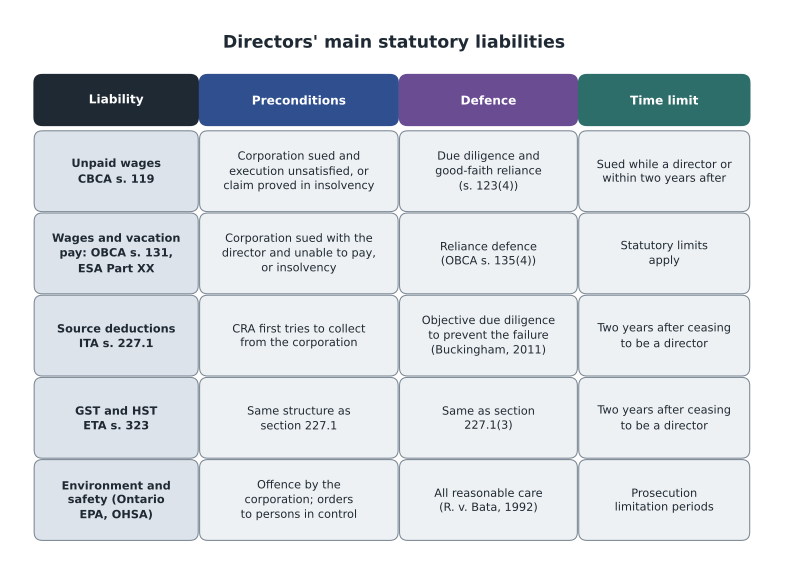
Unpaid wages under corporate statutes
Section 119(1) of the CBCA makes directors jointly and severally liable to employees for all debts not exceeding six months' wages payable to each employee for services performed for the corporation while they are directors. The liability is limited in several ways. Under section 119(2), a director is liable only if the corporation has been sued for the debt within six months after it became due and execution has been returned unsatisfied in whole or in part; or the corporation has started liquidation and dissolution proceedings or been dissolved, and a claim for the debt has been proved within six months; or the corporation has made an assignment or a bankruptcy order has been made against it, and a claim has been proved within six months. Under section 119(3), a director is liable only if sued while a director or within two years after ceasing to be one. And under section 123(4), a director who exercised the care, diligence and skill of a reasonably prudent person in comparable circumstances is not liable under section 119.
What counts as wages? In Barrette v. Crabtree Estate, [1993] 1 S.C.R. 1027, the Supreme Court held that the CBCA provision covers amounts owed for services actually performed, not damages for wrongful dismissal or pay in lieu of reasonable notice. Those are compensation for the employer's breach of contract, not debts for services performed. Ontario courts reached the same conclusion under the OBCA in Mills-Hughes v. Raynor (1988), 63 O.R. (2d) 343 (C.A.). Regular salary, overtime and, in Ontario, vacation pay are covered; damages for termination are not.
The OBCA is somewhat broader. Section 131(1) makes directors jointly and severally liable to employees for all debts not exceeding six months' wages for services performed while they are directors, and for vacation pay accrued while they are directors for not more than twelve months under the Employment Standards Act, 2000 and its regulations or under any collective agreement. The preconditions in section 131(2) are somewhat easier for employees than the CBCA's: the director is liable if the corporation is sued in the same action and cannot pay, or if the corporation goes into liquidation, is ordered wound up or becomes bankrupt and the claim is proved, without the CBCA's requirement of a separate earlier judgment against the corporation. Section 135(4) of the OBCA gives directors a reliance defence parallel to the CBCA's.
Unpaid wages under employment standards legislation
Employees of an Ontario business have a second route. Part XX of the Employment Standards Act, 2000 makes directors of a corporate employer jointly and severally liable for unpaid wages up to six months and vacation pay up to twelve months, subject to conditions such as the employer's insolvency or the failure of collection efforts against it. An employment standards officer can issue an order to pay directly against directors, which is a quicker remedy than a lawsuit. Employees cannot recover twice for the same debt, but they can choose whichever route is most practical. Termination pay and severance pay under the ESA are generally not part of the directors' liability for wages, consistent with the corporate statute cases.
For Tamarack's employees, the September and October wages were paid, so no director liability arises for those months. If the November payroll is missed, Margot, Simon and Petra will each be exposed for those wages and for any accrued vacation pay, whether or not they resign, because the services were performed while they were directors. A director who resigns stops accumulating new liability for wages earned after the resignation, but remains liable for what accrued before it.
Source deductions: Income Tax Act section 227.1
The largest and most common source of personal liability for Canadian directors is unremitted source deductions. An employer must withhold income tax from employees' pay under section 153 of the Income Tax Act, and Canada Pension Plan contributions and employment insurance premiums under those statutes, and remit them to the Receiver General. These amounts belong to the employees and the Crown, not the corporation. Under subsection 227(4) and (4.1), they are deemed to be held in trust for the Crown, separate from the corporation's property, and the trust survives even bankruptcy.
When a corporation fails to deduct, withhold or remit, section 227.1(1) makes its directors at the time jointly and severally liable, together with the corporation, for the amount and any interest and penalties. The Canada Pension Plan (section 21.1) and the Employment Insurance Act (section 83) apply the Income Tax Act provision to their contributions and premiums. The CRA must first try to collect from the corporation: under section 227.1(2), a director is not liable unless a certificate for the amount has been registered in the Federal Court and execution returned unsatisfied, or the corporation has started liquidation or dissolution or been dissolved and a claim has been proved within six months, or the corporation has gone bankrupt and a claim has been proved within six months. Under section 227.1(4), no assessment may be made more than two years after the person last ceased to be a director.
The due diligence defence
Section 227.1(3) provides that a director is not liable for a failure if the director exercised the degree of care, diligence and skill to prevent the failure that a reasonably prudent person would have exercised in comparable circumstances. Earlier cases, following Soper v. Canada (1997, Federal Court of Appeal), applied a standard that was partly objective and partly subjective, taking account of each director's own knowledge and experience, and often treated inside directors involved in management more strictly than outside directors.
In Canada v. Buckingham, 2011 FCA 142, the Federal Court of Appeal held that, after Peoples, the standard is objective. The question is what a reasonably prudent person would have done in comparable circumstances, taking account of the circumstances of the corporation, but not the director's personal shortcomings. Two further points from Buckingham are crucial. First, the defence requires that the director have taken positive steps to prevent the failure to remit; efforts made after the failure to cure it do not count. Second, a director who knows the corporation is in financial difficulty must be especially vigilant, because the risk of failure to remit is greatest when cash is short. In Buckingham, the director had made efforts to keep the business afloat, but those efforts were aimed at the survival of the company, not at ensuring remittances were made, and the defence failed. A director may not decide to pay suppliers or other creditors in order to keep the business going while letting the Crown's trust money go unremitted.
What does prevention look like? Boards of companies under strain typically adopt measures such as requiring management to certify at each board meeting that all source deductions and taxes have been remitted, putting withheld amounts into a separate trust account on each payday, having the bank send remittances directly, and instructing that payroll not be run without the corresponding remittance. A director who asks the right questions, gets assurances, and acts when warning signs appear may succeed in the defence. A director who simply trusts the general manager, as Margot and Simon have done at Tamarack, will probably not.
GST and HST: Excise Tax Act section 323
The same structure applies to GST and HST. A registered business collects tax from its customers on taxable supplies, and must remit its net tax, after input tax credits, to the CRA. Under section 222 of the Excise Tax Act, collected tax is deemed held in trust for the Crown. Section 323 makes directors jointly and severally liable for the corporation's failure to remit net tax, subject to preconditions on prior collection from the corporation (section 323(2)), a due diligence defence in identical terms to the Income Tax Act's (section 323(3)), and a two-year limitation after ceasing to be a director (section 323(5)). The Buckingham analysis applies equally under the Excise Tax Act; indeed the appeal in Buckingham involved both statutes.
Who is a director for these purposes?
Statutory liability attaches to directors, and the courts look at substance as well as form. A person properly elected or appointed is a director in law (de jure). A person who has not been formally appointed, or whose appointment is defective, but who acts as a director and is held out as one, may be treated as a director in fact (de facto). In Canada v. Corsano, [1999] 3 F.C. 173 (C.A.), the Federal Court of Appeal accepted that de facto directors can be liable under section 227.1. Officers who are not directors are generally not caught by section 227.1, and shareholders are not caught at all, unless a unanimous shareholder agreement transfers directors' powers to them; then they take on directors' liabilities to that extent (CBCA section 146(5); OBCA section 108(5)).
Resigning
A director may resign by sending a written resignation to the corporation, effective when sent or at a later time specified (CBCA section 108(2); OBCA section 121(2)). The corporation must then file a notice of change of directors with the government within fifteen days (CBCA section 113), and an Ontario corporation must file its own notice. A careful resigning director keeps a copy of the resignation and proof of delivery, because the two-year limitation periods under the tax statutes run from the date the person ceased to be a director, and the date can be disputed years later.
Resignation has limits. It does not relieve a director of liabilities that arose while the director held office. It does not stop liability if the person continues to act as a director in fact, for example by continuing to sign cheques or make decisions. And for a director with real knowledge of the business, resigning at the moment of crisis may leave employees and the Crown without anyone responsible to sort things out. For Margot, resigning now would not touch the September and October source deductions or the third quarter HST, which are already unremitted; it would only limit exposure for later periods. The better course is usually to address the problem directly while still in office.
Other regulatory liabilities
Directors also have personal duties under many regulatory statutes, which are typically framed as offences rather than debts. Ontario's Occupational Health and Safety Act, section 32, requires every director and officer of a corporation to take all reasonable care to ensure that the corporation complies with the Act, its regulations and orders. Ontario's Environmental Protection Act, section 194, imposes a similar duty to take all reasonable care to prevent the corporation from discharging contaminants in breach of the Act and from failing to comply with certain orders. In R. v. Bata Industries Ltd. (1992), 9 O.R. (3d) 329 (Prov. Div.), directors of a shoe manufacturer were convicted after chemical waste was stored improperly and leaked at a plant; the court considered whether they had a pollution prevention system, monitored it, received reports and acted promptly on problems. Environmental orders may also be issued against directors and officers personally as persons with management or control of a property or undertaking, and those orders can require costly work. For Tamarack's directors, the clean-up order on the creek-side factory is a further risk that a reasonably prudent director would want to understand at once.
Finally, other parts of corporate law impose personal liability for particular decisions. Under CBCA section 118(2), directors who vote for or consent to a resolution authorizing a dividend, a purchase or redemption of shares, or certain other payments, when the solvency tests in the Act are not met, are liable to restore the amounts to the corporation. Section 130 of the OBCA is similar. Ontario's Securities Act imposes civil liability on directors for misrepresentations in a reporting issuer's prospectus or continuous disclosure, a topic for lesson 11.
Insolvency and the directors' charge
When a corporation restructures under the Companies' Creditors Arrangement Act or makes a proposal under the Bankruptcy and Insolvency Act, directors often want to resign to avoid further statutory liability, which would leave the business leaderless at the worst moment. To keep them in place, the court may grant a directors' charge over the debtor's property, securing an indemnity for obligations and liabilities directors incur after the proceedings begin (CCAA section 11.51; BIA section 64.1). The charge does not cover liabilities arising from gross negligence or wilful misconduct, and it is not available to the extent adequate insurance exists. Restructuring legislation also allows a plan to compromise some claims against directors, but not claims for misrepresentation or wrongful or oppressive conduct.
Advising Tamarack's directors
Okwuosa sets the class a practical question: what should Tamarack's directors do today? The students identify the immediate exposure: the unremitted September and October source deductions and the third quarter HST are already Crown trust money, and the directors are presumptively liable for them under section 227.1 and section 323, subject to the CRA first collecting from Tamarack. Their due diligence defence is weak, because they took no steps to prevent the failures before they happened. The November wages are the next exposure, under OBCA section 131 or Part XX of the ESA, if they are not paid.
The directors should meet at once, with Tamarack's accountant and an insolvency lawyer. They should direct that all available cash first go to the employees' November pay and the corresponding remittances, establish a trust account, and require written confirmation of every remittance. They should contact the CRA about a payment arrangement for the arrears. They should ask Lakeshore, as Tamarack's parent, whether it will fund the shortfall, recognizing that Lakeshore's own directors must decide that question in Lakeshore's best interests. And they should consider whether Tamarack can be restructured or must be wound up in an orderly way, perhaps under the BIA. If any director does resign, they should do so in writing, have it recorded, ensure the notice of change is filed and stop acting as a director entirely.
Worked problem
Margot Bellamy's exposure as a director of Tamarack
In the hypothetical, Margot Bellamy has been a director of Tamarack Millwork Ltd. since Lakeshore bought it in March 2026. On November 2, 2026, she learns that Tamarack withheld but did not remit source deductions for September and October, did not remit HST for the third quarter, and cannot meet its November payroll. She asks whether she would be personally liable and whether resigning tomorrow would help.
Show solution
- Source deductions: under Income Tax Act section 227.1(1), as a director when Tamarack failed to remit, Margot is jointly and severally liable with Tamarack and the other directors, together with interest and penalties.
- Preconditions: under section 227.1(2), the CRA must first try to collect from Tamarack, by a registered certificate and unsatisfied execution, or by proving a claim in a liquidation, dissolution or bankruptcy.
- Defence: under section 227.1(3) and Buckingham, she must show objectively reasonable steps to prevent the failure; she took none before the failures, so the defence will probably fail for September and October.
- HST: Excise Tax Act section 323 imposes the same liability, preconditions and defence for the unremitted third-quarter net tax.
- Wages: if the November payroll is missed, she is liable for up to six months' wages and twelve months' vacation pay under OBCA section 131 or ESA Part XX, for services performed while she was a director.
- Resignation: resigning does not affect liabilities already incurred; it limits exposure for later periods and starts the two-year limitation under the tax statutes, provided she stops acting as a director in fact.
- Advice: stay engaged for now, direct cash to wages and remittances, set up a trust account, approach the CRA, and get insolvency advice; if she resigns, do it in writing and file the notice of change.
Common mistakes
MistakeTelling a director that resigning removes liability for unremitted source deductions.
InsteadResignation does not affect liability for failures while the person was a director; it only stops new exposure and starts the two-year limitation.
MistakeIncluding damages for wrongful dismissal in directors' liability for wages.
InsteadBarrette v. Crabtree (SCC 1993) and Mills-Hughes v. Raynor (ONCA 1988) hold that pay in lieu of notice is not a debt for services performed.
MistakeSaying the due diligence defence is satisfied by efforts to save the business.
InsteadBuckingham requires steps aimed at preventing the failure to remit, taken before it happens; keeping the business afloat is not enough.
MistakeApplying a subjective standard that excuses directors with little business experience.
InsteadAfter Buckingham, the standard under section 227.1(3) is objective.
MistakeAssuming the CRA can pursue directors before trying to collect from the corporation.
InsteadSection 227.1(2) and Excise Tax Act section 323(2) require prior collection steps or a proved claim in insolvency.
Practice problems
Work each problem on paper first, then reveal the answer to check.
What wages are directors liable for under CBCA section 119?
Show answer
Debts not exceeding six months' wages payable to each employee for services performed while they were directors, subject to collection preconditions and a two-year limit after they cease to be directors.
How does OBCA section 131 differ from CBCA section 119?
Show answer
It also covers up to twelve months of vacation pay, and its preconditions allow the corporation and the directors to be sued together rather than requiring a prior unsatisfied judgment against the corporation.
What is the limitation period for assessing a director under Income Tax Act section 227.1?
Show answer
Two years after the person last ceased to be a director.
What did Buckingham decide about the standard in section 227.1(3)?
Show answer
It is objective, as in Peoples, and requires positive steps to prevent the failure to remit before it occurs.
Who may be liable as a director even without a formal appointment?
Show answer
A de facto director, who acts as a director and is held out as one (Corsano).
What is a directors' charge in a restructuring?
Show answer
A court-ordered charge on the debtor's property securing an indemnity for liabilities directors incur after proceedings begin, excluding gross negligence or wilful misconduct.
Summary and key terms
- Statutes make directors personally liable for certain corporate obligations despite separate legal personality.
- CBCA section 119 and OBCA section 131 impose liability for up to six months' unpaid wages (and, under the OBCA, twelve months' vacation pay), subject to collection preconditions and time limits; ESA Part XX provides a parallel route.
- Damages for wrongful dismissal and pay in lieu of notice are not wages for this purpose (Barrette v. Crabtree).
- Income Tax Act section 227.1 and Excise Tax Act section 323 make directors liable for unremitted source deductions and net GST or HST, after the CRA tries to collect from the corporation and within two years after the director ceases to hold office.
- The due diligence defence is objective and requires steps to prevent the failure before it happens (Buckingham, 2011 FCA 142).
- De facto directors can be liable; resignation limits future exposure but not past liability.
- Regulatory statutes such as Ontario's OHSA and EPA impose duties of reasonable care on directors (R. v. Bata Industries).
- In restructurings, a directors' charge can secure indemnities to keep directors in office.
- Source deductions
- Income tax, Canada Pension Plan contributions and employment insurance premiums an employer withholds from employees' pay.
- Deemed trust
- A statutory rule that withheld or collected amounts are held in trust for the Crown, separate from the corporation's property.
- Due diligence defence
- A defence for a director who took the care a reasonably prudent person would have taken to prevent the failure.
- De facto director
- A person who acts as a director and is held out as one without being validly appointed.
- Joint and several liability
- Liability under which each person liable may be required to pay the whole amount.
- Directors' charge
- A court-ordered charge on a debtor's assets securing an indemnity for directors during a restructuring.
Lesson quiz · 5 questions
Score 60% or more to complete this lesson.
Create a free account to save your progress, take quizzes and earn a certificate.