
LAWC-203 · Lesson 9 of 12 · 22 min
Character evidence
▶ Video coming soon A video version of this lesson is on the way.
Professor Quaye opens the ninth class with the question she deferred in lesson 3. 'Owen Calder was convicted of assault eight years ago, for punching a man outside a hockey game. Isn't that exactly what a jury would want to know? People who have hit before are more likely to hit again.' Hannah Kowalczyk says that is probably true as a matter of statistics. 'And that,' Quaye says, 'is precisely why the law keeps it out. The danger is not that the evidence is irrelevant. It is that it is too persuasive for the wrong reasons.'
The general rule against bad character evidence
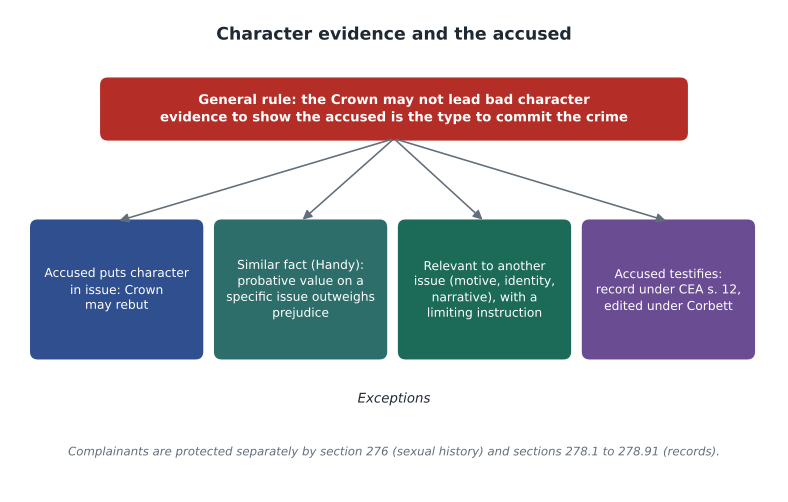
The Crown may not lead evidence of the accused's bad character, including prior misconduct, solely to show that the accused is the type of person likely to have committed the offence. This is the rule against propensity reasoning. In R. v. Handy, 2002 SCC 56, Justice Binnie explained that the rule exists not because such evidence is irrelevant, but because of the risk of moral prejudice, where the jury convicts because it thinks the accused is a bad person who deserves punishment, and reasoning prejudice, where the jury becomes distracted by the other misconduct, gives it too much weight, or is confused by a trial within a trial. The rule protects the presumption of innocence and the principle that people are tried for what they did, not for who they are.
The general rule applies to evidence of other bad acts, discreditable conduct, prior convictions and reputation. It does not bar evidence that happens to reveal bad character if the evidence is relevant to an issue in the case through a non-propensity chain of reasoning, such as motive, identity, animus, narrative, or the relationship between the accused and the victim. Even then, the trial judge must weigh probative value against prejudicial effect and give a limiting instruction.
The accused's good character
An accused may lead evidence of his good character. The evidence may be relevant to credibility, if the accused testifies, and to the likelihood that he committed the offence. Character may be proved by reputation evidence from witnesses who know his reputation in the community for the relevant trait, by the accused's own testimony about himself, and in limited circumstances by expert evidence. In R. v. Mohan, [1994] 2 S.C.R. 9, the Court held that expert evidence that the accused lacks a characteristic of a distinctive group of offenders may be admissible only if the offence was committed by a person with distinctive psychological characteristics that a recognized standard profile identifies, which is rare.
Leading good character evidence opens the door. Once the accused puts his character in issue, the Crown may rebut it by cross-examining the character witnesses, by leading reputation evidence of bad character, by leading evidence of prior convictions under section 666 of the Criminal Code, and in some cases by leading evidence of specific acts. The accused can put character in issue not only by calling character witnesses but by asserting good character in his own testimony, such as 'I am not a violent person' or 'I have never been in a fight'. In R. v. McNamara (No. 1) (1981), 56 C.C.C. (2d) 193 (Ont. C.A.), the court held that an accused who asserts his honesty and integrity puts his character in issue. Calder's counsel must therefore prepare him carefully: if Calder testifies that he 'never starts fights', the Crown will apply to lead the eight-year-old assault.
An attack on the character of a Crown witness does not itself put the accused's character in issue at common law, but it may affect the Corbett balancing for the accused's criminal record, as lesson 5 explained.
Similar fact evidence
Similar fact evidence is evidence of the accused's discreditable conduct on other occasions, offered to prove something about the conduct charged. It is presumptively inadmissible. In Handy, the Court held that the Crown must satisfy the trial judge on a balance of probabilities that, in the context of the case, the probative value of the evidence in relation to a particular issue outweighs its potential prejudice and thereby justifies its reception.
The analysis has several steps. First, identify the issue in question. Similar fact evidence is not admitted generally; it must be relevant to a specific live issue, such as identity, the actus reus, intent, or the rebuttal of a defence such as accident or innocent association. Second, assess probative value. Relevant factors include the proximity in time of the similar acts, the similarity in detail, the number of occurrences, the circumstances surrounding them, any distinctive features unifying the incidents, intervening events, and the strength of the evidence that the similar acts actually occurred. The greater the similarity and distinctiveness, the stronger the inference that the same person committed the acts or that the accused acted with a particular intent. Third, consider the possibility of collusion among witnesses; if there is an air of reality to collusion, the Crown must satisfy the judge that the evidence is not the product of collusion. Fourth, assess prejudice: moral and reasoning prejudice. Fifth, weigh the two.
In Handy, the accused was charged with sexual assault. The Crown sought to lead evidence from his former wife of seven incidents of sexual and physical abuse during their marriage, to show his propensity to insist on sex and to become violent when refused. The Court excluded the evidence. The probative value was weakened by the dissimilarities between the incidents, the possibility of collusion (the former wife had spoken to the complainant and had a financial interest in a criminal injuries claim), and the danger of moral prejudice was high.
Similar fact evidence is most often used to prove identity, where a distinctive modus operandi links the accused to the offence, or to rebut a defence of accident or coincidence. In R. v. Arp, [1998] 3 S.C.R. 339, the Court allowed the jury to consider the evidence on two murders together, with appropriate instructions, because of striking similarities in the way both victims were killed and their bodies left. In civil cases, similar fact evidence follows the same principle of balancing probative value against prejudice, with less concern for moral prejudice.
Calder's earlier assault involved punching a man outside a hockey arena after an argument. The present case involves a shove outside a bar. The Crown might argue that the prior assault rebuts self-defence by showing Calder's tendency to escalate arguments into violence. But that is exactly the general propensity reasoning that Handy forbids, and the incidents share nothing distinctive. The evidence will almost certainly be excluded.
Evidence of the complainant's character and the twin myths
The law of sexual offences has been transformed by rules limiting evidence of the complainant's sexual history. At common law, defence counsel routinely used a complainant's sexual history to suggest she was more likely to have consented or was less worthy of belief. Parliament first restricted that evidence in 1983. In R. v. Seaboyer, [1991] 2 S.C.R. 577, the Supreme Court struck down the original section 276 as overbroad because it could exclude evidence necessary to a fair defence, but the Court affirmed that the 'twin myths' are illegitimate: that because of the sexual nature of her past activity, a complainant is more likely to have consented to the sexual activity in question, or is less worthy of belief. Parliament enacted the present section 276 in 1992, and in R. v. Darrach, 2000 SCC 46, the Court upheld it.
Under section 276(1), evidence that the complainant has engaged in sexual activity, whether with the accused or another person, is not admissible to support either twin myth inference. Under section 276(2), the defence may not adduce evidence of such activity unless the judge determines, under the procedure in sections 278.93 and 278.94, that the evidence is not being adduced for a twin myth purpose, relates to a specific instance of sexual activity, is relevant to an issue at trial, and has significant probative value that is not substantially outweighed by the danger of prejudice to the proper administration of justice. Section 276(3) lists factors, including the interests of justice, the right to make full answer and defence, society's interest in encouraging reporting, the risk of discriminatory belief, prejudice to the complainant's dignity and privacy, and the right to personal security and equal protection of the law.
In R. v. Barton, 2019 SCC 33, the Court held that the section 276 regime applies to Crown-led evidence of prior sexual activity as well as defence evidence, and that trial judges must hold a voir dire whenever such evidence is led. In R. v. Goldfinch, 2019 SCC 38, the Court held that evidence that the accused and complainant were in a 'friends with benefits' relationship was inadmissible where it served only to suggest that because she had consented before, she was more likely to have consented on the occasion in question. The Court emphasized that relevance must be identified precisely and that the 'context' or 'narrative' label cannot be used to smuggle in twin myth reasoning.
In 2018, Parliament amended the regime to clarify that sexual activity includes communications made for a sexual purpose or whose content is of a sexual nature, and to create a procedure for records in the accused's possession relating to the complainant. In R. v. J.J., 2022 SCC 28, the Court upheld these amendments as constitutional, holding that the records regime in sections 278.92 to 278.94 and the complainant's participation rights strike a reasonable balance among the rights of the accused, the complainant and society.
In R. v. Kinamore, 2025 SCC 19, a unanimous Court, in reasons by Chief Justice Wagner, held that evidence of a complainant's sexual inactivity counts as sexual history and is presumptively inadmissible. The Crown had introduced earlier messages in which the complainant repeatedly said she did not want a sexual relationship with the accused, without a voir dire. The Court held that Crown-led sexual history evidence should generally follow the two-step process in sections 278.93 and 278.94, and that the error was not harmless because the credibility assessment was closely tied to the improperly admitted evidence. The conviction was quashed and a new trial ordered.
Third-party records and the complainant's private records
In sexual offence cases, the accused may seek production of records held by third parties, such as counselling, medical or school records, in which the complainant has a reasonable expectation of privacy. Sections 278.1 to 278.91 of the Criminal Code, upheld in R. v. Mills, [1999] 3 S.C.R. 668, establish a two-stage procedure: the accused must show that the record is likely relevant to an issue at trial or to the competence of a witness, and production is necessary in the interests of justice; the judge then reviews the records and decides whether to produce them, weighing the accused's right to full answer and defence against the complainant's privacy and equality rights. For other offences, the common law O'Connor regime from R. v. O'Connor, [1995] 4 S.C.R. 411, applies.
Character of third parties and the victim
The accused may sometimes lead evidence of the violent character of the victim. In a self-defence case, evidence that the victim had a reputation for violence, or had committed violent acts known to the accused, may be relevant to the reasonableness of the accused's fear. Even acts unknown to the accused may be admissible to show that the victim was likely the aggressor, subject to the trial judge's balancing, as recognized in R. v. Scopelliti (1981), 63 C.C.C. (2d) 481 (Ont. C.A.). If Calder's counsel leads evidence that Dorey had been in several bar fights, the Crown may respond with evidence of Calder's propensity for violence, because fairness requires that the jury not see a one-sided picture. Evidence that a third party had motive and propensity to commit the offence, offered to raise a reasonable doubt, may also be admissible if there is a sufficient connection to the crime, as discussed in R. v. Grant, 2015 SCC 9.
Back to Calder
Quaye summarizes the Calder character issues. The prior assault is inadmissible as propensity evidence and cannot be similar fact evidence on these facts. If Calder testifies, the Crown may seek to cross-examine on the conviction under section 12, which will turn on a Corbett application. If Calder asserts that he is not a violent person, or if his counsel leads evidence of Dorey's violent past, the door may open. 'Defence counsel,' she says, 'has to make strategic choices about character. Every good character card you play may come back to you.'
Worked problem
Is this similar fact evidence admissible?
An accused is charged with robbing a convenience store at night wearing a yellow motorcycle helmet and using a starter pistol painted silver. The Crown seeks to lead evidence that he robbed two other convenience stores in the same neighbourhood in the previous month, each time wearing a yellow motorcycle helmet and carrying a silver-painted starter pistol. The defence is identity. Admissible?
Show solution
- Issue: identity, a live issue the Crown must prove.
- Probative value: three robberies close in time and place, with distinctive shared features (yellow helmet, silver-painted starter pistol) that support an inference the same person committed them.
- The strength of the evidence linking the accused to the other robberies matters: if it is strong, the inference of identity is powerful.
- Collusion: not an issue with separate store clerks and video.
- Prejudice: moral prejudice exists but can be addressed by a limiting instruction confining use to identity.
- Under Handy, probative value on identity likely outweighs prejudice: admissible with a limiting instruction.
Common mistakes
MistakeAdmitting prior misconduct because it shows the accused is the kind of person who commits such offences.
InsteadGeneral propensity reasoning is prohibited; similar fact evidence must be tied to a specific issue (Handy).
MistakeForgetting that an accused can put character in issue through his own testimony.
InsteadAsserting good character, such as 'I'm not violent', opens the door to rebuttal.
MistakeUsing 'narrative' or 'context' to admit a complainant's sexual history.
InsteadRelevance must be identified precisely; twin myth reasoning is barred (Goldfinch).
MistakeThinking section 276 applies only to defence evidence of past sexual activity.
InsteadIt applies to Crown-led evidence too (Barton), including evidence of sexual inactivity (Kinamore).
Practice problems
Work each problem on paper first, then reveal the answer to check.
What two kinds of prejudice did Handy identify?
Show answer
Moral prejudice (convicting because the accused is a bad person) and reasoning prejudice (distraction, confusion, undue weight).
What must the Crown show to admit similar fact evidence?
Show answer
On a balance of probabilities, that its probative value on a particular issue outweighs its prejudicial effect.
What are the twin myths?
Show answer
That because of prior sexual activity the complainant is more likely to have consented, or is less worthy of belief.
What did Kinamore (2025) hold?
Show answer
Evidence of a complainant's sexual inactivity is sexual history and presumptively inadmissible; Crown-led sexual history evidence should generally go through the sections 278.93 and 278.94 procedure.
How does an accused open the door to bad character evidence?
Show answer
By leading evidence of good character, including asserting good character in his own testimony.
Summary and key terms
- The Crown may not lead bad character evidence to show propensity; the danger is moral and reasoning prejudice (Handy).
- The accused may lead good character evidence but thereby opens the door to rebuttal, including through his own testimony.
- Similar fact evidence is admissible only if its probative value on a specific issue outweighs its prejudice; similarity, proximity, distinctiveness and collusion matter (Handy; Arp).
- Section 276 bars twin myth reasoning and requires a written application and hearing for sexual history evidence; it applies to Crown evidence (Barton), communications (J.J.) and sexual inactivity (Kinamore).
- Records of complainants are governed by sections 278.1 to 278.98 (Mills; J.J.); victim and third-party character evidence is admissible in limited circumstances.
- Propensity reasoning
- Inferring guilt from the accused's disposition to commit such acts.
- Similar fact evidence
- Evidence of the accused's discreditable conduct on other occasions offered to prove a specific issue.
- Moral prejudice
- The risk of conviction because the accused seems a bad person.
- Twin myths
- The prohibited inferences that sexual history makes a complainant more likely to consent or less credible.
- Section 276 application
- The procedure for seeking admission of a complainant's sexual history.
- Putting character in issue
- Leading evidence of good character, opening the door to rebuttal.
Lesson quiz · 5 questions
Score 60% or more to complete this lesson.
Create a free account to save your progress, take quizzes and earn a certificate.