
LAWC-203 · Lesson 8 of 12 · 23 min
Confessions and evidence obtained in breach of the Charter
▶ Video coming soon A video version of this lesson is on the way.
Two days after the fight, police asked Owen Calder to come to the Corwin police station to 'clear things up'. He went voluntarily. Detective Constable Ian Mercer interviewed him for three hours in a small room. The interview was video-recorded. Calder was told he was free to leave but was not told he could call a lawyer until an hour in, when Mercer said that Dorey had died and that Calder was now under arrest for manslaughter. Calder said he wanted to speak to a lawyer, made one call to a duty counsel number, and then, back in the room, eventually said: 'Fine. I pushed him. He was mouthing off and I lost it. I didn't think he'd fall like that.' Mercer had told him that 'judges go easy on guys who own up' and that 'this is your one chance to tell your side'. Professor Quaye pauses the video. 'Is that statement admissible? There are two separate questions: the common law confessions rule, and the Charter.'
The confessions rule
At common law, a statement made by an accused to a person in authority is inadmissible unless the Crown proves beyond a reasonable doubt, on a voir dire, that it was made voluntarily. The rule applies to inculpatory and exculpatory statements alike. Its purposes are to exclude unreliable confessions, which may lead to wrongful convictions, and to protect the accused's rights and the fairness of the process. The Supreme Court restated the rule in R. v. Oickle, 2000 SCC 38.
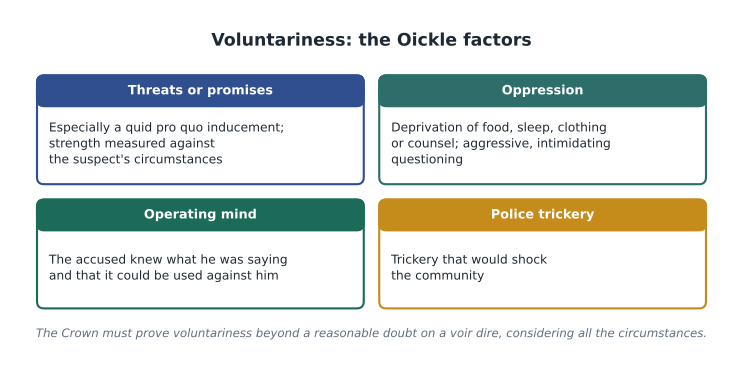
Oickle concerned a series of fires. Police interrogated the accused after a polygraph test, told him the results showed deception, minimized the seriousness of the offences, and suggested it would be better for him and his fiancée if he confessed. He confessed and later re-enacted the fires. The Court, in reasons by Justice Iacobucci, held that the confessions were voluntary. The Court explained that the voluntariness inquiry is contextual and considers several factors together.
Threats or promises. Threats and promises by police can render a statement involuntary, especially where they create a quid pro quo: a benefit in exchange for a confession. Not every inducement is fatal; the question is whether, alone or with other factors, it is strong enough to raise a reasonable doubt about whether the will of the subject was overborne. Spiritual inducements generally are not enough. Moral inducements, such as 'you'll feel better if you tell the truth', usually are not either. But offers of leniency, such as reduced charges or a lighter sentence in exchange for a confession, are problematic. Mercer's suggestion that 'judges go easy on guys who own up' edges toward an implied promise of leniency.
Oppression. Oppressive conditions, such as depriving the suspect of food, clothing, water, sleep or medical attention, denying access to counsel, excessively aggressive or intimidating questioning for a prolonged period, or the use of non-existent evidence, may produce an involuntary confession. Oppression can also make a confession unreliable because the suspect confesses simply to escape the conditions.
Operating mind. The accused must have had an operating mind. In R. v. Whittle, [1994] 2 S.C.R. 914, the Court held that this requires only a limited degree of cognitive ability: the accused must know what he is saying and that it may be used to his detriment. It does not require that the accused make a wise decision or act in his own best interests.
Police trickery. Even where a confession is otherwise voluntary, it will be excluded if police used trickery so appalling that it would shock the community. The standard is high. Police may lie about the strength of their evidence in some circumstances, but tactics such as pretending to be a chaplain or a legal aid lawyer, or injecting truth serum while pretending it is insulin, would shock the community.
Who is a person in authority?
The confessions rule applies only to statements made to a person in authority. In R. v. Hodgson, [1998] 2 S.C.R. 449, the Court held that a person in authority is a person the accused reasonably believes is acting on behalf of the state and could influence or control the proceedings against him. The test has a subjective element (the accused's belief) and an objective element (the reasonableness of that belief). Police officers and prosecutors are the typical examples; parents, employers and victims are usually not, unless they act in concert with the police or the accused reasonably believes they are. Undercover officers are not persons in authority because the accused does not know their status. Statements to friends and family, like Calder's comment at a party in lesson 7, are admissions not subject to the voluntariness rule.
The right to silence
The pre-trial right to silence is protected by section 7 of the Charter. In R. v. Hebert, [1990] 2 S.C.R. 151, the Court held that police violated section 7 by placing an undercover officer in the accused's cell to elicit a statement after the accused had told police he did not wish to speak. The right is the right to choose whether to speak to the authorities. In R. v. Singh, 2007 SCC 48, the Court held that where the person in authority is a police officer and the accused knows it, the voluntariness inquiry and the section 7 right to silence are functionally equivalent. Police may continue to question a detainee who has asserted the right to silence; persistent questioning is not in itself a breach. But a statement obtained by undermining the detainee's ability to choose may be involuntary. In Singh, the accused asserted his right to silence eighteen times; the majority held the statements admissible on the facts, while noting that the number of times the right is asserted is relevant.
The accused's exercise of the right to silence, whether before or at trial, cannot be used as evidence of guilt. In R. v. Chambers, [1990] 2 S.C.R. 1293, the Court held that the jury must not be invited to infer guilt from the accused's silence when questioned by police.
The right to counsel and the confession
Section 10(b) of the Charter gives everyone on arrest or detention the right to retain and instruct counsel without delay and to be informed of that right. Police must inform the detainee of the right, give a reasonable opportunity to exercise it, and refrain from eliciting evidence until that opportunity has been given. In R. v. Sinclair, 2010 SCC 35, the Court held that section 10(b) does not give a detainee the right to have counsel present throughout an interrogation, and generally requires only one consultation, but a renewed opportunity to consult must be given where there is a change in jeopardy, a new procedure such as a line-up, or reason to believe the detainee did not understand the initial advice.
Calder's case raises the threshold question of detention. He came voluntarily, but if a reasonable person in his position would have concluded that he was not free to leave and had to comply, he was psychologically detained, under the test in R. v. Grant, 2009 SCC 32, and R. v. Le, 2019 SCC 34. If he was detained from the start, police should have advised him of his right to counsel then. When he was arrested for manslaughter, his jeopardy changed, and he was entitled to be advised and to consult. He did consult duty counsel. Whether he understood the advice, and whether Mercer's remarks undermined it, would be explored on the voir dire.
Mr. Big confessions
In a Mr. Big operation, undercover officers pose as members of a criminal organization and draw the suspect into the group, eventually inviting him to confess to the boss in order to gain acceptance or benefits. Because the officers are not persons in authority, the confessions rule does not apply. In R. v. Hart, 2014 SCC 52, the Court created a new framework. A Mr. Big confession is presumptively inadmissible. The Crown must show on a balance of probabilities that its probative value outweighs its prejudicial effect, considering the circumstances of the confession, including the inducements offered, and any markers of reliability, such as details unknown to the public or confirmatory evidence. Separately, the accused may show that the operation was an abuse of process, for example through coercion or the exploitation of vulnerabilities. In R. v. Mack, 2014 SCC 58, the Court applied the framework and explained the jury instructions required.
Section 24(2) of the Charter
Section 24(2) provides that where evidence was obtained in a manner that infringed or denied a Charter right, it shall be excluded if it is established that, having regard to all the circumstances, its admission would bring the administration of justice into disrepute. The accused bears the burden on a balance of probabilities.
The first question is whether the evidence was obtained in a manner that infringed the Charter. A causal connection is not required; a temporal, contextual or causal connection that is not too remote may suffice. In R. v. Tim, 2022 SCC 12, police arrested the accused for possessing gabapentin, which they mistakenly believed was a controlled substance; it was not. The arrest and the searches that followed breached sections 8 and 9. The Court held that evidence found in the later searches was obtained in a manner that infringed the Charter, and it was excluded. In R. v. Beaver, 2022 SCC 54, police detained two men under non-existent legislation, realized the error at the station and tried to make a 'fresh start' by advising them of their rights and arresting them properly. A majority, in reasons by Justice Jamal, held that a fresh start can sever the connection between an earlier breach and later evidence. On the facts, the fresh start succeeded for Lambert, who confessed only after consulting counsel and understanding that he was arrested for murder, but not for Beaver, whose confession was therefore obtained in a manner that breached the Charter. The majority nonetheless held that admitting Beaver's confession would not bring the administration of justice into disrepute. Four judges dissented.
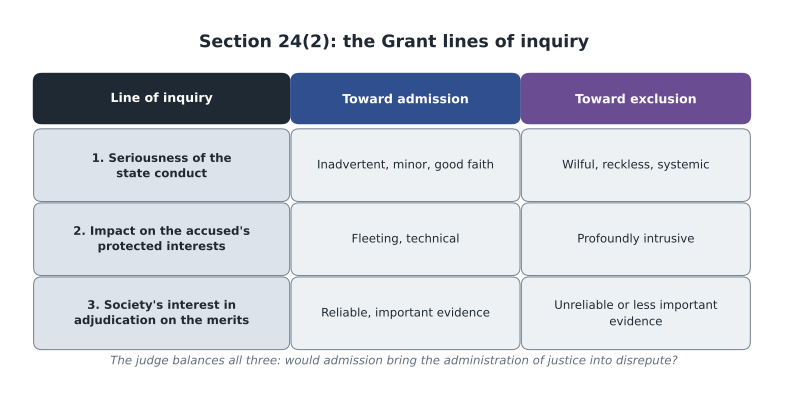
The second question is whether admitting the evidence would bring the administration of justice into disrepute. In R. v. Grant, 2009 SCC 32, the Court set out three lines of inquiry. First, the seriousness of the Charter-infringing state conduct: inadvertent or minor violations favour admission, while wilful, reckless or systemic violations favour exclusion, because the court must dissociate itself from serious misconduct. Good faith reduces seriousness, but ignorance of Charter standards or negligence is not good faith. Second, the impact of the breach on the Charter-protected interests of the accused: the more serious the intrusion, from fleeting and technical to profoundly intrusive, the more admission would bring the administration of justice into disrepute. Third, society's interest in an adjudication on the merits: the reliability of the evidence and its importance to the Crown's case. The court balances all three; no line is determinative. Where the first two lines together make a strong case for exclusion, the third line will seldom tip the balance in favour of admission, as the Court explained in R. v. Le.
Grant also noted that statements obtained in breach of the Charter tend to be excluded, because a breach of the right to counsel or the right to silence goes to the heart of the protection against self-incrimination. But exclusion is not automatic, as Beaver shows.
Applying both frameworks to Calder
Sophie Tremblay-Hart takes the voluntariness question. Mercer is a person in authority. The Crown must prove voluntariness beyond a reasonable doubt. Calder had an operating mind. The interview was three hours, with no deprivation of food or water, so oppression is unlikely. The difficult issue is Mercer's comment that 'judges go easy on guys who own up'. It is an implied promise of leniency, and Calder's confession followed shortly after. Whether it raises a reasonable doubt depends on the whole interview, but it is a serious concern.
Daniel Whitecloud takes the Charter. If Calder was detained before he was told about counsel, the first hour of questioning breached section 10(b). After arrest he was advised and consulted, which is a fresh start argument in the Crown's favour. But Mercer's leniency comments after the consultation may have undermined the advice. On section 24(2), the breach would be fairly serious, the impact on Calder's interests significant because it concerns self-incrimination, and the statement is important to the Crown but not essential, given the bouncer and the video. 'So the Crown may lose the statement on the common law rule,' Quaye says, 'and if not, on the Charter. And notice how little it may matter: if Calder concedes the push and runs self-defence, the only important words are "he was mouthing off and I lost it", which actually hurt the self-defence claim.'
Worked problem
Was the confession voluntary?
A 19-year-old suspect is interviewed at 2 a.m. after twelve hours in custody without sleep. The officer tells him, falsely, that his fingerprints were found on the weapon, and says, 'If you tell me it was an accident, I'll make sure the Crown only charges manslaughter.' The suspect confesses. Is the confession admissible?
Show solution
- The officer is a person in authority, so the Crown must prove voluntariness beyond a reasonable doubt (Oickle).
- Threats or promises: the offer to secure a lesser charge in exchange for a confession is a quid pro quo inducement of the kind Oickle identifies as most troubling.
- Oppression: twelve hours without sleep, at 2 a.m., with a young suspect, points toward oppressive conditions.
- False evidence: lying about fingerprints is not automatically fatal but adds to the pressure, especially combined with the other factors.
- Considered together, these factors very likely raise a reasonable doubt about voluntariness; the confession should be excluded.
Common mistakes
MistakeApplying the confessions rule to statements made to friends or undercover officers.
InsteadThe rule applies only to persons in authority (Hodgson); Mr. Big confessions follow Hart.
MistakeTreating any police lie as automatically making a confession involuntary.
InsteadTrickery leads to exclusion only if it would shock the community, or if it combines with other factors to raise a reasonable doubt.
MistakeAssuming that a detainee who asserts the right to silence cannot be questioned further.
InsteadPersistent questioning is not itself a breach (Singh), but it may undermine the choice to remain silent.
MistakeTreating section 24(2) as automatic exclusion.
InsteadThe accused must show that admission would bring the administration of justice into disrepute under the Grant factors.
Practice problems
Work each problem on paper first, then reveal the answer to check.
Who bears the burden on voluntariness, and to what standard?
Show answer
The Crown, beyond a reasonable doubt, on a voir dire.
List the four Oickle factors.
Show answer
Threats or promises, oppression, operating mind and police trickery that would shock the community.
What is the test for a person in authority in Hodgson?
Show answer
Someone the accused reasonably believes is acting on behalf of the state and could influence or control the proceedings.
What did Hart decide about Mr. Big confessions?
Show answer
They are presumptively inadmissible; the Crown must show probative value outweighs prejudicial effect, and the accused may also show abuse of process.
Name the three Grant lines of inquiry.
Show answer
Seriousness of the Charter-infringing state conduct, impact on the accused's Charter-protected interests, and society's interest in adjudication on the merits.
Summary and key terms
- A statement to a person in authority is admissible only if the Crown proves voluntariness beyond a reasonable doubt (Oickle).
- Oickle factors: threats or promises, oppression, operating mind (Whittle) and community-shocking trickery.
- A person in authority is someone the accused reasonably believes acts for the state (Hodgson); the right to silence is protected by section 7 (Hebert; Singh), and silence cannot be used as evidence of guilt (Chambers).
- Section 10(b) requires advice and an opportunity to consult counsel, with renewed consultation on a change in jeopardy (Sinclair).
- Mr. Big confessions are presumptively inadmissible (Hart).
- Under section 24(2), evidence obtained in a manner that infringed the Charter is excluded if admission would bring the administration of justice into disrepute, weighing the Grant lines (Tim; Beaver).
- Confessions rule
- The common law rule requiring the Crown to prove a statement to a person in authority voluntary beyond a reasonable doubt.
- Person in authority
- Someone the accused reasonably believes is acting for the state and could influence the proceedings.
- Operating mind
- Awareness of what one is saying and that it may be used against oneself.
- Mr. Big operation
- An undercover operation inviting a suspect to confess to a fictitious crime boss.
- Fresh start
- Police steps that sever the connection between an earlier Charter breach and later evidence (Beaver).
- Grant test
- The three-part framework for deciding exclusion under section 24(2).
Lesson quiz · 5 questions
Score 60% or more to complete this lesson.
Create a free account to save your progress, take quizzes and earn a certificate.