
LAWC-203 · Lesson 7 of 12 · 23 min
Hearsay exceptions and admissions
▶ Video coming soon A video version of this lesson is on the way.
Professor Quaye begins the seventh class with a puzzle. 'Last week the principled approach seemed to swallow everything. Why do we still bother with old exceptions like dying declarations and spontaneous statements?' Hannah Kowalczyk answers that the exceptions are shortcuts: they identify situations where reliability is usually present, so the parties do not have to argue it from scratch every time. 'That,' Quaye says, 'is close to what the Supreme Court said in Starr. The exceptions are crystallized versions of necessity and reliability. Today we learn the main ones, and the most important of all: admissions.'
The exceptions and the principled approach
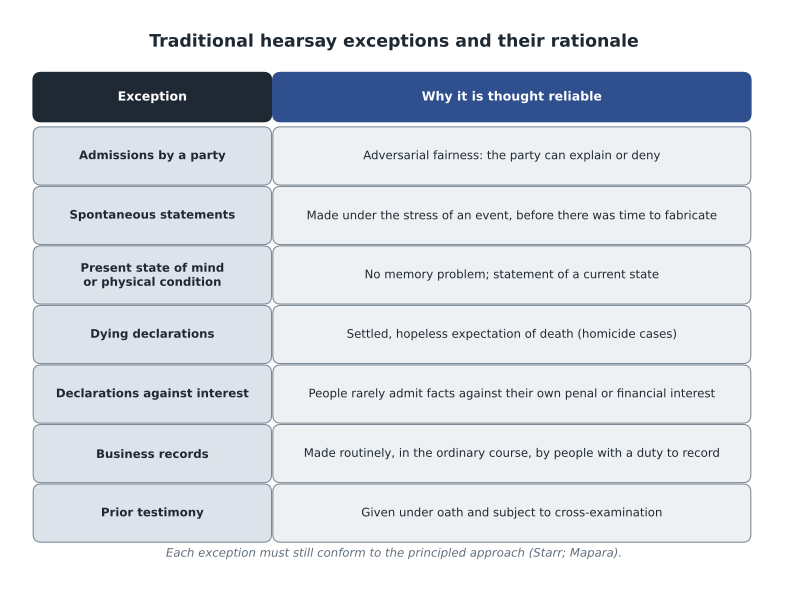
In R. v. Starr, 2000 SCC 40, the Court held that the traditional exceptions must be consistent with the principled approach. Where an exception fails to reflect necessity and reliability, it should be modified. In rare cases, evidence that falls within a valid exception may nonetheless be excluded because, on the facts, the indicia of necessity and reliability are lacking. In Starr, a woman told a friend that she was 'going to go and do an Autopac scam' with the accused on the night she was killed. The Crown relied on the present intentions exception. The Court held that the statement was inadmissible because the circumstances suggested a motive to lie and because the exception does not allow a statement of intention to be used to prove the intentions of another person.
In R. v. Mapara, 2005 SCC 23, the Court summarized the framework. Hearsay is presumptively inadmissible unless it falls under an exception. A hearsay exception can be challenged to determine whether it is supported by indicia of necessity and reliability, and the exception can be modified as necessary. In rare cases, evidence falling within an existing exception may be excluded because the indicia are lacking in the particular circumstances. If hearsay does not fall under an exception, it may still be admitted under the principled approach. The trial judge retains the residual discretion to exclude. The burden of challenging an established exception is on the party who seeks to exclude the evidence.
Admissions by a party
An admission is any statement or conduct of a party offered against that party. Admissions are admissible for the truth of their contents. The rationale is not reliability in the ordinary sense but adversarial fairness: a party can hardly complain that it cannot cross-examine itself, and it may testify to explain or deny the statement. An admission need not be against the party's interest when made, and it need not be based on personal knowledge. In R. v. Evans, [1993] 3 S.C.R. 653, the Court explained that the basis of admissibility is the adversary system rather than reliability.
Admissions in criminal cases are subject to the confessions rule when made to a person in authority, discussed in lesson 8. Statements to friends, family and strangers are not. In R. v. Schneider, 2022 SCC 34, the accused's brother-in-law overheard him say on the phone to his brother that he had killed someone. The trial judge admitted the overheard words. A majority of the Supreme Court held that the evidence was a relevant admission: the jury could reasonably conclude that the accused was talking about killing the victim, given the context, and the risk that he was talking about something else went to weight rather than admissibility. The case shows that the relevance threshold for admissions is low, though the trial judge retains the discretion to exclude where prejudice outweighs probative value.
Admissions may be made by conduct, including silence in some circumstances. An adoptive admission occurs when a party, by words or conduct, accepts the truth of a statement made in his presence. Silence in the face of an accusation may amount to an adoption where the circumstances would ordinarily call for a denial. But silence in the face of police questioning cannot be used this way: the accused has a right to silence and its exercise is not evidence of guilt.
Vicarious admissions arise when a statement of one person is admissible against another because of their relationship. Statements of an agent or employee about a matter within the scope of the employment may be admissible against the employer. In civil cases, statements made by an employee of Corwin Plaza Holdings about the parking lot conditions, made in the course of employment, could be admissible against Plaza. The co-conspirators exception allows statements made by one conspirator in furtherance of a common design to be used against another, once membership in the conspiracy is established on independent evidence. In R. v. Carter, [1982] 1 S.C.R. 938, the Court set out the steps, and in Mapara it held that the exception meets the requirements of the principled approach.
In civil litigation, a party's answers on examination for discovery may be read in at trial by the opposing party as admissions. Under Ontario Rule 31.11(1), at trial a party may read into evidence as part of the party's own case any part of the evidence given on examination for discovery by the adverse party, if otherwise admissible, whether or not the adverse party has already testified. In Ingram, Plaza's counsel may read in Rosa's discovery evidence that she 'wasn't really looking at the ground' as an admission.
Spontaneous statements
Statements made under the stress or pressure of a startling event, before there is time for reflection and fabrication, are admissible as spontaneous statements, sometimes called excited utterances or res gestae. The exception rests on the idea that the stress of the event temporarily stills the capacity for reflective self-interest. The statement need not be strictly contemporaneous, but it must be made while the declarant's mind is still dominated by the event. In R. v. Clark (1983), 7 C.C.C. (3d) 46 (Ont. C.A.), the court admitted a victim's statement 'Help, I've been murdered, I've been stabbed' made moments after the attack. The question in each case is whether the declarant's mind was still dominated by the event, which depends on the time elapsed, the declarant's condition and any intervening events.
The exception fits Rosa Ingram's text sent minutes after her fall if the evidence shows she was still in pain and shock. It fits Dorey's text an hour after the fight less clearly; by then he had walked away, refused an ambulance and gone home. The gap of time, his apparent composure and the casual tone point away from spontaneity, which is why the Crown in Calder will probably rely on the principled approach instead.
Statements of present state of mind and physical condition
A declarant's statement of a present mental state, such as intention, emotion, belief or plan, is admissible to prove that state of mind. The exception rests on the absence of memory problems and the fact that the declarant is the best source on his own mind. In R. v. Smith, the Court noted that statements of intention may be used to prove that the declarant acted in accordance with that intention. In R. v. Griffin, 2009 SCC 28, the deceased had told his girlfriend that if he died, the accused was responsible, because he owed the accused money. The Court held that the statement was admissible under the state of mind exception to show the deceased's fear of the accused, which was relevant to their relationship and to motive, with a limiting instruction. Statements of intention cannot be used to prove the intentions or conduct of another person, as Starr made clear.
Statements of present physical condition, such as 'my head hurts', are admissible to prove that condition, but not to prove the cause. Dorey's 'just a headache' could be admitted to prove that he had a headache an hour after the fight, which may be relevant to the medical evidence. It could not be used to prove that the push caused the headache.
Dying declarations
A dying declaration is a statement by a deceased person about the cause and circumstances of his death, made under a settled, hopeless expectation of almost immediate death, and admissible in a prosecution for the deceased's homicide. The declarant must have been a competent witness if alive. The rationale, historically religious, is that a person about to die has no motive to lie. The exception is narrow and largely superseded by the principled approach. Dorey's text does not qualify: he did not think he was dying.
Declarations against interest
A statement made by a declarant who is unavailable, against the declarant's pecuniary, proprietary or penal interest when made, with knowledge that it was against interest, is admissible. In R. v. Lucier, [1982] 1 S.C.R. 28, the Court held that a declaration against penal interest could not be used to inculpate an accused. In R. v. Demeter, [1978] 1 S.C.R. 538, the Court set out the conditions for declarations against penal interest. These include that the declarant was aware of the danger of prosecution, that the danger was not remote, and that the declaration was made in circumstances suggesting it was true. The exception is used most often by the defence to introduce a third party's confession.
Business records and records of public officials
Business records are admissible at common law if made contemporaneously, in the ordinary course of business, by a person with a duty to record and personal knowledge, or on information from someone with such knowledge. Statutes broaden the rule. Section 30 of the Canada Evidence Act provides that where oral evidence of a matter would be admissible, a record made in the usual and ordinary course of business that contains information about that matter is admissible on production. The statute excludes records made in the course of an investigation or in contemplation of legal proceedings and certain other records. Section 35 of the Ontario Evidence Act provides a similar rule for provincial proceedings, with a requirement of notice.
Northline Snow Services' GPS logs and dispatch records, showing its plow and salt truck at the Corwin Plaza lot at 6:15 a.m., are classic business records in the Ingram litigation. Rosa's lawyer may question whether the records accurately reflect when salt was spread as opposed to when the truck was present, but those questions go mostly to weight. A Plaza incident report prepared after Rosa's lawyer sent a demand letter would probably be excluded from the statutory exception because it was made in contemplation of litigation, and would also raise questions of litigation privilege, discussed in lesson 11.
Public records and documents made by public officials in the course of their duties are admissible under common law and statutory exceptions, including sections 23 to 28 of the Canada Evidence Act for certified copies of official documents.
Prior testimony
Testimony given in an earlier proceeding by a witness who is now unavailable may be admissible. Section 715 of the Criminal Code allows evidence given at a preliminary inquiry or earlier trial to be read in where the witness is dead, insane, too ill to travel or testify, or absent from Canada, or refuses to be sworn or to give evidence, provided the accused was present and had a full opportunity to cross-examine. The trial judge has a discretion to exclude it where its admission would be unfair. The rationale is that the earlier testimony was given under oath and subject to cross-examination. Civil rules similarly permit the use of prior testimony in some cases.
Putting it together
Theo Marchetti asks how a trial lawyer should approach a hearsay statement in practice. Quaye sketches a sequence on the board. First, is it hearsay at all, or is it offered for a non-hearsay purpose? Second, is it an admission by the opposing party? If so, it is generally admissible, subject to the confessions rule for statements to persons in authority. Third, does it fit a traditional exception? If so, it is presumptively admissible, unless the opposing party shows that necessity and reliability are lacking in the circumstances. Fourth, if no exception fits, can necessity and threshold reliability be shown under the principled approach? Fifth, should the judge exclude it under the residual discretion? 'And always,' she adds, 'what is the limiting instruction?'
Worked problem
Which route for which statement?
In the Calder trial, consider three statements: (a) Calder, at a party a week after the fight, told a friend, 'I didn't mean for him to get hurt, he just went down'; (b) Dorey, a week before the fight, told his sister, 'I'm scared of Owen Calder, he's been threatening me'; (c) a stranger on the sidewalk, seconds after the shove, shouted, 'He just pushed that guy for nothing!' and then left without giving a name.
Show solution
- (a) is a statement by the accused offered by the Crown: an admission. The friend is not a person in authority, so the confessions rule does not apply. It is admissible, subject to the residual discretion (Evans; Schneider).
- (b) is offered to show Dorey's fear of Calder: a statement of present state of mind (Griffin). It may be relevant to the nature of the relationship. It cannot be used to prove that Calder actually threatened him, and the judge must weigh prejudice and give a limiting instruction.
- (c) was made seconds after a startling event, under its stress: a spontaneous statement. The stranger's unavailability does not prevent admission, though the jury should consider the limits of an unidentified observer's perspective.
- For each statement, the judge must decide the precise use and instruct the jury on any limits.
Common mistakes
MistakeRequiring an admission to have been against the party's interest when made.
InsteadAny statement of a party offered against that party is an admission; the rationale is adversarial fairness (Evans).
MistakeUsing a declarant's statement of intention to prove what another person intended.
InsteadThe state of mind exception proves only the declarant's own state of mind (Starr).
MistakeTreating an investigation report as a business record under section 30.
InsteadRecords made in the course of an investigation or in contemplation of legal proceedings are excluded.
MistakeAssuming a statement within a traditional exception can never be excluded.
InsteadIn rare cases it may be excluded if necessity and reliability are lacking (Starr; Mapara).
Practice problems
Work each problem on paper first, then reveal the answer to check.
What did Mapara summarize about the traditional exceptions?
Show answer
Hearsay within an exception is presumptively admissible; an exception can be challenged and modified; rarely, evidence within an exception may be excluded if necessity and reliability are lacking; otherwise the principled approach applies; and a residual discretion remains.
What is the basis for admitting admissions?
Show answer
Adversarial fairness: a party cannot complain of not being able to cross-examine itself and can explain the statement.
What are the requirements of a dying declaration?
Show answer
A statement by the deceased about the cause and circumstances of death, under a settled hopeless expectation of almost immediate death, in a prosecution for the homicide, by a declarant who would have been competent.
What does section 30 of the Canada Evidence Act exclude?
Show answer
Records made in the course of an investigation or inquiry, or in contemplation of legal proceedings, among others.
What did Griffin hold about the deceased's statement of fear?
Show answer
It was admissible under the state of mind exception to show his fear of the accused, relevant to their relationship and motive, with a limiting instruction.
Summary and key terms
- Traditional exceptions are presumptively valid applications of necessity and reliability, subject to challenge in rare cases (Starr; Mapara).
- Admissions by a party are admissible for their truth on the basis of adversarial fairness (Evans; Schneider); statements to persons in authority must also be voluntary.
- Spontaneous statements, statements of present state of mind or physical condition, dying declarations and declarations against interest each rest on a specific guarantee of reliability.
- Business records are admissible at common law and under section 30 of the Canada Evidence Act and section 35 of the Ontario Evidence Act, excluding records made for litigation.
- Prior testimony may be read in under section 715 of the Criminal Code when the witness is unavailable and the accused had a full opportunity to cross-examine.
- Admission
- A statement or conduct of a party offered against that party.
- Adoptive admission
- A party's acceptance, by words or conduct, of a statement made in his presence.
- Spontaneous statement
- A statement made under the stress of a startling event before there was time to fabricate.
- Dying declaration
- A deceased's statement about the cause of death made under a settled hopeless expectation of death.
- Declaration against interest
- A statement by an unavailable declarant against the declarant's pecuniary, proprietary or penal interest.
- Business record
- A record made in the usual and ordinary course of business.
Lesson quiz · 5 questions
Score 60% or more to complete this lesson.
Create a free account to save your progress, take quizzes and earn a certificate.