
LAWC-203 · Lesson 5 of 12 · 22 min
Credibility, prior statements and impeachment
▶ Video coming soon A video version of this lesson is on the way.
'Most trials,' Professor Quaye says at the start of the fifth class, 'are not about whether something happened. They are about whose account of it to believe.' She plays a short clip, made by the class's teaching assistant, of an actor describing a parking lot fall. Half the class is asked to watch the actor's face; the other half is asked to listen only. The two halves disagree sharply about whether the witness seemed truthful. 'Keep that in mind,' Quaye says. 'Judges and juries are told to be careful with demeanour. The tools we study today are more reliable: consistency, contradiction, bias and the circumstances in which the witness perceived the event.'
Credibility and reliability
The trier of fact assesses two different qualities of a witness's evidence. Credibility concerns the witness's sincerity, whether the witness is trying to tell the truth. Reliability concerns accuracy, whether the evidence is correct, even if the witness is honest. An honest witness may be unreliable because of poor perception, faulty memory, intoxication, suggestion or simple error. The Ontario Court of Appeal has repeatedly emphasized this distinction; in R. v. H.C., 2009 ONCA 56, Justice Watt described credibility as having to do with a witness's veracity and reliability as having to do with the accuracy of the witness's testimony. Identification evidence by honest witnesses is notoriously unreliable, and judges must caution juries accordingly.
Triers of fact may believe all, some or none of a witness's evidence. They may accept parts of a witness's account and reject others. Credibility assessment considers internal consistency, consistency with other evidence, the witness's interest in the outcome, the plausibility of the account, and the circumstances of observation. Demeanour can be considered but should not be given undue weight; Canadian courts have warned that confident witnesses are not necessarily accurate and that cultural differences, nervousness and the stress of testifying can affect appearance. In R. v. N.S., 2012 SCC 72, the Court discussed the role of demeanour in the context of a witness wearing a niqab, holding that a judge must balance freedom of religion against trial fairness, while acknowledging that demeanour assessment has limits.
Prior inconsistent statements
The most common way to test a witness is to show that the witness said something different before. Sections 10 and 11 of the Canada Evidence Act govern cross-examination on prior inconsistent statements. Under section 10, a witness may be cross-examined on a previous statement made in writing or reduced to writing or recorded, without being shown it, but if counsel intends to contradict the witness with it, the witness's attention must first be drawn to the parts to be used. Under section 11, if a witness does not distinctly admit making a prior oral inconsistent statement, proof may be given that the statement was made, but the circumstances must first be put to the witness. These rules reflect the same fairness principle as Browne v. Dunn.
Traditionally, a prior inconsistent statement could be used only to impeach the witness's credibility, not as proof of its contents. If Leah Pruitt says at trial that she saw nothing, and the Crown proves that she told police she saw Calder shove Dorey, the jury could use the inconsistency to doubt her trial testimony, but could not use the earlier statement as evidence that Calder shoved Dorey. If the witness adopts the earlier statement as true while testifying, it becomes part of her evidence. If she does not, a limiting instruction is required.
Substantive use: R. v. K.G.B.
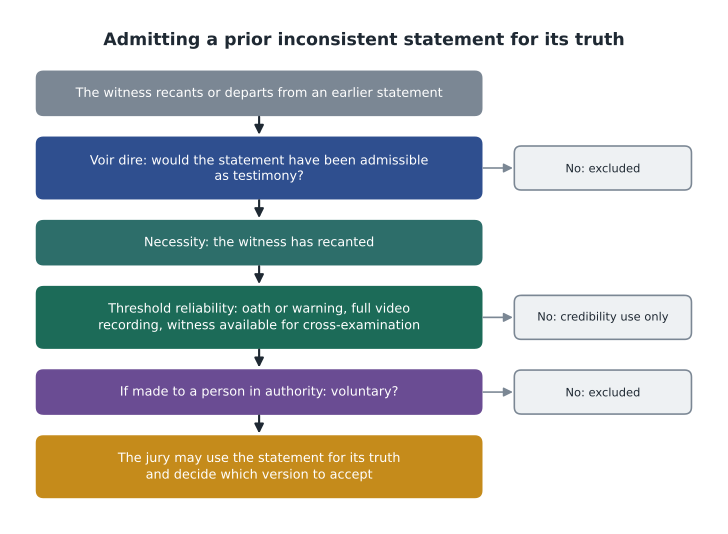
In R. v. B. (K.G.), [1993] 1 S.C.R. 740, the Court held that a prior inconsistent statement may be admitted for the truth of its contents under the principled approach to hearsay, which lessons 6 and 7 cover in detail. In K.G.B., three young people told police that the accused had admitted stabbing the victim. At trial they recanted. The Court held that their statements could be admitted for their truth if the statements met the requirements of necessity and reliability. Necessity is satisfied by the recantation, because the witness's evidence is no longer available in the form of trial testimony. Reliability is best shown by three indicia: the statement was made under oath or solemn affirmation after a warning about the consequences of lying; it was videotaped in its entirety; and the witness is available for full cross-examination at trial about the statement. The Crown must also show that the statement would have been admissible as the witness's testimony, and, where it was made to a person in authority, that it was voluntary.
Later cases have made clear that the K.G.B. indicia are not a checklist. In R. v. Bradshaw, 2017 SCC 35, discussed in lesson 6, the Court emphasized that threshold reliability may be established by procedural safeguards, by substantive reliability, or by a combination. Where the witness is available for cross-examination at trial, that is a powerful procedural safeguard, because the trier of fact can see the witness explain the change. The trial judge decides threshold reliability on a voir dire, on a balance of probabilities. If the statement is admitted, the jury must decide which version, if either, to believe.
For Pruitt, the Crown is well placed. Her statement was video-recorded in full on the night of the fight. Police warned her about the importance of telling the truth, though she was not under oath. She is available for cross-examination at trial. The judge may well admit the statement for its truth, and the jury would then decide whether to believe her earlier account or her trial testimony.
Prior consistent statements
Prior consistent statements are generally inadmissible. A witness may not bolster her own evidence by showing that she said the same thing before. The rule exists because repetition does not make a statement more likely to be true and because such evidence wastes time. In R. v. Stirling, 2008 SCC 10, the Court reaffirmed the rule and explained the exceptions.
The main exceptions are these. First, where it is suggested that the witness recently fabricated the evidence, a prior consistent statement made before the alleged motive to fabricate arose may be admitted to rebut the suggestion. In Stirling, the defence suggested that a witness had fabricated his account because of a civil lawsuit, and his earlier consistent statements were admissible to rebut that suggestion, but only for that purpose, not for their truth. Second, prior identification of the accused may be admitted. Third, statements forming part of the narrative may be admitted to explain how the case unfolded, for example the timing of a complaint in a sexual offence case, but not to prove the truth of the complaint. Fourth, a prior consistent statement may be admitted as part of the res gestae, if it was made spontaneously during the event. Fifth, an accused's exculpatory statement made on arrest may be admissible to show his reaction, as recognized in cases such as R. v. Edgar, 2010 ONCA 529.
Juries need careful instructions about prior consistent statements. Even when admitted for a limited purpose, they cannot be used to show that the witness is more likely to be telling the truth because she said the same thing before.
The rule against oath-helping and collateral facts
A party may not call evidence solely to bolster the credibility of its own witness before that credibility has been attacked. Expert evidence that a witness is truthful is also generally inadmissible, because credibility is for the trier of fact. In R. v. Marquard, [1993] 4 S.C.R. 223, the Court held that expert evidence on human conduct and psychology may be admissible to explain behaviour outside the ordinary experience of the jury, such as why child complainants may delay disclosure, but not to tell the jury that a particular witness is credible.
The collateral facts rule limits contradiction. A party who cross-examines a witness on a matter that is collateral, relevant only to credibility and not to a fact in issue, is bound by the witness's answer and may not call other evidence to contradict it. The rule prevents trials from becoming sprawling contests over side issues. Exceptions allow contradiction on bias or interest, on the witness's prior convictions, on the witness's capacity to perceive, and on prior inconsistent statements about matters in issue. If the defence asks the bouncer whether he had worked at the bar for three years and he says yes, the defence cannot call his former employer to say it was two years, unless that fact bears on some issue beyond credibility.
Impeachment by criminal record
Section 12 of the Canada Evidence Act provides that a witness may be questioned as to whether the witness has been convicted of any offence, and if the witness denies the conviction or refuses to answer, the conviction may be proved. The provision applies to all witnesses, including the accused. The theory is that a criminal record may bear on a witness's credibility.
When the witness is the accused, the risk of prejudice is acute: the jury may reason that the accused is a criminal and therefore likely guilty. In R. v. Corbett, [1988] 1 S.C.R. 670, the Court upheld section 12 against a Charter challenge but held that the trial judge has a discretion to exclude evidence of some or all of an accused's prior convictions where the prejudicial effect outweighs the probative value on credibility. Relevant factors include the nature of the previous conviction, especially whether it involves dishonesty, which is more probative of credibility; its remoteness in time; the similarity between the prior offence and the charge, which increases prejudice; and fairness, including whether the defence has attacked the character of Crown witnesses. If the convictions are admitted, the jury must be instructed that they may be used only on credibility, not as evidence of guilt.
Calder's eight-year-old assault conviction, if he testifies, will be the subject of a Corbett application. It involves violence rather than dishonesty, so it has little bearing on credibility; it is similar to the present charge, which increases the risk of propensity reasoning; and it is old. The judge will very likely exclude it, unless defence counsel attacks the character of the Crown witnesses in a way that would leave the jury with a distorted picture.
Other forms of impeachment
A witness may also be impeached by showing bias, interest or motive to lie, such as a relationship with a party, a financial interest or animosity. Bias is never collateral. A witness's capacity may be challenged: eyesight, distance, lighting, intoxication and the time available to observe. Reputation evidence for untruthfulness is admissible in limited circumstances, and in R. v. Clarke (1998), 129 C.C.C. (3d) 1 (Ont. C.A.), the Court of Appeal discussed the narrow conditions for such evidence. A witness's prior false allegations may also be relevant in some cases.
Kara Dorey, the deceased's sister, has an obvious interest in seeing someone held responsible for her brother's death, which the defence may explore respectfully. The bouncer, Brendan Hollis, had his own reason to cast events in a particular light: the bar's licence could be affected if it served Calder too much. 'Interest is not the same as dishonesty,' Quaye cautions. 'You can show the jury why a witness might shade the truth without calling them a liar.'
Disclosure and the tools of impeachment
In criminal cases, the Crown's duty of disclosure under R. v. Stinchcombe, [1991] 3 S.C.R. 326, requires disclosure of all relevant, non-privileged information in the Crown's possession, whether inculpatory or exculpatory. Witness statements, notes and records are central to impeachment, and late or incomplete disclosure can undermine the fairness of cross-examination. In civil cases, examinations for discovery and documentary production serve a similar function, and Ontario Rule 31.11 allows the use of discovery transcripts to impeach a party at trial.
Worked problem
Using a prior statement in Ingram
Suppose Ingram goes to trial. Rosa Ingram testifies that the parking lot was a sheet of ice with no salt visible. On her examination for discovery a year earlier, she said there were 'patches of ice' and she 'wasn't really looking at the ground'. Corwin Plaza Holdings wants to use the discovery transcript. How?
Show solution
- Rosa is a party, so her discovery evidence may be used to impeach her under Rule 31.11 and the Ontario Evidence Act provisions on prior inconsistent statements.
- Counsel must first draw her attention to the specific passages, giving her a chance to explain (the same fairness principle as section 10 of the Canada Evidence Act and Browne v. Dunn).
- If she adopts the earlier answers, they become part of her trial evidence.
- Because she is an adverse party, her discovery answers may also be read in as admissions against her interest, which can be used for their truth (lesson 7).
- The trier of fact then weighs the inconsistency in assessing both her credibility and the reliability of her description of the lot.
Common mistakes
MistakeTreating credibility and reliability as the same thing.
InsteadCredibility is about sincerity; reliability is about accuracy. Honest witnesses can be wrong.
MistakeLetting a jury use a prior inconsistent statement for its truth without a K.G.B. ruling.
InsteadUnless adopted or admitted under K.G.B., a prior inconsistent statement goes only to credibility.
MistakeAdmitting a prior consistent statement to show the witness has been consistent and so is truthful.
InsteadPrior consistent statements are inadmissible except for recognized purposes, such as rebutting recent fabrication (Stirling), and then not for their truth.
MistakeAssuming an accused's entire record comes in once he testifies.
InsteadCorbett gives the judge discretion to exclude convictions whose prejudice outweighs their value on credibility.
Practice problems
Work each problem on paper first, then reveal the answer to check.
What are the three K.G.B. indicia of reliability?
Show answer
An oath or solemn affirmation with a warning; a complete video recording; and the witness's availability for cross-examination at trial.
When may a prior consistent statement be admitted to rebut recent fabrication?
Show answer
When it is suggested the witness fabricated the evidence, a statement made before the alleged motive arose may rebut the suggestion (Stirling), but not prove its truth.
What is the collateral facts rule?
Show answer
A party is bound by a witness's answer on a matter relevant only to credibility and may not call evidence to contradict it, subject to exceptions such as bias.
Name three Corbett factors.
Show answer
The nature of the conviction (dishonesty), its remoteness, its similarity to the charge, and fairness in light of attacks on Crown witnesses.
Why must the circumstances be put to a witness before proving a prior oral statement under section 11?
Show answer
Fairness: the witness must have a chance to admit, deny or explain the statement.
Summary and key terms
- Credibility concerns honesty; reliability concerns accuracy. Demeanour should be used with caution.
- Prior inconsistent statements may be used to impeach (sections 10 and 11 of the Canada Evidence Act) and, after a K.G.B. voir dire, for their truth.
- Prior consistent statements are presumptively inadmissible; exceptions include rebutting recent fabrication and narrative, not for truth (Stirling).
- Oath-helping and expert evidence on a witness's truthfulness are generally inadmissible; the collateral facts rule limits contradiction.
- Section 12 permits impeachment by criminal record, subject to Corbett for the accused; bias and capacity are always open to challenge.
- Credibility
- A witness's sincerity or truthfulness.
- Reliability
- The accuracy of a witness's evidence.
- Prior inconsistent statement
- An earlier statement by a witness that conflicts with the witness's testimony.
- K.G.B. statement
- A prior inconsistent statement admitted for its truth under the principled approach.
- Collateral facts rule
- The rule that a party is bound by a witness's answer on matters relevant only to credibility.
- Corbett application
- An accused's application to exclude some or all prior convictions from cross-examination.
Lesson quiz · 5 questions
Score 60% or more to complete this lesson.
Create a free account to save your progress, take quizzes and earn a certificate.