
LAWC-203 · Lesson 1 of 12 · 23 min
Sources and structure of the law of evidence
▶ Video coming soon A video version of this lesson is on the way.
Professor Rosalind Quaye opens the first evidence class by placing a single object on the lectern: a cheap black cellphone in a clear plastic evidence bag. 'This phone belonged to a man named Mark Dorey,' she says. 'Some of you met him last year in Professor Castellano's criminal law class, in the fictional file R. v. Calder. He was shoved outside a bar on Ridley Street, hit his head, went home and died. This year, Owen Calder goes to trial for manslaughter. Over the next twelve lessons you will decide what the jury gets to hear.' She holds up the bag. 'On this phone is a text Dorey sent his sister an hour after the fight. Can the jury read it? That depends on what it is, what it is offered to prove, and which rules stand in the way. By the end of this course you should be able to answer that question in four sentences.'
Quaye spent sixteen years as a trial lawyer, first as defence counsel in Ottawa and then in a small civil and criminal practice in Corwin, before joining Brannock. She teaches with what she calls the four gates: Is the evidence relevant? Is it material to an issue in the case? Does an exclusionary rule bar it? If so, does an exception or a discretion let it in, or keep it out? Her constant question to students is 'What is it, and what is it for?' Two files run through the course. The first is R. v. Calder, now a jury trial in the Superior Court of Justice in Corwin. The second is a civil file the class met in first-year legal research, Ingram v. Corwin Plaza Holdings, in which a dental hygienist slipped on ice in a strip mall parking lot. Everything said here about either file going to trial is hypothetical, and every name in both files is invented.
What the law of evidence does
The law of evidence governs what information a court may consider when it decides disputed facts, how that information is presented, and what use may be made of it. It does not tell the court what the substantive law is; that comes from criminal law, torts, contracts and the other subjects. It tells the court which facts may be proved, and by what means. Because trials turn on facts far more often than on law, evidence rules shape outcomes in a very practical way.
The Supreme Court of Canada has repeatedly said that the overarching goal of the law of evidence is the search for truth, tempered by other values. Those other values include fairness to the parties, especially to an accused person facing the power of the state; the efficiency and manageability of trials; the protection of relationships and interests that society values, such as the confidential relationship between lawyer and client; and the integrity of the justice system, which may require exclusion of evidence obtained by serious misconduct. Many evidence rules are best understood as compromises between truth-seeking and one of these other values. Privilege, for instance, keeps relevant and reliable information out of court in order to protect a relationship.
Modern Canadian evidence law is also marked by a shift from rigid categories to principles. Over the last thirty-five years, the Supreme Court has replaced or supplemented many fixed rules with flexible, principled tests. Hearsay is the leading example: since R. v. Khan, [1990] 2 S.C.R. 531, and R. v. Smith, [1992] 2 S.C.R. 915, hearsay may be admitted when it is necessary and reliable even if it fits no traditional exception. The same movement appears in the law of expert evidence, similar fact evidence and privilege. Students who come to evidence expecting a list of rules to memorize find instead a set of purposes and frameworks to apply.
The sources of evidence law
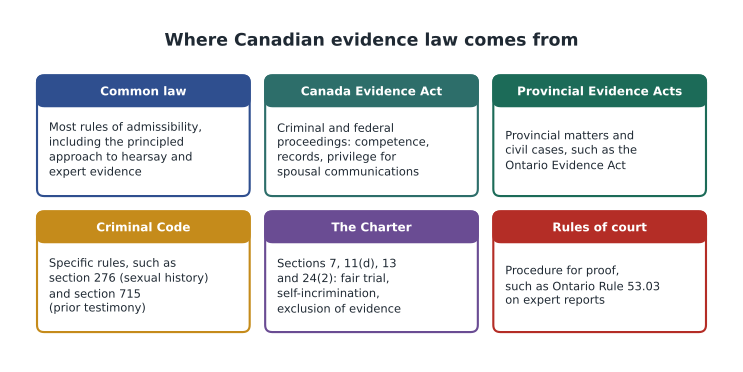
There is no comprehensive evidence code in Canada. The rules come from several sources that work together.
The common law. Most of the core rules, including relevance, hearsay, character evidence, opinion evidence, confessions and most privileges, are judge-made. The Supreme Court of Canada is the most important source of these rules, and its decisions bind every court in the country on matters of common law evidence that apply in both federal and provincial proceedings.
The Canada Evidence Act, R.S.C. 1985, c. C-5. This federal statute applies to criminal proceedings and to civil proceedings and other matters over which Parliament has legislative authority. It deals with the competence of witnesses, including spouses (section 4), the testimony of children and adults with mental disabilities (sections 16 and 16.1), the protection against self-incrimination for witnesses (section 5), cross-examination on prior statements (sections 10 and 11), impeachment with a criminal record (section 12), business and government records (sections 26 to 30), electronic documents (sections 31.1 to 31.8), the protection of journalistic sources (section 39.1), and public interest objections to disclosure (sections 37 to 39). Section 40 incorporates provincial evidence law into federal proceedings where the federal Act is silent.
Provincial Evidence Acts. Each province has its own Evidence Act that applies to proceedings within provincial jurisdiction, including most civil litigation. In this course the Ontario Evidence Act, R.S.O. 1990, c. E.23, is the main example. It deals with similar matters: the competence of witnesses, business records (section 35), medical reports (section 52), and admissions of convictions in civil cases (section 22.1). Ingram is a civil action in the Ontario Superior Court, so the Ontario Evidence Act applies alongside the common law and the Rules of Civil Procedure.
The Criminal Code. The Code contains many specific evidence provisions. Section 276 governs evidence of a complainant's sexual history in sexual offence cases, and sections 278.1 to 278.98 govern access to and use of private records. Section 715 permits the reading in of earlier testimony in certain circumstances, sections 715.1 and 715.2 allow video-recorded statements of young or disabled witnesses to be adopted, section 655 permits formal admissions, and sections 486.1 to 486.31 provide testimonial aids such as support persons, screens and closed-circuit television.
The Charter. The Canadian Charter of Rights and Freedoms affects evidence in several ways. Section 7 protects the right to silence and the principle against self-incrimination, and it requires full answer and defence. Section 11(c) makes the accused non-compellable, and section 11(d) protects the presumption of innocence. Section 13 protects witnesses from having their compelled testimony used to incriminate them in other proceedings. Section 24(2) requires exclusion of evidence obtained in a manner that infringed a Charter right if admitting it would bring the administration of justice into disrepute.
Rules of court. Procedural rules supplement the statutes. In Ontario, Rule 53.03 of the Rules of Civil Procedure regulates expert reports, Rule 31 governs examination for discovery and its use at trial, and Rule 51 deals with requests to admit. Criminal courts also have rules on applications such as the section 276 hearing.
Kinds of evidence
Evidence comes in a few basic forms. Testimonial evidence is what witnesses say under oath or affirmation in court. Real evidence is a physical object produced for the trier of fact to examine, such as Dorey's phone or a pair of boots with salt stains. Documentary evidence is a writing or recording offered for its contents, such as a text message, an email, a contract or a GPS log. Demonstrative evidence, such as a diagram, a model or a computer animation, illustrates other evidence and has no independent value of its own. Courts sometimes also speak of 'judicial notice', which is not evidence at all but the acceptance of facts so notorious or easily verified that no proof is needed, and of formal admissions, which remove a fact from dispute.
Evidence may also be direct or circumstantial. Direct evidence, if believed, proves a fact in issue without any inference: a witness who says 'I saw Calder push Dorey' gives direct evidence of the push. Circumstantial evidence proves a fact from which the fact in issue may be inferred: blood on Calder's sleeve, a security video showing him running away, or his deleting a text conversation. Circumstantial evidence is not inferior. Many convictions rest entirely on it. But it requires care, and in R. v. Villaroman, 2016 SCC 33, the Court explained that where the Crown's case on an element depends on circumstantial evidence, the trier of fact must consider whether guilt is the only reasonable inference available on the evidence or the lack of evidence. Lesson 2 returns to that test.
Who decides what
A trial has two decision-makers, even when one person plays both roles. The judge decides questions of law, including whether evidence is admissible, and in a jury trial instructs the jury on the law. The trier of fact, which is the jury or, in a judge-alone trial, the judge, decides what happened, which witnesses to believe and how much weight to give each piece of admitted evidence. The distinction between admissibility and weight is basic. Admissibility is a threshold question for the judge: may the trier of fact hear this at all? Weight is the question for the trier of fact: how much does this evidence prove, considered with everything else?
When the admissibility of evidence depends on facts that must themselves be proved, the judge holds a voir dire, a trial within a trial, usually in the jury's absence. In a voir dire on the voluntariness of Calder's statement to police, for example, the officers and Calder may testify about the circumstances of the interview, and the judge decides whether the Crown has proved voluntariness beyond a reasonable doubt. The jury never hears the voir dire evidence. If the statement is admitted, the jury hears the statement and decides what weight it deserves. In a judge-alone trial, the judge must keep the two roles mentally separate, and evidence heard on the voir dire is not evidence at the trial unless the parties agree to apply it.
The process of admission
Evidence does not appear in a trial by itself. A party tenders it, usually through a witness. Counsel asks questions, and the witness's answers become evidence. Exhibits are introduced through a witness who can identify them. The opposing party may object, ideally before the answer is given, stating the ground: hearsay, irrelevance, leading, privilege, and so on. The judge rules, sometimes immediately, sometimes after argument in the jury's absence, sometimes after a voir dire. Evidence that is admitted for a limited purpose must be accompanied by a limiting instruction telling the jury what it may and may not use the evidence for. Failing to object can have consequences. On appeal, a party who did not object at trial will find it much harder to complain, although in criminal cases appellate courts still intervene where the admission of evidence caused a miscarriage of justice.
Quaye emphasizes that an evidence objection is a precise legal claim, not a protest. 'Objection, prejudicial!' is not enough. Counsel should be able to say what rule applies and why. In practice, experienced counsel raise the major evidence issues before trial, through pre-trial motions or applications, so that the jury is not exposed to inadmissible material and both sides can plan.
Criminal and civil evidence
Most rules of evidence apply in both criminal and civil cases, but the emphasis differs. Criminal trials are shaped by the presumption of innocence, the Charter and the accused's right to make full answer and defence. Several rules exist only in criminal cases or are much stricter there: the confessions rule, the rules on the accused's character, section 276, and Charter exclusion. Civil trials, by contrast, are shaped by documentary discovery, examinations for discovery, expert reports exchanged under strict timelines, and a broader reliance on business records and admissions. Juries are common in serious criminal trials and much less common in Ontario civil trials, and the civil standard of proof is the balance of probabilities.
Appellate review of evidence rulings is generally deferential. Admissibility rulings involving the application of legal principles to facts are reviewed for palpable and overriding error unless the trial judge applied the wrong legal test, which is reviewed for correctness. Discretionary rulings, such as the decision to exclude evidence whose prejudicial effect outweighs its probative value, attract considerable deference. In criminal cases, even when an evidence error is found, the Crown may ask the court to apply the curative proviso in section 686(1)(b)(iii) of the Criminal Code if the error was harmless or the evidence of guilt was overwhelming.
A roadmap of the course
The course follows the logic of the four gates. Lesson 2 deals with the burden and standard of proof, the frame within which all evidence is weighed. Lesson 3 covers relevance and the discretion to exclude. Lessons 4 and 5 deal with witnesses: who may testify, how they are examined, and how their credibility is tested. Lessons 6 and 7 cover hearsay. Lesson 8 deals with statements of the accused and evidence obtained in breach of the Charter. Lessons 9, 10 and 11 cover three major exclusionary areas: character evidence, opinion evidence and privilege. Lesson 12 is a capstone trial problem.
Back in class, Theo Marchetti, who worked for ten years as a litigation clerk before law school, asks the practical question. 'In my old firm, the first thing anyone asked about a document was whether we could get it in. Is that what evidence is about?' Quaye nods. 'It is about getting things in and keeping things out. But underneath that is a harder question: what does a fair trial need the trier of fact to know, and what would mislead them? Keep both in mind.'
Worked problem
Classifying the evidence in R. v. Calder
In the Calder trial the Crown plans to call: a bouncer who saw the shove; the security video from the bar's front camera; Dorey's text to his sister, 'Calder pushed me, I'm ok, just a headache'; the pathologist who did the autopsy; and the officer who took Calder's statement. Classify each item and identify the main evidence issue it raises.
Show solution
- The bouncer: testimonial, direct evidence of the push. Issues: identification and credibility (lessons 4 and 5).
- The security video: real or documentary evidence, circumstantial and direct depending on what it shows. Issue: authentication and accuracy (lesson 3).
- Dorey's text: a document containing an out-of-court statement. If offered to prove that Calder pushed him, it is hearsay (lessons 6 and 7).
- The pathologist: expert opinion on cause of death. Issue: admissibility and scope under Mohan and White Burgess (lesson 10).
- Calder's statement: a statement by the accused to a person in authority. Issues: voluntariness and any Charter breach (lesson 8).
Common mistakes
MistakeTreating admissibility and weight as the same question.
InsteadThe judge decides admissibility; the trier of fact decides weight once evidence is admitted.
MistakeAssuming circumstantial evidence is weaker than direct evidence.
InsteadCircumstantial evidence can be compelling; the test in Villaroman asks whether guilt is the only reasonable inference.
MistakeLooking only to the Canada Evidence Act in a civil case in Ontario.
InsteadProvincial civil cases are governed by the Ontario Evidence Act, the common law and the Rules of Civil Procedure.
MistakeObjecting with a general complaint such as 'prejudicial'.
InsteadState the rule and the reason, and raise major issues before trial.
Practice problems
Work each problem on paper first, then reveal the answer to check.
What is a voir dire?
Show answer
A hearing within a trial, usually in the jury's absence, to decide facts on which the admissibility of evidence depends.
Name three things the Canada Evidence Act deals with.
Show answer
Any three of: witness competence, spouses, children's testimony, self-incrimination, prior statements, criminal records, business and government records, electronic documents, journalistic sources, public interest objections.
What is the difference between direct and circumstantial evidence?
Show answer
Direct evidence proves a fact in issue without inference if believed; circumstantial evidence proves facts from which the fact in issue may be inferred.
What is a limiting instruction?
Show answer
A direction to the jury that evidence may be used only for a particular purpose.
Which statute governs evidence in a civil action in the Ontario Superior Court?
Show answer
The Ontario Evidence Act, together with the common law and the Rules of Civil Procedure.
Summary and key terms
- The law of evidence governs what information a court may consider, how it is presented and how it may be used.
- Its main goal is the search for truth, balanced against fairness, efficiency, the protection of valued relationships and the integrity of the justice system.
- Sources include the common law, the Canada Evidence Act, provincial Evidence Acts, the Criminal Code, the Charter and rules of court.
- The judge decides admissibility; the trier of fact decides weight. A voir dire resolves disputed facts on admissibility.
- Evidence is tendered through witnesses, objected to with a stated ground, ruled on, and, if admitted for a limited purpose, accompanied by a limiting instruction.
- Admissibility
- Whether the trier of fact may hear and consider evidence at all; a question of law for the judge.
- Weight
- How much evidence proves, assessed by the trier of fact.
- Voir dire
- A trial within a trial to determine the admissibility of evidence.
- Circumstantial evidence
- Evidence of facts from which a fact in issue may be inferred.
- Real evidence
- A physical object produced for examination by the trier of fact.
- Limiting instruction
- A direction restricting the use the jury may make of evidence.
Lesson quiz · 5 questions
Score 60% or more to complete this lesson.
Create a free account to save your progress, take quizzes and earn a certificate.