
LAWC-203 · Lesson 3 of 12 · 22 min
Relevance and admissibility
▶ Video coming soon A video version of this lesson is on the way.
Professor Quaye begins the third class with a list of things the Crown might want to tell the jury in R. v. Calder. Calder had six beers that night. He once posted online that he 'hates guys like Dorey'. He drives a pickup truck with an aggressive bumper sticker. He has a criminal record for an assault eight years ago. He left the scene running. He deleted his text conversation with Leah Pruitt the next morning. 'Which of these are relevant?' she asks. 'And of the relevant ones, which should the jury hear?' The class argues for twenty minutes. By the end, Hannah Kowalczyk observes that almost everything is relevant to something, and that the hard question is the second one.
Relevance
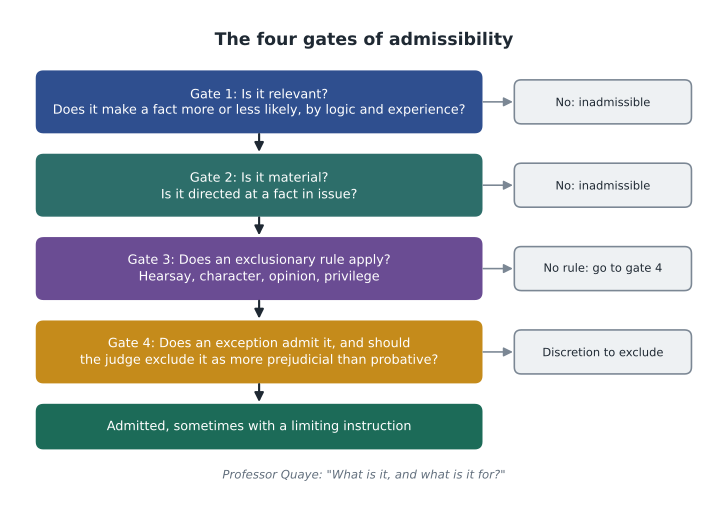
Relevance is the first condition of admissibility. Evidence that is not relevant is not admissible, and evidence that is relevant is admissible unless some rule or discretion excludes it. In R. v. Arp, [1998] 3 S.C.R. 339, Justice Cory explained that evidence is relevant if, as a matter of logic and human experience, it tends to make the proposition for which it is advanced more likely than that proposition would be in the absence of that evidence. Relevance is not a high threshold. The evidence need not prove the proposition, or even make it probable. It need only make it somewhat more or less likely. In R. v. Seaboyer, [1991] 2 S.C.R. 577, the Court described the threshold as low.
Relevance is relational. Evidence is never relevant in the abstract; it is relevant to a particular proposition. That is why Quaye keeps asking, 'What is it for?' Calder's six beers may be relevant to his perception, to the likelihood that he acted aggressively, or to his credibility if he testifies about what he saw. The bumper sticker is probably not relevant to anything. The online post may be relevant to motive or animus toward Dorey, if it was about Dorey, and much less so if it was a general insult about a type of person.
Relevance depends on human experience and inference, and judges should explain the chain of reasoning when relevance is disputed. Some reasoning that seems logical is forbidden by law, either because experience shows it to be unreliable or because it is unfair. The most important examples are reasoning that the accused is the kind of person likely to have committed the offence because of his bad character, which lesson 9 covers, and the twin myths about sexual assault complainants, which section 276 forbids.
Materiality
Evidence must also be material: it must be directed at a matter in issue in the case. A fact may be logically relevant to something that is not in dispute. If the defence in Calder formally admits that Dorey died of a brain bleed caused by a skull fracture, evidence about the mechanics of the fracture is no longer material to cause of death, although it might remain material to another issue, such as the force of the shove. The issues are defined by the substantive law, the charge, the defences raised, and in civil cases the pleadings. Some courts treat materiality as part of relevance; others treat it separately. Either way, the question is whether the evidence bears on something the trier of fact must decide.
Evidence bearing on the credibility of witnesses is always material in the sense that the trier of fact must decide whom to believe. But the collateral facts rule, discussed in lesson 5, limits how far a party may go in contradicting a witness on matters that bear only on credibility.
The discretion to exclude
Relevant evidence may be excluded if its prejudicial effect outweighs its probative value. Probative value is the evidence's tendency to prove the proposition for which it is offered, considering its reliability and the strength of the inference it supports. Prejudicial effect does not mean that the evidence hurts a party's case; all good evidence does that. It means the danger that the evidence will be misused. The main forms of prejudice are moral prejudice, where the trier of fact may convict because the accused seems a bad person; reasoning prejudice, where the evidence may distract, confuse or consume time out of proportion to its value; and unfair surprise. Courts also consider whether a limiting instruction can address the danger.
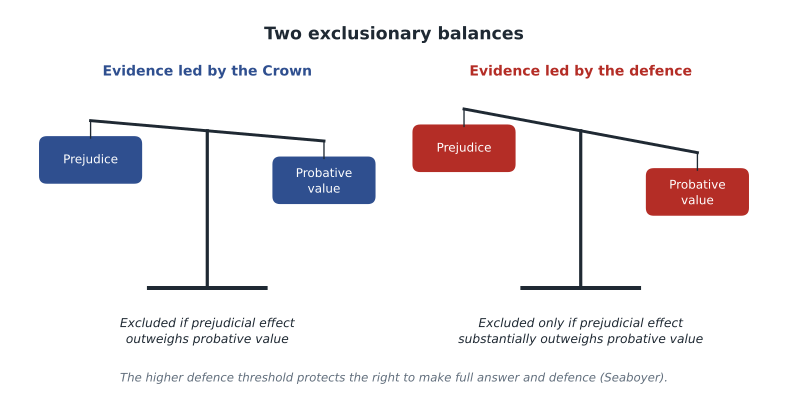
In Seaboyer, the Court held that the balancing is different for Crown and defence evidence. For evidence tendered by the Crown, the trial judge may exclude it if its prejudicial effect outweighs its probative value. For evidence tendered by the defence, the judge may exclude it only if its prejudicial effect substantially outweighs its probative value. The difference reflects the accused's constitutional right to make full answer and defence and the principle that the innocent must not be convicted. In civil cases, the judge has a similar discretion to exclude evidence whose probative value is outweighed by its prejudicial effect or by the time it would consume.
Applying the discretion requires a concrete assessment. In Calder, the Crown argues that the deleted texts are strong evidence of consciousness of guilt. The defence responds that the probative value is low because there are innocent explanations, and that the jury may be overly impressed by the deletion. The judge might admit the evidence with a careful instruction about the range of explanations, or might find its value too slight. The eight-year-old assault conviction is a different matter: as evidence that Calder is a violent person, it faces the strict rules on character evidence and, unless the defence opens the door, will very likely be excluded.
Circumstantial evidence and post-offence conduct
Evidence of what an accused did after an offence, such as fleeing, lying, destroying evidence or hiding, is called post-offence conduct. It used to be called consciousness of guilt, but the courts now prefer the neutral term because the conduct may be explained in other ways. In R. v. White, [1998] 2 S.C.R. 72, the Court held that post-offence conduct is circumstantial evidence like any other; its relevance and weight depend on the issues and on the inferences it supports, and the jury should be cautioned where appropriate about other explanations. In R. v. Calnen, 2019 SCC 6, the Court confirmed that post-offence conduct can be relevant to the accused's state of mind and to the level of culpability, depending on the circumstances, and that the trial judge must assess whether the inference sought is reasonable given the evidence as a whole.
Post-offence conduct is often of limited value in distinguishing between degrees of culpability. In White, the Court noted that flight may show that the accused knew he had done something wrong, but it may not help distinguish murder from manslaughter. Calder running from the scene may be relevant to whether he knew he had done something wrong, but not to whether his push was in self-defence, unless the circumstances support that inference.
Real evidence, documents and authentication
Real and documentary evidence must be authenticated before it can be admitted. Authentication means showing that the item is what the party says it is. The threshold is low: there must be some evidence capable of supporting a finding that the item is authentic. A witness may identify the item, a chain of custody may be proved, or the item's distinctive features may speak for it. Disputes about accuracy or tampering usually go to weight once the threshold is met.
Electronic documents are governed by sections 31.1 to 31.8 of the Canada Evidence Act and similar provincial provisions, including section 34.1 of the Ontario Evidence Act. A person seeking to admit an electronic document must prove its authenticity by evidence capable of supporting a finding that it is what it purports to be. The best evidence rule for electronic documents is satisfied by proof of the integrity of the electronic documents system in which the document was recorded or stored, and the statutes create presumptions of integrity in certain circumstances. Courts have applied these provisions to text messages, social media posts, emails and video. Typical authentication evidence includes testimony from a participant in a conversation, the phone number or account details, the content and context of the messages, and forensic extraction reports.
The bar's security video in Calder can be authenticated by the bar manager, who can describe the camera system, the time stamp and how the video was exported, or by a witness who was present and can say that the video fairly depicts what happened. A forensic examiner may be needed if the defence alleges editing. Dorey's text to his sister can be authenticated by the sister, who received it from his number, and by a forensic extraction of his phone.
The best evidence rule and demonstrative evidence
The traditional best evidence rule required the original of a document to be produced when its contents were in issue. Modern law has largely reduced the rule to the case where a party could produce the original but deliberately fails to do so. Photocopies and printouts are routinely admitted, and electronic documents follow the statutory system-integrity approach.
Demonstrative evidence, such as diagrams, maps, models and computer reconstructions, is admissible if it is a fair and accurate representation of something relevant and helps the trier of fact understand other evidence. Animations and reconstructions can be powerful and must be carefully scrutinized for accuracy and for the risk that the jury will treat an illustration as proof. In Calder, the Crown may use a scale diagram of the Ridley Street sidewalk and curb to help witnesses explain where Dorey fell.
Conditional admissibility and the voir dire
Sometimes the relevance of evidence depends on another fact that has not yet been proved. A court may admit the evidence conditionally, on counsel's undertaking to connect it later, and instruct the jury to disregard it if the connection is not made. Where admissibility depends on disputed preliminary facts, the judge holds a voir dire and decides those facts, usually on a balance of probabilities, except for confessions, where the Crown must prove voluntariness beyond a reasonable doubt.
Limited admissibility and limiting instructions
Evidence is often admissible for one purpose but not another. Quaye calls this the 'what is it for?' half of her question. A prior statement may be admissible to show that a witness has been inconsistent, but not as proof of what it says. An accused's criminal record may be used to assess his credibility as a witness, but not to infer that he is the kind of person who commits crimes. A threat made by the accused weeks before an assault may be admissible to show motive and animus, even though it also reveals bad character. In each case the evidence passes the four gates only for a defined use, and the trial judge must tell the jury what that use is.
The tool for doing so is the limiting instruction. In R. v. Corbett, [1988] 1 S.C.R. 670, the Supreme Court expressed confidence that juries can follow such instructions and rejected the idea that jurors are incapable of using evidence for one purpose while ignoring it for another. That confidence has limits. Where the risk of improper use is high and the permitted use is marginal, a limiting instruction may not be enough, and the better course is to exclude the evidence under the discretion described above. Counsel who tender evidence should always be ready to answer two questions: for what purpose, and with what instruction? Counsel who oppose it should ask for the instruction in writing before the charge to the jury.
Back to the list
By the end of the class, the list on the board has been sorted. The six beers are relevant to perception and behaviour and are likely admissible. The online post is relevant to animus only if it was about Dorey; otherwise its value is slight and the risk of moral prejudice is high. The bumper sticker is irrelevant. The prior assault conviction is relevant only through forbidden propensity reasoning unless something else makes it relevant, and will be addressed in lesson 9. Flight and the deleted texts are post-offence conduct, relevant to whether Calder knew he had done something wrong, and admissible with an instruction about alternative explanations. 'Relevance is generous,' Quaye says. 'The discretion is where judges earn their pay.'
Worked problem
Should the deleted texts be admitted?
The morning after the fight, Calder deleted his entire text conversation with Leah Pruitt, including messages from before the night of the fight. Police recovered the messages from Pruitt's phone. Calder's counsel says he deleted them because Pruitt had sent embarrassing photos and he was worried about his girlfriend. The Crown wants to lead the deletion as post-offence conduct. How should the judge approach it?
Show solution
- Relevance: deleting messages after a fatal fight may support an inference that Calder believed the messages were incriminating, which is relevant to whether he knew he had done something wrong (White; Calnen).
- Materiality: knowledge of wrongdoing bears on the issues of unlawfulness and self-defence only indirectly; the judge should identify exactly what inference the Crown seeks.
- Probative value: reduced because the deletion covered unrelated messages and an innocent explanation exists; the recovered messages themselves may be more probative than the deletion.
- Prejudicial effect: risk that the jury jumps from deletion to guilt without considering alternatives.
- Ruling: admissible if the Crown identifies a reasonable inference, with an instruction that the jury must consider other explanations and may use the evidence only if it rejects them.
Common mistakes
MistakeExcluding evidence because it is damaging to one side.
InsteadPrejudice means the risk of misuse, not the fact that evidence hurts a party.
MistakeUsing the same balancing test for Crown and defence evidence.
InsteadDefence evidence is excluded only if prejudice substantially outweighs probative value (Seaboyer).
MistakeCalling flight 'consciousness of guilt' and treating it as strong proof.
InsteadPost-offence conduct is circumstantial evidence; its value depends on the inference sought and alternatives must be considered (White; Calnen).
MistakeRefusing a text message because the witness cannot prove it with certainty.
InsteadAuthentication requires only evidence capable of supporting a finding of authenticity; doubts go to weight.
Practice problems
Work each problem on paper first, then reveal the answer to check.
State the test for relevance from Arp.
Show answer
Evidence is relevant if, as a matter of logic and human experience, it tends to make the proposition for which it is advanced more likely than it would be without the evidence.
What is materiality?
Show answer
The requirement that evidence be directed at a matter in issue in the case.
Name two kinds of prejudice.
Show answer
Moral prejudice and reasoning prejudice (distraction, confusion, undue time); unfair surprise is a third.
How is an electronic document authenticated under the Canada Evidence Act?
Show answer
By evidence capable of supporting a finding that it is what it purports to be; the best evidence rule is met by proof of the integrity of the electronic documents system.
Why is post-offence conduct often of limited value?
Show answer
It may have innocent explanations and often does not distinguish between levels of culpability, such as murder and manslaughter.
Summary and key terms
- Relevance is a low threshold: evidence that makes a proposition more or less likely as a matter of logic and human experience (Arp).
- Evidence must also be material: directed at a fact in issue.
- Relevant evidence may be excluded where its prejudicial effect outweighs its probative value; defence evidence only where prejudice substantially outweighs value (Seaboyer).
- Post-offence conduct is circumstantial evidence whose value depends on the inference sought (White; Calnen).
- Real, documentary and electronic evidence must be authenticated to a low threshold; electronic documents follow sections 31.1 to 31.8 of the Canada Evidence Act.
- Relevance
- A tendency, as a matter of logic and human experience, to make a proposition more or less likely.
- Materiality
- The connection between evidence and a matter in issue.
- Probative value
- The strength with which evidence proves the proposition for which it is offered.
- Prejudicial effect
- The danger that evidence will be misused by the trier of fact.
- Post-offence conduct
- What an accused did after an alleged offence, offered as circumstantial evidence.
- Authentication
- Proof that an item is what the party claims it to be.
Lesson quiz · 5 questions
Score 60% or more to complete this lesson.
Create a free account to save your progress, take quizzes and earn a certificate.