
LAWC-203 · Lesson 6 of 12 · 23 min
Hearsay
▶ Video coming soon A video version of this lesson is on the way.
Professor Quaye returns to the phone in the evidence bag. An hour after the fight, Mark Dorey texted his sister Kara: 'Calder pushed me, I'm ok, just a headache. dont tell mom.' He died the next morning. The Crown wants the jury to see the text. 'Why would the law hesitate?' Quaye asks. 'The text was written close in time, to his sister, with no obvious reason to lie. Isn't this exactly the kind of evidence a jury should have?' Arjun Mehta answers: 'Because Dorey can't be cross-examined. We don't know if he saw who pushed him, if he was confused, or if he was blaming the wrong person.' Quaye nods. 'That is the hearsay problem in one sentence.'
What hearsay is
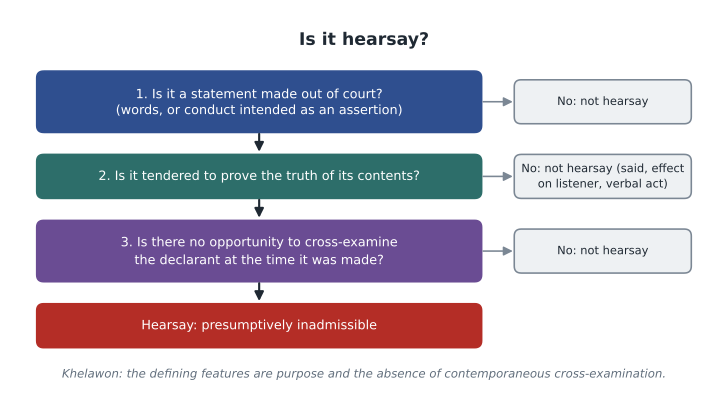
Hearsay is an out-of-court statement tendered to prove the truth of its contents, where there is no opportunity for a contemporaneous cross-examination of the declarant. In R. v. Khelawon, 2006 SCC 57, Justice Charron identified the essential defining features: the fact that the statement is adduced to prove the truth of its contents, and the absence of a contemporaneous opportunity to cross-examine the declarant. The person who made the statement is the declarant. The witness who reports the statement in court is not the problem; the problem is that the declarant is not before the court to be tested.
The rationale for the exclusionary rule lies in the ways testimony can go wrong. A declarant's statement may be inaccurate because of four hearsay dangers: problems of perception (the declarant may not have seen or heard correctly), memory (the declarant may have forgotten or reconstructed), narration (the declarant may have expressed himself badly or been misunderstood) and sincerity (the declarant may have lied). In court, these dangers are addressed by the oath, by the trier of fact's ability to observe the witness and, above all, by cross-examination. Hearsay escapes all three safeguards.
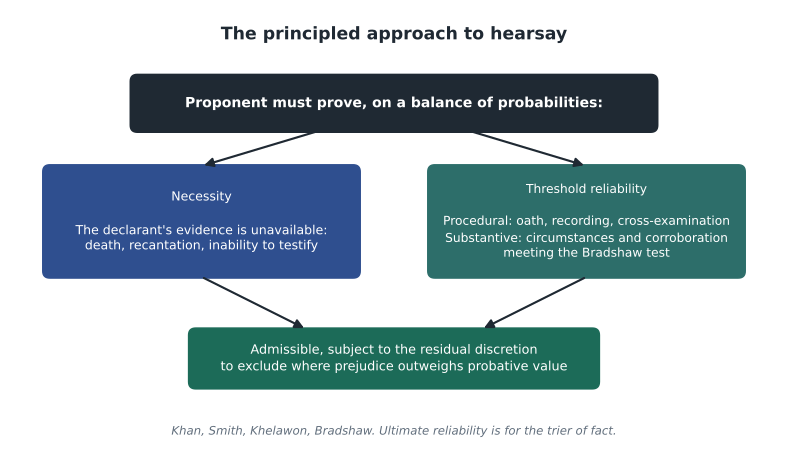
Hearsay is presumptively inadmissible. It may be admitted only under a recognized exception or under the principled approach. The burden is on the party tendering the evidence to establish admissibility on a balance of probabilities.
What hearsay is not
The definition depends on purpose. An out-of-court statement is not hearsay if it is tendered for some reason other than the truth of its contents. Common non-hearsay uses include the following.
To show that the statement was made. If the issue is whether a threat was uttered, testimony that the accused said 'I will kill you' is not hearsay; the words themselves are the fact in issue. Statements that have legal effect, such as the words of a contract or a defamatory statement, are often called verbal acts or operative words and are not hearsay.
To show the effect on the listener. Evidence that a police officer was told a man with a red jacket had a gun may be admitted to explain why the officer drew his weapon, not to prove that the man had a gun. In R. v. Subramaniam, [1956] 1 W.L.R. 965 (P.C.), the Privy Council held that threats made to the accused by terrorists were admissible to show their effect on his state of mind for the defence of duress.
To show the declarant's state of mind, by inference. Sometimes a statement is circumstantial evidence of the declarant's knowledge, belief or emotion, without being offered for its literal truth. The line between this use and a hearsay use can be thin, and modern courts are careful to ask what inference is actually being drawn. Lesson 7 deals with statements of present state of mind as a hearsay exception.
As original evidence of the accused's own statements. Statements by a party offered against that party are admissions, a hearsay exception discussed in lesson 7, rather than non-hearsay, but the result is that they are generally admissible.
The courts are alert to attempts to disguise hearsay as non-hearsay. In R. v. Saddleback, 2026 SCC 18, a judge-alone murder case from Alberta, the victim had phoned his girlfriend shortly before his death and said he 'was being ditched' by friends who were leaving for a party. The trial judge relied on the call to conclude that the accused was the only person left with the victim. A majority of the Supreme Court, in reasons by Justice O'Bonsawin, held that the statement had been used for the truth of its contents: that the others had left and the victim remained with the accused. It was therefore hearsay, the trial judge had not conducted an admissibility analysis, and a new trial was required. Justice Côté dissented. The case is a reminder that the label the parties put on a use does not matter; what matters is the inference the trier of fact actually draws.
Implied assertions raise a further complication. Conduct or words not intended as assertions, but from which a belief can be inferred, may raise hearsay dangers. In R. v. Baldree, 2013 SCC 35, police answered a phone call to the accused's cellphone during a drug arrest, and the caller asked to buy marijuana. The Crown tendered the call to prove that the accused was a drug dealer. The Court held that the call was hearsay because its value depended on the caller's implied assertion that the accused sold drugs, and the caller's sincerity, perception and knowledge could not be tested. It was inadmissible because the Crown had not shown necessity or reliability.
From categories to principles
For most of the twentieth century, hearsay was admitted only if it fit a recognized exception, such as dying declarations or declarations against interest. The categories were rigid, sometimes excluding reliable evidence and sometimes admitting unreliable evidence. In R. v. Khan, [1990] 2 S.C.R. 531, the Court began to change course. A three-and-a-half-year-old girl had told her mother, shortly after a medical appointment, that the doctor had put his 'birdie' in her mouth. She was too young to testify. The statement fit no recognized exception. The Court held that hearsay could be admitted where it was necessary and reliable. Necessity was established because the child could not testify; reliability was supported by the timing and spontaneity of the statement, the child's age and lack of motive, and corroborating physical evidence.
In R. v. Smith, [1992] 2 S.C.R. 915, the Court confirmed that Khan was not limited to child witnesses but stated a general principled approach. In Smith, the deceased made phone calls to her mother on the night of her death saying that the accused had abandoned her at a hotel, and later that he had come back for her. The Court held that the earlier calls were admissible, but that the last call, reporting that he had come back, was not reliable enough because she may have been mistaken or misled about who had returned and why. In R. v. B. (K.G.), [1993] 1 S.C.R. 740, discussed in lesson 5, the Court applied the approach to prior inconsistent statements of recanting witnesses.
Necessity
Necessity is satisfied when the declarant's evidence, in the form of testimony, is not available. Death, serious illness, absence from the jurisdiction despite reasonable efforts, incapacity, the inability of a young child to testify, and a witness's refusal or recantation can all establish necessity. Necessity is interpreted flexibly; the question is whether the evidence is reasonably necessary to get the declarant's account before the trier of fact. A party cannot create necessity by failing to make reasonable efforts to call the declarant. Dorey is dead, so necessity for his text is clear.
Threshold reliability: Khelawon and Bradshaw
Reliability at the admissibility stage is threshold reliability, not ultimate reliability. The trial judge asks whether the statement is sufficiently reliable to be put to the trier of fact, who will then decide its ultimate weight. In Khelawon, the Court rejected the old rule that judges could not consider corroborating or contradicting evidence at the threshold stage and explained that threshold reliability can be established in two ways. Procedural reliability exists where there are adequate substitutes for testing the evidence: for example, the statement was recorded and the declarant is available for cross-examination at trial, as in K.G.B. Substantive reliability exists where the statement is inherently trustworthy because of the circumstances in which it was made and any corroborating evidence. The two may work together.
In Khelawon itself, an elderly resident of a care home told staff and police that the manager had beaten him. He died before trial. The Court held that the statements were not sufficiently reliable: the declarant was elderly and possibly confused, had complained about others, may have had a motive related to a dispute with the home, and there were alternative explanations for his injuries. The case shows that the circumstances of a statement must be considered in context, including features that reduce reliability.
In R. v. Bradshaw, 2017 SCC 35, the Court clarified how corroborative evidence may be used to establish substantive reliability. A trial judge may rely on corroborative evidence only if it shows, when considered as a whole and in the circumstances of the case, that the only likely explanation for the hearsay statement is the declarant's truthfulness about, or the accuracy of, the material aspects of the statement. The judge should identify the material aspects of the statement, identify the specific hearsay dangers raised, consider alternative even speculative explanations for the statement, and determine whether the corroborative evidence, as a whole, rules out those alternatives so that the only likely explanation is that the statement is true or accurate on the material points. Corroborative evidence that is consistent with the statement but equally consistent with other explanations does not help.
In R. v. Charles, 2024 SCC 29, a majority of the Court, in reasons by Justice Moreau, applied Bradshaw strictly. A witness's out-of-court statement to police had been admitted at trial. The majority held that it lacked the indicia of reliability required: the results of a search of the witness's residence did not meet the Bradshaw criteria for corroborative evidence, and the circumstances of the statement did not establish threshold reliability. The majority also held that the Court of Appeal should not have relied on the complainant's trial testimony, given outside the voir dire, to find threshold reliability. Three judges dissented. The convictions were quashed and a new trial ordered.
The residual discretion
Even where necessity and threshold reliability are established, the trial judge retains a discretion to exclude hearsay tendered by the Crown if its prejudicial effect outweighs its probative value. Conversely, the hearsay rule is applied with some flexibility to defence evidence, consistent with the right to make full answer and defence, although the principled approach still applies. In R. v. Khelawon the Court described the residual discretion as part of the framework.
Hearsay in civil cases
The principled approach applies in civil cases too. Civil litigation also relies heavily on statutory exceptions, especially for business records under section 35 of the Ontario Evidence Act, and on admissions of parties. In Ingram, Rosa's text to her sister minutes after the fall, 'Wiped out in the Plaza lot, ice everywhere, no salt at all, think my wrist is broken', would be hearsay if offered by her to prove the absence of salt, although it may fit the spontaneous statement exception or the principled approach, and it may be admissible against her if Plaza tenders it as an admission. Lesson 7 deals with these routes.
Applying the framework to Dorey's text
Quaye walks the class through the analysis. The text is an out-of-court statement. If the Crown offers it to prove that Calder pushed Dorey, it is tendered for its truth. Dorey cannot be cross-examined. It is hearsay. Necessity is met because Dorey is dead. On threshold reliability there is no procedural safeguard: no oath, no recording of the circumstances, no cross-examination. The question is substantive reliability. The text was sent within about an hour, to a sibling, in casual language, with no apparent motive to falsely accuse Calder, whom Dorey named because he knew him. But the hearsay dangers include perception and memory: Dorey had hit his head and may have been confused. The Crown will point to corroboration under Bradshaw: the bouncer saw Calder push Dorey, and the security video shows it. If that corroboration rules out the alternative explanations on the material point, the identity of the person who pushed him, the text may be admitted. Much depends on whether the push itself is disputed. If Calder admits pushing Dorey and argues self-defence, the text adds little on the disputed issue, and the judge may consider its prejudicial effect. 'The answer is not yes or no,' Quaye says. 'It is an analysis.'
Worked problem
A text that is, and is not, hearsay
In the Calder trial, Kara Dorey testifies that her brother texted 'Calder pushed me, I'm ok, just a headache. dont tell mom.' The Crown offers the text for three purposes: (1) to prove Calder pushed him; (2) to explain why Kara did not call an ambulance; (3) to show Dorey was conscious and able to text an hour after the fight. Which uses are hearsay?
Show solution
- Use 1 depends on the truth of 'Calder pushed me': it is hearsay and requires the principled approach (necessity and threshold reliability).
- Use 2 relies on the effect on the listener: Kara's understanding that he was 'ok' explains her conduct. That is not a hearsay use, provided her conduct is relevant.
- Use 3 relies on the fact that a coherent text was sent, not on its truth. Sending the text is circumstantial evidence of his condition: not hearsay.
- 'I'm ok, just a headache' offered to prove he felt fine is a statement of his physical condition, which may fit the present state exception (lesson 7).
- Where some uses are permitted and others are not, the judge must give a limiting instruction or decide the hearsay use on a voir dire.
Common mistakes
MistakeCalling any out-of-court statement hearsay.
InsteadIt is hearsay only if tendered for its truth without an opportunity for contemporaneous cross-examination (Khelawon).
MistakeRelabelling a truth use as 'context' or 'narrative' to avoid the rule.
InsteadCourts look at the inference actually drawn (Saddleback, 2026 SCC 18).
MistakeTreating any consistent evidence as corroboration of a hearsay statement.
InsteadUnder Bradshaw, corroboration counts only if it shows the only likely explanation is the statement's truth or accuracy on material points.
MistakeAsking whether the statement is ultimately true at the admissibility stage.
InsteadThe judge decides threshold reliability; ultimate reliability and weight are for the trier of fact.
Practice problems
Work each problem on paper first, then reveal the answer to check.
What are the defining features of hearsay according to Khelawon?
Show answer
The statement is tendered for the truth of its contents and there is no contemporaneous opportunity to cross-examine the declarant.
Name the four hearsay dangers.
Show answer
Perception, memory, narration and sincerity.
What two ways of establishing threshold reliability did Khelawon recognize?
Show answer
Procedural reliability (adequate substitutes for testing) and substantive reliability (inherent trustworthiness).
What is the Bradshaw test for corroborative evidence?
Show answer
Corroboration may be used only if, considered as a whole, it shows the only likely explanation for the statement is the declarant's truthfulness about, or accuracy on, its material aspects.
Why was the phone call in Baldree inadmissible?
Show answer
It was an implied assertion that the accused sold drugs, offered for its truth, and the Crown did not establish necessity or reliability.
Summary and key terms
- Hearsay is an out-of-court statement tendered for its truth without contemporaneous cross-examination of the declarant (Khelawon).
- It is presumptively inadmissible because of the dangers of perception, memory, narration and sincerity.
- Statements offered for another purpose, such as their effect on a listener or as verbal acts, are not hearsay; courts examine the inference actually drawn (Saddleback, 2026).
- Under the principled approach (Khan, Smith, K.G.B.), hearsay is admissible if necessity and threshold reliability are proved on a balance of probabilities.
- Threshold reliability may be procedural or substantive; corroboration must meet Bradshaw, applied strictly in Charles (2024). The judge retains a residual discretion to exclude.
- Hearsay
- An out-of-court statement tendered for its truth without a contemporaneous opportunity to cross-examine the declarant.
- Declarant
- The person who made the out-of-court statement.
- Necessity
- The unavailability of the declarant's evidence in the form of testimony.
- Threshold reliability
- Sufficient reliability for hearsay to be admitted and weighed by the trier of fact.
- Procedural reliability
- Reliability shown by adequate substitutes for testing, such as recording and cross-examination at trial.
- Substantive reliability
- Reliability shown by the statement's inherent trustworthiness and corroboration.
Lesson quiz · 5 questions
Score 60% or more to complete this lesson.
Create a free account to save your progress, take quizzes and earn a certificate.