
LAWC-203 · Lesson 11 of 12 · 22 min
Privilege
▶ Video coming soon A video version of this lesson is on the way.
The Ingram file arrives in Professor Quaye's class with a stack of documents that Rosa's counsel wants produced. One is the incident report a Corwin Plaza security guard wrote the day Rosa fell, which Plaza sent to its insurer. Another is an email from Plaza's property manager to the company's in-house lawyer, asking whether the salting contract with Northline gave Plaza any protection. A third is a letter in which Plaza's lawyer offered to settle for a modest sum. Rosa's counsel says relevance is obvious. Plaza says all three are privileged. 'This is the one area of evidence,' Quaye says, 'where relevant, reliable evidence is kept out on purpose. Privilege is the law's way of saying some relationships matter more than the truth in one case.'
What privilege is
A privilege is a right to refuse to disclose information, or to prevent another from disclosing it, even though the information is relevant and otherwise admissible. Privileges are exceptions to the general principle that the court is entitled to every person's evidence. They are justified by policy: certain relationships and interests would be damaged if confidential communications could be compelled. Privilege can be asserted at the discovery stage, to resist production, and at trial, to resist testimony.
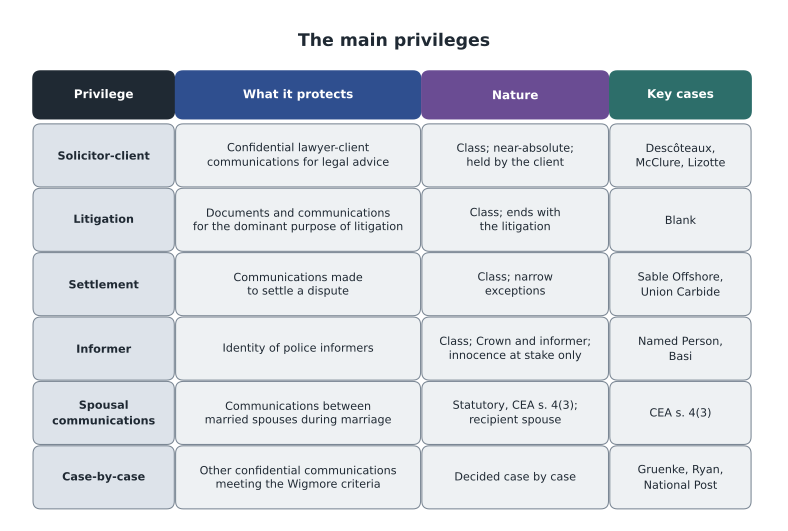
Canadian law distinguishes two kinds of privilege. Class privileges arise automatically when the communication falls within the protected category; the communication is presumptively privileged and the party seeking disclosure must bring it within a recognized exception. Solicitor-client, litigation, settlement and informer privilege are class privileges. Case-by-case privileges are recognized only where the party claiming the privilege shows, for the particular communication, that the policy reasons for protecting it outweigh the interest in disclosure.
Solicitor-client privilege
Solicitor-client privilege protects communications between a lawyer and client that are made in confidence for the purpose of seeking or giving legal advice. In Descôteaux v. Mierzwinski, [1982] 1 S.C.R. 860, the Court described the privilege as a substantive rule, not merely a rule of evidence, and set out its elements: a communication between solicitor and client, which entails the seeking or giving of legal advice, and which is intended to be confidential by the parties. In Solosky v. The Queen, [1980] 1 S.C.R. 821, the Court recognized it as a fundamental civil and legal right. The privilege belongs to the client, not the lawyer, and only the client can waive it.
The privilege is close to absolute. In R. v. McClure, 2001 SCC 14, the Court held that solicitor-client privilege must be as close to absolute as possible and yields only in clearly defined circumstances. The main exceptions are innocence at stake, public safety and communications in furtherance of crime. In McClure, the Court recognized the innocence at stake exception: an accused may obtain a third party's privileged communications only where the information is not available from any other source, the accused is otherwise unable to raise a reasonable doubt, and the communication is likely to raise a reasonable doubt. The test is stringent, and R. v. Brown, 2002 SCC 32, added procedural protections, including that the privilege holder's communication cannot later be used against him.
In Smith v. Jones, [1999] 1 S.C.R. 455, a psychiatrist retained by defence counsel learned that the accused planned to kill sex workers. The Court held that the public safety exception permitted disclosure where there is a clear risk to an identifiable person or group, the risk is of serious bodily harm or death, and the danger is imminent. Communications made to facilitate a crime or fraud are not privileged at all, because seeking advice on how to commit a crime is not the seeking of legal advice.
The privilege covers in-house lawyers when they are giving legal advice, but not when they are giving business advice. The email from Plaza's property manager to its in-house lawyer asking about the effect of the Northline contract is a request for legal advice about legal rights, made in confidence. It is privileged. Rosa's counsel cannot obtain it, and the in-house lawyer cannot be compelled to testify about it. The underlying facts, however, are not privileged: Rosa can ask Plaza's witnesses about the terms of the salting contract and when Northline salted the lot.
Courts protect the privilege against statutory and state intrusion. In Alberta (Information and Privacy Commissioner) v. University of Calgary, 2016 SCC 53, the Court held that a statute must use clear, explicit and unequivocal language to abrogate solicitor-client privilege; a general power to compel documents is not enough. In Canada (Attorney General) v. Chambre des notaires du Québec, 2016 SCC 20, the Court struck down provisions allowing tax authorities to demand documents from notaries and lawyers without adequate protection for privilege.
Litigation privilege
Litigation privilege protects communications and documents created for the dominant purpose of litigation, whether existing or reasonably contemplated. In Blank v. Canada (Minister of Justice), 2006 SCC 39, the Court distinguished it from solicitor-client privilege. Solicitor-client privilege protects a relationship; litigation privilege protects the adversarial process by creating a zone of privacy in which parties can prepare their cases. Litigation privilege covers communications with third parties, such as investigators and experts, and is not limited to communications with a lawyer. It ends when the litigation and closely related litigation end. In Lizotte v. Aviva Insurance Company of Canada, 2016 SCC 52, the Court confirmed that litigation privilege is a class privilege and, like solicitor-client privilege, cannot be abrogated by general statutory language.
The incident report is the hard case. The security guard wrote it the day of the fall, under a standing Plaza policy requiring reports of all injuries on the property, and Plaza sent it to its insurer. Was the dominant purpose litigation? Plaza will argue that a slip on ice with an injured customer makes litigation reasonably contemplated. Rosa will argue that the report was routine, prepared for many purposes including maintenance, insurance and record keeping, and that the dominant purpose test is not met. Courts in Ontario have often held that reports prepared under a standing policy, before any claim is made, fail the dominant purpose test, though each case turns on its facts. Even if the report is privileged, the facts it records are not, and the guard can be examined about what he saw.
Settlement privilege
Settlement privilege protects communications made with the intention of settling a dispute. In Sable Offshore Energy Inc. v. Ameron International Corp., 2013 SCC 37, the Court held that settlement privilege is a class privilege covering negotiations whether or not a settlement is reached, and that the amounts of concluded settlements with other defendants are also protected, even from the non-settling defendants, although the terms that change the litigation landscape must be disclosed. In Union Carbide Canada Inc. v. Bombardier Inc., 2014 SCC 35, the Court recognized an exception allowing settlement communications to be disclosed to prove the existence or terms of the settlement itself.
Plaza's settlement offer is privileged. Rosa cannot put it before the jury to suggest that Plaza admits liability. The policy is obvious: if offers could be used as admissions, parties would never make them. Ontario's Rule 49 provides a related regime: formal offers to settle are not filed or disclosed to the trier of fact until liability and damages have been decided, when they become relevant to costs.
Informer privilege
Informer privilege protects the identity of police informers. It belongs to both the Crown and the informer and cannot be waived by the Crown alone. In Named Person v. Vancouver Sun, 2007 SCC 43, the Court described it as nearly absolute and held that a judge has no discretion to disclose an informer's identity. The only exception is innocence at stake. In R. v. Basi, 2009 SCC 52, the Court held that defence counsel could not attend the hearing on informer privilege, though the judge may appoint an amicus curiae. In R. v. Brassington, 2018 SCC 37, the Court held that police officers accused of offences could not reveal informer information even to their own lawyers. In Durham Regional Crime Stoppers Inc. v. R., 2017 SCC 45, the Court held that informer privilege did not protect a person who used a Crime Stoppers tip as part of a plan to pervert the course of justice.
The privilege covers not only the informer's name but any information that might tend to identify the informer. In practice, this can require extensive redaction of search warrant affidavits; the Crown may then seek to defend the warrant on the redacted record, with a judicial summary under R. v. Garofoli, [1990] 2 S.C.R. 1421, of what was removed.
Spousal privilege
Section 4(3) of the Canada Evidence Act provides that no husband is compellable to disclose any communication made to him by his wife during their marriage, and no wife is compellable to disclose any communication made to her by her husband during their marriage. The privilege belongs to the recipient spouse, who may choose to disclose. It does not survive divorce and applies only to legally married spouses, not common-law partners. Lesson 4 explained the related rule of spousal competence and compellability, which was largely abolished in 2015 for criminal proceedings. The communications privilege remains.
Calder's girlfriend, Tess Halloran, is not his spouse, so section 4(3) does not apply. If Calder told her the morning after the fight that 'I didn't mean to hurt him,' she can be compelled to testify to that statement, and it is admissible against Calder as an admission. If they had married before trial, section 4(3) would apply only to communications during the marriage, not those before it.
Case-by-case privilege and the Wigmore criteria
Communications outside the class privileges may still be protected on a case-by-case basis. In R. v. Gruenke, [1991] 3 S.C.R. 263, the Court declined to recognize a class privilege for religious communications but held that such communications could be protected case by case using the four criteria from the American scholar John Henry Wigmore: the communication must originate in confidence that it will not be disclosed; confidentiality must be essential to the full and satisfactory maintenance of the relationship; the relationship must be one that the community believes ought to be sedulously fostered; and the injury to the relationship from disclosure must be greater than the benefit gained for the correct disposal of the litigation.
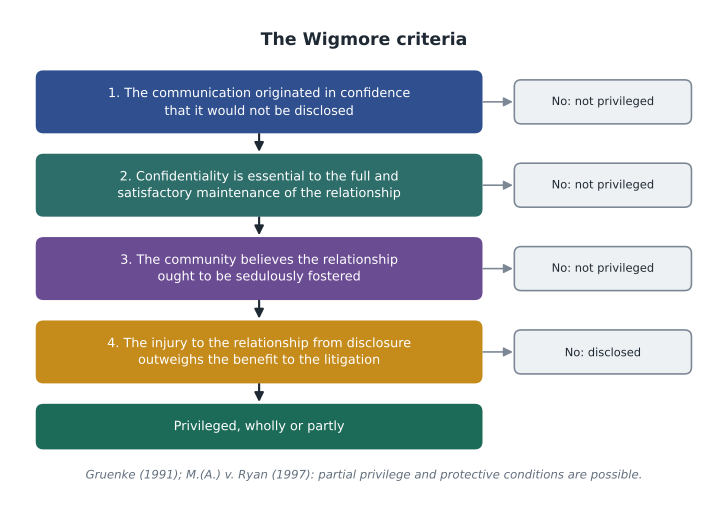
In M.(A.) v. Ryan, [1997] 1 S.C.R. 157, the Court applied the Wigmore criteria to a psychiatrist's records of a sexual assault complainant in a civil action, and held that partial privilege could be recognized, with disclosure of only the most relevant records and protective conditions. In the criminal context, the production of third-party records relating to complainants is now governed by sections 278.1 to 278.91 of the Criminal Code, as lesson 9 explained.
Journalistic sources
In R. v. National Post, 2010 SCC 16, the Court declined to recognize a class privilege for journalists' confidential sources but held that such sources could be protected case by case under the Wigmore framework. Parliament responded in 2017 with the Journalistic Sources Protection Act, which added section 39.1 to the Canada Evidence Act. Section 39.1 allows a journalist to object to disclosing information that identifies or is likely to identify a journalistic source, and places on the party seeking disclosure the burden of showing that the information cannot be obtained by other reasonable means and that the public interest in the administration of justice outweighs the public interest in preserving confidentiality. In Denis v. Côté, 2019 SCC 44, the Court applied section 39.1 for the first time.
Public interest immunity
Sections 37 to 39 of the Canada Evidence Act allow the government to object to disclosure of information on grounds of a specified public interest, international relations, national defence or national security, or confidences of the King's Privy Council. Section 37 objections are decided by the court using a balancing test; section 38 objections involving national security go to the Federal Court; and section 39 certificates for cabinet confidences are very difficult to challenge.
Waiver
Privilege can be waived expressly or by implication. Implied waiver occurs where the holder discloses the privileged communication voluntarily, or where the holder puts the privileged communication in issue, such as by relying on legal advice as a defence. Courts treat inadvertent disclosure with care; the modern trend is that inadvertent disclosure does not automatically waive privilege, particularly where the holder moved promptly to recover the documents. Partial waiver can lead to waiver of the whole if fairness and consistency require it.
Back to Ingram
Quaye goes through the three documents. The email to in-house counsel is protected by solicitor-client privilege, though the underlying facts are not. The settlement offer is protected by settlement privilege and cannot be shown to the jury. The incident report turns on dominant purpose: if Plaza prepared it under a routine policy, it is probably producible; if it was prepared after Plaza's insurer told it to expect a claim, it may be privileged. 'The facts are never privileged,' Quaye says. 'Only the communication. Rosa can still ask the guard what he saw.'
Worked problem
Is the communication privileged?
In R. v. Calder, Calder's defence lawyer retained a private investigator to interview Brendan Hollis, the bouncer. The investigator's notes record that Hollis said he did not see the shove. Hollis now testifies for the Crown that he saw Calder push Dorey hard. The Crown asks for the investigator's notes. Must the defence produce them?
Show solution
- Identify the privilege: the notes were made by a third party retained by defence counsel for the dominant purpose of the trial, so litigation privilege applies.
- Solicitor-client privilege does not cover communications with third-party witnesses such as Hollis.
- The defence has no disclosure obligation comparable to the Crown's Stinchcombe duty, so the notes are not producible to the Crown.
- If the defence wants to use the prior inconsistent statement to impeach Hollis, it will have to prove it, which may require calling the investigator and waiving privilege over the relevant parts.
- Partial waiver may lead the judge to require disclosure of related parts of the notes for fairness.
Common mistakes
MistakeTreating privilege as protecting the underlying facts.
InsteadPrivilege protects communications, not facts; the facts can be proved by other means.
MistakeThinking the lawyer owns solicitor-client privilege.
InsteadThe client holds and waives the privilege.
MistakeAssuming all documents prepared after an accident are protected by litigation privilege.
InsteadLitigation privilege requires that litigation be the dominant purpose (Blank).
MistakeApplying section 4(3) spousal privilege to common-law partners.
InsteadIt applies only to communications between legally married spouses during the marriage.
Practice problems
Work each problem on paper first, then reveal the answer to check.
What is the difference between class and case-by-case privilege?
Show answer
Class privilege is presumptive for communications in a protected category; case-by-case privilege requires showing the Wigmore criteria are met for the particular communication.
What is the McClure innocence at stake test?
Show answer
The information is unavailable elsewhere, the accused cannot otherwise raise a reasonable doubt, and the communication is likely to raise a reasonable doubt.
How does litigation privilege differ from solicitor-client privilege?
Show answer
It protects the adversarial process, covers third-party communications, requires dominant purpose of litigation, and ends with the litigation (Blank).
Who holds informer privilege?
Show answer
Both the Crown and the informer; the Crown cannot waive it alone.
What does section 39.1 of the Canada Evidence Act do?
Show answer
Protects journalistic sources unless the party seeking disclosure shows the information is otherwise unavailable and the public interest in disclosure outweighs confidentiality.
Summary and key terms
- Privilege excludes relevant evidence to protect relationships and interests the law values.
- Class privileges are solicitor-client, litigation, settlement and informer privilege; case-by-case privileges use the Wigmore criteria (Gruenke; Ryan; National Post).
- Solicitor-client privilege is near-absolute, yielding only to innocence at stake, public safety and crime-fraud (McClure; Smith v. Jones).
- Litigation privilege requires dominant purpose and ends with the litigation (Blank; Lizotte).
- Settlement and informer privilege protect negotiations and informer identities (Sable Offshore; Named Person); spousal communications are protected by section 4(3) of the Canada Evidence Act.
- Class privilege
- A privilege that applies automatically to communications in a recognized category.
- Case-by-case privilege
- A privilege recognized for a particular communication meeting the Wigmore criteria.
- Solicitor-client privilege
- Protection for confidential communications between lawyer and client for legal advice.
- Litigation privilege
- Protection for documents and communications whose dominant purpose is litigation.
- Settlement privilege
- Protection for communications made to settle a dispute.
- Informer privilege
- Protection for the identity of police informers.
- Waiver
- Loss of privilege by voluntary disclosure or by putting the communication in issue.
Lesson quiz · 5 questions
Score 60% or more to complete this lesson.
Create a free account to save your progress, take quizzes and earn a certificate.