
LAWC-203 · Lesson 4 of 12 · 23 min
Witnesses: competence, compellability and examination
▶ Video coming soon A video version of this lesson is on the way.
Professor Quaye opens the fourth class with a scenario. In the Calder trial, the Crown wants to call four witnesses: Brendan Hollis, the bouncer; Dorey's sister, Kara Dorey, who received his text; Leah Pruitt, Calder's friend, who was at the scene and who the Crown fears will be unhelpful; and Calder's girlfriend, Tess Halloran, whom Calder phoned that night. Pruitt has an eleven-year-old son, Jayden, who was waiting in her car across the street and says he saw part of the fight. 'Which of these people can testify?' Quaye asks. 'Which of them can be forced to? And once they are in the witness box, how do we get the evidence out of them fairly?'
Competence and compellability
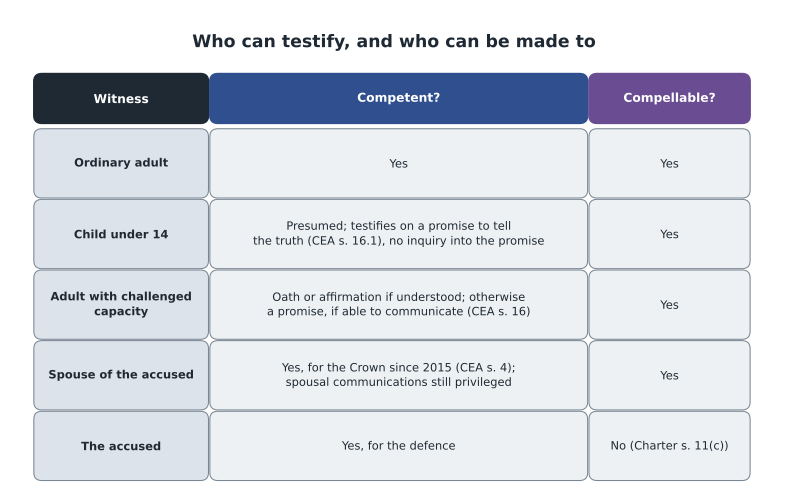
A witness is competent if the law permits the witness to testify. A witness is compellable if the witness can be required to testify. The general rule is that every person is both competent and compellable. Exceptions exist for children and adults with limited mental capacity, for spouses, and for the accused.
Children under fourteen. Section 16.1 of the Canada Evidence Act, added in 2005, provides that a person under fourteen years of age is presumed to have the capacity to testify. A child does not take an oath or solemn affirmation. Instead, the child's evidence is received if the child is able to understand and respond to questions, and the child must promise to tell the truth before testifying. Section 16.1(7) expressly prohibits asking the child questions about the child's understanding of the nature of the promise to tell the truth for the purpose of determining whether the evidence will be received. A party who challenges a child's capacity must satisfy the court that there is an issue as to the child's capacity to understand and respond to questions. Jayden Pruitt, at eleven, is presumed competent. If the defence raises an issue, the judge will inquire only into whether he can understand and respond to questions.
Adults with mental disabilities. Section 16 of the Canada Evidence Act governs a proposed witness who is fourteen or older and whose mental capacity is challenged. The court conducts an inquiry into whether the witness understands the nature of an oath or solemn affirmation and whether the witness is able to communicate the evidence. If the witness understands the oath or affirmation and can communicate, the witness testifies under oath or affirmation. If the witness does not understand them but is able to communicate the evidence, the witness may testify on promising to tell the truth. In R. v. D.A.I., 2012 SCC 5, the Court held that the witness need not be able to explain the abstract nature of the obligation to tell the truth in order to promise to tell the truth; the question is whether the witness understands what it means to tell the truth and can communicate the evidence. The case involved an adult complainant with a mental disability, and the Court emphasized that excluding such witnesses on abstract tests would leave vulnerable people without the protection of the law.
Spouses. At common law, the spouse of an accused was not competent to testify for the prosecution, with narrow exceptions. Section 4 of the Canada Evidence Act long preserved that rule subject to statutory exceptions. In 2015, the Victims Bill of Rights Act amended section 4 so that the spouse of an accused is now competent and compellable for the prosecution in all cases. The spousal privilege for communications made during the marriage, in section 4(3), remains and is discussed in lesson 11. Tess Halloran is Calder's girlfriend, not his spouse; unless they are legally married, the spousal rules do not apply to her at all. Common-law partners were not covered by the old incompetence rule, and the courts declined to extend it to them.
The accused. The accused is a competent witness for the defence under section 4(1) of the Canada Evidence Act but cannot be compelled to testify. Section 11(c) of the Charter protects any person charged with an offence from being compelled to be a witness in proceedings against that person in respect of the offence. A co-accused tried jointly is also not compellable by the Crown, but may be called by the other accused in some circumstances; if severance is ordered, a former co-accused becomes a compellable witness at the other's trial, subject to the protections in section 13 of the Charter and section 5 of the Canada Evidence Act.
Oaths, affirmations and testimonial protections
Witnesses aged fourteen or older normally testify under oath or solemn affirmation. Section 14 of the Canada Evidence Act allows any witness to affirm instead of swearing an oath. The form of oath does not affect the weight of the testimony. A witness who lies under oath or affirmation commits perjury.
Witnesses are protected against self-incrimination in two ways. Section 5 of the Canada Evidence Act removes the old privilege to refuse to answer incriminating questions but provides that, if the witness objects, the answer cannot be used against the witness in later criminal proceedings except for perjury. Section 13 of the Charter now provides broader protection: a witness who testifies in any proceedings has the right not to have any incriminating evidence so given used to incriminate that witness in any other proceedings, except in a prosecution for perjury or for giving contradictory evidence. In R. v. Nedelcu, 2012 SCC 66, the Court held that section 13 applies only to compelled testimony; in R. v. Henry, 2005 SCC 76, it held that an accused who chooses to testify at a retrial can be cross-examined on his testimony from his first trial, because that testimony was voluntary.
Testimonial aids
Testifying can be difficult, especially for children, complainants in sexual offence cases and vulnerable adults. The Criminal Code provides testimonial aids. Under section 486.1, a witness under eighteen or with a disability may have a support person present. Under section 486.2, such a witness may testify outside the courtroom by closed-circuit television or behind a screen. Under section 486.3, an accused who is self-represented may be prevented from personally cross-examining a child witness or a complainant in certain cases, with counsel appointed for that purpose. The orders are mandatory for young witnesses and witnesses with disabilities on application, unless the order would interfere with the proper administration of justice, and discretionary for other witnesses. Section 715.1 permits a video-recorded statement made by a witness under eighteen within a reasonable time after the alleged offence to be admitted if the witness, while testifying, adopts its contents. In Calder, Jayden Pruitt may be able to testify by closed-circuit television with a support person.
Examination-in-chief
Witnesses are examined first by the party who calls them. In examination-in-chief, counsel may not ask leading questions on contested matters. A leading question suggests the answer or assumes a disputed fact: 'You saw Calder push Dorey, didn't you?' is leading; 'What did you see?' is not. The rule exists because a witness called by a party is presumed to be sympathetic to that party, and leading questions would allow counsel to give the evidence. Leading questions are permitted on introductory and uncontested matters, to direct the witness to a topic, and, with leave, where the witness is hostile or adverse or has difficulty communicating, such as a young child.
A witness may refresh memory from a document or other item while testifying. The item need not be admissible and need not have been made by the witness, but the opposing party is entitled to see it and cross-examine on it. If the witness's memory is truly revived, the evidence is the witness's present recollection. If it is not revived, the document may still be admissible under the doctrine of past recollection recorded, which requires that the record was made or reviewed by the witness reasonably close to the event, while the memory was fresh, that the witness can vouch for its accuracy, and that the original is used if available. In R. v. Fliss, 2002 SCC 16, the Court applied these principles to a police officer who testified from notes reconstructing an unrecorded conversation.
Adverse and hostile witnesses
A party may not ordinarily impeach its own witness by attacking the witness's character, but a party is not bound by the witness's testimony and may call other evidence to contradict it. Section 9 of the Canada Evidence Act provides an exception. Under section 9(1), if the court finds that a witness is adverse, the party calling the witness may, with leave, contradict the witness by other evidence and prove that the witness made a prior inconsistent statement. Adverse has been interpreted to mean opposed in interest, not merely unhelpful, and a judge may consider the prior inconsistent statement itself in deciding whether the witness is adverse. Under section 9(2), a party may, with leave, cross-examine its own witness on a prior inconsistent written or recorded statement without proof of adversity. The Milgaard procedure, from R. v. Milgaard (1971), 2 C.C.C. (2d) 206 (Sask. C.A.), governs the section 9(2) voir dire. At common law, a judge may also declare a witness hostile, meaning the witness shows an unwillingness to tell the truth, and permit cross-examination at large.
The Crown fears that Leah Pruitt will testify that she saw nothing. She told police on the night of the fight, in a recorded statement, that Dorey 'didn't do anything, Owen just shoved him'. If she changes her story, the Crown may apply under section 9(2) to cross-examine her on the recorded statement and, as lesson 5 explains, may apply under K.G.B. to have the statement admitted for its truth.
Cross-examination
Cross-examination is a central right, especially for the accused. The cross-examining party may ask leading questions and has wide latitude. But the latitude is not unlimited. In R. v. Lyttle, 2004 SCC 5, the Court held that counsel may ask a question in cross-examination if counsel has a good faith basis for asking it, even if counsel cannot prove the suggestion through admissible evidence. A good faith basis depends on the information available to counsel, counsel's belief in its likely accuracy and the purpose of the question. Counsel may not put suggestions to a witness that are known to be false or recklessly made. Cross-examination is also limited by relevance, by the prohibition on harassment and abuse, and by specific rules such as section 276 and the collateral facts rule.
The rule in Browne v. Dunn (1893), 6 R. 67 (H.L.), requires that if a party intends to call evidence contradicting a witness on a significant matter, or to argue that the witness is not telling the truth on that matter, the contradiction should be put to the witness in cross-examination so that the witness has an opportunity to respond. The rule is grounded in fairness to the witness and to the opposing party. In R. v. Quansah, 2015 ONCA 237, the Ontario Court of Appeal explained that the rule is not fixed and that the remedy for a breach is in the trial judge's discretion, including recalling the witness or instructing the jury that the failure may affect the weight of the contradicting evidence. If the defence in Calder intends to call a witness who will say that Dorey swung first, defence counsel should put that suggestion to the bouncer and to Pruitt when cross-examining them.
Re-examination and order of witnesses
After cross-examination, the party who called the witness may re-examine, but only on matters arising from cross-examination that require explanation or rebuttal. Re-examination is not an opportunity to repeat the examination-in-chief or to introduce new subjects. The trial judge controls the order of evidence. Witnesses are often excluded from the courtroom until they testify, on the motion of a party, so that they do not hear one another's evidence. The Crown generally calls its evidence first, then the defence, and the Crown may then call reply evidence on matters arising from the defence case that it could not reasonably have anticipated.
Applying the rules
Daniel Whitecloud sums up the witness list. Hollis, the bouncer, is competent and compellable. Kara Dorey is competent and compellable, although what she can repeat of her brother's text raises hearsay issues. Pruitt is competent and compellable; if she becomes adverse, the Crown can use section 9. Jayden is presumed competent at eleven and will testify on a promise to tell the truth, probably with testimonial aids. Tess Halloran is competent and compellable because she is not married to Calder, though even a spouse could now be compelled by the Crown. Calder himself cannot be compelled. 'And defence counsel,' Quaye adds, 'will need to decide whether to put self-defence to every Crown witness in cross. Forgetting Browne v. Dunn has embarrassed many lawyers.'
Worked problem
The reluctant friend
At the Calder trial, Leah Pruitt testifies in chief that she was looking at her phone and did not see who started the fight. On the night of the fight she gave police a video-recorded statement saying Dorey did nothing and Calder shoved him. The Crown asks for permission to cross-examine her. What should happen?
Show solution
- Pruitt is the Crown's own witness, so the Crown cannot cross-examine her at large without a ruling.
- Under section 9(2) of the Canada Evidence Act, the Crown may apply for leave to cross-examine her on her prior recorded statement without proving adversity.
- The judge holds a voir dire (the Milgaard procedure): the statement is produced, the judge decides whether it is inconsistent with her testimony and whether to grant leave.
- If leave is granted, the Crown may cross-examine her on the inconsistency. Without more, the statement goes only to her credibility.
- If the Crown wants the jury to use the recorded statement for its truth, it must apply under K.G.B. for substantive admission (lesson 5).
Common mistakes
MistakeAsking a child under fourteen whether she understands what a promise means before receiving her evidence.
InsteadSection 16.1(7) prohibits questions about the child's understanding of the promise; the only question is whether she can understand and respond to questions.
MistakeTreating the accused's spouse as an incompetent Crown witness.
InsteadSince 2015, section 4 makes a spouse competent and compellable for the prosecution; spousal communications privilege remains.
MistakeAsking a question in cross-examination with no basis, hoping the witness agrees.
InsteadLyttle requires a good faith basis for every suggestion put to a witness.
MistakeCalling contradictory evidence without putting it to the earlier witness.
InsteadThe rule in Browne v. Dunn requires putting significant contradictions to the witness in cross-examination.
Practice problems
Work each problem on paper first, then reveal the answer to check.
What is the difference between competence and compellability?
Show answer
Competence is whether the law permits a witness to testify; compellability is whether the witness can be required to testify.
What does section 16.1 of the Canada Evidence Act provide for children under fourteen?
Show answer
They are presumed capable; they testify on a promise to tell the truth if able to understand and respond to questions, and cannot be questioned on their understanding of the promise.
What did Lyttle hold?
Show answer
Counsel may put a suggestion to a witness in cross-examination with a good faith basis, even if it cannot be proved by admissible evidence.
What does section 9(2) of the Canada Evidence Act allow?
Show answer
A party may, with leave, cross-examine its own witness on a prior inconsistent written or recorded statement without proving adversity.
What is the purpose of the rule in Browne v. Dunn?
Show answer
Fairness: a witness must have the chance to respond to contradictory evidence or an attack on credibility on a significant matter.
Summary and key terms
- Every person is presumptively competent and compellable, subject to rules for children, adults with limited capacity, spouses and the accused.
- Children under fourteen testify on a promise to tell the truth (section 16.1); adults whose capacity is challenged are assessed under section 16 and D.A.I.
- Since 2015 the spouse of an accused is competent and compellable for the Crown; the accused is not compellable (Charter section 11(c)).
- Witnesses are protected by section 5 of the Canada Evidence Act and section 13 of the Charter; testimonial aids are available under sections 486.1 to 486.3 and 715.1 of the Criminal Code.
- Examination-in-chief bars leading questions; section 9 governs adverse witnesses; cross-examination requires a good faith basis (Lyttle) and respect for Browne v. Dunn; re-examination is limited to matters arising.
- Competence
- Legal capacity to testify.
- Compellability
- Liability to be required to testify.
- Leading question
- A question that suggests the answer or assumes a disputed fact.
- Adverse witness
- A witness whose interest is opposed to the party calling them (Canada Evidence Act, section 9(1)).
- Good faith basis
- The information and belief needed to put a suggestion to a witness in cross-examination (Lyttle).
- Rule in Browne v. Dunn
- The requirement to put significant contradictory evidence to a witness during cross-examination.
Lesson quiz · 5 questions
Score 60% or more to complete this lesson.
Create a free account to save your progress, take quizzes and earn a certificate.